How to Create a Farmhouse Oak Kitchen That Feels Cozy and Timeless - 19 Ideas
16 july 2026A farmhouse oak kitchen feels cozy and timeless when you let the wood carry the warmth, then give it a few hardworking contrasts. I have seen plenty of kitchens miss that by going too orange, too busy, or too gray. If your oak cabinets feel dated but you don't want a full remodel, this order of moves is the part that works.
Before you start: the Two-Wood Rule
Before you buy a single pull or paint sample, decide what role the oak is playing in your room. If your cabinet fronts are the hero, you need one supporting wood tone and one dark note, not six competing browns. I call that the Two-Wood Rule, and you'll feel the difference the second your eye stops bouncing from honey oak to red oak to walnut to black stain.
For most kitchens, that means oak cabinets, a second wood on the island or shelves, then restraint everywhere else. Keep your counter height at 36 in so your replacements and add-ons land where they should. Leave 42 to 48 in around the island if you're reworking traffic flow, and protect the classic 18 in gap between the counter and uppers if a backsplash is part of the plan.
If you only have budget for one pass, paint and hardware beat replacement more often than people think. New cabinets can be worth it, sure, but a lot of kitchens don't need demolition.
They need editing. That's a much cheaper problem.
- Start with honey oak shaker cabinet fronts
- Anchor the island with a butcher block top
- Layer cream beadboard behind open shelves
- Hang brass cup pulls on every drawer
- Build a plate rack above the sink
- Frame the range with oak corbels
- Add seeded glass to upper cabinets
- Run oak crown molding to the ceiling
- Style crocks beside a farmhouse sink
- Install a warm brick backsplash panel
- Mix black lantern pendants over oak
- Choose soapstone counters for rustic contrast
- Tuck woven stools under the island
- Mount peg rails along the breakfast wall
- Paint the pantry door soft sage
- Display ironstone on chunky oak shelves
- Bring in skirted fabric below cabinets
- Set a vintage runner through the galley
- Finish with linen cafe curtains
1Start with honey oak shaker cabinet fronts
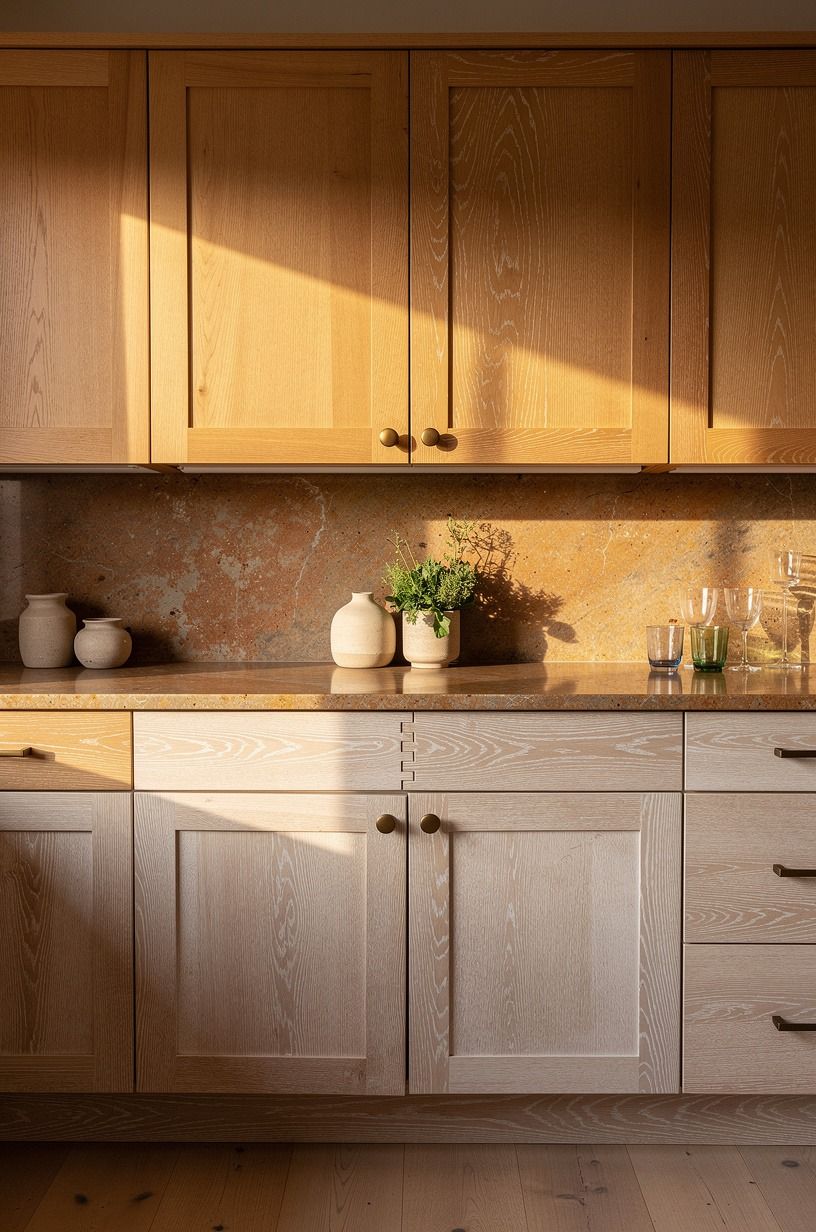
Start here, because honey oak shaker fronts decide whether the whole room reads farmhouse or builder-basic. Honey oak shaker fronts work when the rail profile stays simple and the finish leans soft rather than orange. If your existing doors have cathedral arches or heavy grooves, I would replace those before I touched the floor.
The cleaner face is what gives you that warm oak kitchen feeling without turning the room into a cabin set.
You will want the grain to show, not shout. A brushed finish on cerused white oak or lightly toned honey oak catches daylight in a calmer way than high-gloss stain ever will. And if you're sampling paint around them, Benjamin Moore White Dove OC-17 is a safer wall partner than cold white because it keeps the wood from looking sharper than it is.
I learned this the expensive way with cool white walls. I once tried to save old orange oak with cooler walls, and the cabinets looked even louder by dinner.
If you're keeping oak, commit to it. Your room wants confidence, not apology.
2Anchor the island with a butcher block top
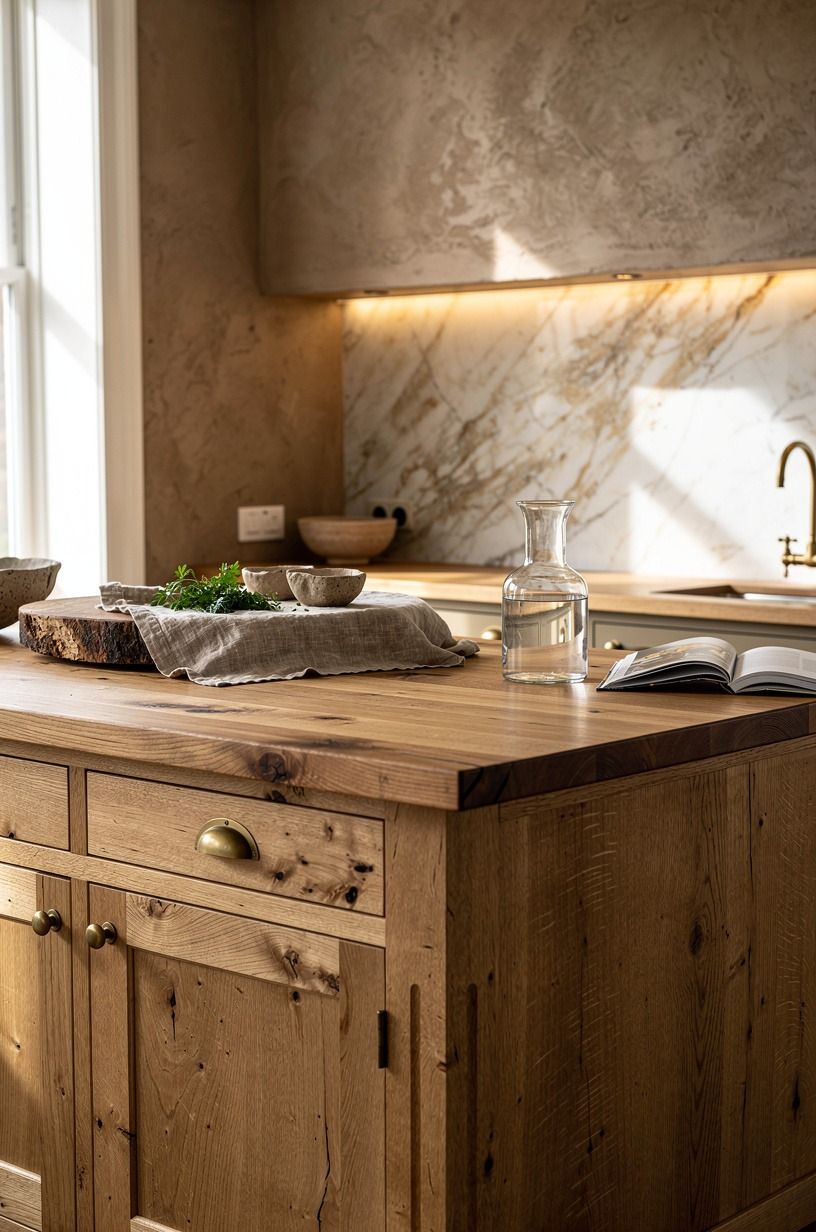
A farmhouse island looks grounded when the top has weight.
3Layer cream beadboard behind open shelves
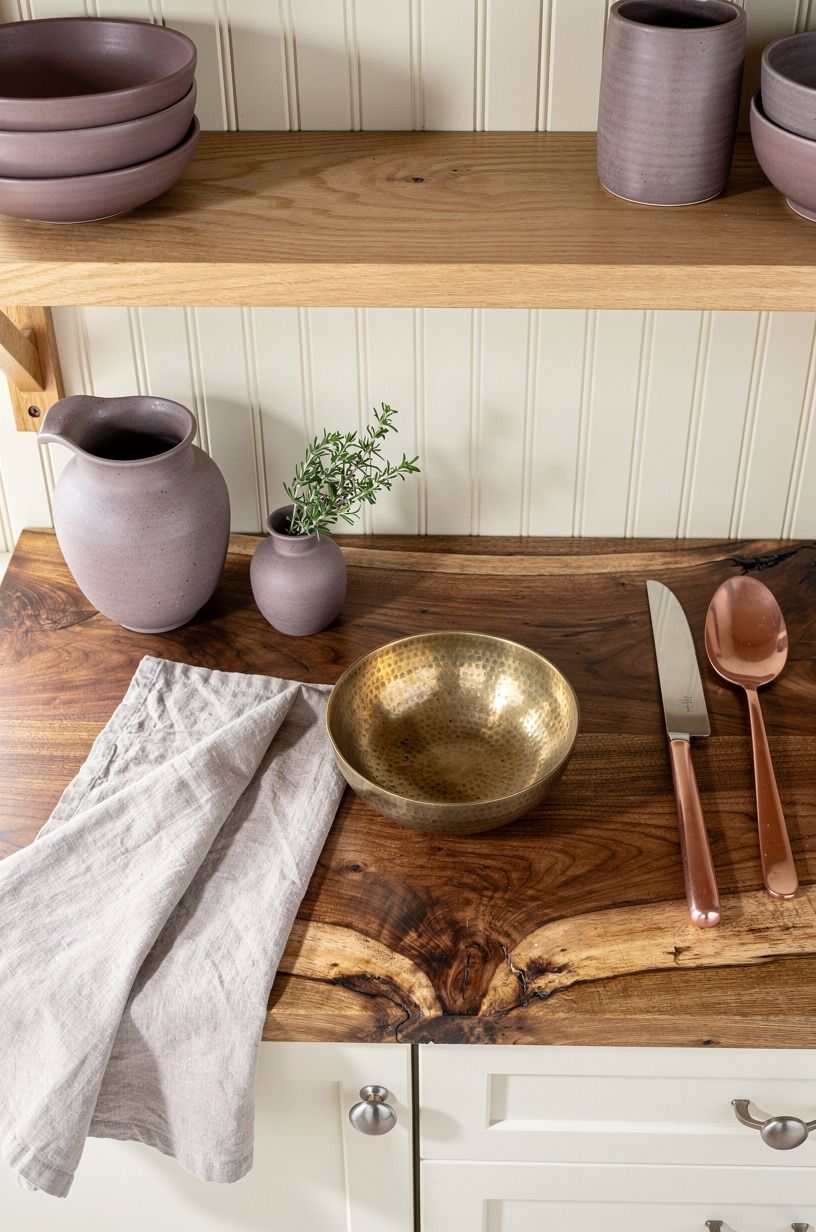
Cream beadboard is what keeps open oak shelves from floating around with nothing to hold onto. On its own, a shelf can look like a plank on drywall.
Add a vertical bead behind it, and suddenly your mugs, bowls, and crocks sit inside a backdrop that feels built in. That's a quiet move, but you notice it every morning.
For this step, I would keep the paint creamy rather than bright. Benjamin Moore White Dove OC-17 again works because it softens the line where shelf meets wall, and you do not get that harsh flash of white behind warm dishes. If your uppers are gone, beadboard gives your eye a surface to rest on while the oak still does the talking.
Style it lightly with a stoneware pitcher. A stack of plates, a stoneware pitcher, one jar of wooden spoons.
That is enough! If you're stuffing every inch, the beadboard won't save you, because clutter always wins the first read.
4Hang brass cup pulls on every drawer
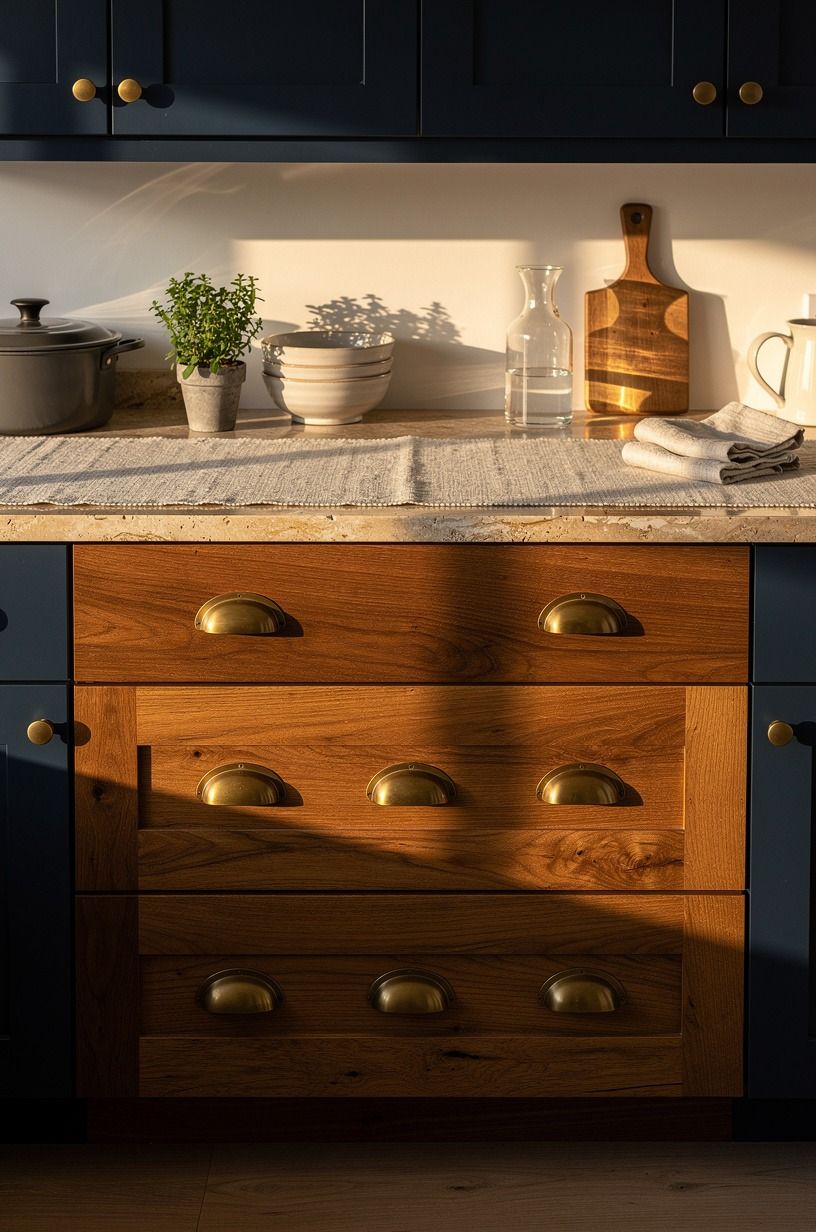
Brass cup pulls are where farmhouse oak either gets charming or gets costume-y. Brass cup pulls are the better call on drawers because they give you a little glint without pulling the room toward polished glam.
On honey oak, especially, that rounded shape softens the front and makes the cabinetry feel older in the good way. You don't need sparkle.
You need patina.
Look for unlacquered brass or a brushed finish that will go a little darker with use. Shiny yellow pulls can make oak look cheaper, and I would skip black bin pulls unless the rest of the room already carries enough black to support them. One lonely dark note on warm cabinets just feels abrupt.
And yes, every drawer. Mixing knobs on some and cup pulls on others often reads accidental instead of thoughtful. Repetition is what gives this step its strength, and your hand notices that consistency before your brain names it.
5Build a plate rack above the sink
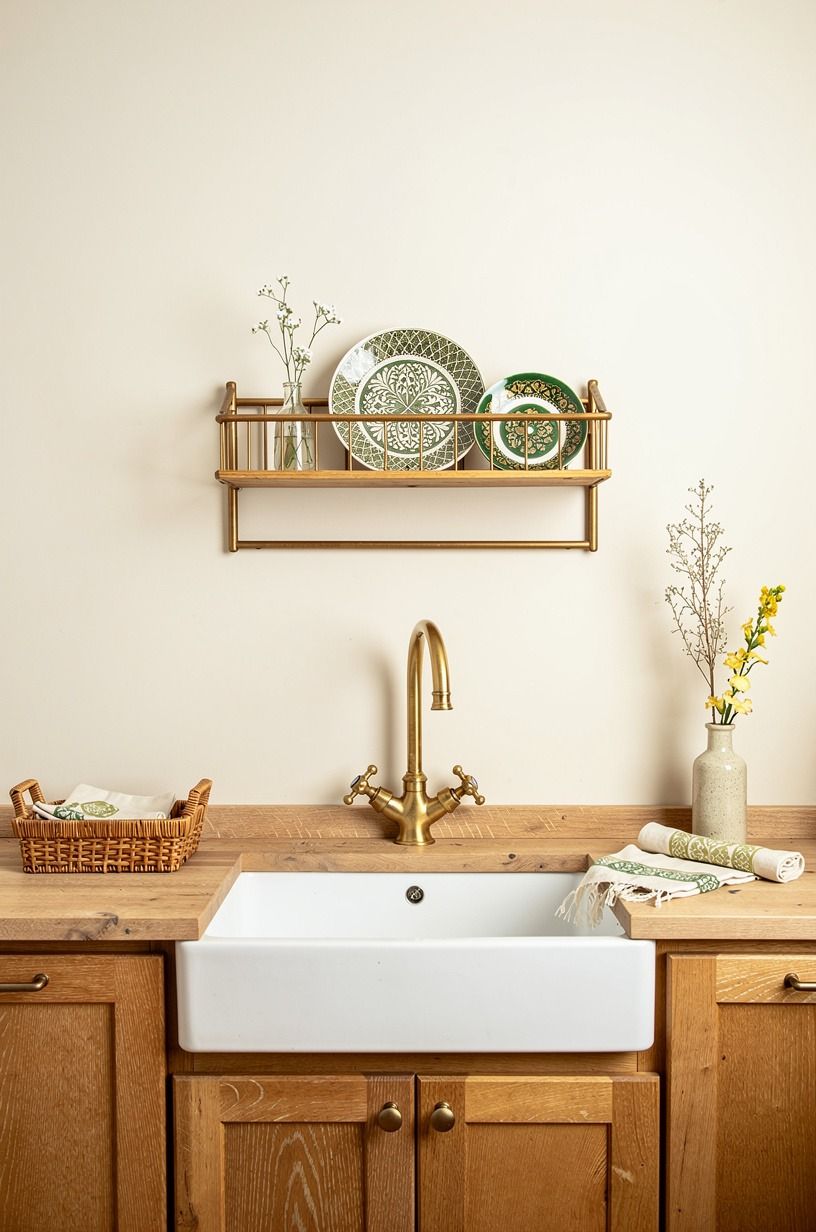
A plate rack above the sink is one of those old farmhouse moves that still earns its keep. It fills that small wall zone with something useful, but it also breaks the run of cabinets in a way that feels breathable. If your sink wall is staring back at you with too much blank symmetry, this is the piece that calms it down.
Keep the oak plate rack open enough that you can see plates from across the room. Thick rails, oak sides, and a finish that relates to the cabinetry will do more for you than carving or fancy trim. In a natural wood cabinets kitchen traditional enough to have a farmhouse sink, simple joinery always looks richer than over-detailing.
What do you put there? White ironstone, cream stoneware, maybe a few shallow platters.
Not every plate you own. If the rack feels like overflow storage, you've missed the whole charm of it.
6Frame the range with oak corbels
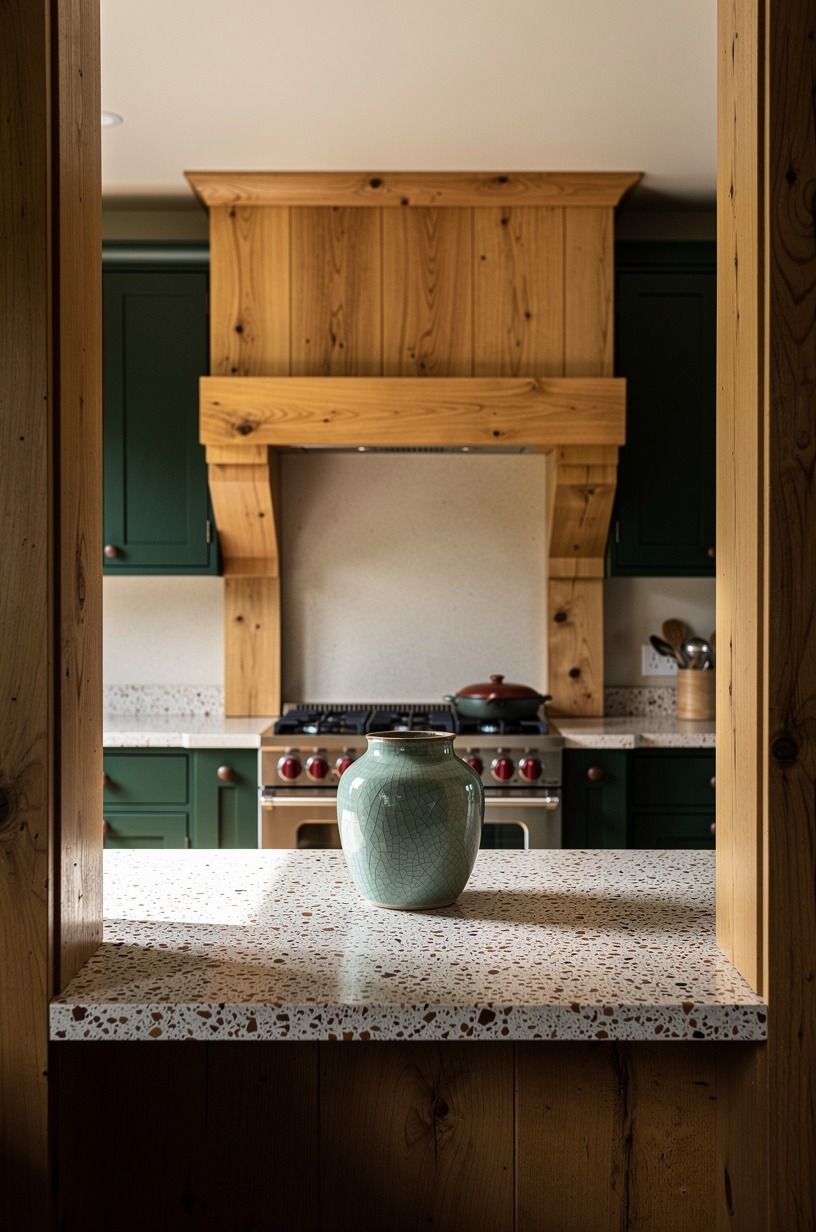
This is where oak corbels let you lean into that cottage renovation inspiration without building a fake mantel over the stove.
7Add seeded glass to upper cabinets
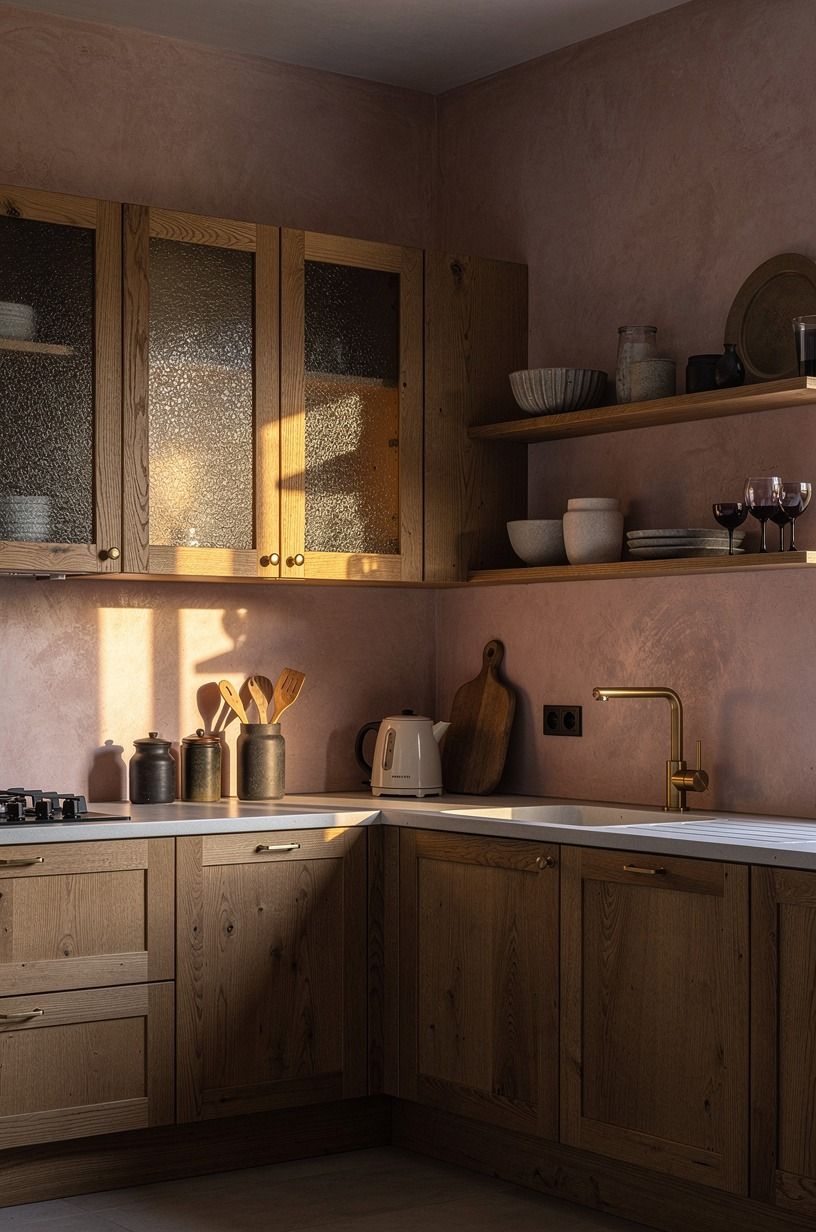
Seeded glass is useful because it blurs without hiding everything. You still get lightness in the uppers, but you do not have to keep every mug shelf styled like a shop display. That's why it works so well in a farmhouse oak kitchen.
The texture softens the run of doors and keeps the room from getting too blocky.
Choose a glass with a gentle bubble, not dramatic ripples. Subtle texture looks older and lets the oak frame stay in charge. Pair it with a wall color like Farrow & Ball Studio Green No. 93 in a pantry nook or adjoining breakfast wall if you want the glass to glow against something moodier.
But edit the pale dishes sitting behind it. Pale dishes, clear jars, maybe one darker stack for depth.
If the cabinet interior is a jumble of cereal boxes and neon cups, the glass won't read romantic. It'll read messy.
8Run oak crown molding to the ceiling
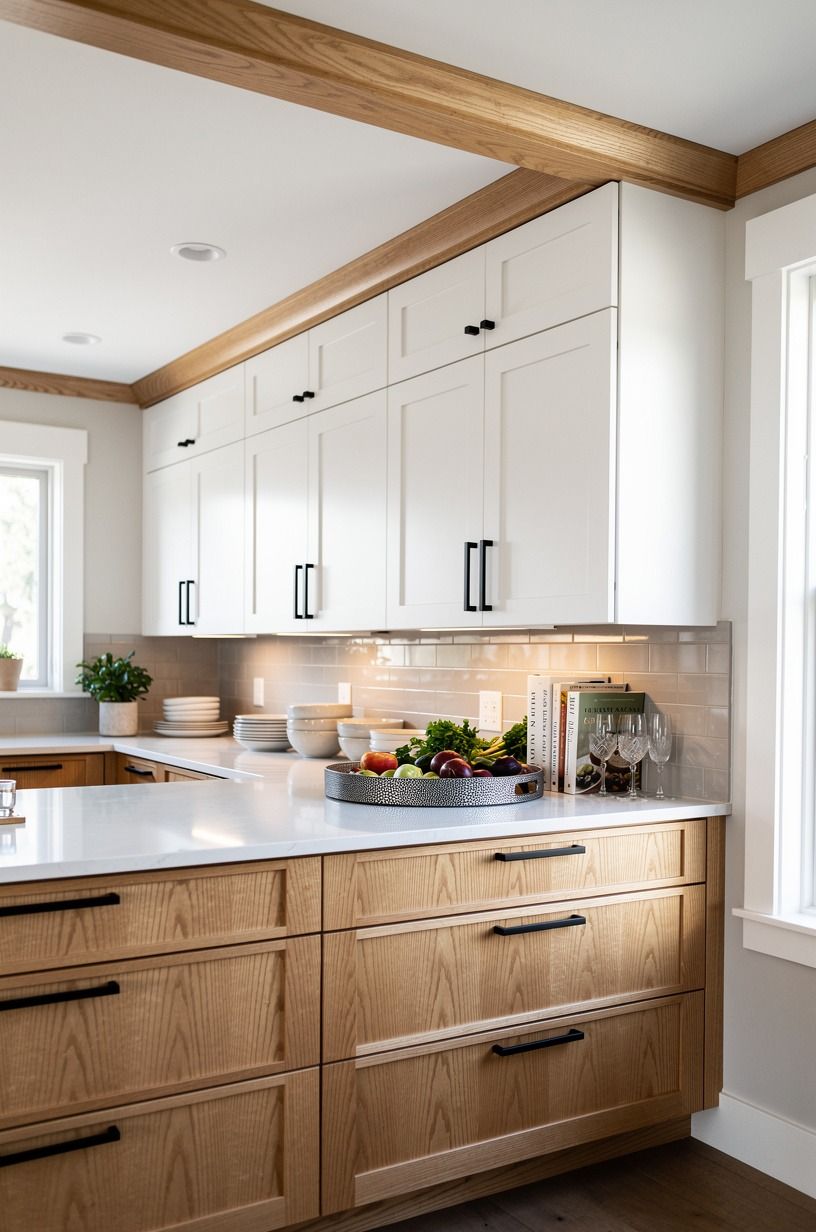
Oak crown molding matters more than people expect because the line at the top of the cabinets tells your brain whether the kitchen is finished. If the uppers stop short and you leave that dusty strip above them, the whole room can feel temporary. Run oak crown to the ceiling, and the cabinetry looks built for the house instead of dropped into it.
You do not need anything elaborate here. A plain crown profile with a little projection is enough, especially in a classic wood kitchen where the warmth is already doing heavy lifting.
Match the oak tone to the cabinets closely here. Unlike the island, this is not the place for contrast. You want one clean climb from door front to ceiling.
And if your ceiling is low, keep the slim crown profile narrower. The goal is height, not bulk. Too much molding overhead can make the whole room hunch.

9Style crocks beside a farmhouse sink
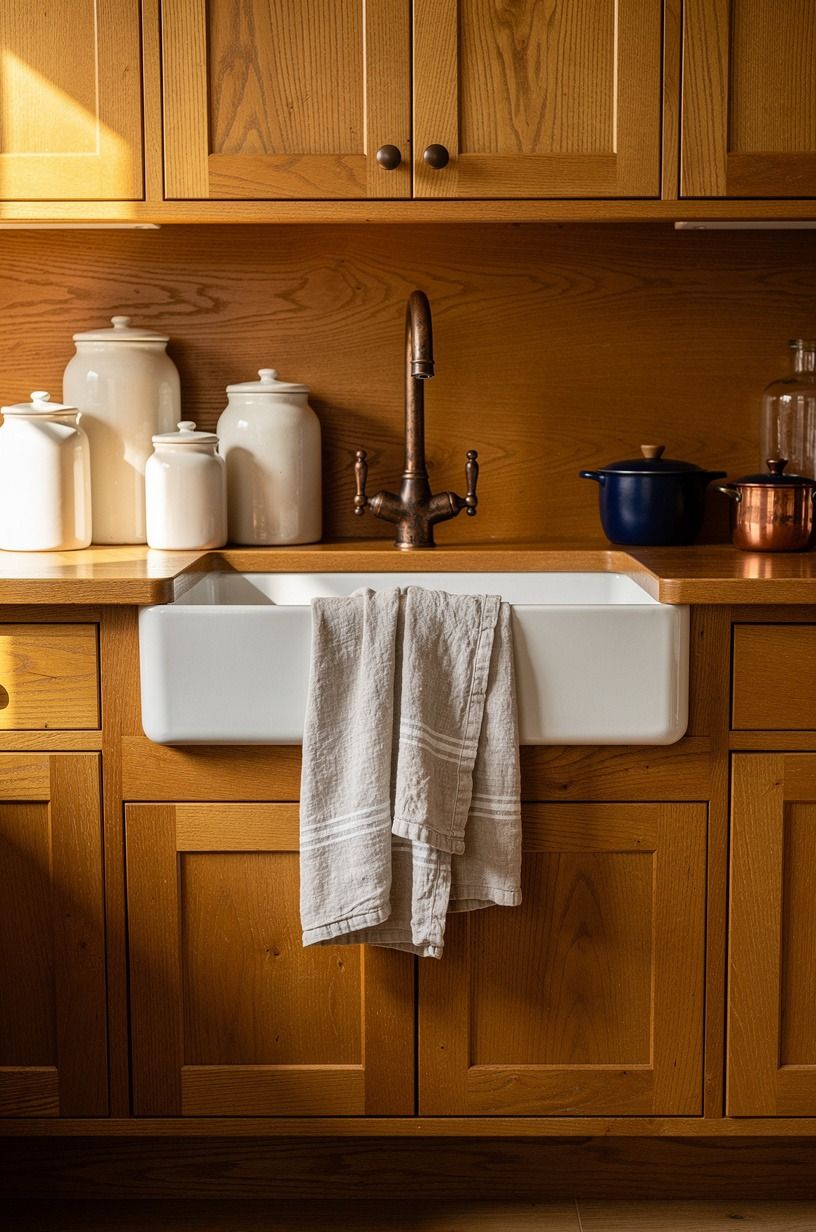
Sink crocks work because they bring in the kind of useful clutter that feels right in a room like this. Wooden spoons, a scrub brush, maybe kitchen shears, all gathered in one sturdy holder.
It's practical. But it's also one of the easiest ways to make the sink wall feel lived in without throwing color everywhere.
Use salt-glazed stoneware or cream crocks with a little age in the glaze. The shape wants to be chunky enough to hold its own against an apron-front sink and oak cabinetry. If you go tiny or glossy, they disappear.
In the bright morning light from the photo, that heavier pottery is what keeps the styling from floating away.
I keep coming back to this because sink styling is cheap and visible. You use the sink a hundred times a week, so why shouldn't the tools there look intentional? That's the question that changed how I style hardworking kitchens.
10Install a warm brick backsplash panel
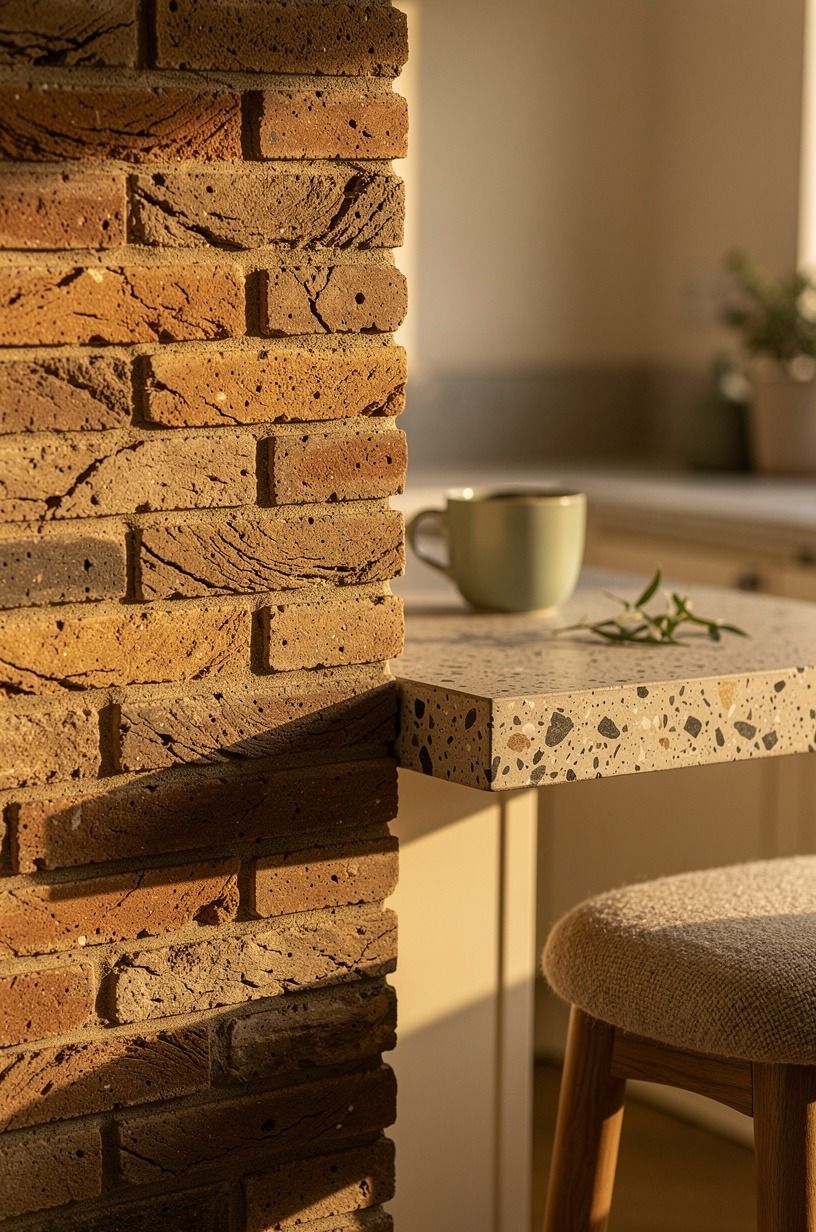
A warm brick panel behind the range or sink brings the room back to earth fast. The warm kind, not the pink kind.
In close view, you want to see a little sootiness in the tone, a little chalk in the mortar, and enough texture that the wall feels touched by hand. Smooth backsplash tile can be nice, but it doesn't give you the same quiet weight.
Keep the panel narrow if you only need a focal moment, or let it run full width if the room can carry it. When you're pairing it with a hard counter like poured concrete with visible aggregate, the warmth of the brick is what keeps the whole composition from turning severe. That's why this step works so well in kitchens with oak.
If peel-and-stick brick is the route, it can get you through a cosmetic phase. Just don't choose a color with purple undertones. Oak hates that combination, and you'll notice it every time the kettle is on.
11Mix black lantern pendants over oak
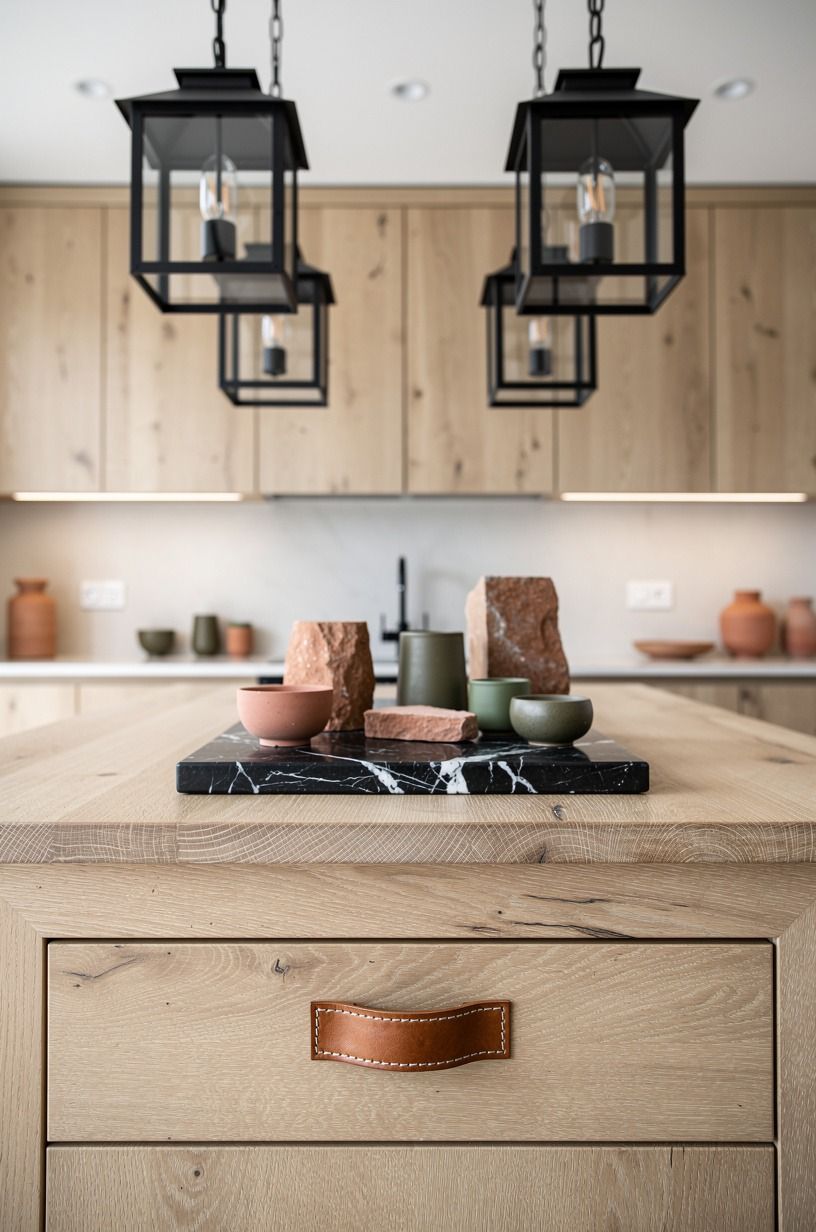
Black lantern pendants are one of the few places where black earns its spot in a warm oak kitchen. A black lantern pendant has enough outline to register from across the room, but because it's open, it doesn't block the warmth below it.
Over an island, that balance matters. You want punctuation overhead, not a heavy lid.
Hang the open cage shape so the bottoms feel connected to the island, not stranded in the air. In most kitchens, that means keeping the drop low enough to define the work zone while preserving sightlines. And if the island top already has strong grain, the simple cage shape of the lantern is the better partner than a solid drum shade.
But keep the stainless faucet and the rest of the metal count disciplined. If you have black pendants, brass pulls, and a stainless faucet, stop there. Add more finishes and your eye starts sorting hardware instead of enjoying the room.
12Choose soapstone counters for rustic contrast
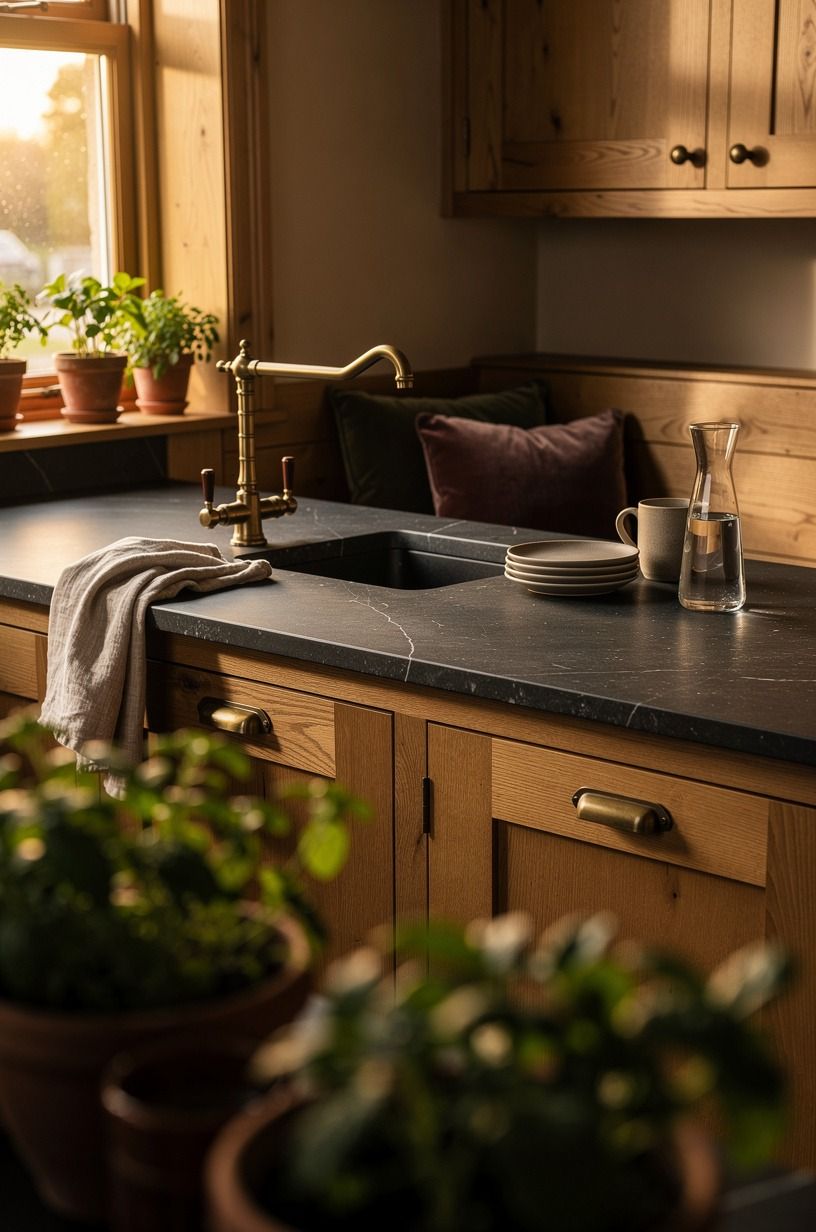
Soapstone counters are one of the best surfaces you can pair with oak if you want the room to feel older, steadier, and a little quieter. The soft matte surface cuts against the movement in the grain, so the cabinets get to glow while the counter settles them down. That contrast is why people keep coming back to it.
The dark soapstone practical part matters too. A dark counter can hide the small flour, coffee, and bread crumbs that show up by noon, and in a room with leafy herbs by the window it gives all that green a richer backdrop. If you're pricing surfaces, use the material table below as your guardrail instead of guessing.
I would choose bright white quartz last in this style, and soapstone first, every time! White can look crisp, yes, but soapstone gives oak a reason to stay warm instead of fighting to look modern.
13Tuck woven stools under the island
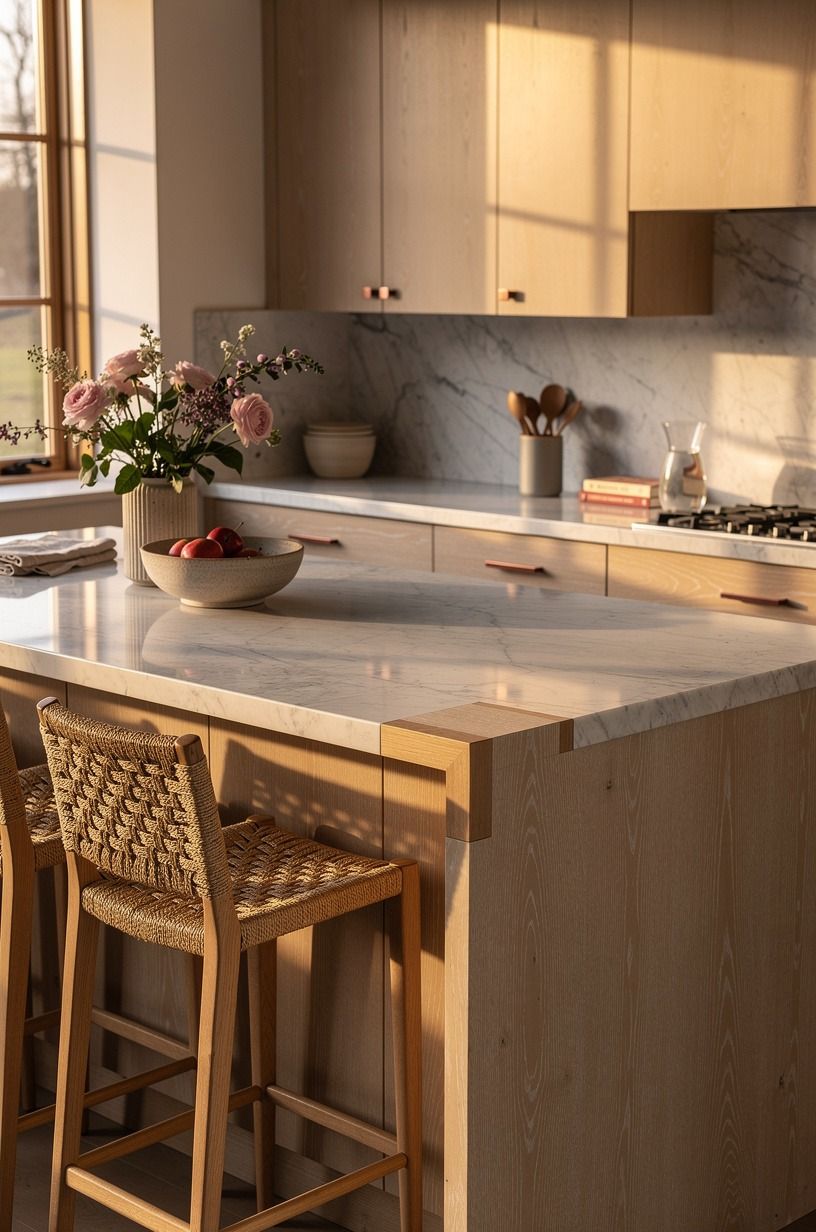
Look for paper-cord seats with a darker frame if the kitchen already has black lanterns overhead.
14Mount peg rails along the breakfast wall
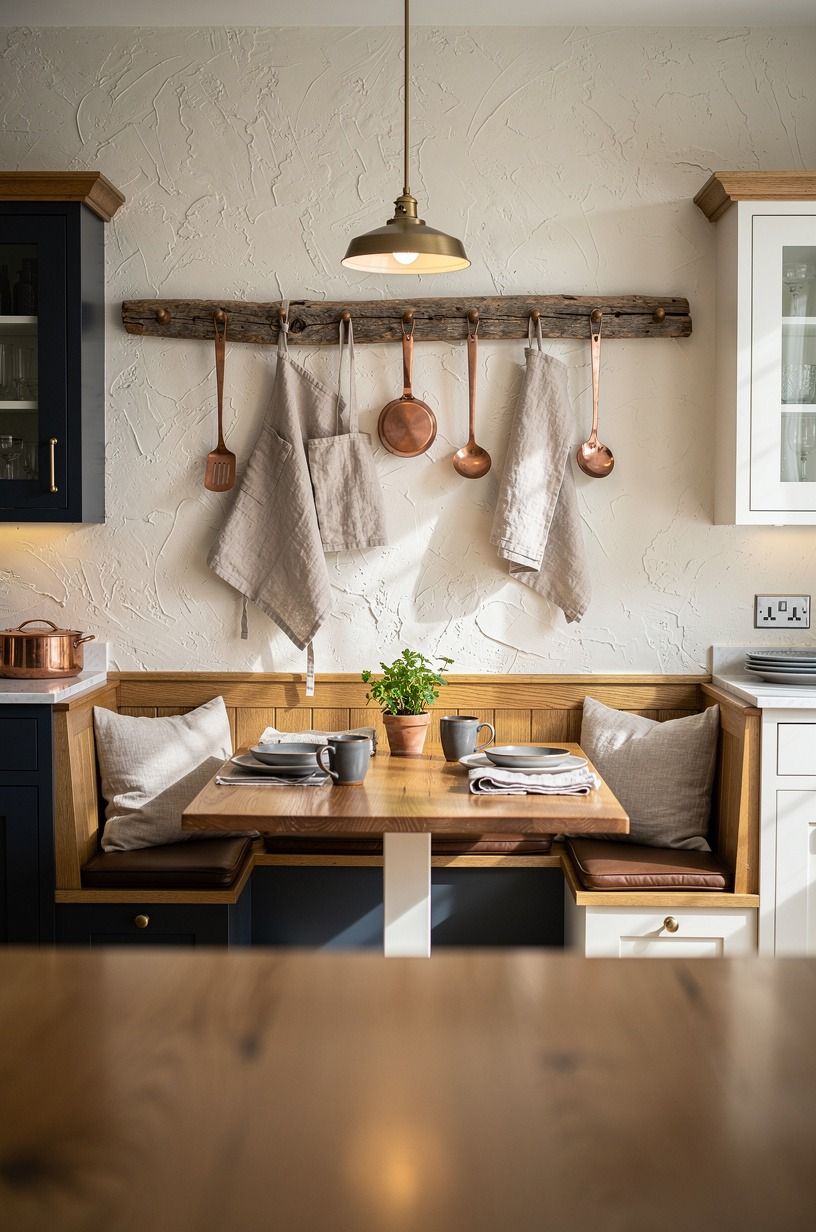
Oak peg rails do for a breakfast wall what cup pulls do for drawers. They bring rhythm.
A row of simple oak pegs gives you a spot for market bags, a linen apron, maybe a hat if the nook opens near a back door. More than that, it makes the wall feel used, and that usefulness is part of the farmhouse pull.
Mount them low enough that you can reach them without stretching but high enough that chair backs will not bang into the breakfast nook seating. If the breakfast zone is symmetrical, like the photo, peg rails keep the wall from feeling too stiff because you can break the perfection with a lived-in touch or two.
But do not overload them with a striped towel and more decor. A peg rail buried under signs and wreaths starts to feel like a gift shop.
One apron. One basket.
Maybe a striped towel. Done.
15Paint the pantry door soft sage
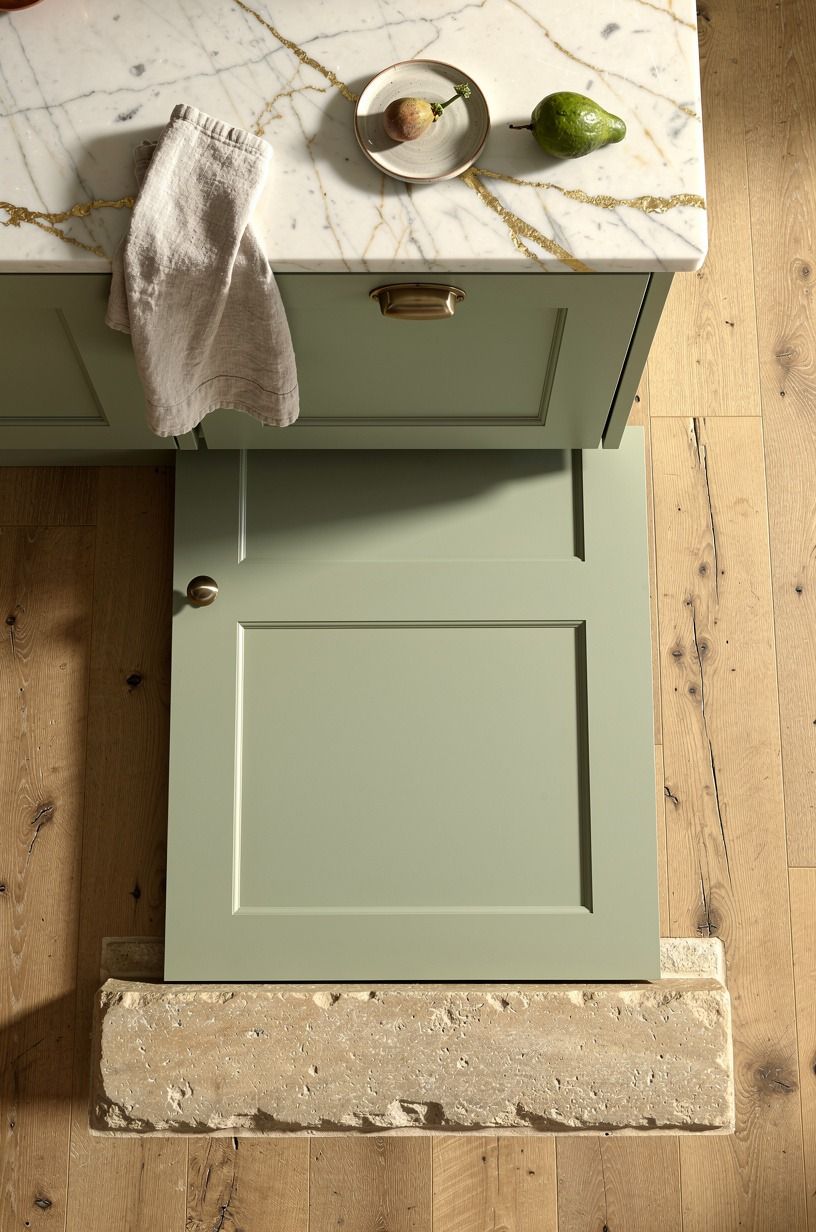
When a room is full of warm wood, one painted door can be the breath mark.
16Display ironstone on chunky oak shelves
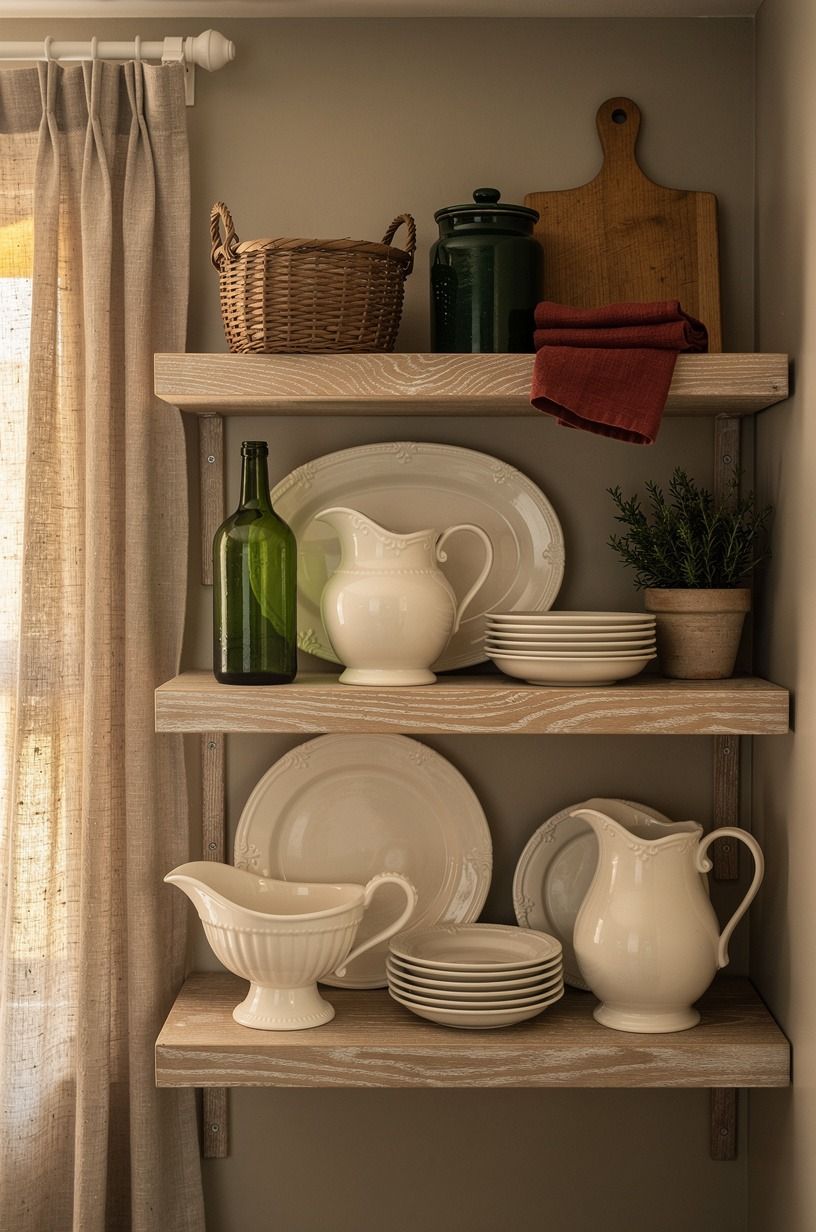
Ironstone and chunky oak shelves are such a good pairing because both have heft, and neither is trying too hard. The shelves give you thickness and grain. The ironstone gives you a pale shape that stands out without adding noise.
If your open storage looks flat, this combination usually fixes it.
Shelf depth matters here. Too shallow and a stack of bowls looks nervous. Too deep and everything gets pushed back into shadow.
I like just enough depth for a layered front row and one taller piece behind it, especially if the oak has a brushed finish similar to cerused white oak.
What should you display? Tureens, plates, pitchers, maybe one dark wood board leaning at the back.
Not novelty pieces. The room wants objects with a little weight and a little age to them.
17Bring in skirted fabric below cabinets
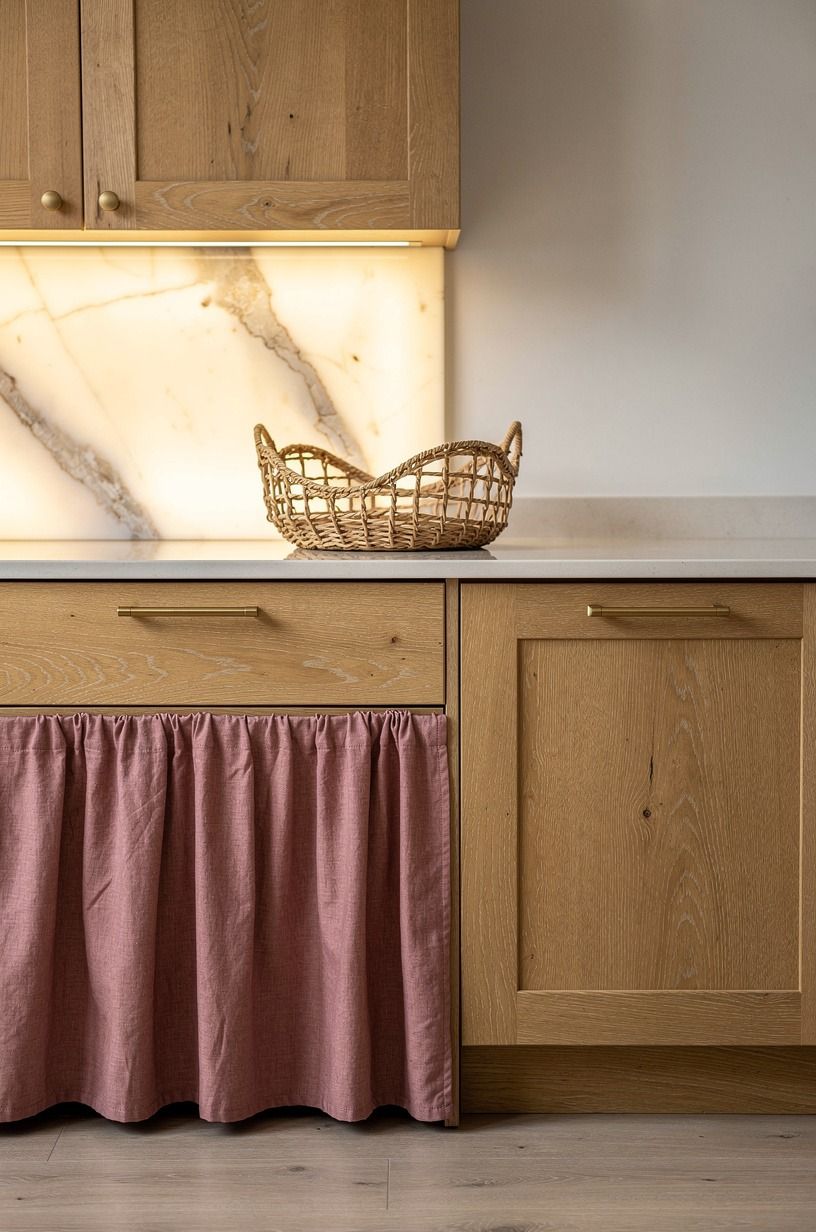
This is a softer move, and skirted linen is exactly why it works. A skirt under a sink base, hutch section, or open lower cabinet breaks up the hard lines that can make wood-heavy kitchens feel rigid. You get storage hidden behind fabric, but you also get movement, and movement is what keeps a farmhouse kitchen from feeling too square.
Choose Belgian flax linen or a sturdy cotton stripe that hangs with some body. Limp fabric looks sad fast. If the room already has oak, soapstone, and brick, the skirt is your chance to bring in a little hush, especially in a corner that needs to feel less utilitarian.
Would I use one skirted bay under every lower cabinet? No, and that is why it stays charming.
One or two placements are enough. More than that, and the kitchen starts reading theatrical.
18Set a vintage runner through the galley
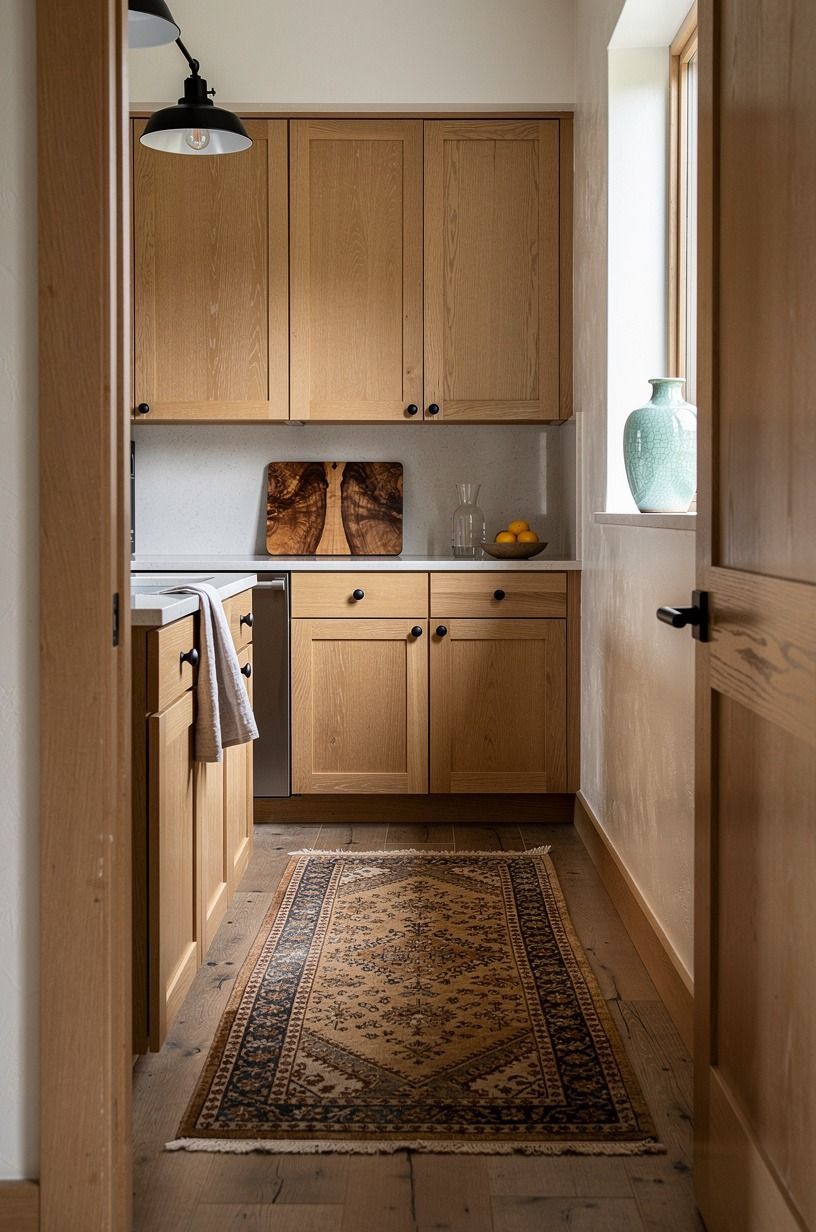
A vintage runner does two jobs at once. It gives your feet warmth under the busiest path in the room, and it pulls the long galley view together so the oak on both sides feels connected. In a doorway view, that strip of pattern is often what keeps the whole space from looking like a corridor of cabinets.
Go for a camel runner with warm white and a little black so it can talk to both wood and metal. The old-looking palette matters. Bright reds can dominate a farmhouse oak kitchen too easily, while a worn pattern sits down and lets the cabinets keep their authority.
But buy for the galley lane, not the fantasy. If the rug bunches at every turn or is too wide for the walkway, you'll hate it by day three. A runner should guide you forward, not ask for constant fixing.
19Finish with linen cafe curtains
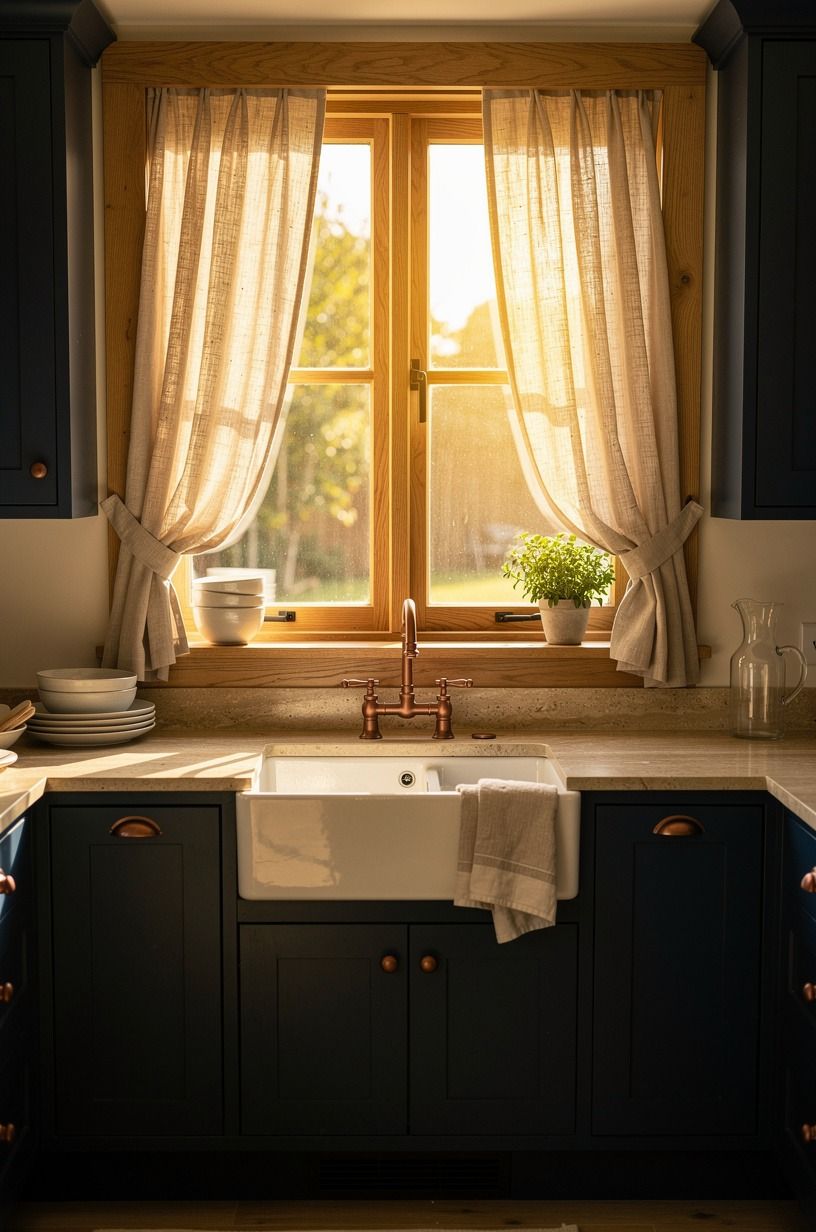
Linen cafe curtains are one of the cleanest ways to soften an oak kitchen window without blocking the light that makes the wood look alive. Cover only the lower half, keep the rod simple, and let the fabric skim rather than puddle. That's how you get privacy and still keep the room bright by breakfast.
Use Belgian flax linen or a washed cotton with a visible slub so the cloth has some grain of its own. Against a warm travertine counter, that natural texture reads relaxed instead of precious. If your sink sits under the window, cafe curtains also stop the whole wall from feeling like one more hard surface.
And do not over-trim plain hems. No tassels, no loud print, no fussy tie-backs.
The point is softness with discipline. That's what makes them timeless.
Why does the Three-Layer Warmth Rule keep oak from feeling flat?
Because warmth in a kitchen can't come from the wood alone. That's the mistake I see over and over.
People install oak, maybe even well-finished oak, then stop there and wonder why the room still feels stiff. The answer is that oak needs three different kinds of warmth around it before it relaxes: visual warmth from color, touch warmth from texture, and lived warmth from use.
Miss one of those and the room stays halfway done.
Visual warmth is the easiest to explain. If the walls are too cold, the oak goes orange.
If the metal is too sharp, the oak looks dated. That is why shades like Benjamin Moore White Dove OC-17 and Sherwin-Williams Evergreen Fog SW 9130 keep showing up in strong kitchens.
They support the wood instead of challenging it. Black can help too, but only in a thin line, like a lantern pendant or stool frame.
Too much black and the room turns graphic when what you wanted was grounded.
Touch warmth is where materials earn their keep. A butcher block edge, a brick panel, unlacquered brass, woven rush, Belgian flax linen, soapstone that goes matte under your palm.
Those things don't just look warm. They feel finished when you use the room.
I made the mistake once of pairing oak cabinets with a polished counter, polished pulls, and slick stools. On paper it looked neat.
In person it felt like every surface was refusing your hand.
Then lived warmth is the layer people skip because it sounds less glamorous. You feel it!
Crocks by the sink. Plates in the rack. An apron on the peg rail.
A runner where your feet land every morning. That layer matters because a farmhouse kitchen isn't supposed to feel staged at 11 a.m.
It should feel like you could slice bread there, lean on the island, and keep talking while the kettle starts to hum. That's what makes the room timeless.
Not age for its own sake. Use, softened by restraint.
A Few Things Worth Answering
What is the best Farmhouse Oak Kitchen Ideas for a Cozy, Timeless Look for a small kitchen?
For a small kitchen, I would start with honey oak shaker fronts and seeded-glass uppers because you get warmth without visual weight. If you need a fast stool or storage add, IKEA HAVSTA usually sits nicely with oak without eating the room.
Where can I buy Farmhouse Oak Kitchen Ideas for a Cozy, Timeless Look pieces on a budget?
Start with Target Threshold and then check IKEA and Wayfair Lark Manor for stools, pulls, shelving, and simple lighting. For the pieces that give a room age, Facebook Marketplace is still your friend. Old crocks, plate racks, and runners often look better secondhand because the wear is already there.
How much does a Farmhouse Oak Kitchen Ideas for a Cozy, Timeless Look makeover cost?
A cosmetic pass usually runs about $300-$1,500, and that covers paint, hardware, and a lighter backsplash update. A mid refresh often lands around $3,000-$12,000. The big money starts with cabinet replacement, stone counters, and appliances, so keep the free wins for styling and layout first.
Can I create a Farmhouse Oak Kitchen Ideas for a Cozy, Timeless Look on a budget?
Yes, and you do not need to start with demolition. Choose cafe curtains first if you want a quick visible move: swap hardware, add cafe curtains, bring in crocks, and paint the pantry door. Those moves shift the mood fast, and they don't lock you into a full remodel before you're ready.
Is a Farmhouse Oak Kitchen Ideas for a Cozy, Timeless Look worth it in a small space?
Yes, because a small room often benefits more from soft sage pantry color and repeat finishes than a big one does. Keep the walkway clear, tuck stools fully under the island, and use one painted accent like a soft sage pantry door so the room feels arranged instead of crowded.
Is Farmhouse Oak Kitchen Ideas for a Cozy, Timeless Look a good idea for a rental?
Yes, if you focus on peel-and-stick brick and other reversible texture and color. Use peel-and-stick brick, a tension rod for cafe curtains, removable hardware if your lease allows, and styling pieces that travel with you later. Renters do not need less warmth.
You just need moves you can undo on moving day.
Start With the One-Step Rule
If I had to pick one step to start with, I would start with honey oak shaker fronts. If the cabinet face looks wrong, every pull, pendant, and runner is just decorating a bad base. Fix that first, and the rest of the room starts making sense.