11 Dark Japandi Kitchen Ideas That Make Minimalism Feel Grounded
10 july 2026Dark Japandi kitchen ideas for moody, grounded minimalism work when you anchor the room first, then let the lighter pieces breathe around it. I learned that the hard way after painting a kitchen dark and leaving every other surface floating, and the whole space felt heavy instead of settled. The style isn't about making everything black. It's about weight, grain, shadow, and one warm note that keeps your eye moving.
- ✓ Anchor walnut slab cabinets under matte black stone
- ✓ Run smoked oak shelves across a plaster backsplash
- ✓ Frame the range hood in dark ribbed wood
- Anchor walnut slab cabinets under matte black stone
- Run smoked oak shelves across a plaster backsplash
- Frame the range hood in dark ribbed wood
- Ground the island with a charcoal waterfall counter
- Mix blackened ash lowers with pale oak uppers
- Install shoji-inspired pantry doors in espresso wood
- Layer warm brass rails on deep wood drawers
- Wrap the ceiling beam in stained cedar
- Float a black stone ledge above the sink
- Choose lantern pendants with woven black shades
- Soften dark cabinets with clay tile flooring
- Why does warm plaster outperform glossy tile in a dark kitchen?
- Walnut against black against clay: the Three-Material Stack
- Small Japandi kitchens vs. wide open plans: where the dark formula bends
- What makes a dark Japandi kitchen actually feel calm?
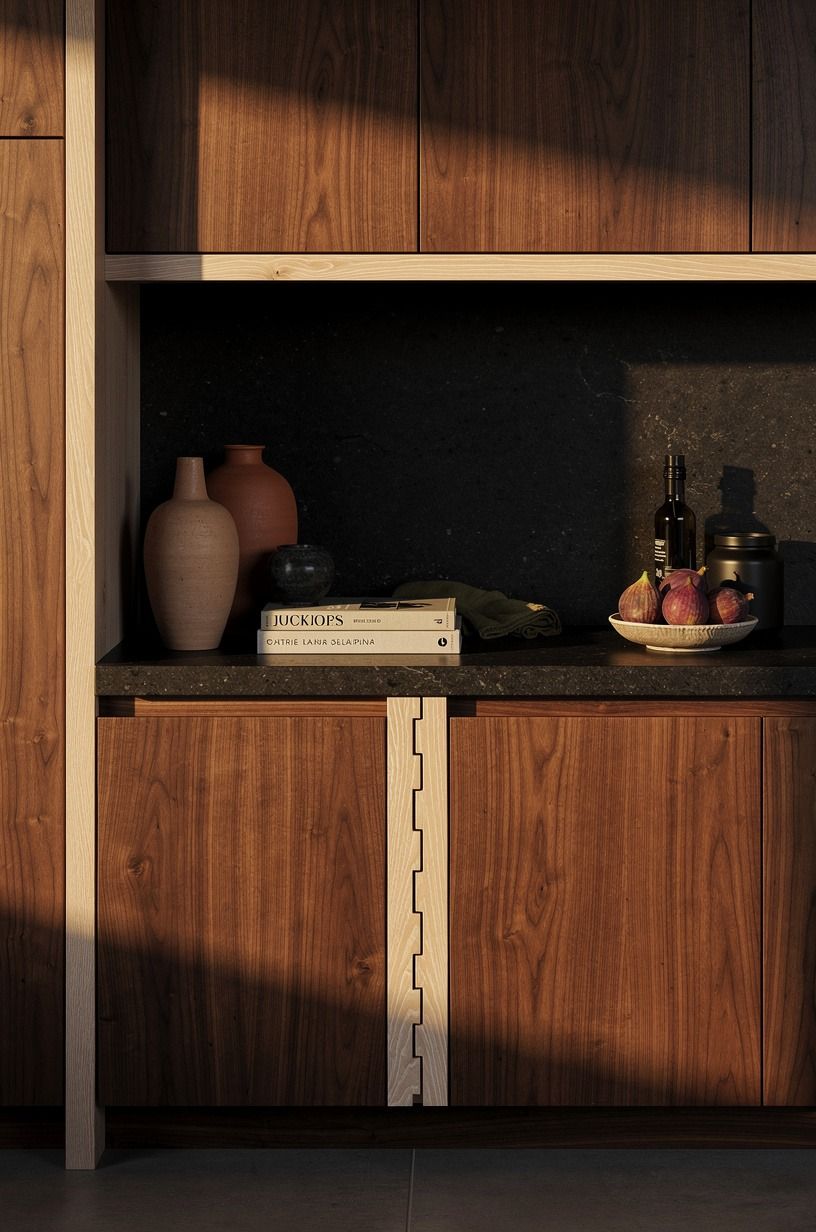
1Anchor walnut slab cabinets under matte black stone
Start with the base of the room. If your cabinets already have a flat front, a walnut slab profile under a matte black counter gives you that deep Japandi pull without adding visual noise, and you'll feel it the second you walk in. Flat walnut fronts in quarter-sawn grain are even better if you can swing the upgrade, because the ribbon stripe catches afternoon light without ever looking busy.
I wouldn't pair those cabinets with a glossy top. The shine fights the calm. A honed charcoal quartz slab or matte black composite reads quieter, hides daily smudges better, and gives your eye one dark horizontal line to trust.
In a smaller kitchen, keep your counter at the standard 36 in height and let the darker top do the grounding rather than stacking too much color above it. If you are exploring kitchen black countertop ideas, this is the version I would steal first.
You can keep the rest simple. A low bowl in blackened stoneware.
One cutting board in end-grain walnut. Nothing fussy. And if your room gets weak daylight, I would lighten the wall paint instead of changing the cabinets.
Benjamin Moore White Dove OC-17 against walnut keeps the room from collapsing inward.
2Run smoked oak shelves across a plaster backsplash
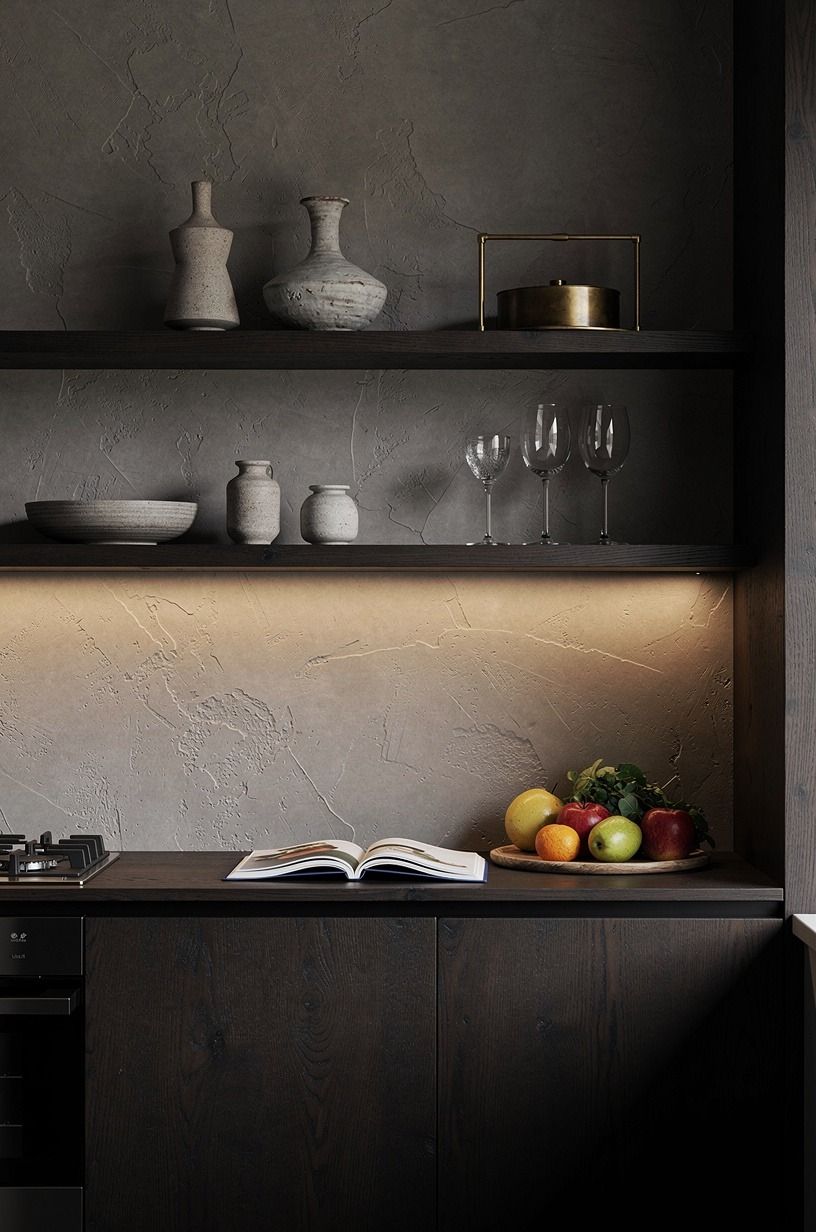
Open shelving only works here if it feels architectural.
3Frame the range hood in dark ribbed wood
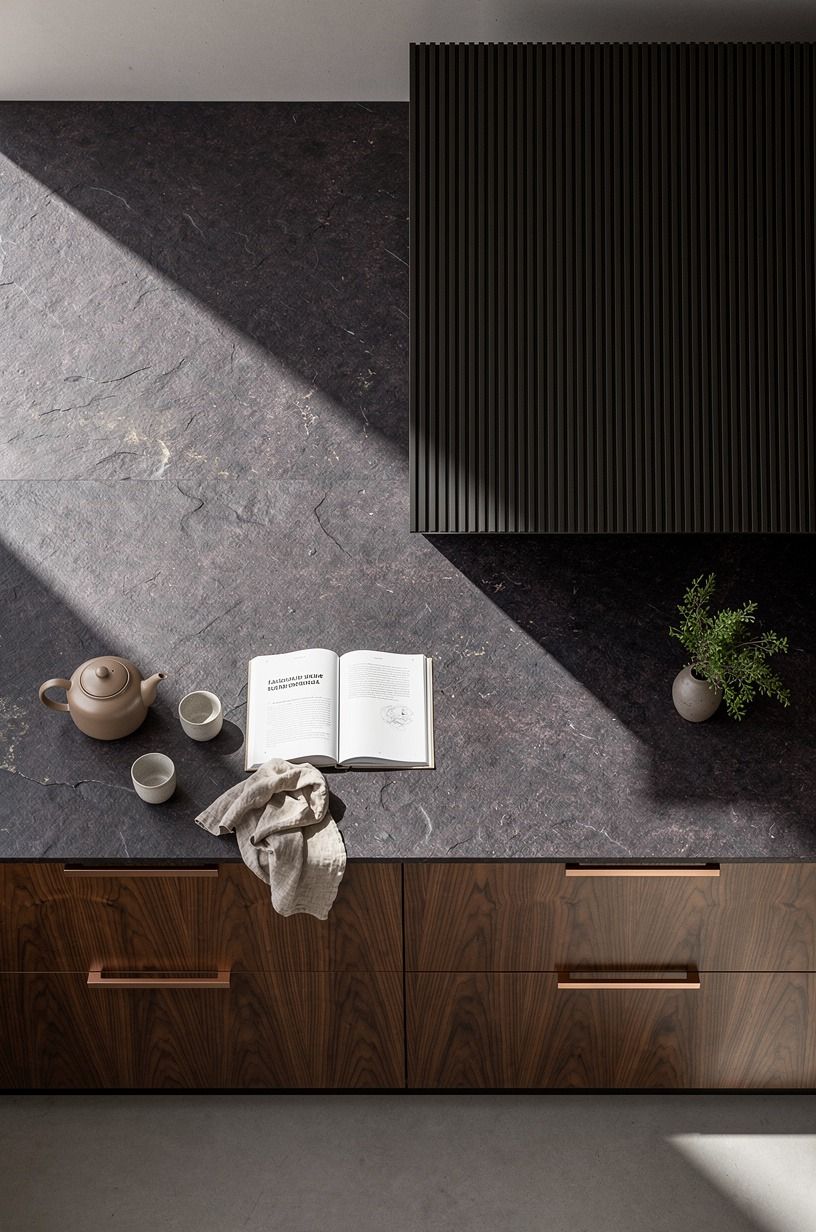
Your hood is where the room either gets soulful or starts feeling builder-grade. Wrap it in dark ribbed oak or stained ash, and suddenly the cooking wall has pulse instead of a blank box hanging over the range.
The ribbing can't be too fine. Thin fluting goes a little hotel lobby fast. I prefer wider vertical spacing because you still get shadow, but the surface feels handmade rather than machine-perfect.
If you've got upper cabinets nearby, keep them simpler so the hood wins. In a modern asian kitchen, one textured focal point is enough.
Here's the part I would push: tie the hood color to one other dark note, then stop. Maybe aged bronze hardware.
Maybe a narrow soapstone trim shelf. That is it. If you repeat the ribbed treatment everywhere, your kitchen starts trying too hard.
And nobody wants a kitchen that looks like it memorized a trend board. The whole hood frame should read as one quiet object, not as the loudest thing in the room.
4Ground the island with a charcoal waterfall counter
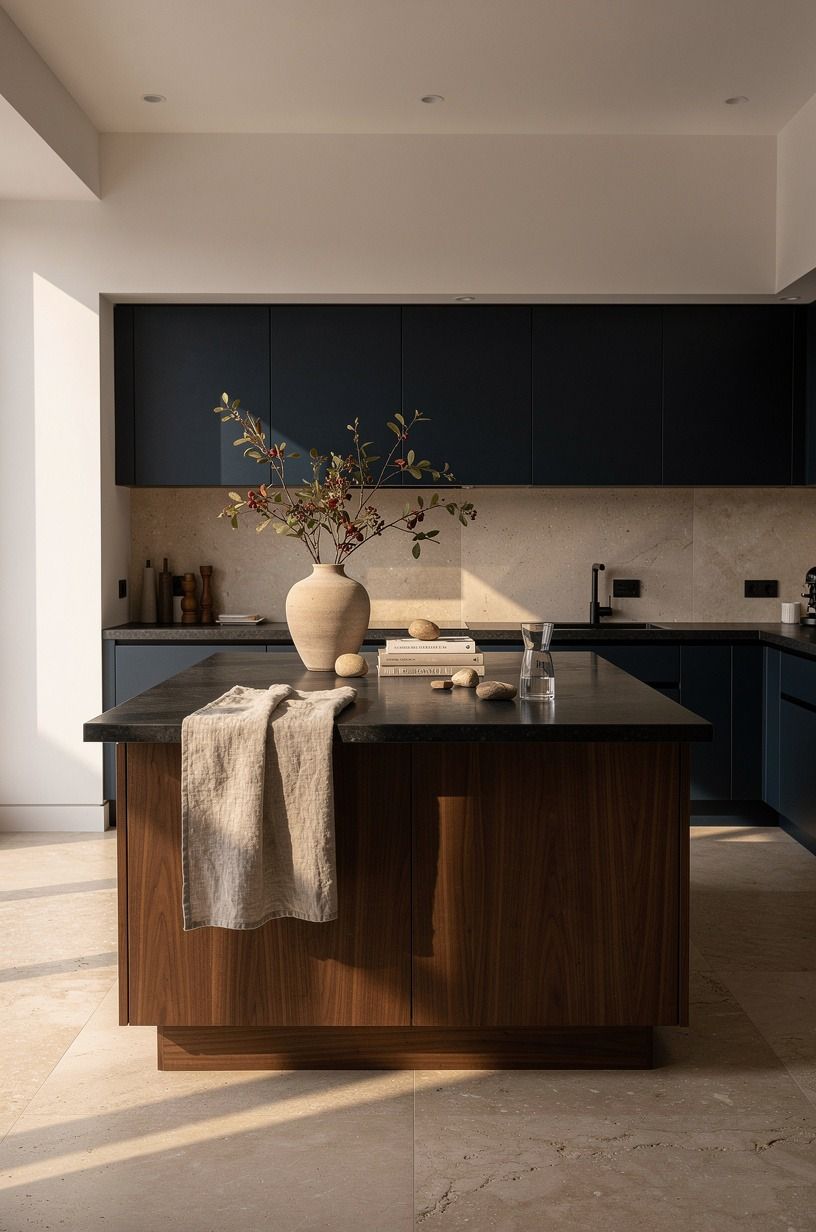
If your island feels like it's drifting, give it weight at the edges. A charcoal waterfall counter drops the eye straight to the floor, and your island starts acting like furniture instead of a block parked in the middle of the room.
This works best when the clearances are right. Leave 42 to 48 in all around if you can, because a dark island needs breathing room or you'll feel the squeeze every time you turn with a pan.
I made the mistake once of choosing the right stone for the wrong footprint, and the room felt cramped no matter how pretty the slab was. For a japandi kitchen black countertop, I would take a leathered finish over polished every time.
You still get depth, but you do not get glare bouncing around overhead.
Keep the stools quiet. CB2 Gwyneth black oak stools or a simple backless seat in woven rush will let the stone stay in charge. One branch in a low vessel.
Maybe fruit. Done! If you want a deeper dive into island sizing and clearances, our japandi kitchen island guide covers the math I wish I'd known sooner.
5Mix blackened ash lowers with pale oak uppers
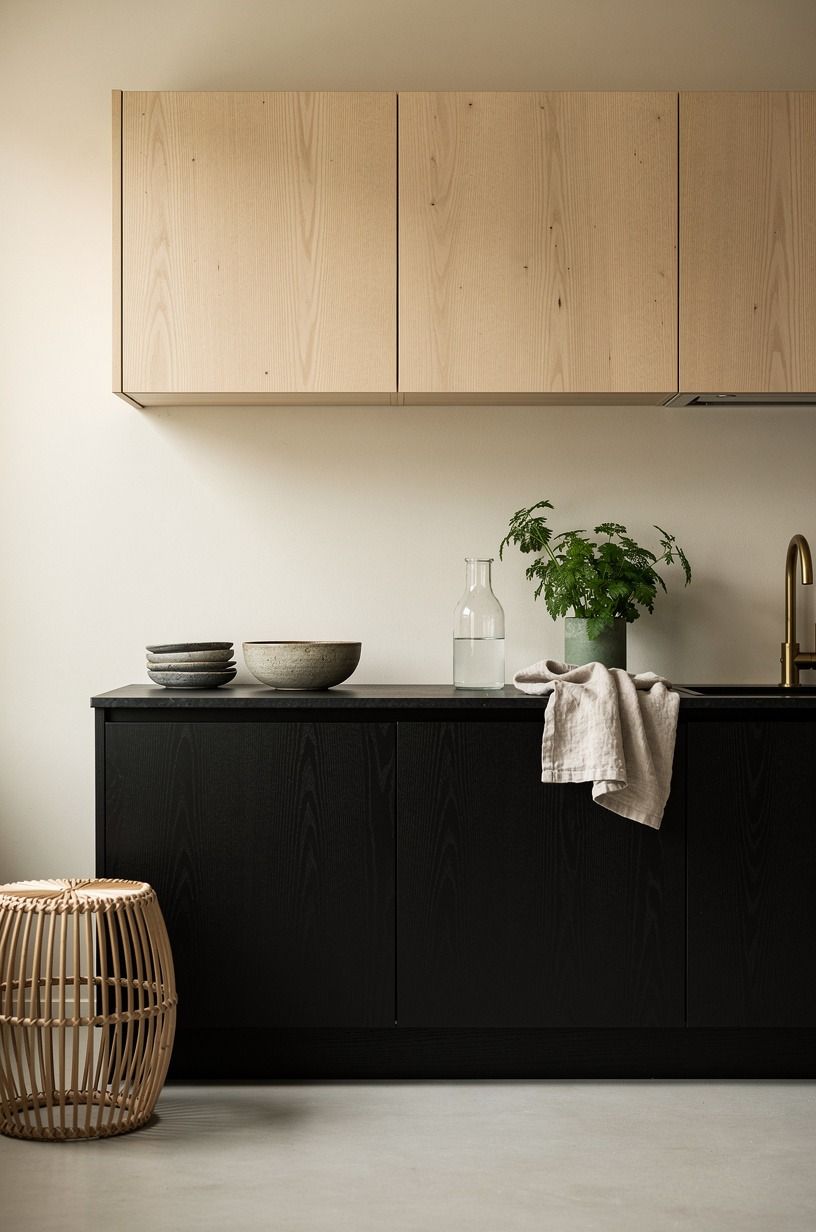
This is the Two-Wood Rule in its easiest form: darker weight below, lighter lift above.
6Install shoji-inspired pantry doors in espresso wood
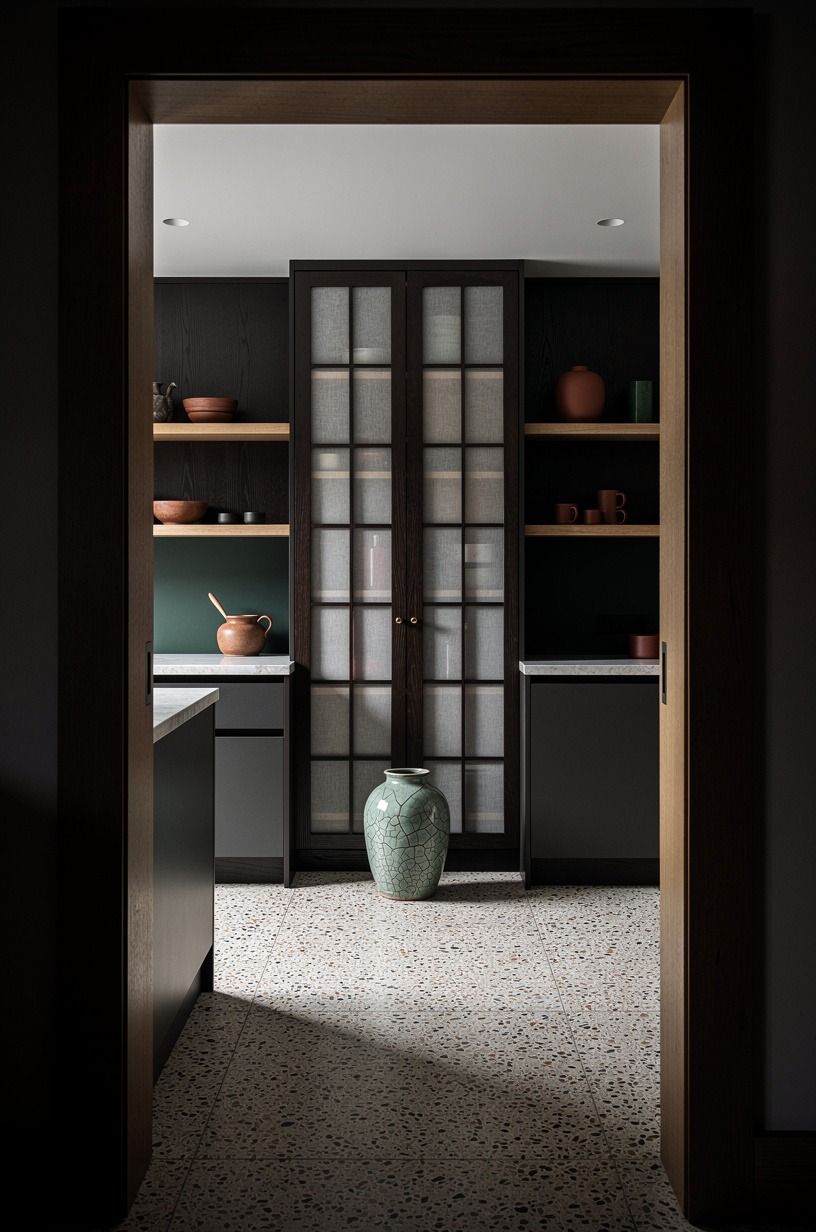
Pantry doors are a huge visual field, so treat them like millwork, not an afterthought. Shoji-inspired frames in espresso-stained oak add rhythm, and they bring in that quiet Japanese reference without turning your kitchen into a theme set. The grid lines echo the ribs on your hood and the seams in your cabinetry, which is exactly the kind of quiet repetition a dark room loves.
You do not need literal rice paper. In fact, I wouldn't do that in a working kitchen.
Fluted glass, reeded acrylic, or a warm opaque insert cleans easier and gives you the same softened grid. If you are renting, this idea can start smaller with removable film over clear panels and a stained over-frame attached to the existing door.
It won't be custom millwork, but it can still pull the room together.
The reason this works so well is simple: large dark panels can feel flat, while a grid gives your eye stops along the way. And if your pantry sits off the main cooking wall, the layered doorway view becomes part of the pleasure. You see depth first, storage second.
Big difference! For more on door details, our hidden pantry door roundup shows grids in every budget range.
7Layer warm brass rails on deep wood drawers
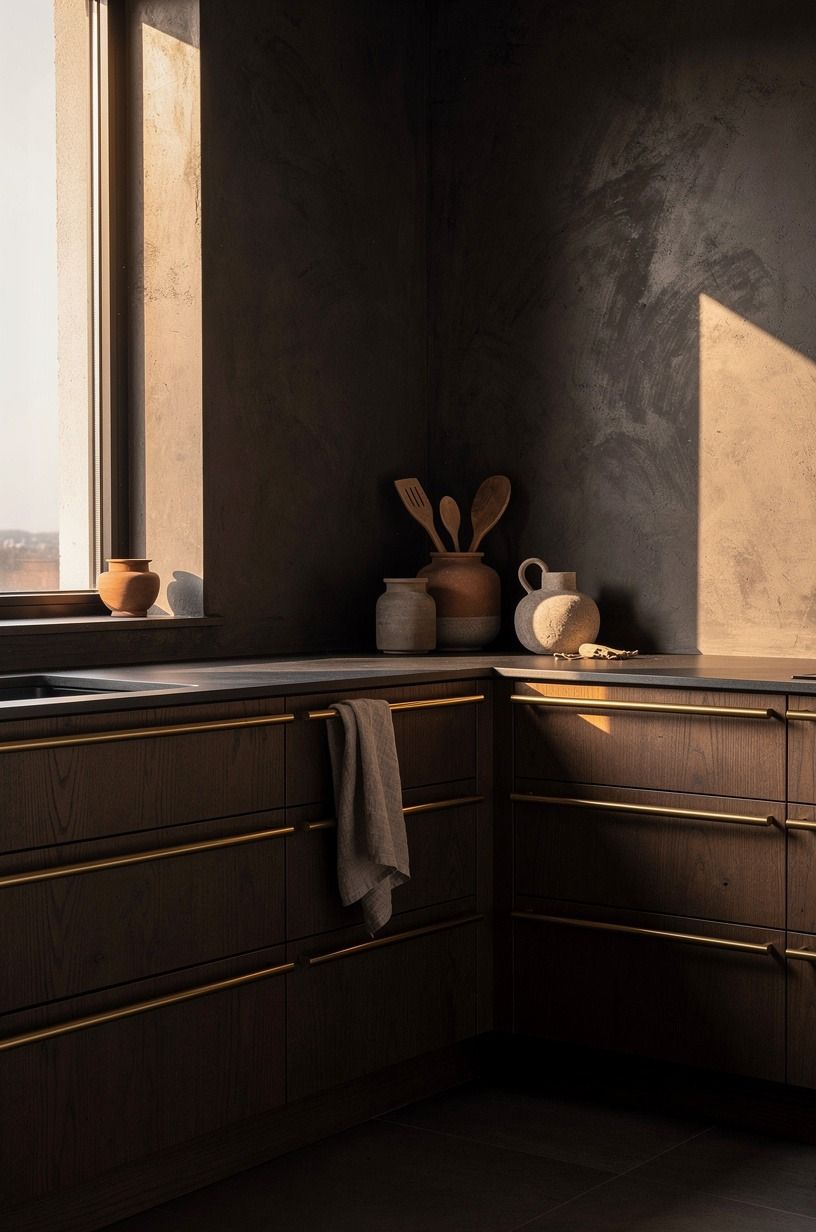
Hardware is where dark kitchens can go cold if you pick the wrong finish. Warm brass rails over deep wood drawers give you just enough glow, and your hands read the room before your eyes even catch up.
I would skip bright yellow brass here. Too loud.
What you want is unlacquered brass or a brushed finish that dulls a little with use. On a long drawer bank, longer rail pulls look more settled than tiny knobs, especially if your fronts are broad slab panels. The contrast against stained walnut veneer is small but powerful, and it keeps the kitchen from turning flat at night.
This is also one of the cheapest shifts you can make. You can spend about $100 to $300 changing hardware on a small kitchen, and you'll feel the difference every single time you cook.
Look at Rejuvenation for the splurge end, Target Threshold for a decent budget pass, and Facebook Marketplace if you are patient. A pile of mismatched vintage brass that tones together? Better than a perfect boxed set, honestly.
If pulls are where you want to start, our japandi cabinet hardware guide breaks down the shapes that disappear into flat fronts.
8Wrap the ceiling beam in stained cedar
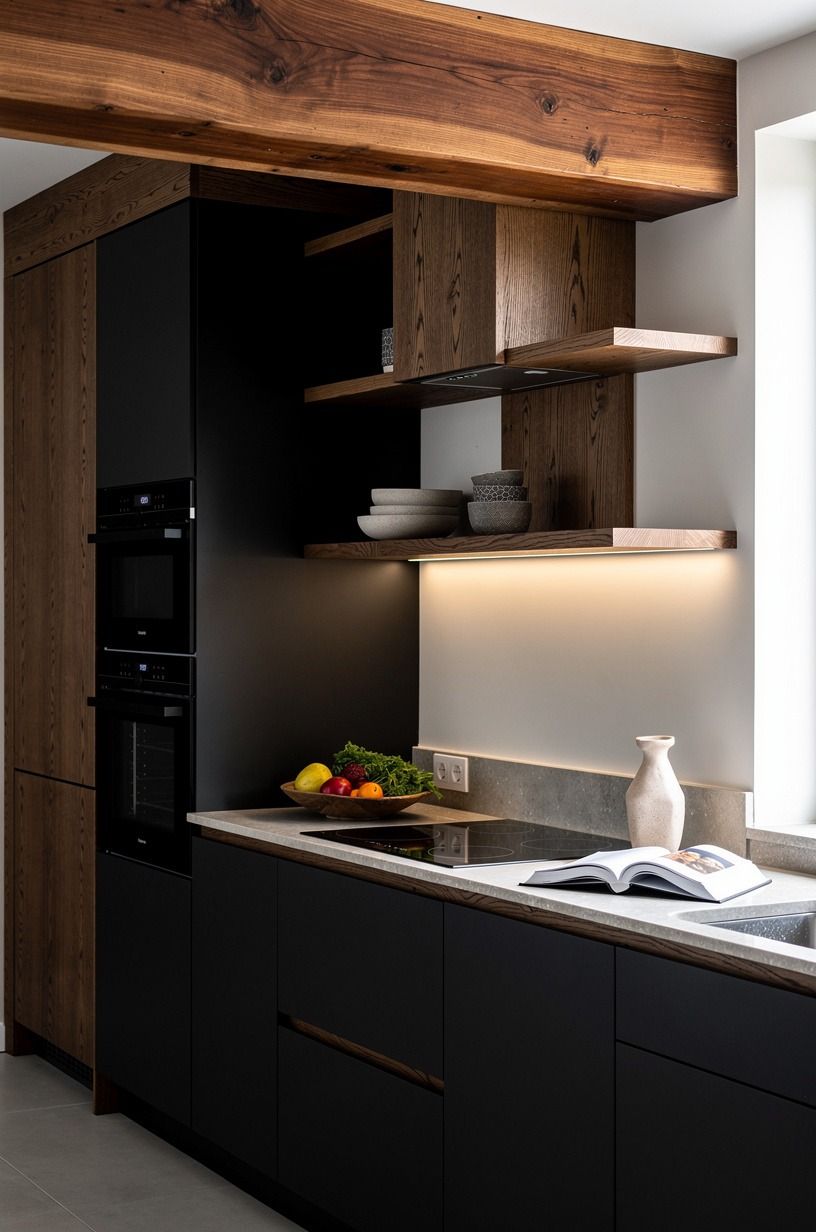
If your kitchen has a beam, do not paint it white and pretend it disappeared.
9Float a black stone ledge above the sink
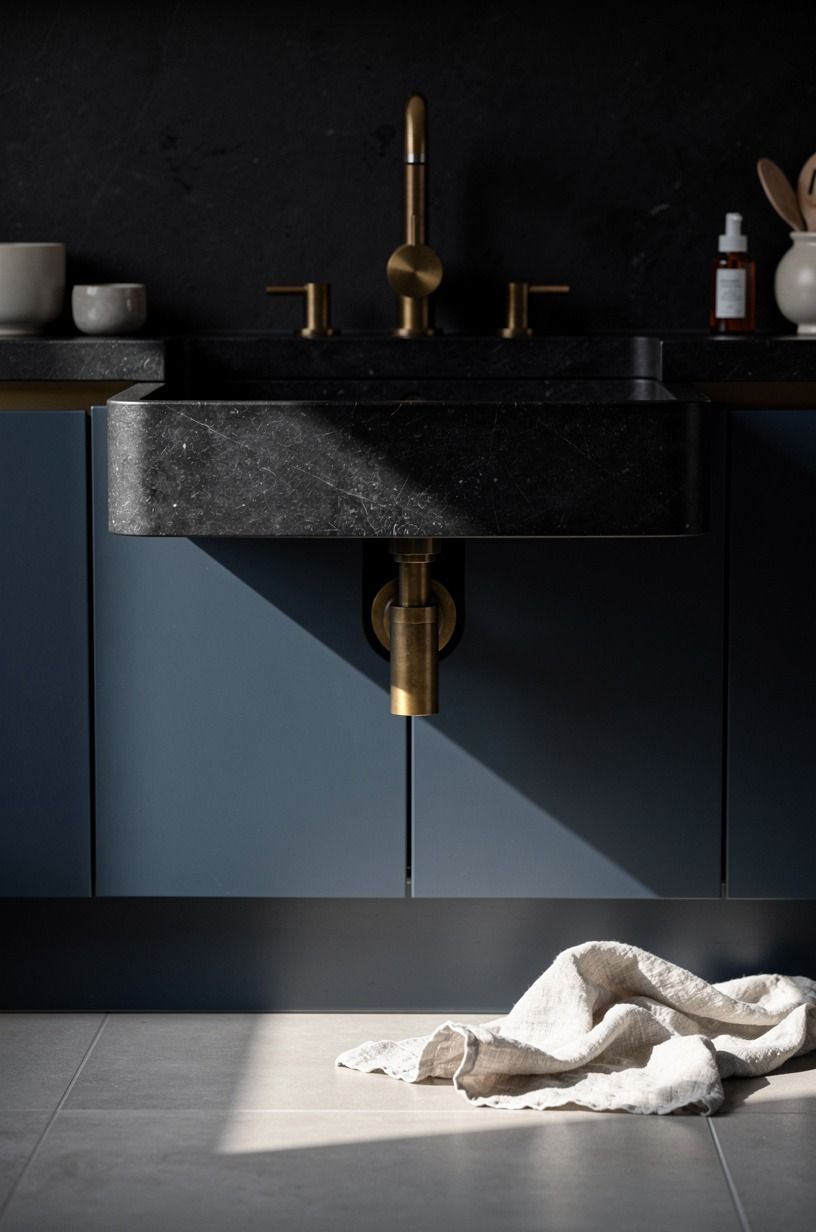
A sink wall needs one practical pretty thing, not six. Float a black stone ledge above the basin, and you get a landing strip for daily objects without the visual chatter of full shelves.
The ledge should feel slim. Think 3 to 4 in deep, just enough for soap, a scrub brush, and maybe a tiny bronze vase with one clipped branch. If you make it too deep, it becomes storage, and storage above a sink gets grubby fast.
In a dark Japandi kitchen, that's the whole fight: keeping the useful objects visible while refusing clutter. A small Farrow & Ball Drop Cloth No. 283 wall behind the ledge lets the dark stone pop without ever feeling theatrical.
I love this detail with a limey plaster wall or a quiet tile in a hand-finished look. Zellige can work if the color stays muddy and low-shine, but I would choose a soft plaster first.
Why? Because the stone ledge is already giving you a strong dark line. You do not need a second headline shouting over it.
For more sink-side moves, our japandi sink roundup walks through quieter basin choices.
10Choose lantern pendants with woven black shades
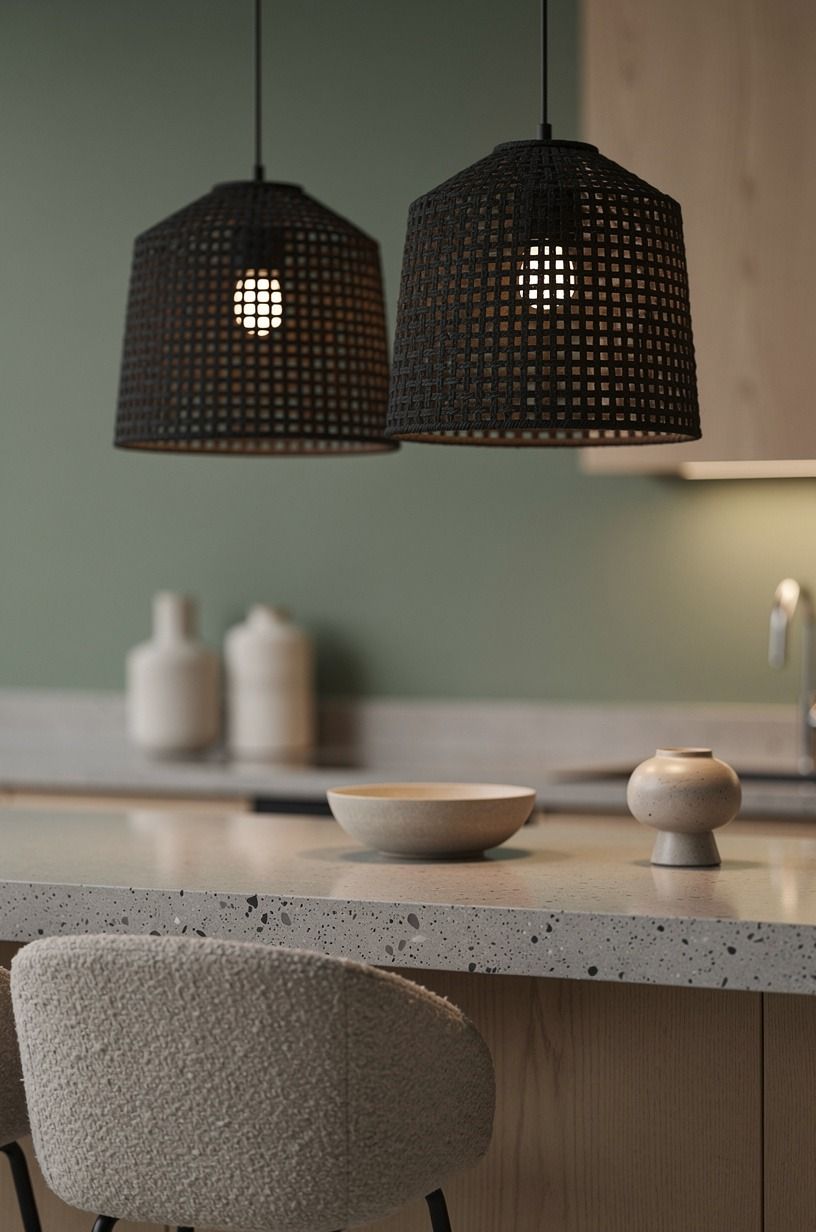
Lighting is where a moody kitchen either softens or turns severe. Lantern pendants with woven black rattan shades throw a gentler shadow pattern than metal domes do, and the room starts feeling lived in once the sun drops.
This is my Three-Height Light Stack rule: ceiling light, counter light, and one low ambient glow somewhere else. If your pendants are the only warm source, the island will glow and the perimeter will die.
Add under-cabinet lighting or a small counter lamp on the far wall, and the whole kitchen settles. For scale, hang pendants so the bottoms land roughly 30 to 36 in above the island, then check sightlines from the entry before you call it done.
You can go expensive here, sure, but you don't have to. West Elm Roar + Rabbit woven pendants have the right mood, and I've seen vintage lanterns rewired for less that looked even better. But don't choose a tight black shade with zero texture.
Dark on dark needs one surface that lets a little softness through. If you want more ideas for soft-glow layering, our japandi kitchen lighting guide shows how to stack sources without cluttering the ceiling.
11Soften dark cabinets with clay tile flooring
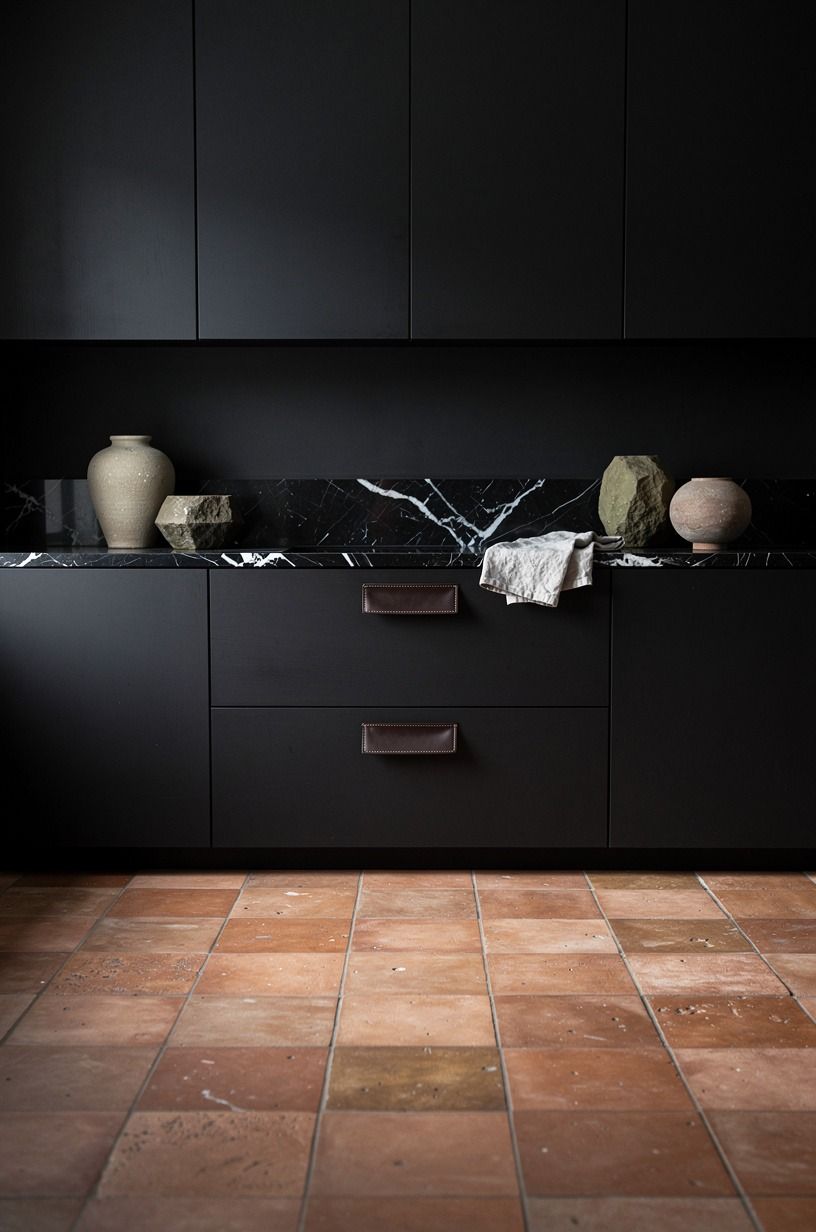
When people say a dark kitchen feels oppressive, the floor is usually the culprit. Dark cabinets over a warm clay tile floor soften the whole composition because the eye reads the room from the ground up, not just cabinet-height.
I wouldn't default to gray porcelain here. It's easy, and it's usually the wrong kind of easy.
Handmade-look terracotta, muted brick, or even a clay-toned porcelain with slight edge variation brings warmth without asking the walls to do all the saving. A floor tile around 8 by 8 in or 6 by 6 in keeps the grid modest, and a matte finish helps the cabinets feel richer rather than harsher. If you want more flooring references, our japandi kitchen flooring guide is the sister article I would pair with this look.
This is also where cost reality matters, because flooring decisions can tilt a whole refresh. Here's the range I use as a gut check before anyone gets precious about finishes:
And if you're pricing surfaces, this is the other table worth keeping close:
12Why does warm plaster outperform glossy tile in a dark kitchen?
Because glossy tile bounces hard light straight back at the dark cabinets, and every reflection turns into a small argument between two finishes. Warm limewash or American clay absorbs the light instead, which is exactly what moody minimalism needs.
I tested this in my own kitchen by holding a sample of Farrow & Ball Bone No. 15 limewash next to a flat black cabinet door. The tile sample made the cabinet look dusty.
The plaster sample made it look richer. Same wall, same lighting, completely different room.
If you go this route, ask for two coats of primer plus a hand-troweled topcoat, then seal with a matte wax. Skip the high-sheen sealer even if the installer suggests it.
The whole point is the surface to drink in light, not throw it back. For paint pairings that hold up against deep walnut, our dark oak kitchen roundup tests the same paints against oak grain.
13Walnut against black against clay: the Three-Material Stack
The easiest dark Japandi formula is walnut (warm mid-tone), matte black stone (anchor), and clay tile (ground). One material from each tier, and you almost can't get the mood wrong.
This works because every piece talks to a different part of your eye. Walnut reads as grain and softness.
Black stone reads as weight and shadow. Clay tile reads as warmth from below.
Together they form a triangle the eye keeps returning to, which is exactly the calm rhythm you want in a cooking space. You can swap any one of the three for an equivalent, like Farrow & Ball Off-Black No. 57 instead of stone, or Benjamin Moore Chestertown Buff HC-9 instead of clay, and the room still holds together.
Done in the right combo, the whole kitchen reads warm even at midnight!
What you do not want is a fourth or fifth material fighting for attention. Once you add a copper sink, a marble island top, and a brass range hood all at once, the formula collapses.
Keep it to three. Edit ruthlessly.
14Small Japandi kitchens vs. wide open plans: where the dark formula bends
The dark formula bends more than you'd think.
15What makes a dark Japandi kitchen actually feel calm?
Three things, in order of how often people forget them: one warm material repeated, one quiet texture repeated, and one soft light source repeated. Calm is repetition with breathing room, not minimalism for its own sake.
The warm material might be walnut, brass, or clay. The quiet texture might be ribbed oak, woven rattan, or hand-troweled plaster. The soft light might be paper lanterns, under-cabinet strips, or a single counter lamp.
Pick one from each category and let it appear at least twice in the room, in two different zones, so the eye picks up the echo.
Most people skip the repetition step. They pick a beautiful dark cabinet, a beautiful pendant, and a beautiful floor, and then wonder why the kitchen still feels scattered. Calm isn't about choosing better objects.
It's about letting the ones you choose show up more than once.
The Shadow-Line Rule That Keeps Dark Japandi Warm
Here's the thing: the best dark Japandi kitchens aren't dark because someone was brave with paint. They're dark because every heavy surface has a soft answer somewhere else.
I didn't understand that at first. I thought mood came from depth alone, so I kept adding darker finishes, darker walls, darker stools, darker pendants.
The result wasn't serene. It was just tired.
What changed my mind was seeing how the good rooms distribute weight. You get one broad dark plane, then a quieter middle tone, then a lighter natural surface that lets your eye rest. That's why walnut slab cabinets under black stone work.
That's why pale oak uppers can save blackened ash lowers. That's why clay tile under deep cabinetry feels human while polished charcoal floor tile can feel a little severe. A kitchen needs gravity, yes, but it also needs relief.
I would also say this is where money matters less than editing. If you have $300, put it into hardware, paint, and lighting before you start fantasizing about a $60 per sq ft stone slab.
If you've got room in the budget for more, great, but dark minimalism falls apart when every upgrade screams for attention. The rooms that hold up over time don't perform for you. They absorb you a little.
And you don't need to mimic a showroom to get there. A used wood stool with a worn edge.
A branch clipped from the yard. One lamp on a back counter, even in a kitchen.
That kind of softness is what keeps minimalism from feeling cold. And honestly, isn't that the whole point?
You want a room that feels grounded at 7am and forgiving at 9pm.
The Three-Surface Budget Filter
If you're deciding where to spend, use this filter: touch surface, eye-level surface, and floor. Spend first on the place your hand lands every day, second on the line your eye catches first, and third on the surface that warms the whole room.
For most kitchens, that means hardware or faucet, then the backsplash or shelf wall, then the flooring. Keep that order and you'll get more calm per dollar than you will from blowing the whole budget on one dramatic stone slab.
The Quiet-Contrast Rule for Small Kitchens
If your kitchen is tight, keep the contrast broad and slow. You want one dark cabinet mass, one lighter upper or wall zone, and one warm material underfoot so the room reads in three calm beats instead of ten little interruptions. That is why small dark kitchens often look better with fewer shelves, fewer stools, and one long counter run.
I would also keep the accessories low and useful. A teak tray. A dark soap pump.
One lamp if you have the outlet for it. Small spaces reward editing faster than big ones do, and that is good news for your budget. For layout-specific ideas, our galley kitchen roundup shows how narrow dark kitchens stay calm without feeling closed in.
Honestly, restraint is where the magic lives!
A Few Things Worth Answering
What is the best Dark Japandi Kitchen Ideas for Moody, Grounded Minimalism for a small kitchen?
The best move is mixed woods with lighter uppers. Lighter storage above eye level keeps a small kitchen open, while dark lowers still give you that grounded mood. I would start with blackened ash below and pale oak above, then keep your counter clear except for one daily-use object.
Where can I buy Dark Japandi Kitchen Ideas for Moody, Grounded Minimalism pieces on a budget?
Start with IKEA, Target Threshold, and Wayfair for the basics. You can usually find shelf brackets, stools, pendants, and hardware there without blowing the plan.
For better character, check Facebook Marketplace for old wood stools, brass pulls, and handmade-look pottery. Our budget cabinet makeover guide has a longer list of where each finish actually lives.
How much does a Dark Japandi Kitchen Ideas for Moody, Grounded Minimalism makeover cost?
A cosmetic version usually runs about $300 to $1,500, and a fuller refresh can land between $3,000 and $12,000. Paint, hardware, and styling are the cheap wins.
New cabinetry, stone counters, and appliances are where the bigger numbers show up fast. Our IKEA oak kitchen roundup breaks down a real budget at the low end of this range.
Can I create a Dark Japandi Kitchen Ideas for Moody, Grounded Minimalism on a budget?
Yes, and you don't need a full remodel. Cheap changes can still shift the mood.
Darken the hardware, style one long shelf instead of adding more cabinetry, and swap harsh bulbs for warmer light. Even a peel-and-stick backsplash can help if the finish stays matte.
For cabinet flips that read Japandi without a full tear-out, our honey oak modernize guide shows the cheapest moves first.
Is a Dark Japandi Kitchen Ideas for Moody, Grounded Minimalism worth it in a small space?
Yes, it's worth it, and small rooms often pull it off better. A tighter footprint makes restraint easier because you can't overfill the room.
Keep 42 in of passage where you can, let one dark surface lead, and avoid busy open storage. For apartment-scale Japandi moves, our small-spaces Japandi guide is the closest fit.
Is Dark Japandi Kitchen Ideas for Moody, Grounded Minimalism a good idea for a rental?
Yes, if you stick to reversible layers. Rent-friendly swaps still carry the look. Try removable hardware, peel-and-stick backsplash panels, a stained shelf run, and lantern pendants swapped back before move-out.
I'd also use film or inserts before changing permanent pantry doors. Our hidden door hardware roundup leans into the swap-without-trace side of Japandi doors.
Where I'd Start First
If I had to pick one, I'd start with the walnut slab cabinets under matte black stone. That pairing fixes the room's center of gravity before you spend on little extras.
Pin that idea for later and let the lighting and hardware follow. If you want a single warm-up move before any of that, swap the pulls for unlacquered brass and see how the room changes over a single week of cooking in it.