I Tried Floating Mantel Ideas, My Modern Fireplace Finally Feels Clean
30 june 2026Floating mantel ideas for a clean, modern fireplace cost me $642, two evenings, and one long Saturday before the wall finally clicked. I had the modern firebox already. What I didn't have was calm. I wanted the fireplace to feel lighter, sharper, and warmer, but I couldn't justify rebuilding the whole room.
Here's what it looked like before the Clean Float Reset
Before this makeover, my fireplace had that polished-but-off feeling you can spot from the sofa in about three seconds. The firebox was crisp, the wall color sat close to Benjamin Moore Revere Pewter HC-172, and the shelf I'd put up there was too thick for the room.
The original slab was a heavy 8-inch oak beam with a glossy polyurethane face, the kind every 90s builder threw above every firebox. It pushed forward instead of floating, so the whole wall felt heavier than the furniture around it, and the floating illusion I wanted didn't even register from the sofa.
I tried styling around it for a season and gave up fast.
I knew the proportions were wrong when I checked the room from my seat instead of from six inches away. The sofa was about 38 inches deep, the Target Threshold round marble coffee table landed just under 18 inches high, and the TV sat at a distance that should have felt easy to watch. But the mantel kept stealing attention in the wrong way.
It looked like a block that didn't belong on a clean wall. If your room is doing the same thing, this mantel decor guide that pulls the room together shows why the shelf has to behave like architecture first.
- Choose a thinner oak shelf before anything else
- Mark the sofa sightline with painter's tape
- Center the mantel below the framed TV
- Leave breathing room around the firebox
- Pick a deep ledge for layered frames
- Use a shallow shelf for brass candlesticks
- Stain the wood to match built-ins
- Add hidden brackets for a cleaner float
- Hang one landscape slightly off center
- Stack small art behind low pottery
- Balance the ledge with one branch vase
- Ground the hearth with woven log baskets
- Finish with warm sconces beside built-ins
1Choose a thinner oak shelf before anything else
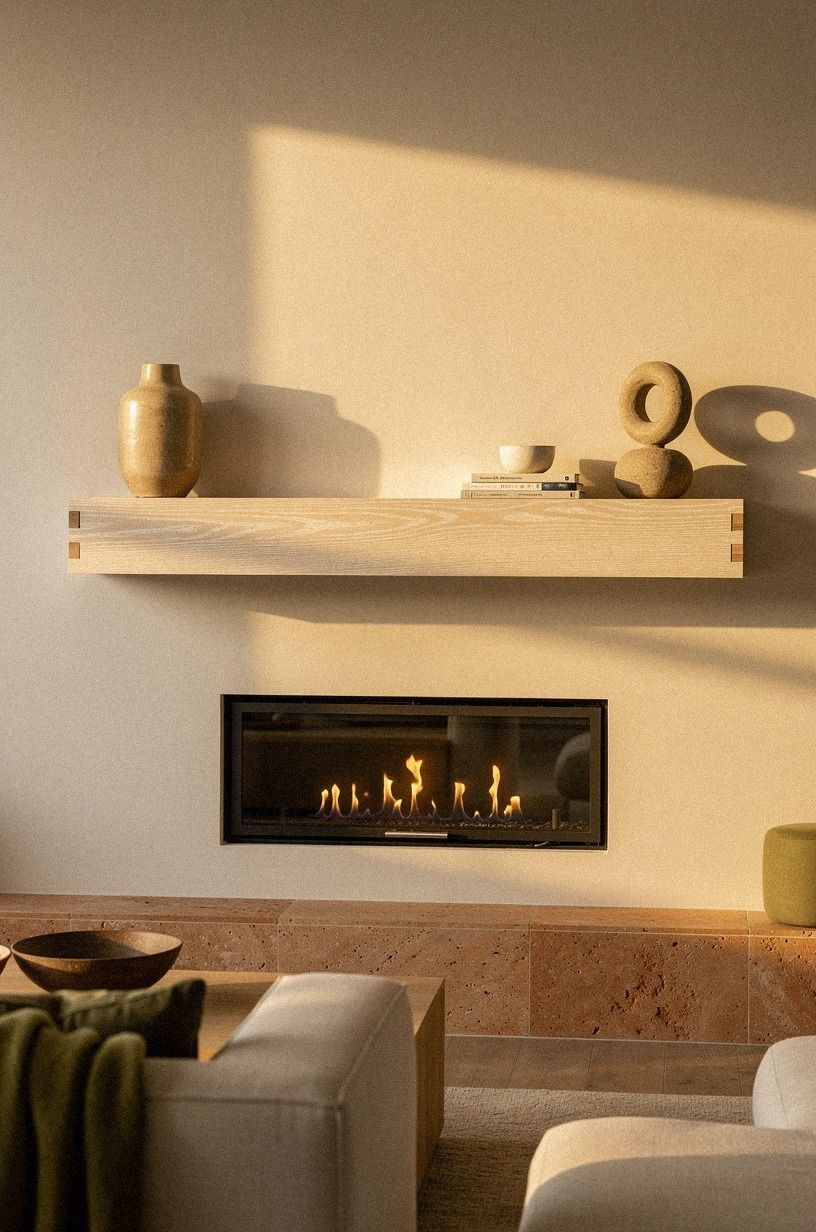
I started with the shelf because nothing else reads right until that line reads right. My first mantel was almost 8 inches tall, and on a modern wall it felt bulky in a way I couldn't style my way out of. The replacement was a thinner cerused white oak shelf with a dry finish and a much quieter face, and the room relaxed the second it went up.
I went with a 5-inch profile from a small mill shop on Etsy after measuring six ready-made shelves at West Elm and CB2 and rejecting every one of them. None of those read right at the depth I needed, so I spent the extra $40 to get something that did.
The part that worked was restraint. A thin shelf lets you see more wall, more firebox, and more of the shadow line underneath, and that's what creates the clean float in the first place.
I kept the depth useful enough for styling, but I refused to go chunky again. If you're comparing profiles, start here before you buy art, candlesticks, or anything else.
You can see the same proportion lesson in this modern mantel decor guide, and it saved me from repeating an expensive mistake. Trust the lighter line; everything below it lands cleaner.
2Mark the sofa sightline with painter's tape
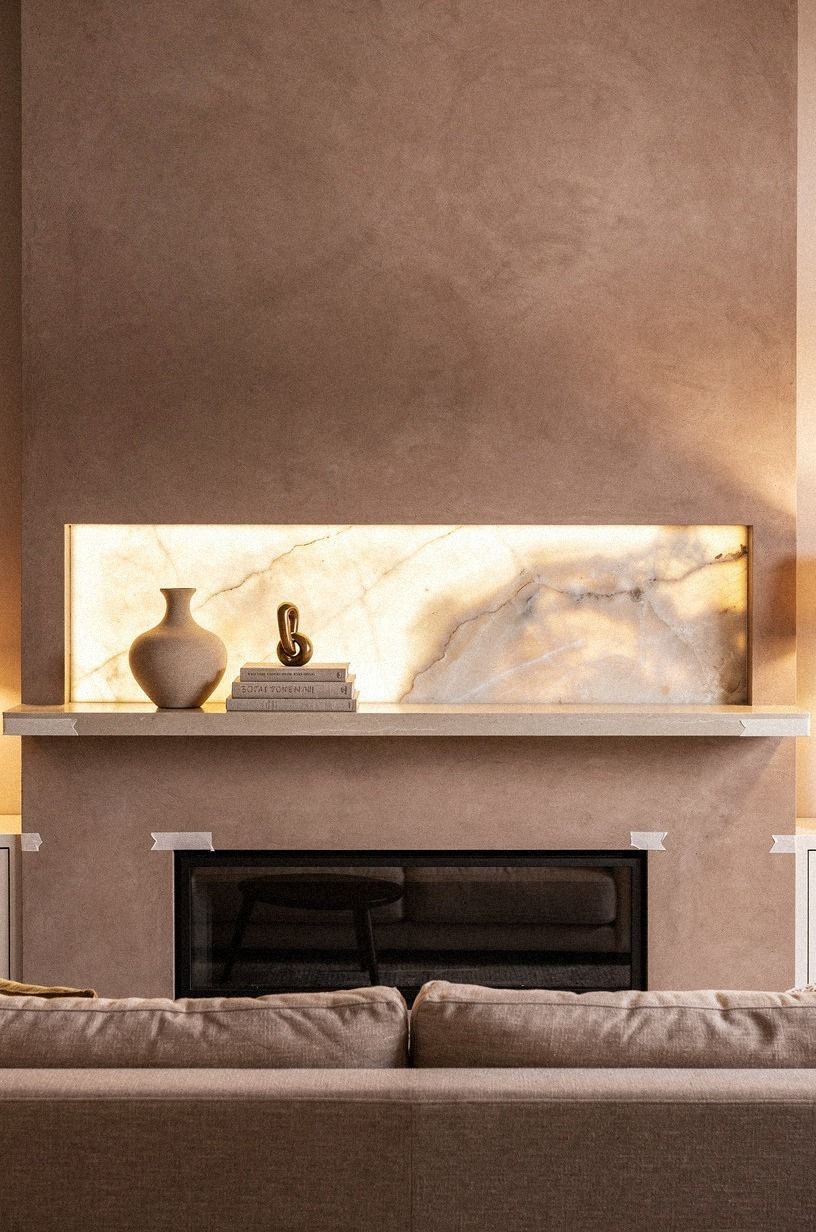
This step felt fussy for about five minutes, then it saved me hours.
3Center the mantel below the framed TV
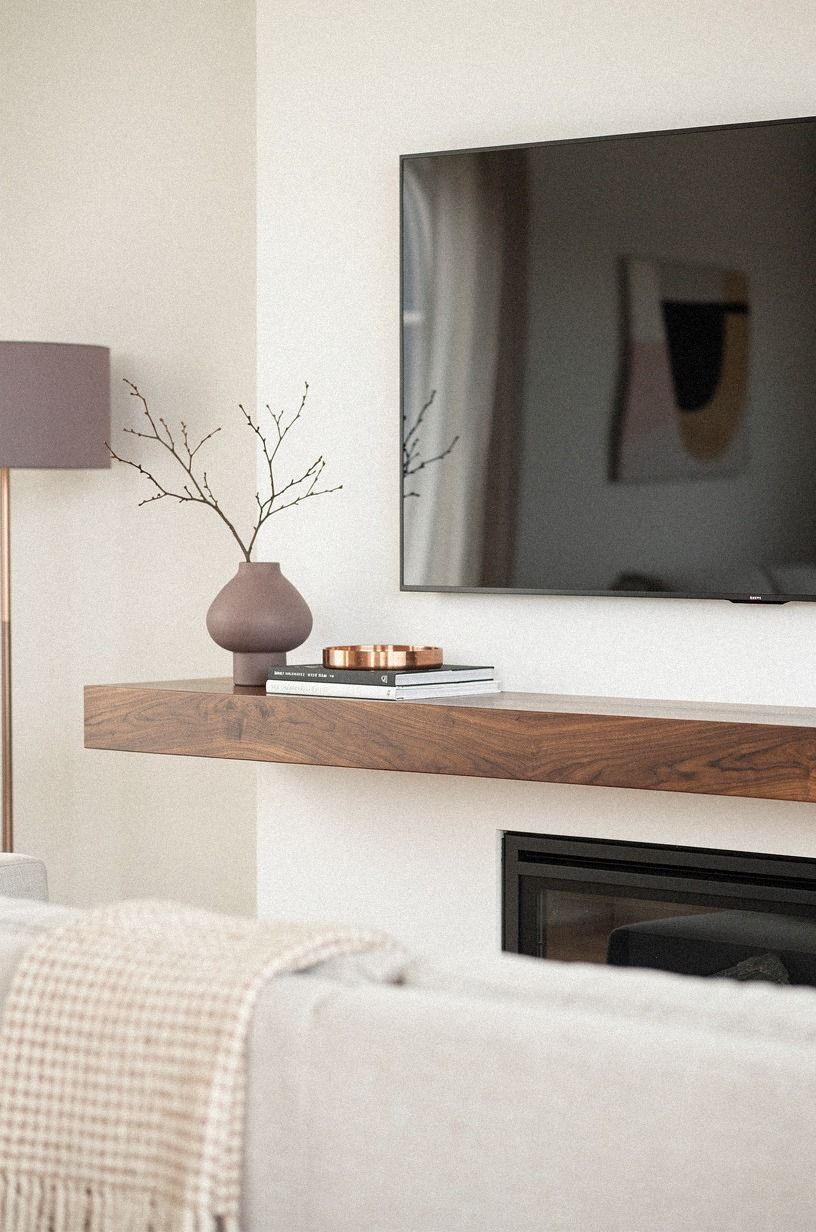
My TV was already framed in a slim walnut surround, so the mantel had to respect that line instead of pretending the screen was not there. I centered the new shelf directly below it, then checked the spacing until the gap felt intentional rather than squeezed.
Modern walls get ugly fast when the TV and mantel start competing for authority. A 4 to 6 inch gap between the bottom of the framed TV and the top of the mantel is the calm number, and anything tighter starts pushing the wall toward a stack rather than a composition.
The whole wall reads like one tidy focal point once that gap is set, and that's the whole point.
What surprised me was how little adjustment it took. A couple of inches left or right completely changed the wall from tense to settled, especially once the book-matched walnut frame above and the oak shelf below started reading like cousins instead of strangers. You don't need them to match, but you do need them to agree.
If your wall also has a screen above the firebox, this TV-over-mantel guide explains why the gap between the two pieces matters so much.
4Leave breathing room around the firebox
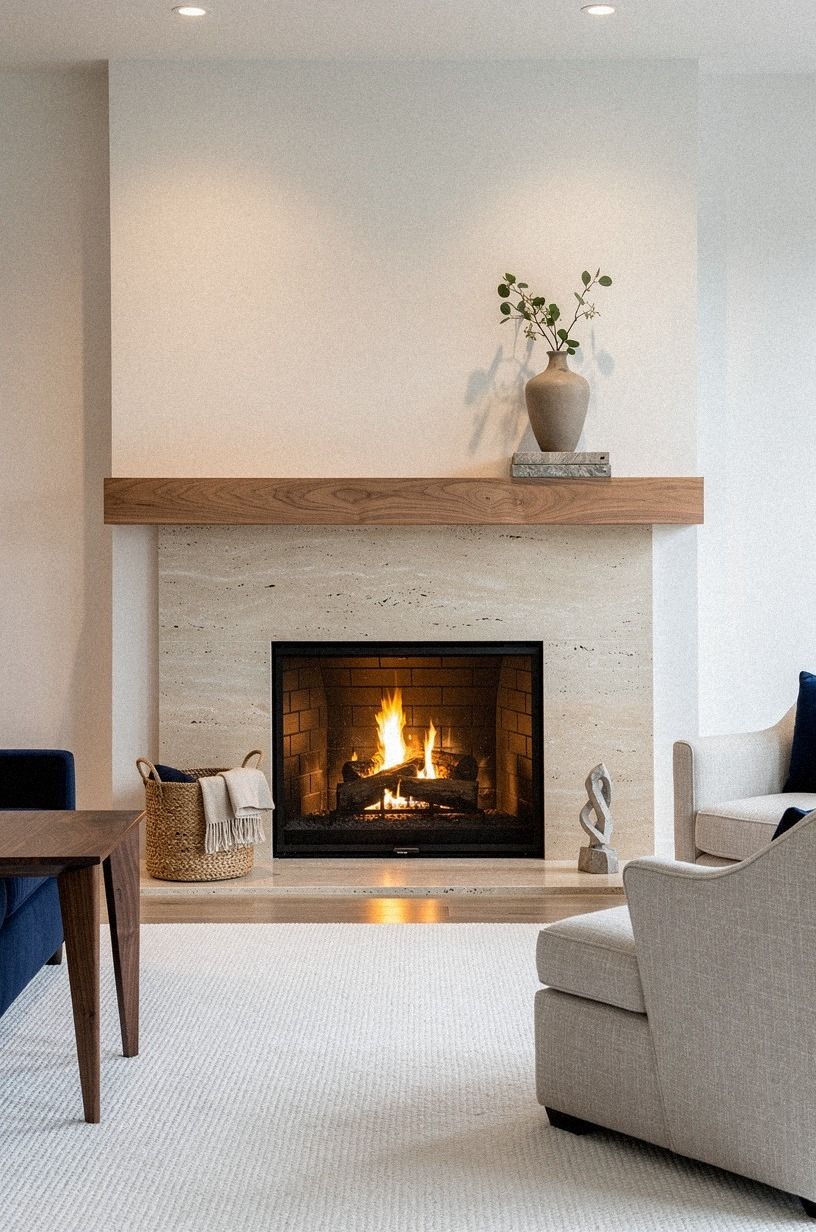
I used to think a modern fireplace needed more around it to feel finished. Turns out, it needed less.
Once I stopped crowding the opening with decor, tile fuss, and side clutter, the firebox finally looked intentional against the wall. That empty wall space wasn't wasted space.
It was the thing making the room breathe. The wall is the styling here, not the objects on the ledge, and once you accept that, the cheaper, calmer version of the room starts pulling itself together.
The same empty-walls rule applies to bookshelves and around couches. Modern is mostly about what you decide to leave out.
But mine had a warm travertine surround and a crisp linear opening, so I let that contrast do the work. No extra objects right up against the edge.
No tiny stools tucked too close. No random basket trying to help.
But I did pay attention to the larger room so the fireplace didn't feel stranded, which is where rug size and furniture scale matter. Front legs on an 8x10 or 9x12 rug, then let the wall stay open.
This simple mantel styling guide helped me trust the blank areas instead of filling them on instinct.
5Pick a deep ledge for layered frames
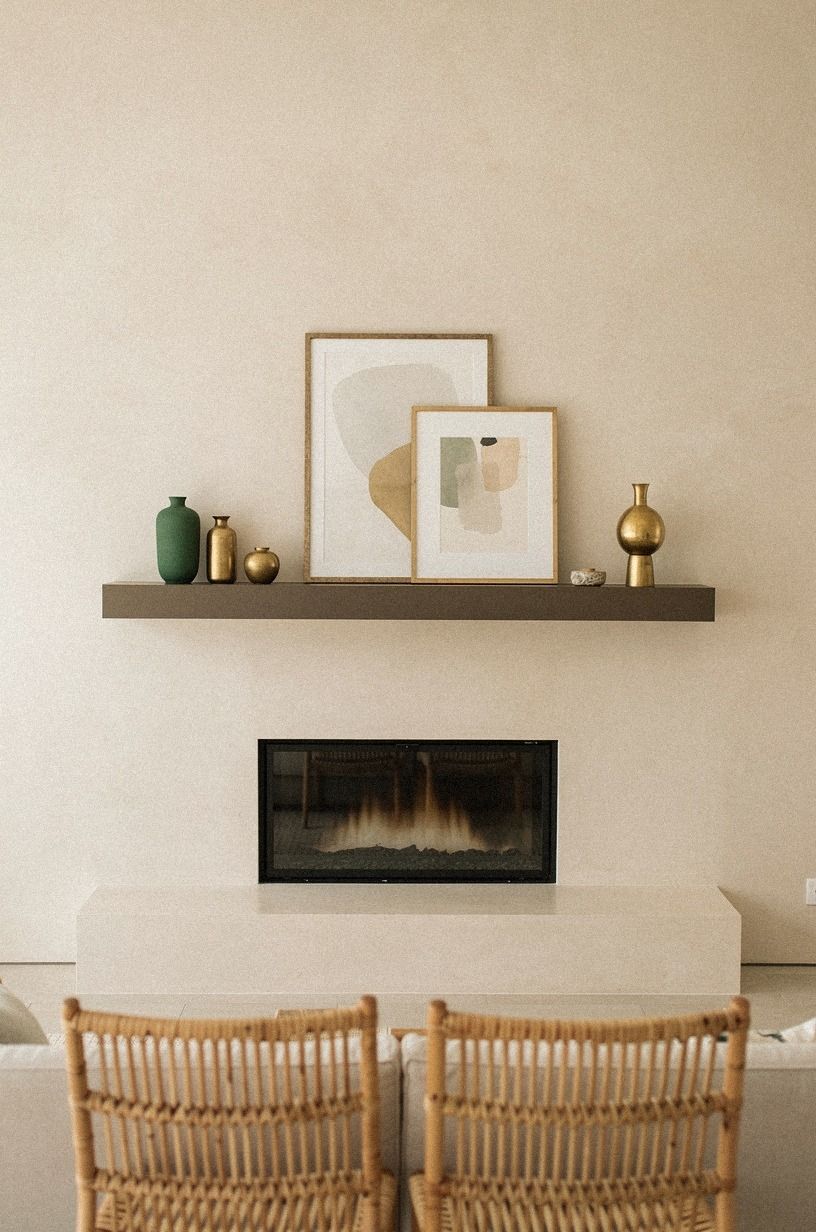
Once the shelf profile was right, I gave myself one place to add depth without adding noise: a deeper ledge for frames.
6Use a shallow shelf for brass candlesticks
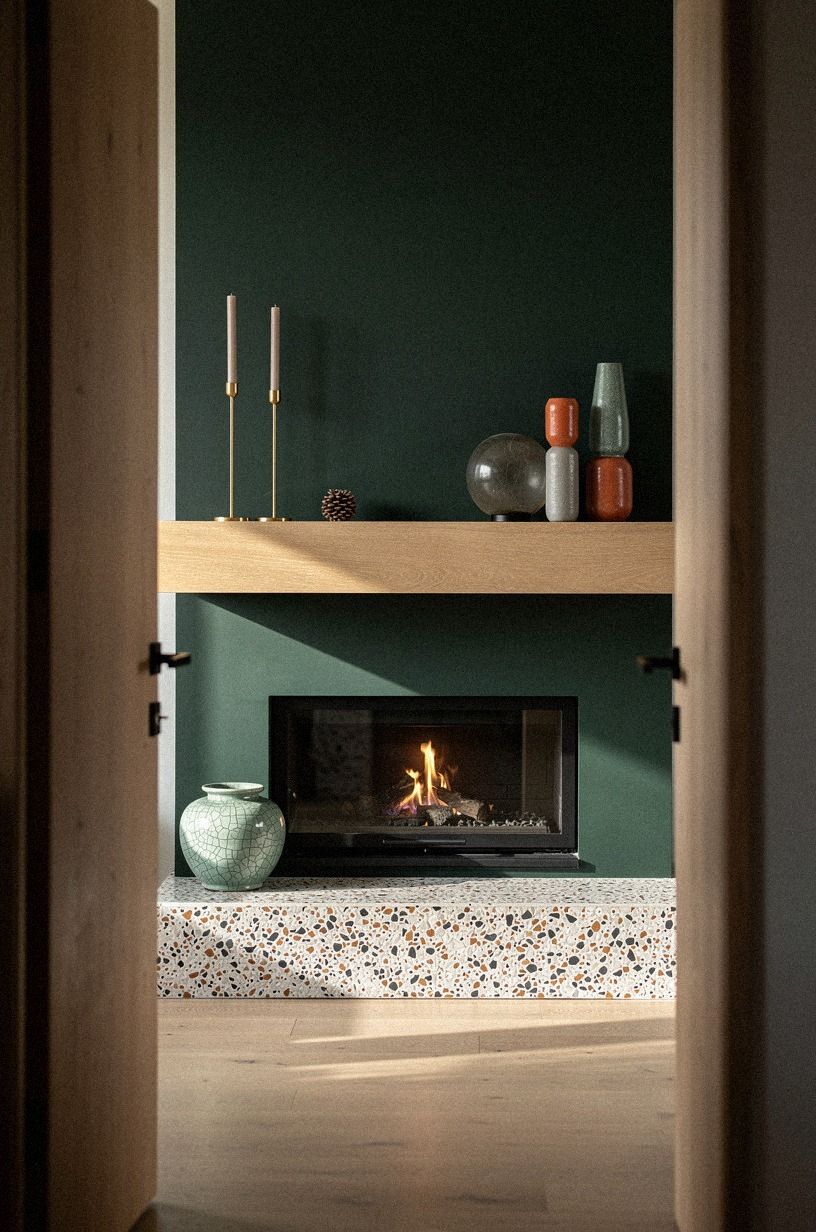
Not every shelf needed depth. For candlesticks, the opposite was true. I tested a shallow shelf with slim unlacquered brass candlesticks, and the lighter projection looked cleaner from every angle, especially through the doorway where a deeper ledge had been reading clunky.
Sometimes less shelf is exactly what makes styling look more expensive. Huge difference!
I used narrow holders with a little patina, not fat polished ones that would have dragged the wall toward traditional. The candles stayed pale, the heights stayed staggered, and the whole thing looked like it belonged with the firebox instead of sitting on top of it like a separate vignette.
But I only liked this when the rest of the wall was already calm. If you want more glow without more clutter, this warm candle mantel article is worth saving. Real talk: linen shades and warm bulbs change everything after sunset.
7Stain the wood to match built-ins
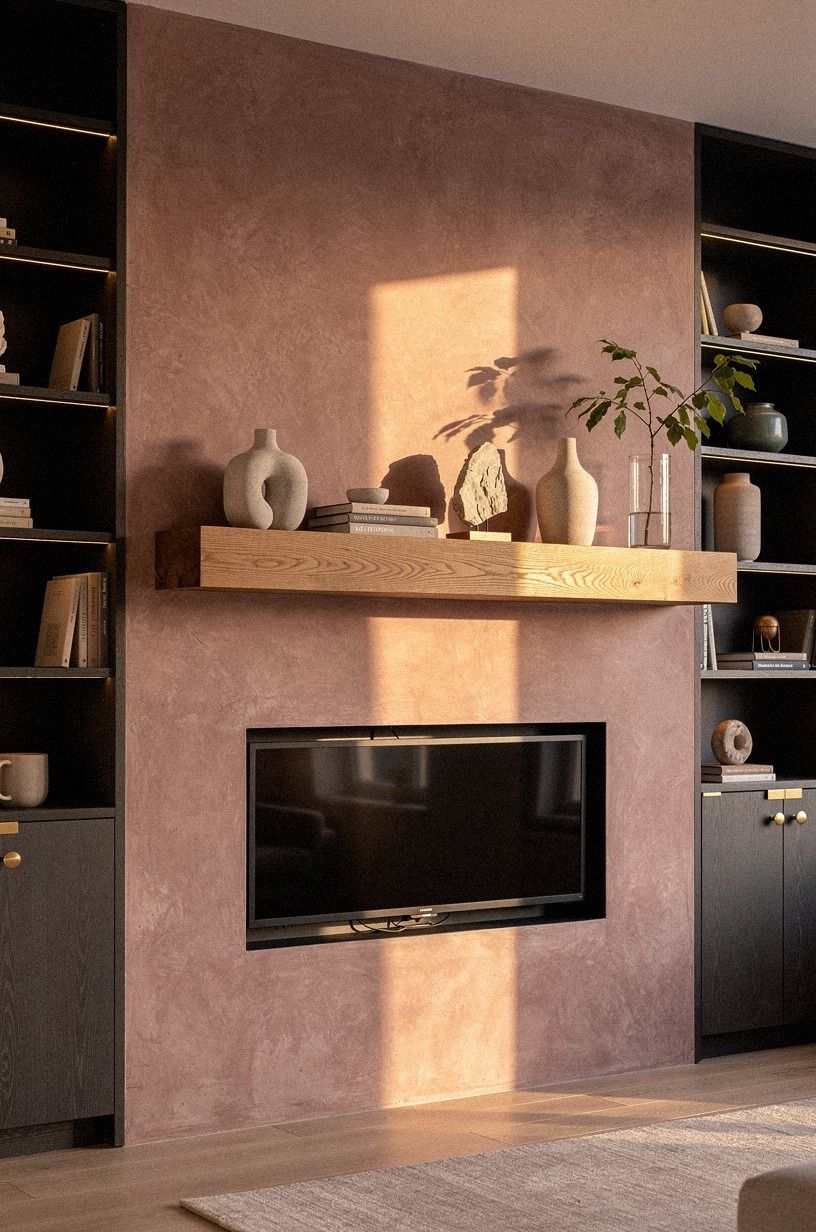
This was the move that made the fireplace stop looking like a one-off purchase.
8Add hidden brackets for a cleaner float
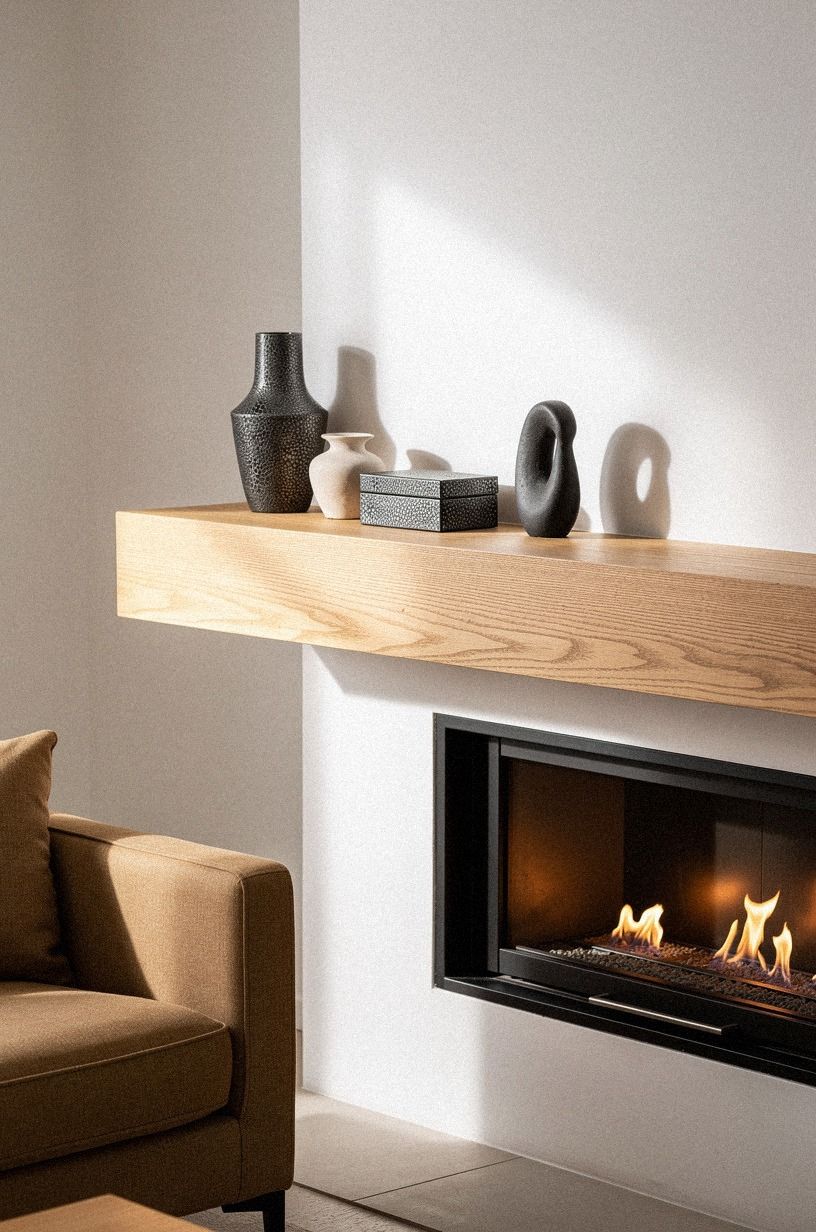
Hidden brackets were the technical detail that made the whole makeover believable. The first shelf had visible support that kept reminding me it was attached. The second one disappeared into the wall, and that clean underside shadow is what sold the floating effect from the first glance.
It looked lighter because it was visually lighter, and your eye stops reading the shelf as a block the second the support vanishes. Spend on the bracket block, not the bracket finish.
The steel rod itself is what holds the weight, not the trim.
I'd spend on this before I spent on decorative accessories. Real talk: cheap visible supports kill the illusion fast, even if the shelf itself is beautiful.
My installer used hidden steel mounting brackets sized for the oak depth, and the finished line looked almost weightless above the linear firebox. If you're rebuilding a shallow mantle decor setup and want the modern version, prioritize the mechanics.
This white mantel article shows how strong a shelf looks when the support disappears. Test the load rating before you commit; that's the boring part that decides everything.
9Hang one landscape slightly off center
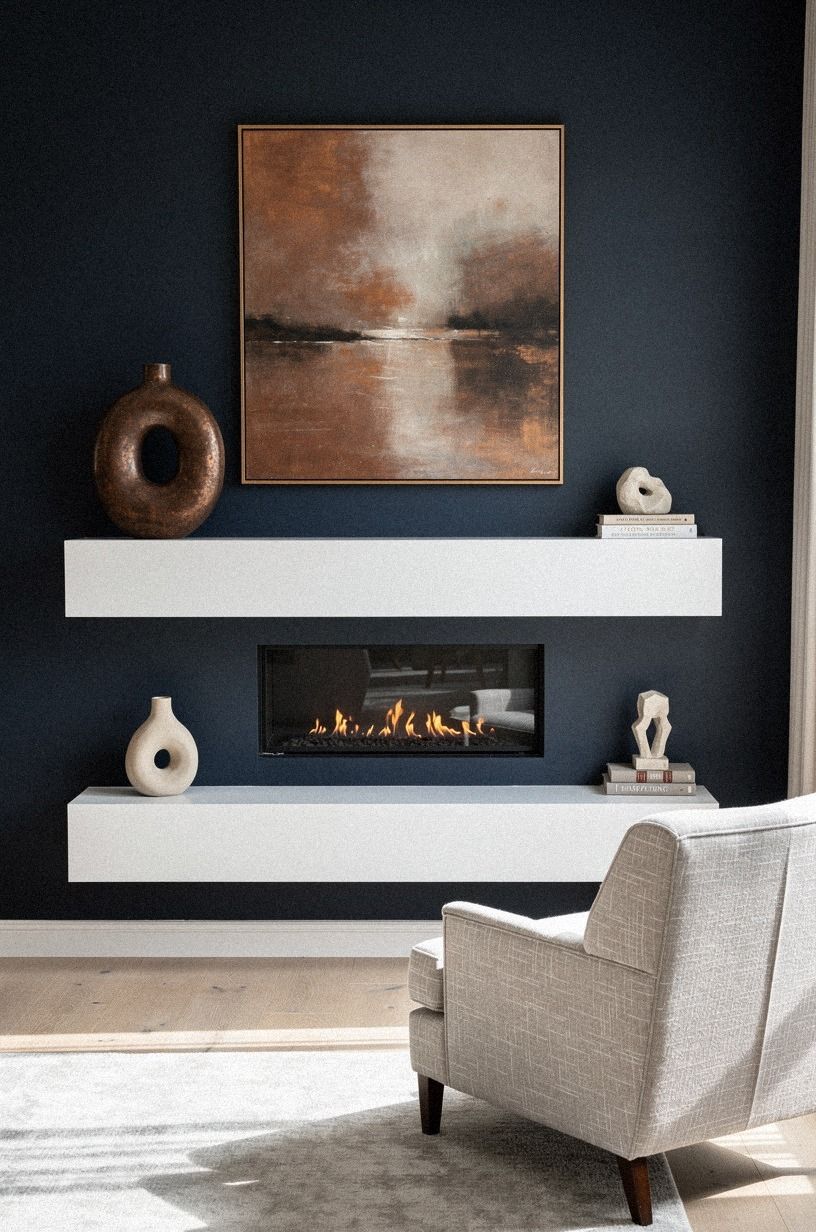
Perfect symmetry was making my fireplace feel more formal than I wanted. One landscape hung slightly off center fixed that fast.
The off-center shift was small, maybe a few inches, but it gave the wall a human rhythm that matched the cleaner shelf and kept the whole arrangement from turning stiff. I went with a 24x36 muted landscape in a thin maple frame, and the slight offset toward the heavier side of the room made the whole composition settle.
Try a paper template first so you don't drill twice.
I chose a muted landscape with soft charcoal, cream, and dusty green so it could sit above the firebox without shouting over the materials. And I let the art lean emotionally warmer than the room, because modern rooms can get cold if every line is too controlled. Why does that tiny offset work so well?
Because your eye likes balance more than it likes obvious perfection. If you're nervous about asymmetry, this black mantel contrast guide is a good reminder that a strong focal wall can take one small irregular move.
The dusty green specifically softens the cooler grays in the room.
10Stack small art behind low pottery
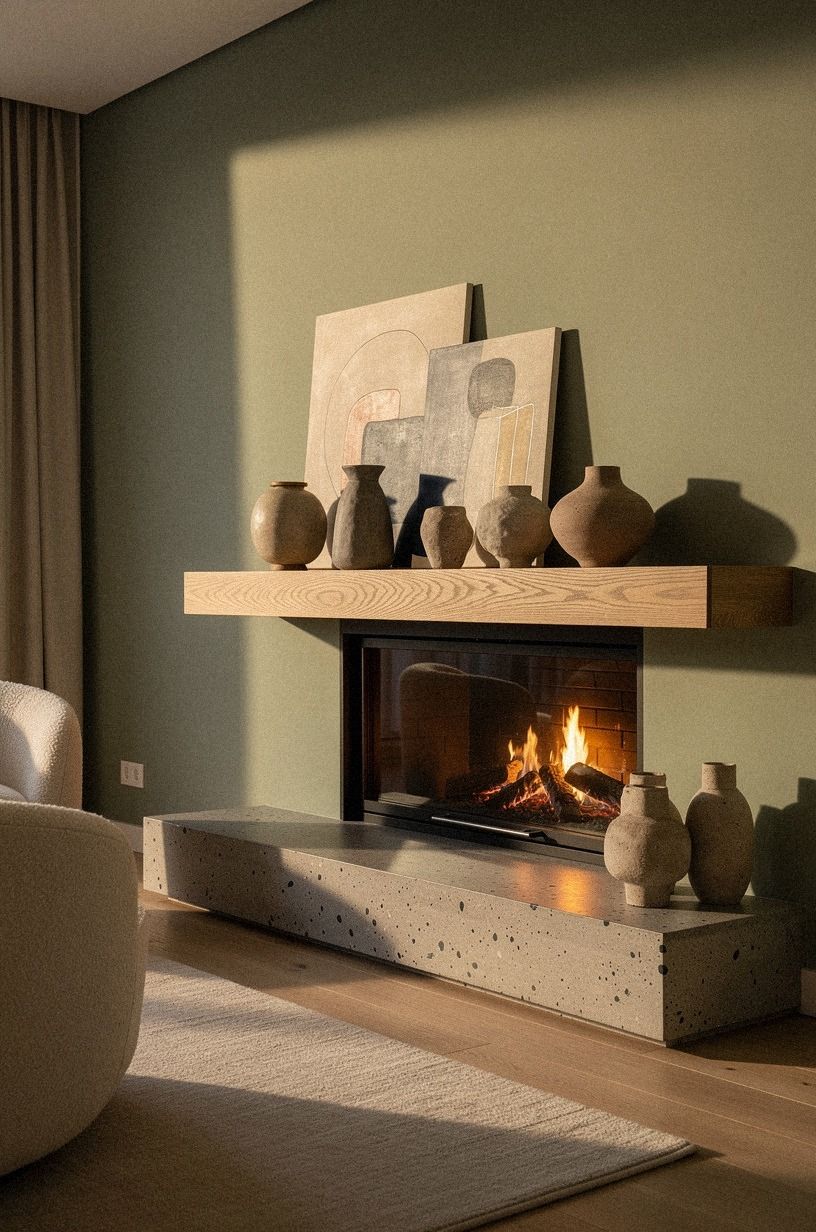
This was where the mantel started feeling layered instead of empty.
11Balance the ledge with one branch vase
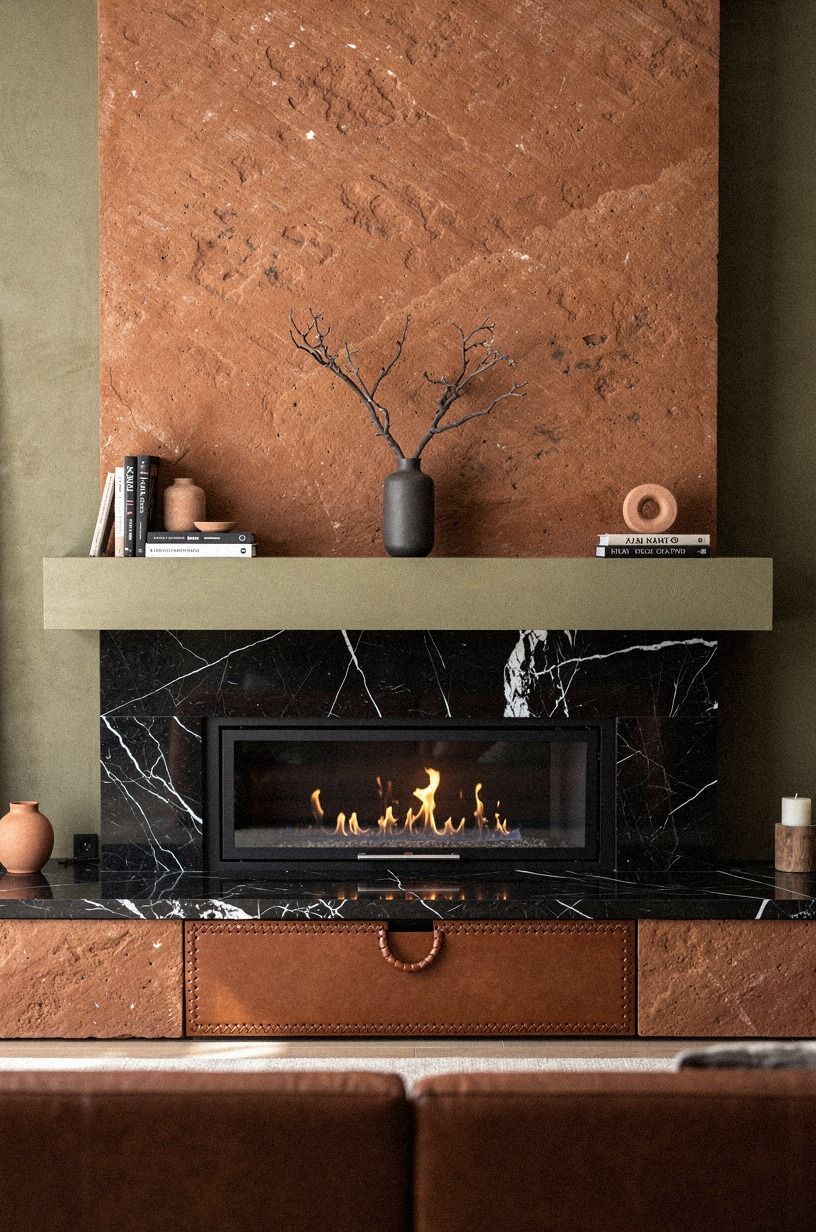
The whole ledge needed one vertical move, not three. I placed a single branch vase on one side and let that be the tallest thing touching the shelf line.
That one branch arrangement gave me lift, softness, and a little motion, which was especially important once the mantel itself went slimmer and straighter. I clipped olive branches from a neighbor's tree, and the soft silver-green against the warm oak was the calm contrast the wall had been begging for. A few eucalyptus sprigs would have read too sweet; the olive branch kept it grounded.
The asymmetry is the whole point.
I've clipped branches that bent a little instead of exploding outward, then trimmed them until the silhouette felt narrow enough for the room. A terracotta vase looked best here because it had enough body to ground the stems without turning glossy or precious.
But I kept the rest of the ledge low so the branch could do its job. If your fireplace wall feels too static, one vertical organic line can wake it up fast.
You'll see it right away! This cozy fall mantel guide shows the same principle with a warmer seasonal mood and a slightly deeper vase.
12Ground the hearth with woven log baskets
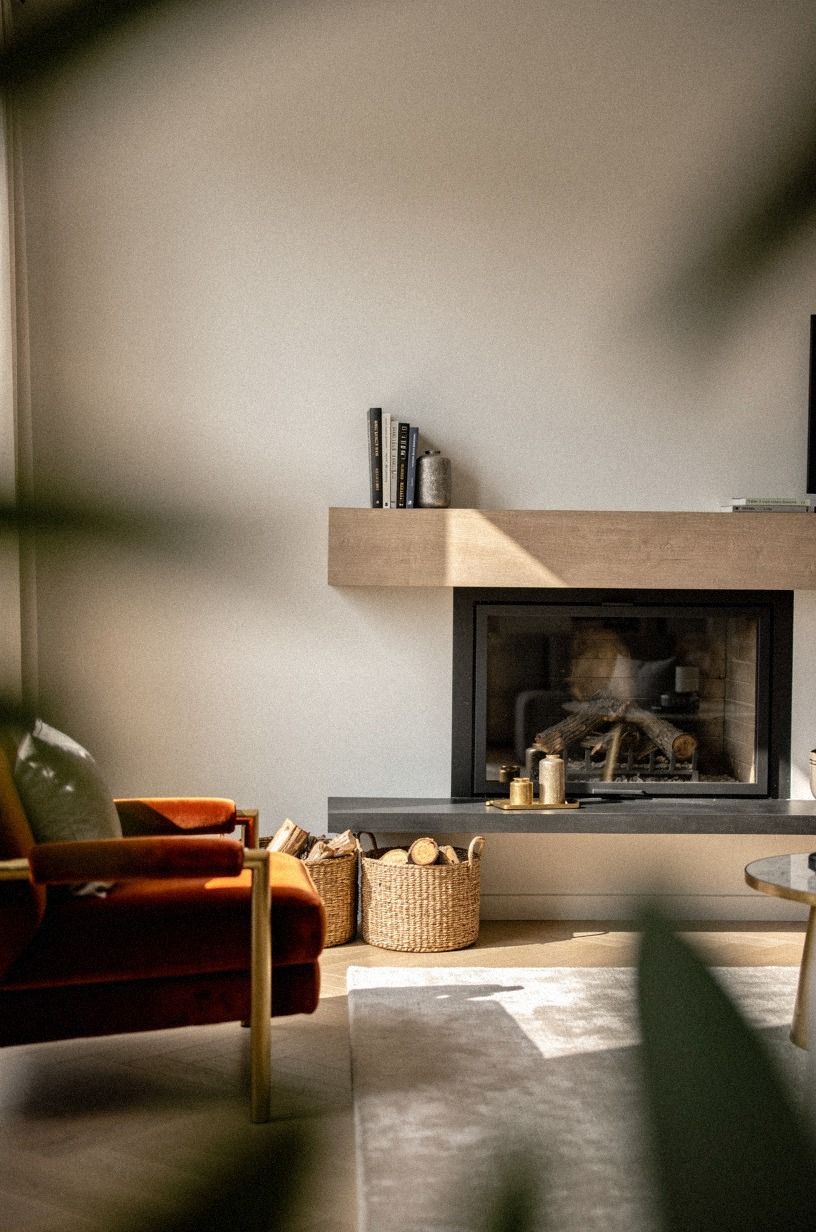
After the shelf was fixed, the hearth looked oddly unfinished. So I grounded the lower half with woven log baskets, and that was the moment the fireplace stopped floating away from the room.
The baskets gave the base warmth and texture without stealing attention from the cleaner mantel above. I used two matching seagrass baskets flanking the firebox, one for actual split logs and one for folded throws, and the symmetry calmed the lower half without feeling forced.
Split oak logs read cleaner than pine, and the bark held the heat longer when the fire was actually lit.
I went with a woven shape that felt architectural rather than floppy, then kept the logs stacked tight so the basket read as structure first and storage second. If your sofa sits around 35 to 40 inches deep, that lower texture helps the fireplace relate to the scale of the seating.
And if you don't burn logs, rolled throws work too, but the basket still needs presence. This modern fall mantel article reminded me that the hearth has to carry weight when the shelf gets visually lighter, and a good woven basket does exactly that work.
13Finish with warm sconces beside built-ins
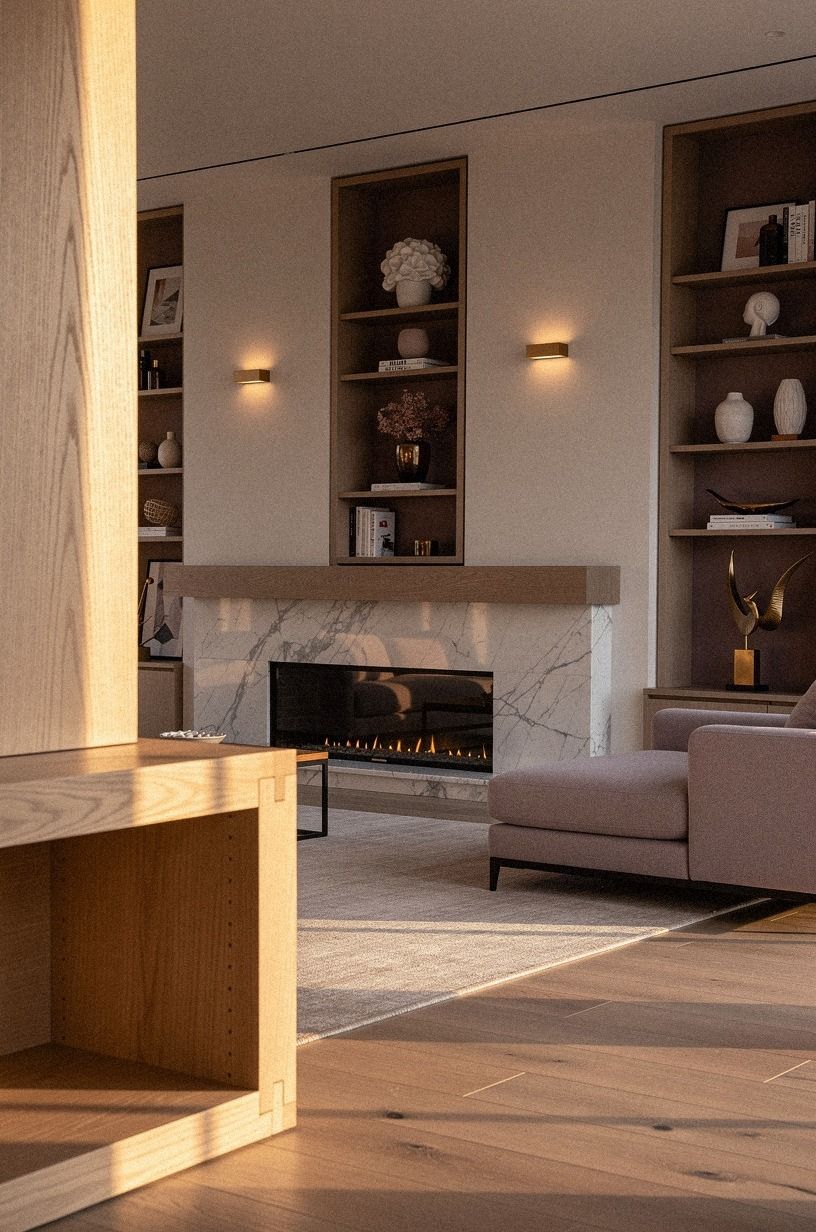
The last layer was light, and it changed the room more than any little object ever could. That's what the wall had been missing. I added warm sconces beside the built-ins so the mantel zone glowed after sunset instead of going flat.
My wall already looked decent by day. At night, it needed atmosphere, and the only honest fix was light, not another object on the shelf.
I used slim sconces with linen-toned shades and warm 2700K bulbs only, because cooler light makes oak and marble feel harder than they are. The final wall had a Carrara marble surround, a slim oak shelf, and those side lights pulling everything together in one soft pool.
And that was the first night the fireplace felt clean without feeling cold. If you want more examples of light doing the heavy lifting, this neutral minimalist mantel guide is a smart next read. Dim them to about 40 percent when no one's watching TV, and the room goes from pretty to intimate in a single tap.
Depth over bulk: How much it cost
I tracked the whole makeover because mantel projects feel mysterious until you break them into actual numbers. My exact spend was $642: $248 for the thinner white oak shelf, $110 for the hidden bracket hardware, $94 for the warm sconces, $76 for the woven log baskets, $42 for the maple art frame, and $72 across brass candlesticks, stoneware pottery, and a branch vase.
The free moves mattered too: painter's tape, stepping back to the sofa sightline, and removing half the objects I'd been using before. Hiding that threshold for $0 was the best dollar I never spent.
The other numbers that kept me honest were room-scale numbers, not shopping numbers. A typical sofa depth runs 35 to 40 inches, a coffee table usually lands around 16 to 18 inches high, and TV distance wants to live around 1.5 to 2.5 times the screen diagonal.
Once I looked at the mantel through those measurements, the wall stopped feeling like a decor problem and started feeling like a proportion problem. That's a much cheaper problem to solve.
Why did the Clean Float Reset finally work?
I think this makeover finally worked because I stopped asking the mantel to provide all the personality in the room. That'd been my bad habit for years. If the wall felt flat, I added another object.
If the shelf felt empty, I added height. If the fireplace still looked heavy, I added texture. None of that fixed the real issue, because the proportions were wrong from the start and the shelf was carrying more visual weight than the rest of the room could absorb.
The whole shift came down to one proportion fix, and almost everything else stopped fighting after that.
And once the shelf got thinner, every other decision got easier. The TV line made sense.
The empty wall around the firebox started feeling luxurious instead of unfinished. The branch vase looked intentional because it had one clear job.
Even the woven baskets on the hearth felt calmer because the shelf above was no longer shouting. I keep coming back to that because it is the real budget lesson here: the best upgrade was not buying more styling, it was correcting the line everything else had to follow.
The line came first; everything else just followed.
I also learned that modern doesn't mean sterile. That was the part I kept getting wrong.
A clean floating mantel still needs oak grain, soft brass, woven texture, and warm light or it turns into a showroom exercise. The nicest version in real life is the one that feels edited but touched by a person, and that's the one I'd chase again.
A branch with a crooked bend. A basket with a little weight.
A landscape that sits a few inches off center because perfect symmetry can feel dead in a room you live in every day. The whole wall should feel like a person lives there, not a catalog, and that's the part you can't shop for.
And honestly, the part that surprised me most was how much better the whole wall looked once I gave myself permission to leave space. Not blank-for-the-sake-of-blank space. Useful space.
Space around the firebox. Space under the art.
Space on the shelf itself. If your fireplace still feels busy after you style it, remove three things before you buy one more.
It'll teach you more than shopping will. You will learn faster, and the room will probably look better by dinner.
The Questions I Get Asked Most
What is the best Floating Mantel Ideas for a Clean, Modern Fireplace for a small living room?
The best version for a small room is a thin oak shelf with one low grouping and one vertical move, because clear proportion beats more decor every time. I'd pair it with an IKEA STOCKHOLM mirror or one muted landscape, then keep the hearth simple. This small mantel guide is a good scale check, and the same rule applies whether your room is 180 square feet or 480.
Where can I buy Floating Mantel Ideas for a Clean, Modern Fireplace pieces on a budget?
I'd start with IKEA, Target Threshold, and Wayfair for frames, sconces, and baskets, then look at Facebook Marketplace for oak shelves or pottery. Secondhand texture often looks better than boxed sets anyway.
If you want styling direction before you shop, this mantel styling guide helps, and the local ReStore is gold for seagrass baskets under $20. I scored a vintage brass tray there for $8 that ended up being the best move of the room.
How much does a Floating Mantel Ideas for a Clean, Modern Fireplace makeover cost?
A typical makeover costs about $100 to $300 if your shelf stays put and you're mostly editing, repainting, and restyling. The free wins are real: tape the sightline, remove clutter, restack the ledge, and move light closer. If you replace hardware and lighting too, you can climb past that fast.
For a slim white oak shelf with hidden brackets, $150 to $400 is the real range, and most of the styling you can do with what you already own. The bigger spend goes into the surround if you're rebuilding it, not the floating shelf itself.
Can I create a Floating Mantel Ideas for a Clean, Modern Fireplace on a budget?
Yes, and the cleanest moves are usually the cheapest. You can thin out the styling, shift the art, shop your house for a branch vase, and add baskets or candlesticks one at a time.
I'd spend on bracket hardware before I spent on more small objects. Start with painter's tape and a free evening, and you'll know what the wall actually needs before you spend a single dollar. Most of my favorite updates cost less than dinner out.
Is a Floating Mantel Ideas for a Clean, Modern Fireplace worth it in a small space?
Yes, because a lighter shelf makes a small room feel less crowded. When the fireplace line is slimmer and the wall around the firebox stays open, your whole seating area reads cleaner.
Keep the object count low, then let the oak shelf and woven baskets do the grounding. It's the cheapest square-footage gain you'll get this year, and it works in rentals too if you focus on leaners and plug-ins.
Same shelf move also helps a tall ceiling feel a little less cavernous because the eye lands lower.
Is Floating Mantel Ideas for a Clean, Modern Fireplace a good idea for a rental?
Yes, if you focus on removable layers. Use a lease-safe shelf only if your landlord allows it, lean art, add plug-in sconces, stack low pottery, and use baskets for the hearth.
A command-strip leaner mirror can sit above the firebox without a single drill hole, and plug-in warm sconces avoid the electrician altogether. If the wall setup is awkward, this TV-and-mantel guide gives renter-friendly spacing ideas.
The whole job should leave the deposit untouched.
Sightline over symmetry: Where I'd Start First
If I had to pick one, I'd start with the thinner oak shelf. A heavy profile makes every frame, vase, and sconce work twice as hard before the wall can breathe. Pin that move for later and trust the lighter line first!
Once the line is right, the room does most of the styling for you. That's the part nobody tells you before you start, and it's why I never go back to thick beams. Even my renter friends use the same rule by leaning art instead of mounting it.