17 Harvest & Thanksgiving Mantel Ideas That Make Guests Stay Late
26 june 2026I've styled a lot of late-fall mantels, and the ones that survive a house full of guests, a wine spill, a toddler with a pomegranate, and a six-hour turkey aren't the prettiest setups from the start. They're the ones that started with one strong anchor and let everything else fall in around it. If your mantel looks chaotic the moment you load it up, the issue isn't your props. It's the absence of a center of gravity.
These 17 ideas are how I make a harvest mantel feel generous without feeling like a craft store exploded. Most cost under $60 total.
A couple of the showstoppers climb into the $200 range, and I've flagged which. The short answer on budget: a complete refresh runs $150 to $400 for most living rooms, and you can skip half the props if your mantel already has a strong wall color behind it (more on Sherwin-Williams Evergreen Fog in a minute).
Quick confession: the first year I styled a harvest mantel, I bought one of every pretty thing. Twelve little gourds, three signs, a garland that didn't match the garland next to it.
It looked like a farmers market on a cart. Then I pulled everything off, started with a horn of plenty, and built back in. The lesson stuck: anchor first, layer second.
Pin this as your before-you-start checklist, and you'll save yourself a Black Friday impulse run.
- anchor the mantel with a horn of plenty
- crown the firebox with a wheat sheaf wreath
- cluster heirloom gourds beside amber tapers
- lean a Give Thanks sign behind foliage
- trail Indian corn bundles along one edge
- why does a cranberry garland always look more expensive than it costs?
- stack mini pumpkins on a burlap runner
- frame the mirror with oak leaf garland
- float pillar candles in copper apple cups
- can pomegranates do the work of a $40 floral arrangement?
- hang a vintage scale above the hearth
- tuck plaid ribbons into wheat bundles
- layer cranberries inside glass hurricanes
- anchor one side with a wooden apple crate
- lean a Pilgrim era lantern beside dried corn
- cascade maple leaves down the mantel corner
- crown the display with a thankful tree branch
- Farrow & Ball vs Benjamin Moore: which paint anchors the mantel wall?
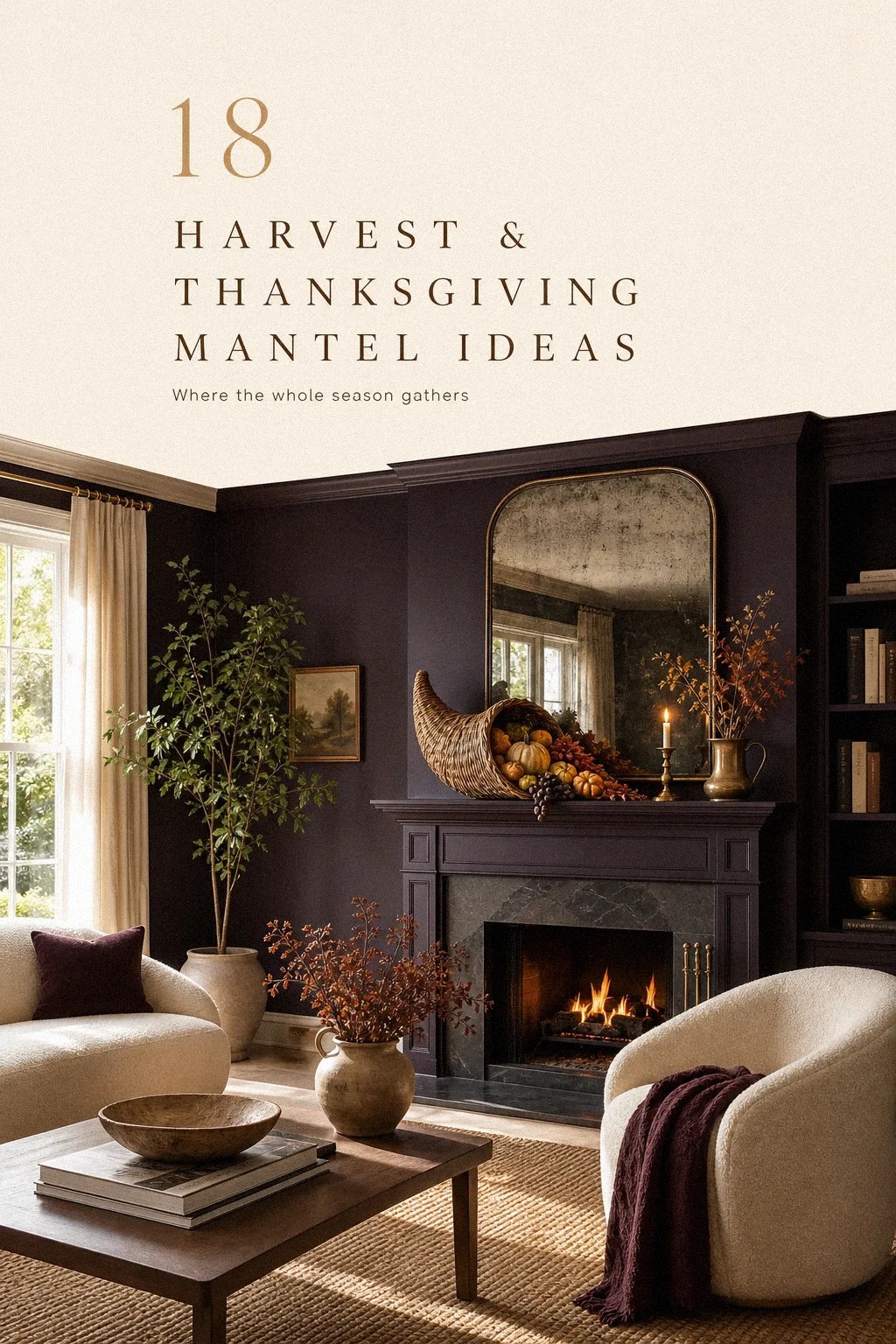
1anchor the mantel with a horn of plenty
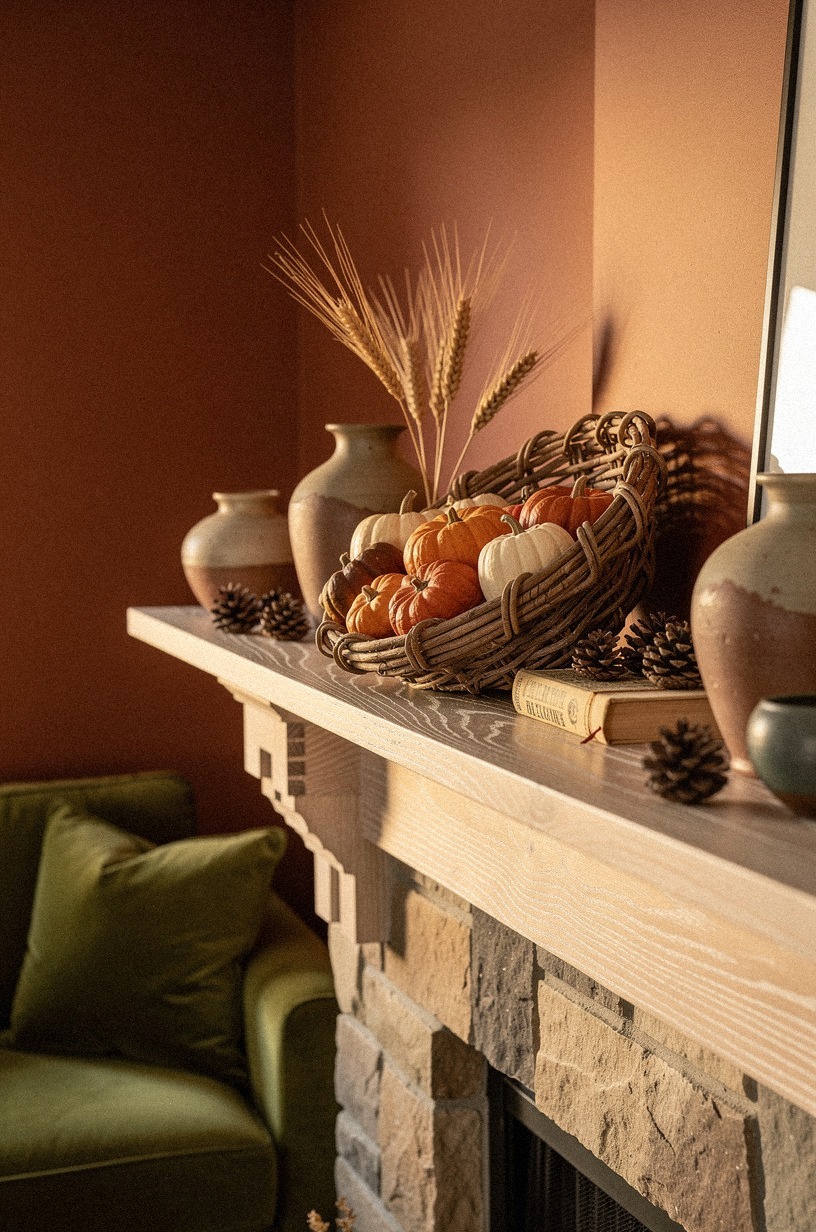
The horn of plenty is the single move that does the most work on a harvest mantel, and it's the move most people skip because it sounds old-fashioned. Don't skip it.
A woven cornucopia, about 18 to 24 inches long, sits off-center on the mantel and acts as a visual anchor that everything else orients around. Stuff it with three or four miniature pumpkins in cream and sage, a few sprigs of dried wheat, three or four pinecones, and one trailing vine of preserved eucalyptus so the eye has somewhere soft to land.
The version I keep coming back to is a Target Threshold woven cornucopia at about $25, oversized enough to read from across the room. Place it a third of the way in from one end, not dead center.
The asymmetry is what makes it feel styled, not staged. Pin a sprig of wheat to the front lip with floral wire if the arrangement wants to lean toward one side.
Free fix and free.
If you want a higher-end version, West Elm's harvest horn (around $80) runs the same shape in a tighter weave. Worth it if you're styling the rest of the room around a warm neutral palette and you want one piece to last a decade. Honestly, either version is fine.
The composition is doing the work, not the price tag.
2crown the firebox with a wheat sheaf wreath
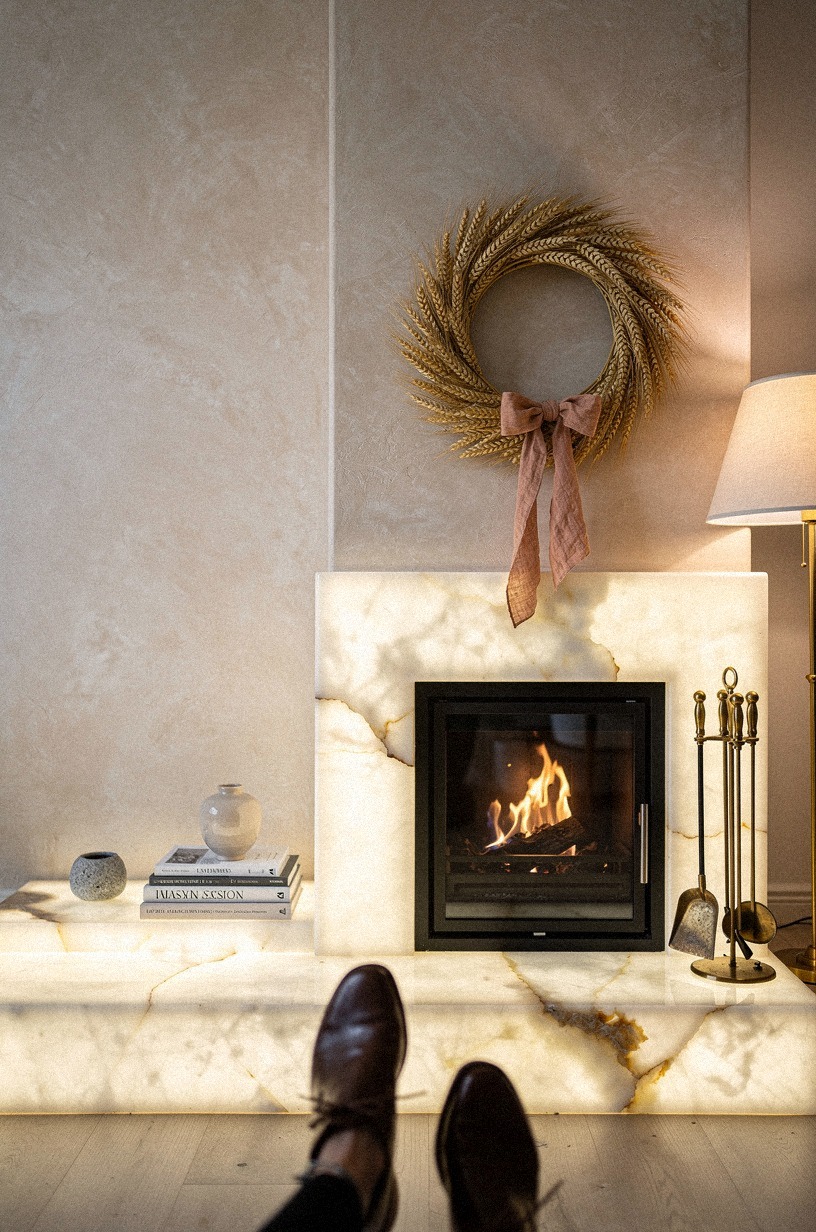
A wheat sheaf wreath hung just above the firebox is the harvest equivalent of a Christmas wreath in December.
3cluster heirloom gourds beside amber tapers
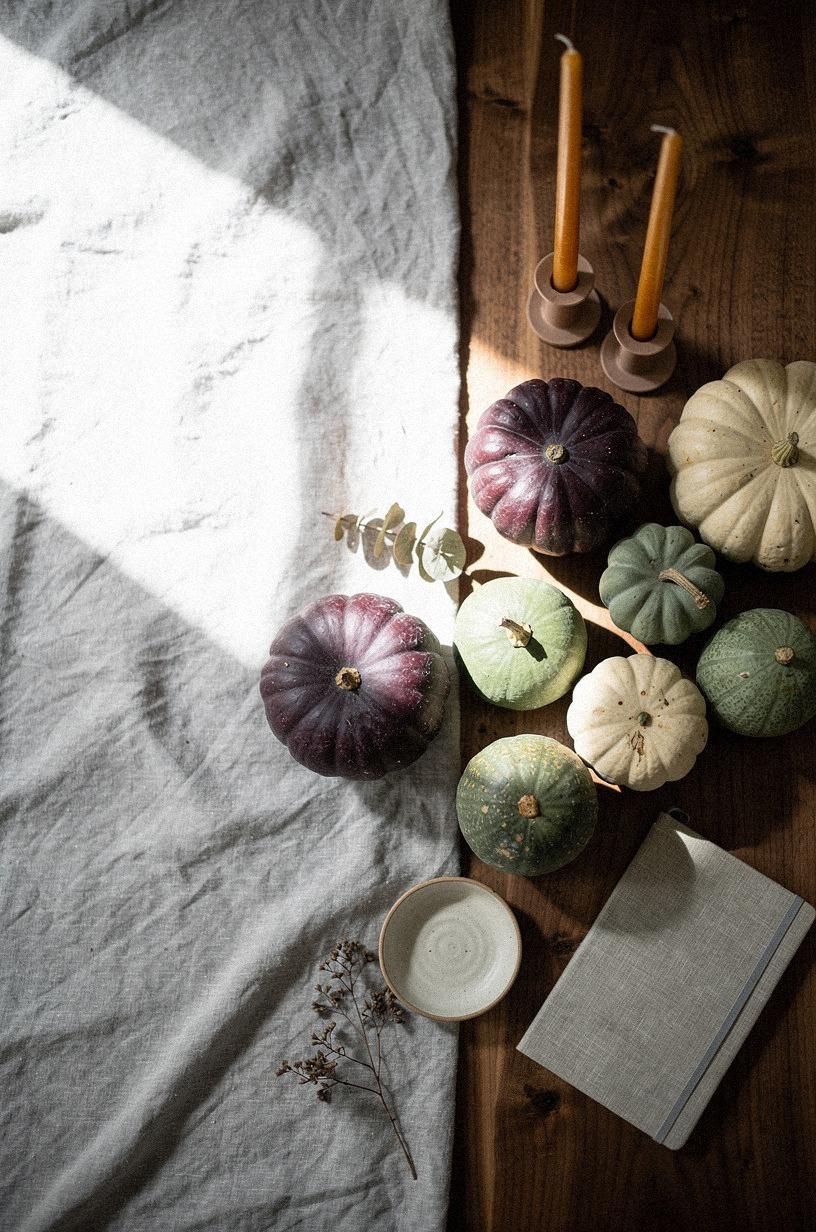
Heirloom gourds in plum, sage, and cream are the unsung hero of a harvest mantel. They photograph beautifully, they don't wilt the way pumpkins start to by Thanksgiving weekend, and they cost about $1.50 a piece at any farmers market in October. Buy eight to twelve.
Cluster three or four of them on the mantel at one end, at varying heights, and pair with two amber glass taper candles in slim brass holders. The detail most people miss: the cluster should look like it just landed there, not like it was arranged by a copywriter. Slightly off-balance.
One gourd tipped on its side. The candle flame doing the styling.
Worth it!
Color story to commit to: plum (the dark teardrop-shaped ones), cream (the lumpy Cinderella-shaped ones), and sage (the small warty ones). That's your trio.
Anything else reads as October costuming. If your table needs the same palette, my dining room centerpiece ideas carry the harvest palette to the room below.
Easy!
4lean a Give Thanks sign behind foliage
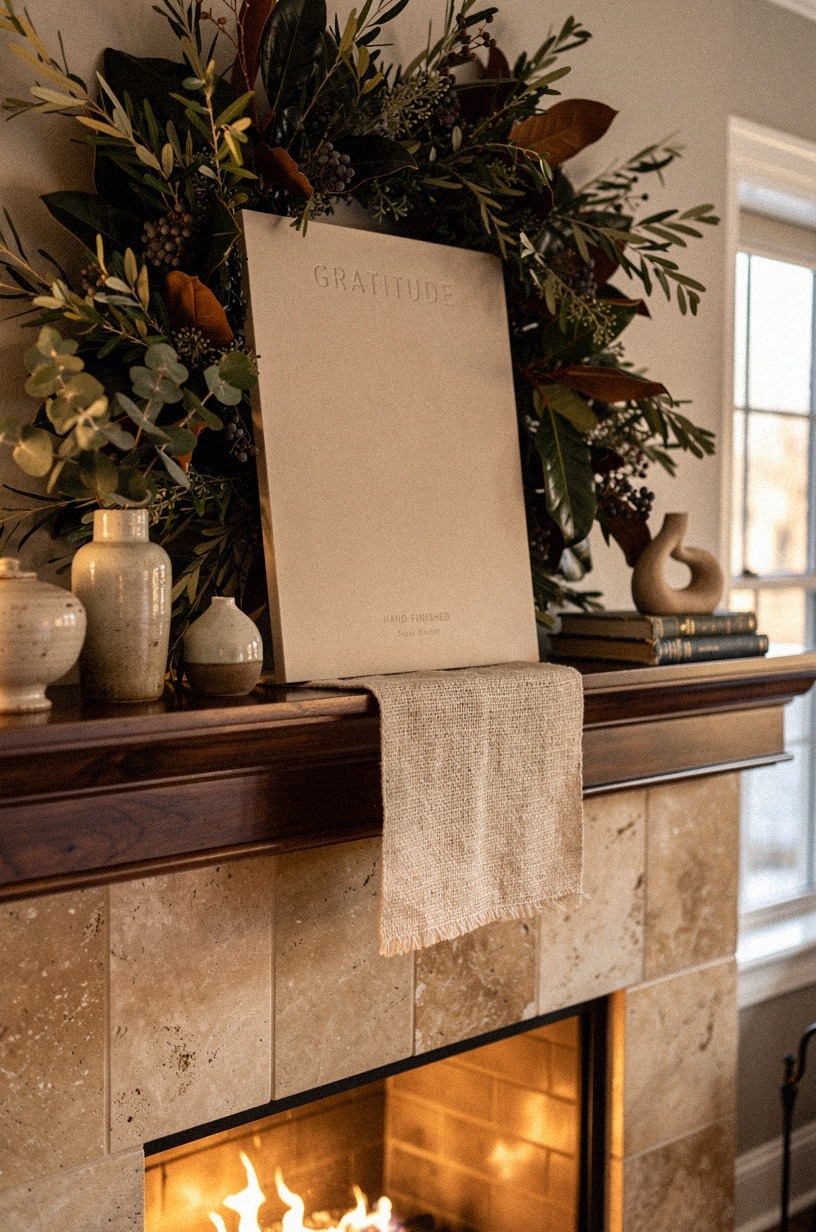
A gratitude plaque, leaning against the wall instead of hung, is the move that signals harvest without being a craft-store slogan. The best versions are smooth, hand-finished, and either plain wood or Farrow & Ball Hague Blue with the words just visible in chalky white. About 14 by 18 inches is the right scale.
The lean is what gives it weight. The plaque isn't a wall fixture, it's a piece that's been set down temporarily, which is exactly the energy a late-fall mantel wants. Frame the back of it with a low layer of preserved oak leaves, eucalyptus, or magnolia, so the foliage softens the rectangle behind it.
Free swap if you don't want to buy one: take a chalkboard frame, paint the words yourself in chalk, and lean it the same way. Honestly, the homemade version usually reads more honest.
And the Farrow & Ball Hague Blue No.30 paint reference is real, by the way, the same dark navy-green that lives in a third of every well-styled fall Pinterest pin right now. If you want the same hue in a deeper room, my dark cozy bedroom guide runs that exact palette on four walls.
5trail Indian corn bundles along one edge
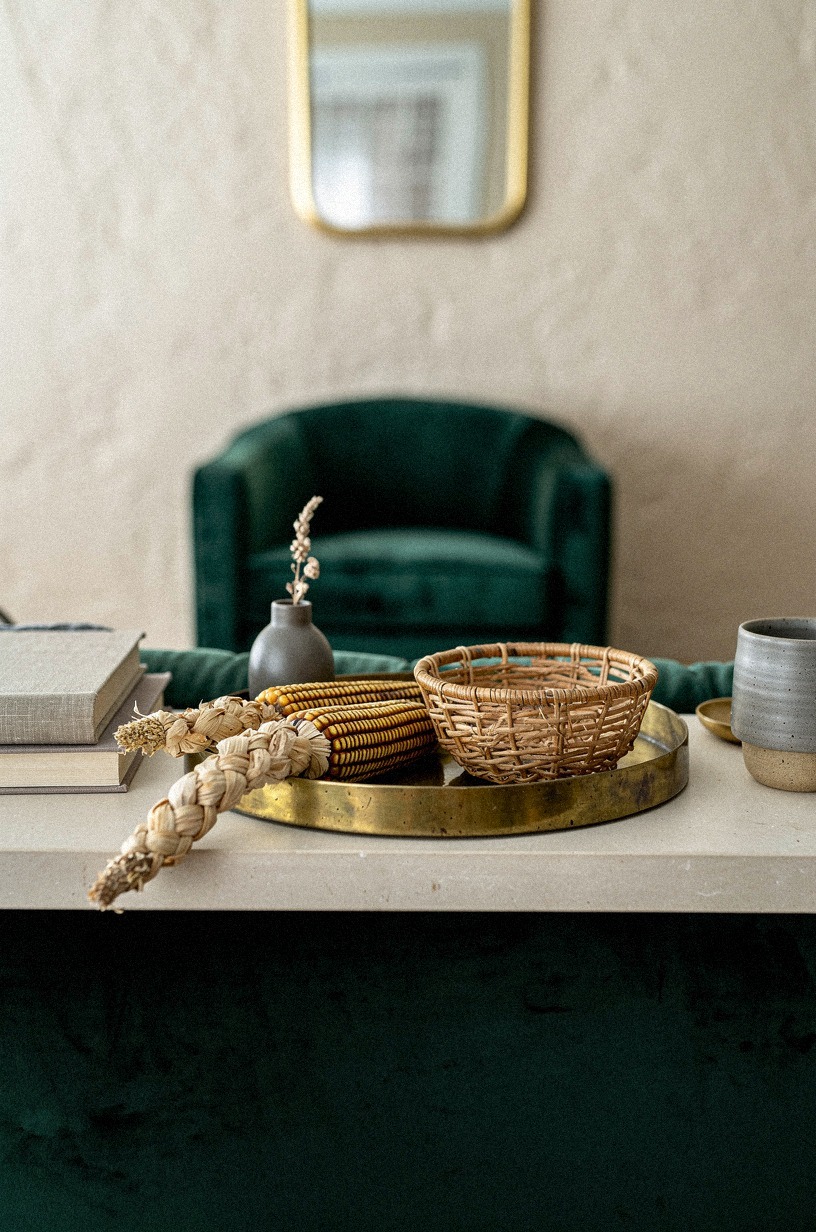
Indian corn, the kind with the deep burgundy and cream kernels, runs about $4 a bundle at farm stands and lasts the entire season if you keep it dry. Tuck three or four small bundles along one edge of the mantel, stems tucked under a low garland or a piece of twine, kernels fanning outward.
The visual effect is a slow trail of color, like a vine. It's the harvest equivalent of a string of bistro lights: subtle, repetitive, and it ties the whole edge together. Free tip: if your bundles come tied with orange plastic string, replace it with a length of natural jute twine.
The orange string is what tells you a mantel was styled in a hurry.
If you can only find one or two bundles, double down on them. Three bundles on one side of the mantel and nothing on the other reads like you ran out.
Two bundles, mirrored at each end with low greenery in between, reads intentional. If you want the front door in on the harvest moment too, my fall wreath roundup runs the same warm palette outside.
6why does a cranberry garland always look more expensive than it costs?
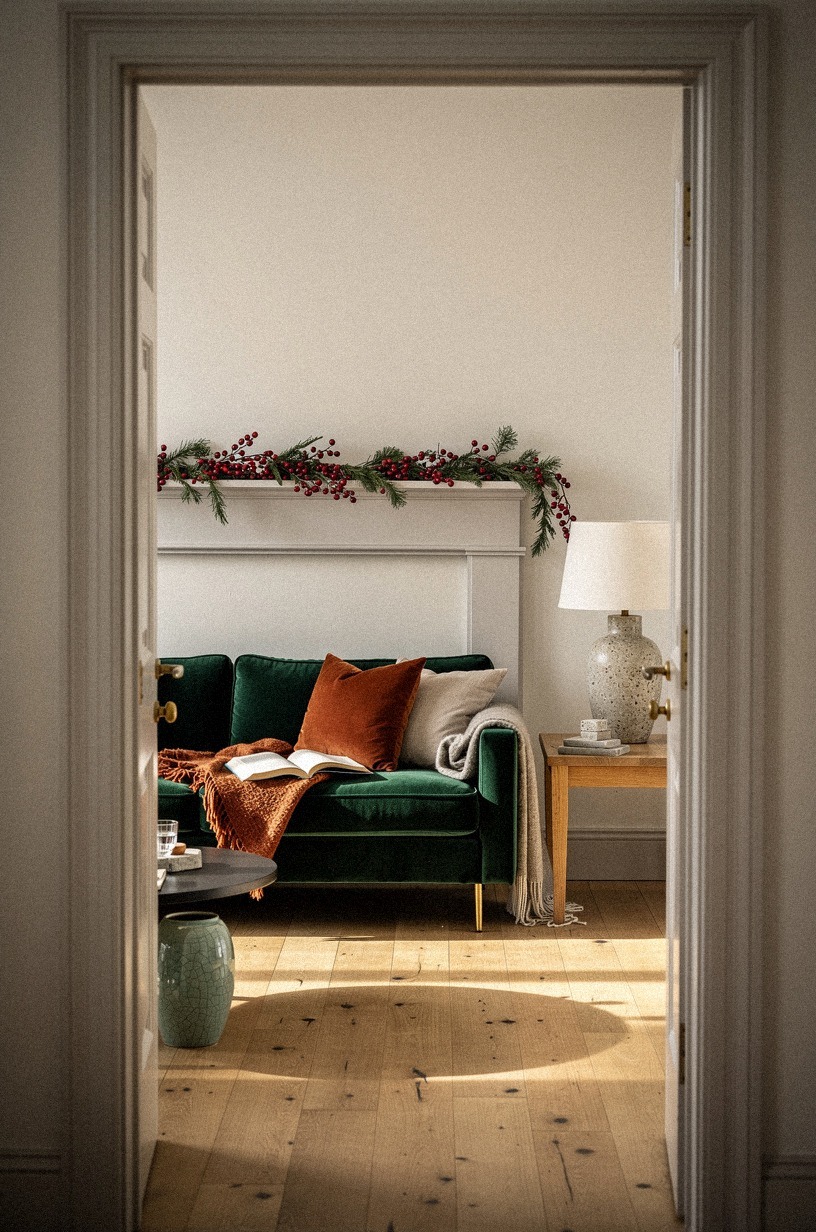
A cranberry-strung garland draped over the front edge of the mantel is the move that's been in designer portfolios for the last six falls and refuses to leave.
7stack mini pumpkins on a burlap runner
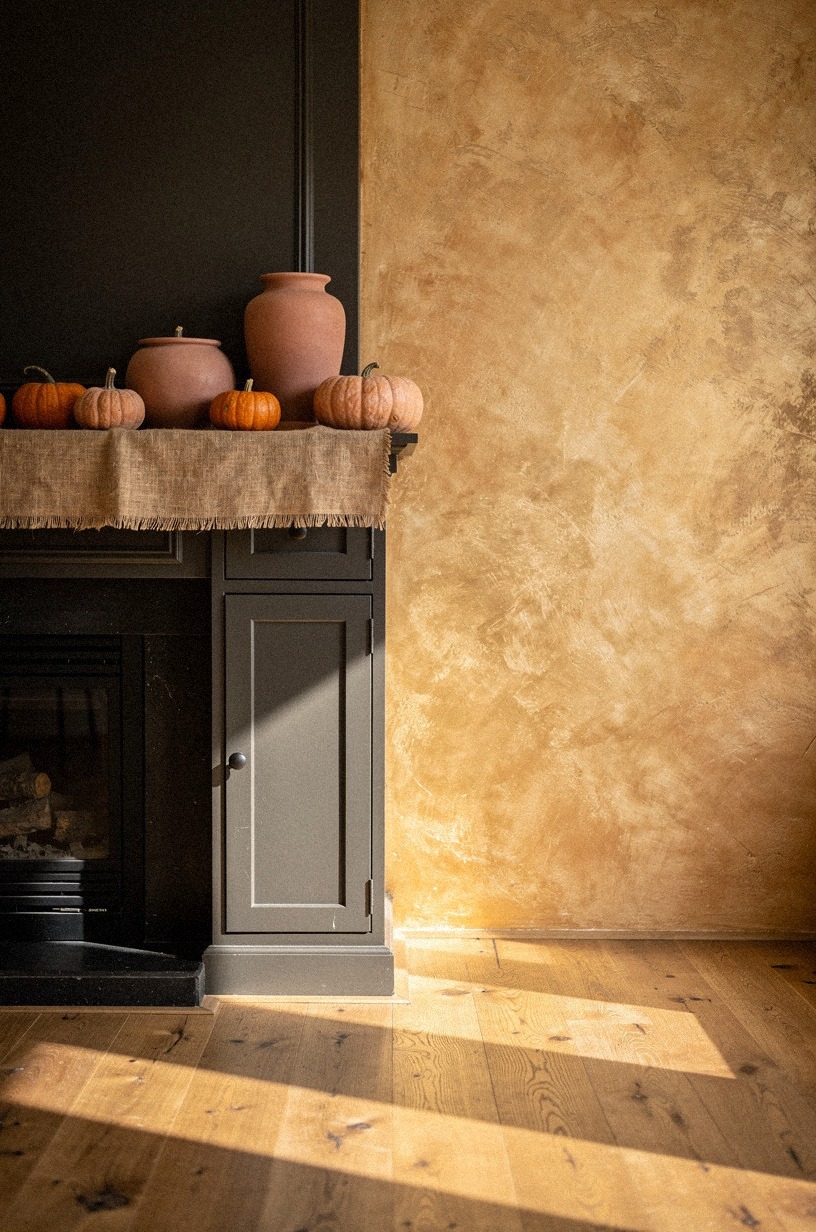
A burlap runner down the center of the mantel solves two problems at once: it gives you a defined zone for the styling, and it gives every object a slightly raised stage to sit on, which makes the whole composition read from across the room. Cut the runner about 10 inches wide and the full length of the mantel.
Stack four or five mini pumpkins along the runner in cream, soft white, and pale orange. The stack is key, not the line.
A pyramid of three small pumpkins next to a flat row of one larger pumpkin reads intentional. A line of identical pumpkins reads like a school project.
Burlap frays. To keep it from looking ragged by Thanksgiving weekend, fold under the cut edges about a quarter inch and run a line of fabric glue along the fold.
Five minutes of work, and the runner survives the season. Worth it if you plan to keep the runner in storage for next fall.
If you want a softer version, a raw Belgian flax linen runner in oatmeal does the same job with a slightly dressier read. And if the whole room could use that same lived-in feel, my warm minimalist bedroom roundup carries the same restraint into a bedroom.
8frame the mirror with oak leaf garland
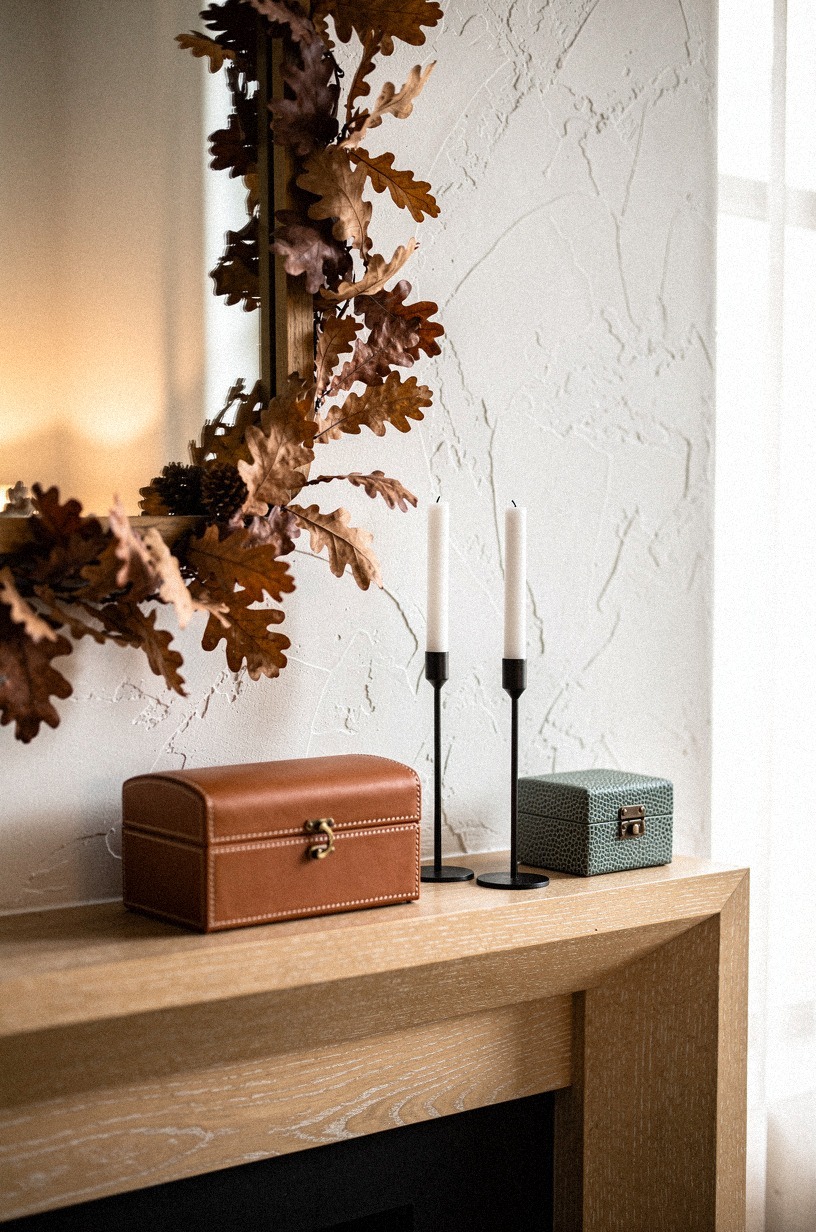
If you have a mirror above the mantel, this is the move.
9float pillar candles in copper apple cups
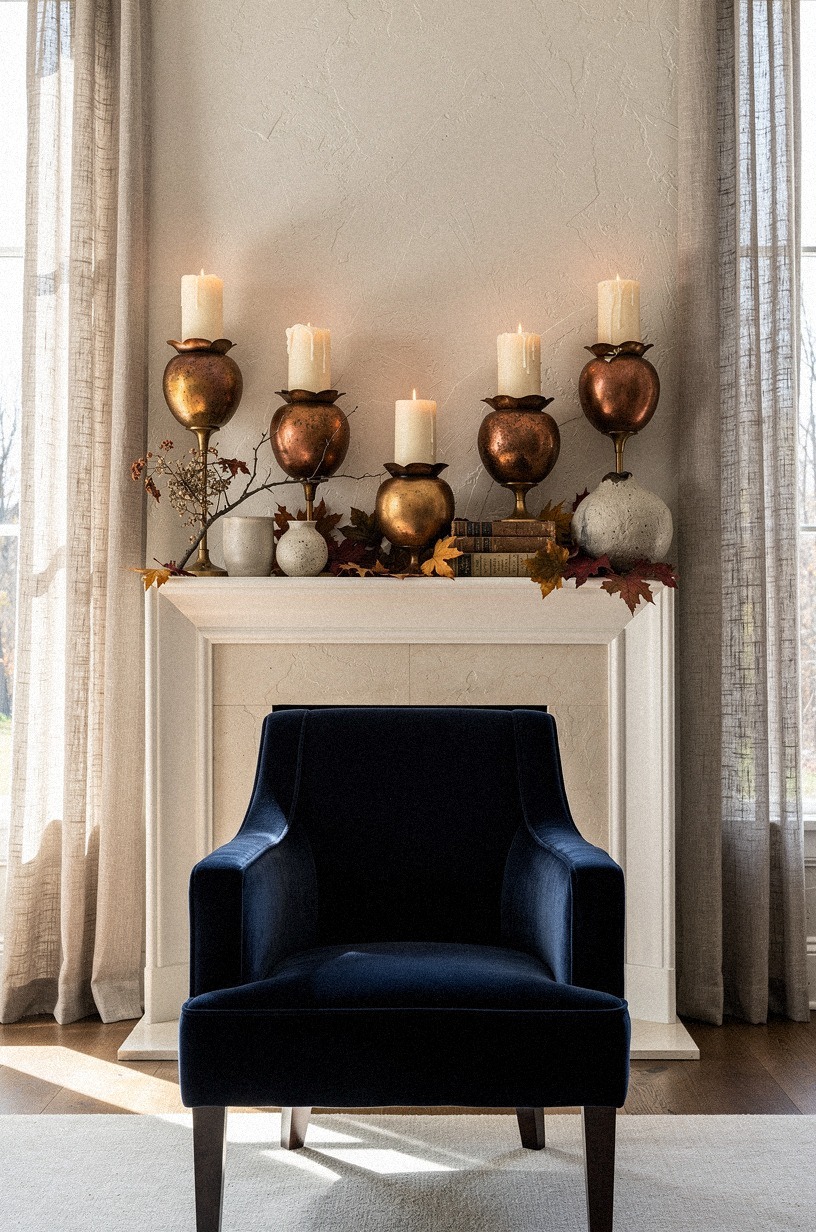
Pillar candles in hand-formed copper apple cups with aged bronze patina are the move that makes a mantel feel like it belongs to a grown-up. The candlelight bounces off the warm copper, the patina deepens the harvest palette, and the whole thing reads as one intentional design choice rather than a collection of objects.
Three cups, spaced unevenly across the mantel, in ivory pillar candles about 3 inches in diameter. Buy the cups from a small pottery studio on Etsy (about $35 to $50 each) or from Terrain if you want the easier path.
The handmade versions look more honest and age better over the years. And they pair beautifully with the cozy minimalist bedroom guide when you want the same restraint in the bedroom.
Warning: don't light the candles and walk away. The copper gets hot.
If you have kids, a cat, or a guest who'll knock something over, run the candles as decoration only. The composition works unlit, and the unlit version means you can leave the room without the smoke alarm ruining Thanksgiving dinner.
10can pomegranates do the work of a $40 floral arrangement?
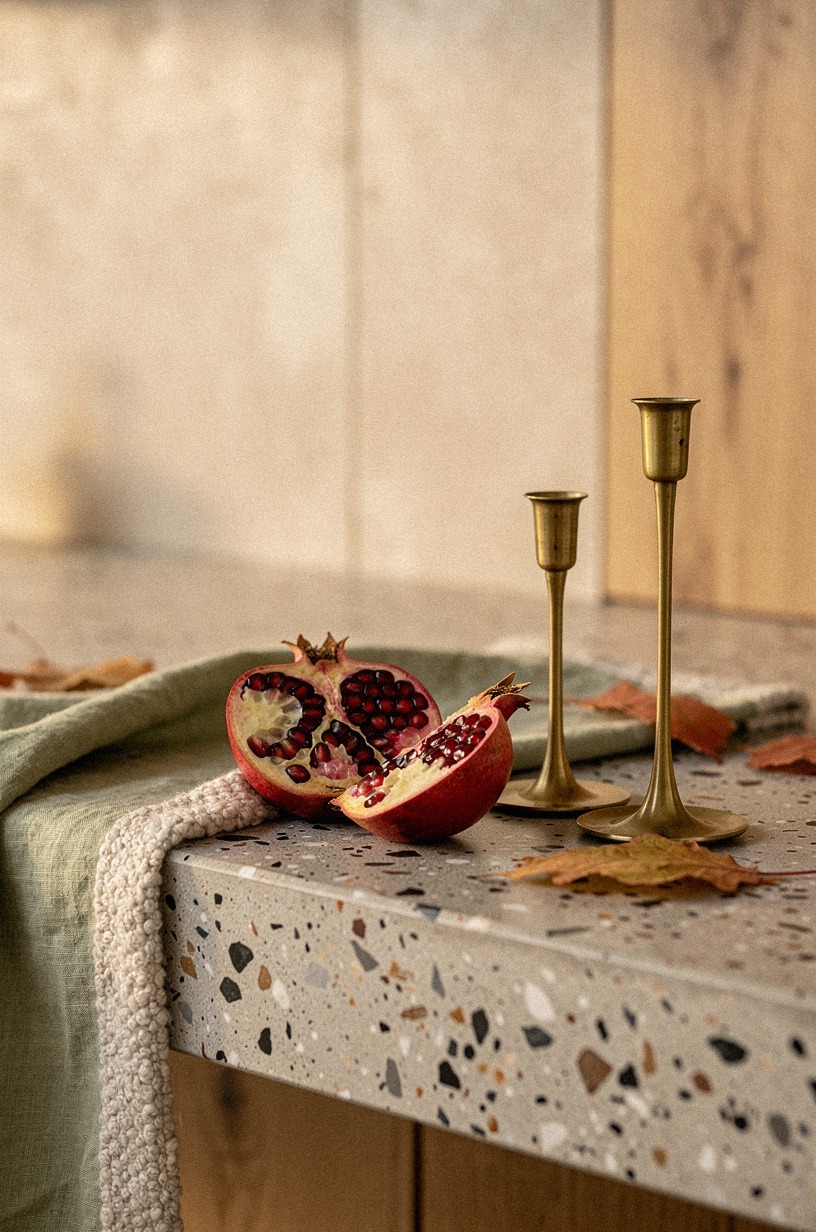
Split pomegranates between slim brass candlesticks is the move that adds the deepest red in the harvest palette without spending anything.
11hang a vintage scale above the hearth
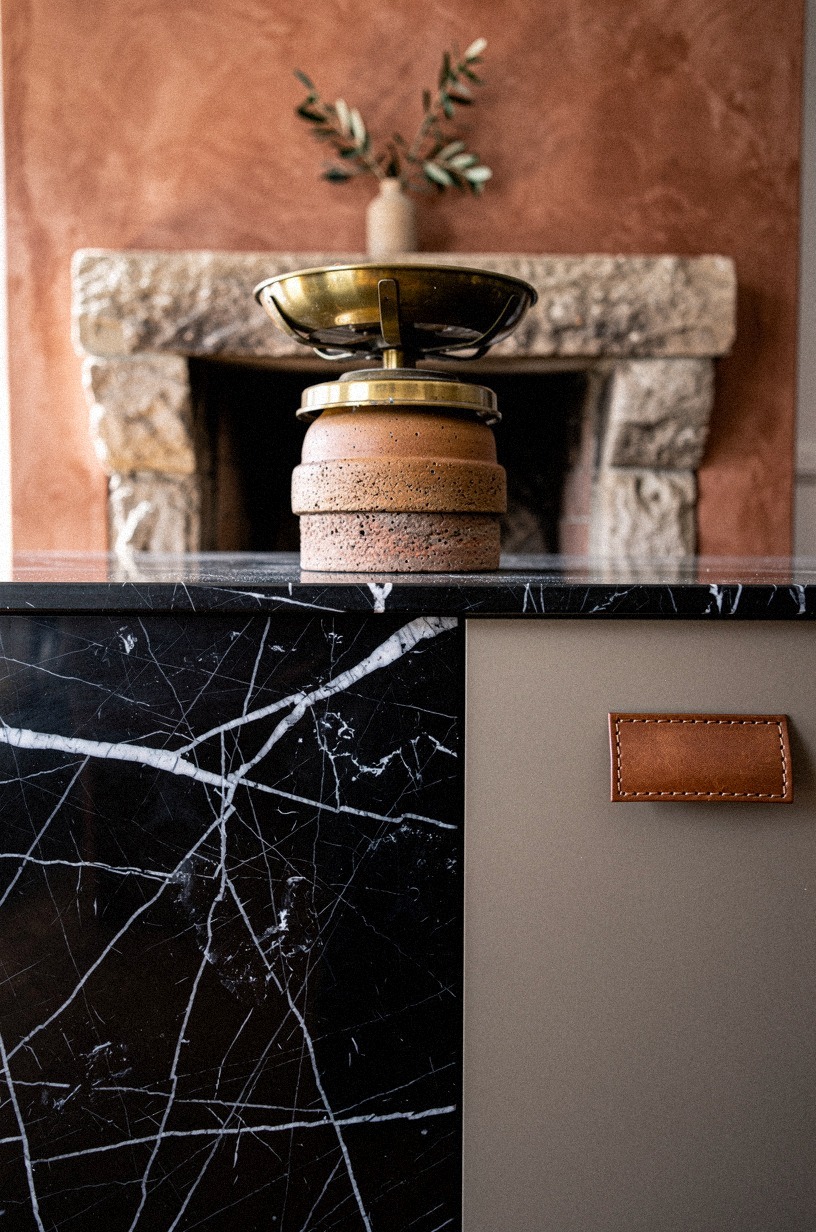
A vintage brass harvest scale hovering above the hearth reads like a gallery piece. The combination of Nero Marquina black marble with white veining on the hearth and the warm brass of the scale is the kind of pairing that justifies the whole composition. About 18 to 24 inches tall is the right scale to hang above the firebox without crowding it.
Source: estate sales, Facebook Marketplace, and Etsy vintage dealers. The real ones run $80 to $250 depending on age and patina.
Faux versions are about $30 and look fine if you don't mind a little plastic in the casting. Free tip: search "vintage brass harvest scale" specifically, not just "vintage scale." The harvest-scale category has the right shape (the round dial with a small hanging tray).
Position about 8 to 12 inches above the mantel line, slightly off-center to one side so it doesn't compete with the horn of plenty on the opposite end. If you're rebuilding the whole room and want a heavier hearth, my fireplace styling guide covers the same logic with a different focal point.
12tuck plaid ribbons into wheat bundles
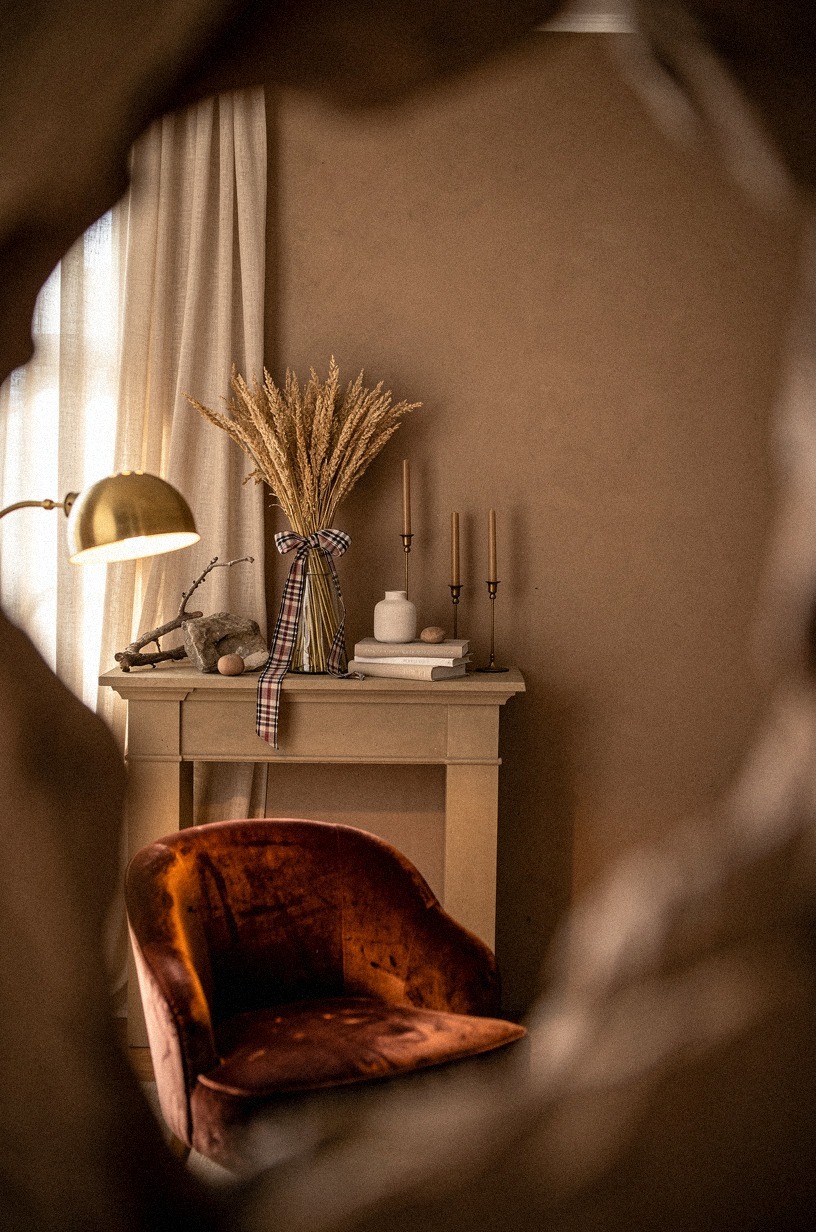
Plaid ribbons tucked into tall wheat bundles are the move that adds pattern without going kitsch. Clay-painted walls behind the mantel give the wheat bundles a soft background, and the ribbons add just enough texture to keep the wheat from reading as a single-tone block.
The plaid: think narrow buffalo check in rust and cream, not wide holiday plaid in red and green. Tie a 14-inch length of ribbon around each bundle, leave the ends trailing, and let one or two pieces curl naturally. If you're using three bundles, vary the ribbon length slightly so the rhythm isn't mechanical.
Budget-conscious version: paint your own 1-inch ribbon with watercolor in muted rust and cream. Free if you own the paints. Looks handmade in the right way, not the wrong way.
And the ribbon will hold its color longer than you'd think, even through the holiday season.
13layer cranberries inside glass hurricanes
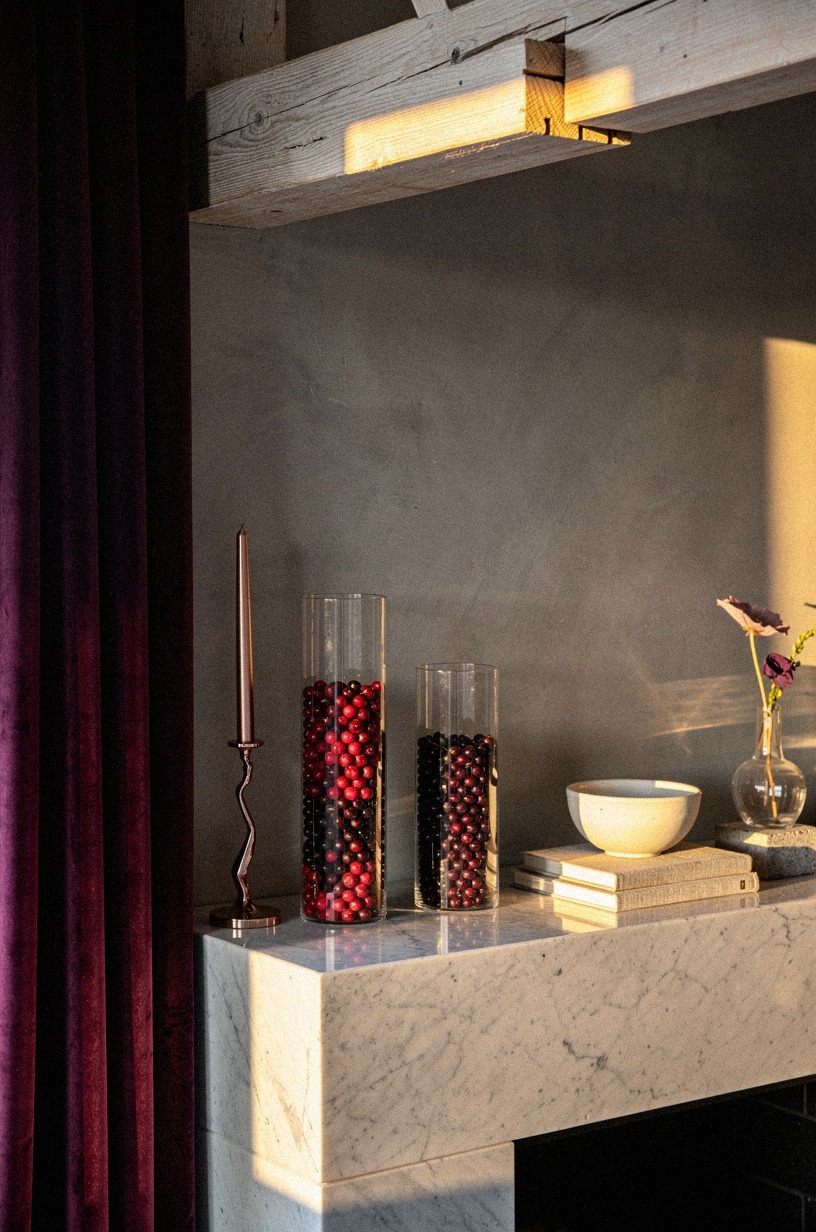
Tall glass hurricanes filled with layered cranberries along a Carrara marble mantel with subtle grey veining are the move that looks expensive and costs $14. Buy three hurricanes, 12 to 16 inches tall, in clear glass.
Fill each one a third of the way with fresh cranberries. Top each with a slim ivory pillar.
The reflection of the cranberries in the marble is what makes this read as a designer move. The marble picks up the deep red, the glass refracts the lamplight, and the whole composition glows at night in a way that flat surfaces can't match. Worth the fourteen dollars, easy.
Free swap: if you don't have hurricanes, use any clear glass vessel. Mason jars work, even simple drinking glasses.
The cranberries do the work. The glass is just the stage. If you want to make the composition last through New Year's, swap the fresh cranberries for split walnuts, dried orange slices, and a few cinnamon sticks.
The same hurricanes, a different season. And the same glass-and-cranberry move shows up in my cozy fire pit guide for a patio.
14anchor one side with a wooden apple crate
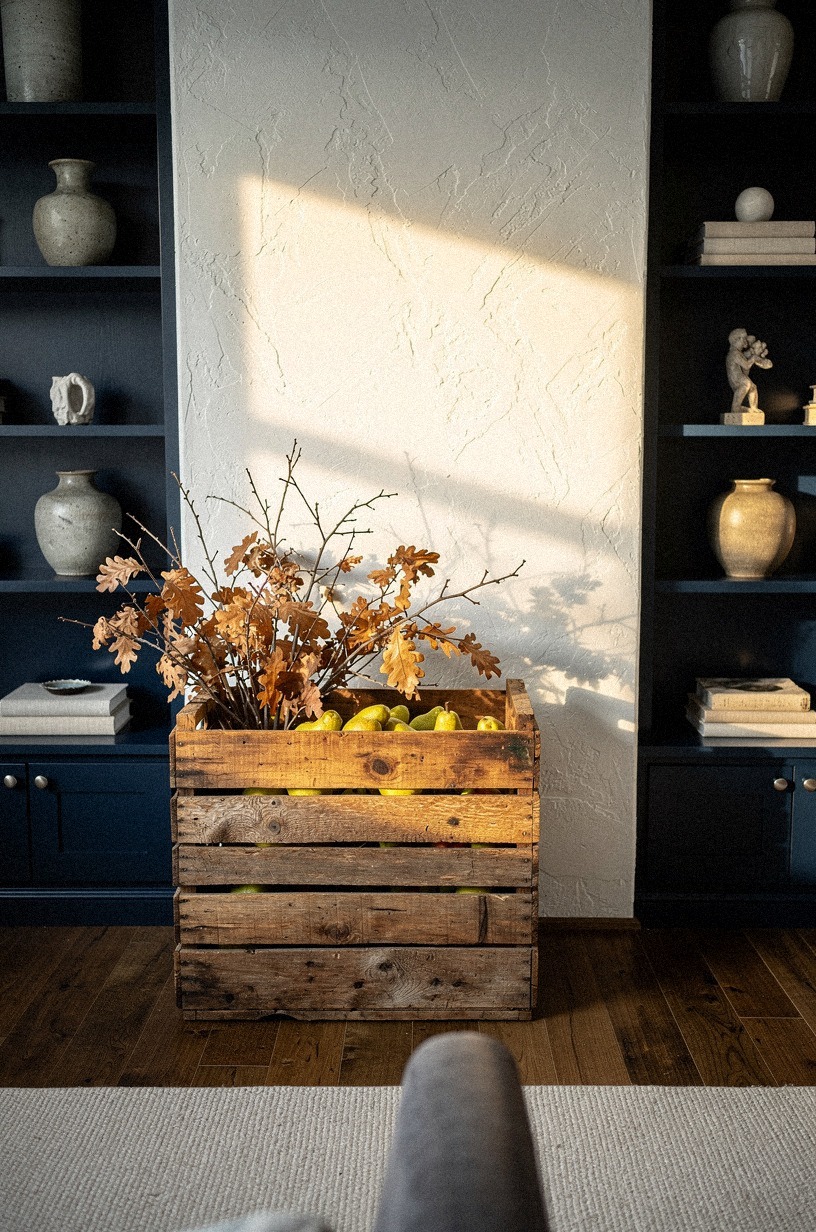
A reclaimed weathered teak apple crate anchoring the left side of the mantel, filled with foraged oak branches and late-season persimmons, is the move that gives the composition a piece of furniture. The crate adds height without adding clutter, and the teak weathers into a deeper warmth over the season.
Apple crates at farmers markets in late October run $15 to $40. Etsy has the vintage versions for more.
Fill with three or four oak branches (about 24 to 30 inches tall so they extend above the mantel line) and three persimmons tucked between the branches. The persimmons add the orange that pulls the whole palette together.
If you can't source a teak crate, a plain wooden crate painted in Benjamin Moore White Dove OC-17 works. The white reads as background, not foreground, which is what you want from the crate.
The branches and persimmons do the styling work. Want a softer bed for the branches? A cozy fall backyard reads with the same palette outside.
15lean a Pilgrim era lantern beside dried corn

A Pilgrim-era tin lantern set beside bundles of dried ornamental corn on a Calacatta marble surface with gold veining is the move that grounds the whole composition in something older. The lantern isn't decoration, it's a piece of design history doing the job of a focal point.
Lean the lantern at the back of the mantel, where its silhouette can read against the wall. Pair with two or three bundles of dried corn, husks pulled back to expose the kernels, tucked at the base of the lantern. The contrast between the rough dried husks and the smooth tin is what makes the composition feel considered.
Worth it or skip: tin lanterns run $40 to $120 depending on age and patina. If you're not collecting, a $25 reproduction from a craft fair works fine.
The shape is what reads Pilgrim, not the actual age. And on the night you're hosting, a battery-operated LED candle inside the lantern gives you the glow without worrying about the kids or the cat. Worth it.
16cascade maple leaves down the mantel corner
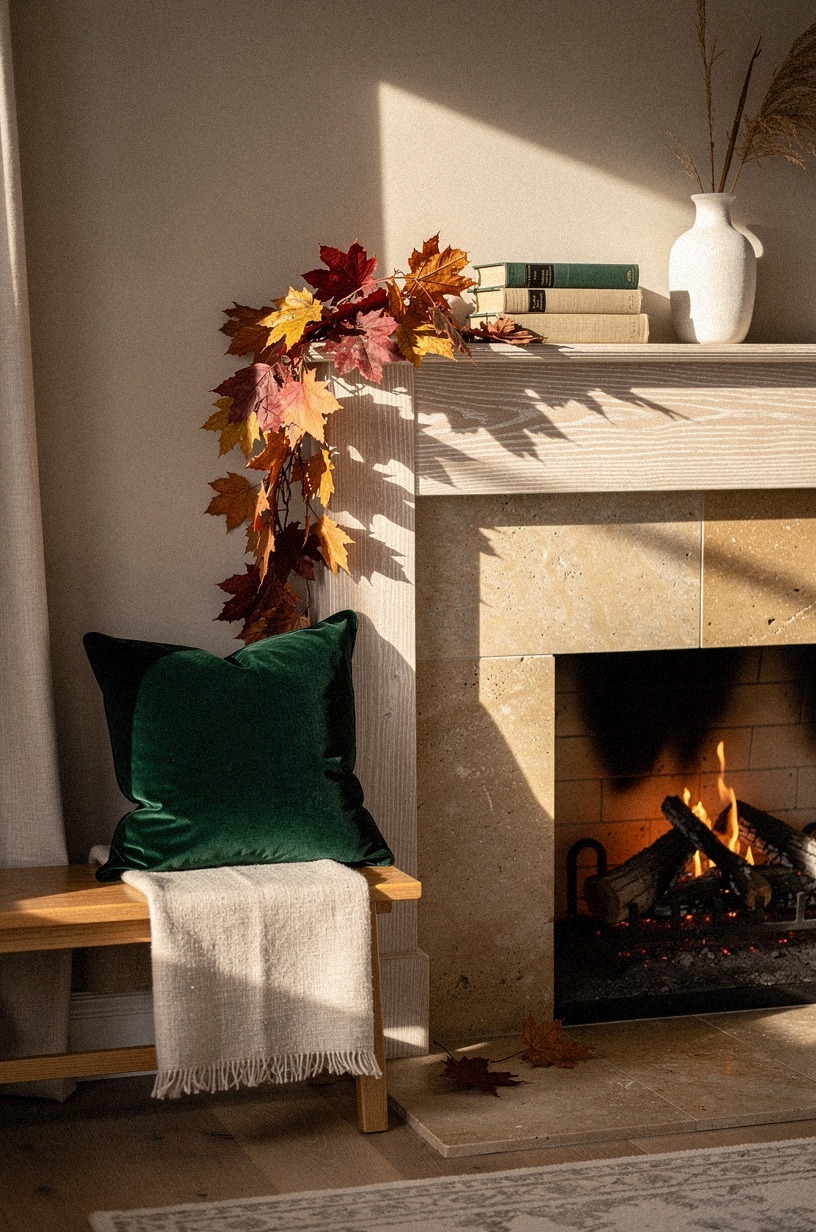
A cascade of rust-and-amber maple leaves spilling down one corner of a cerused white oak mantel is the move that adds movement to a composition that otherwise reads static. The eye follows the leaves down, then back up to the horn of plenty on the opposite end, and the whole mantel feels alive.
Wire individual leaves onto a long piece of thin jute string, then drape the string from the top corner of the mantel, down the side, pooling an inch or two at the base. The pooling is the point.
A clean cut at the bottom reads as a mistake. A natural pool reads as abundance.
If you don't have access to real maple leaves, fabric leaves from a craft store work. Real leaves dry out by Thanksgiving and shed.
Fabric leaves survive the entire holiday season and can go in storage for next year. And the fabric versions photograph better in low light, which matters if you're styling for the wide-angle shot your guests will inevitably take.
17crown the display with a thankful tree branch
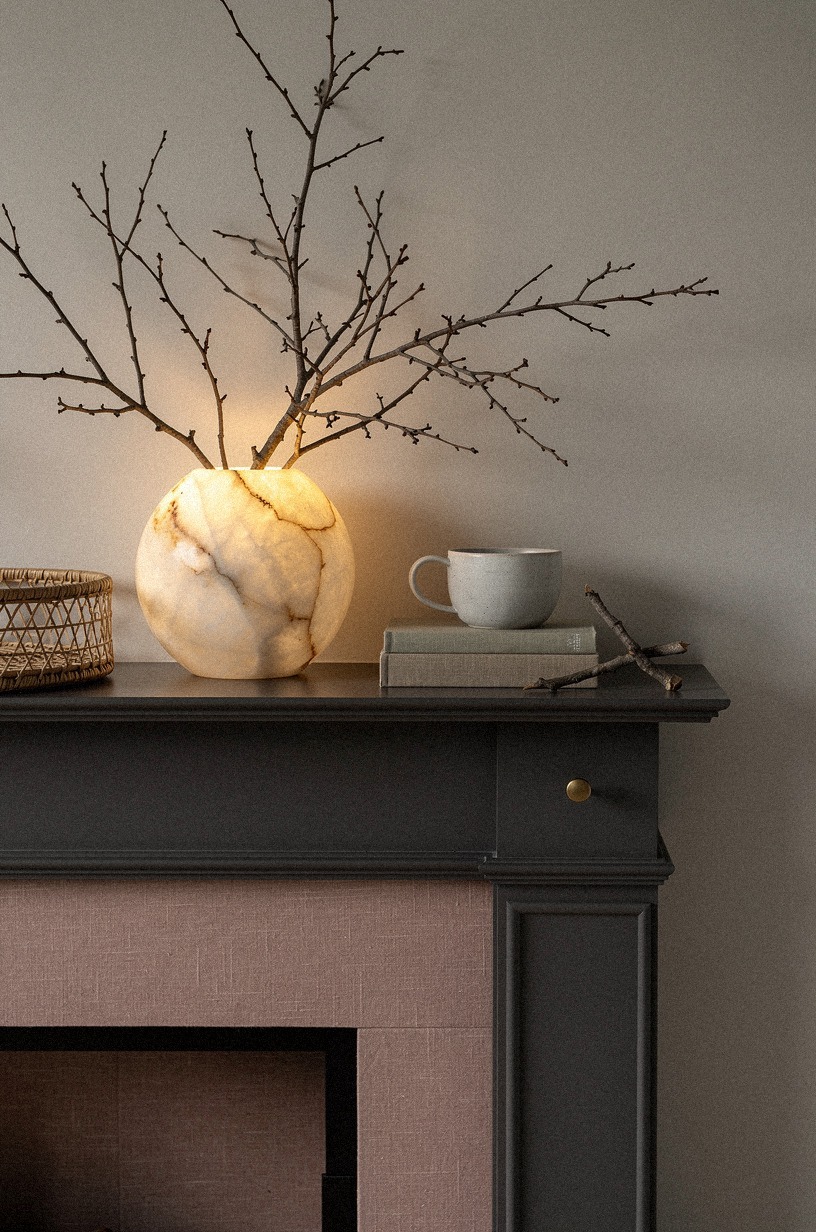
A thankful bare-branch arrangement rooted in a backlit translucent onyx vessel is the move that closes the composition with a vertical element.
18Farrow & Ball vs Benjamin Moore: which paint anchors the mantel wall?
The mantel is only as good as the wall behind it, and the wall is only as good as the paint. For a harvest mantel, you want a color that goes deep without going black, warm without going beige, and reads differently at noon versus 9pm.
Two paints keep coming up in real rooms: Farrow & Ball Hague Blue and Benjamin Moore Essex Green HC-188. Both work.
They don't do the same thing.
Hague Blue is the moodier one. It's a deep navy-green that pulls almost black by lamplight and reads as soft teal in direct morning sun.
On a north-facing wall it can feel heavy. On a south or west wall it sings.
The same color over a deep orange mantel makes the whole corner look like a moody portrait.
Essex Green is the warmer one. It carries olive and yellow undertones that keep it alive even on the coldest north wall.
Pair it with the rust-and-amber maple leaves in section 16 and the whole room feels like a late-October walk. The trade-off: it goes muddy next to gray furniture, and it dates a room to the 2010s if you over-style it.
The honest call: if your room has plenty of warm wood and brass, go Hague Blue. If your room is full of white plaster and pale linen, go Essex Green.
The mantel wants contrast, not a paint that disappears. If you want a quieter neutral for the wall behind a heavily-loaded mantel, my warm neutral bedroom roundup shows the same paint logic in a calmer palette.
The honest case for editing your harvest mantel down by half
Here's the part of harvest decorating nobody talks about: the mantel that makes guests stay late is almost never the most decorated one. It's the most edited one. The first year I tried a fully-loaded harvest mantel with eleven props and two garlands and three candle groupings, I walked into the room the next morning and felt tired before I even sat down.
Too much. The second year I styled it with the horn of plenty, two taper candles, and a single wheat sheaf wreath on the fireplace, and I sat down in the room with a coffee and didn't want to leave.
The difference was restraint.
Most harvest mantels I've seen fail because the homeowner bought one of every pretty thing and put it all on the mantel at once. The composition reads as a collection, not a moment.
The fix is brutal: take everything off, choose three to five pieces that genuinely earn their place, and put those back. If a piece doesn't have a job (anchor, light, color, texture, height), it goes back into the basket.
If you want a smaller, more disciplined version of the same idea, my warm neutral bedrooms roundup shows the same restraint logic applied to a whole room.
The honest cost ranking: the highest-impact moves are the ones that anchor the composition (horn of plenty, wheat sheaf wreath, vintage scale, wooden crate). They give the eye somewhere to land.
Without an anchor, every other piece competes for attention and none of them win. With one anchor, the rest of the styling becomes layering instead of crowding.
The $25 to $80 range is where most of the anchoring moves live, and they're worth prioritizing over the small decorative props that fill the rest of the mantel.
A few things worth skipping entirely: any garland with glitter (it sheds onto everything below it), any sign with a script font (it dates the whole room to a specific Pinterest era and not in a good way), and any pumpkin larger than 6 inches across (it stops reading as harvest and starts reading as fall festival). Skip those and the room gets better. Trust the edit, not the impulse.
The piece I'd put my money on first, if I had to choose, is the horn of plenty. Everything else works harder when it's anchoring around.
What to do with the extras after Thanksgiving
A harvest mantel doesn't need to vanish on December 1st. The reusable pieces (the horn of plenty, the brass candlesticks, the copper apple cups, the onyx vessel) all carry into a winter palette with a single swap. Replace the gourds with white birch logs, the wheat sheaves with bare evergreen branches, the amber tapers with cream pillars.
Same skeleton, different season. The composition is doing the work, not the props.
The disposables (cranberry garlands, mini pumpkins, the Give Thanks plaque) get stored in a labeled kraft box by mid-December. Pull them out next October and you're twenty minutes from a finished mantel.
The reusable investment is the brass, the copper, the wood. The cheap swap each year is everything else.
This is also the move that saves you real money over time. A $25 horn of plenty you use for ten Thanksgivings costs $2.50 a year.
A $60 fresh-flower centerpiece you buy every November costs $60 a year. The math isn't subtle. Invest in the anchors, swap the fillers, and you get a richer mantel for less, every single year.
A Few Things Worth Answering
What is the best mantel anchor for a small living room?
A horn of plenty is the strongest anchor for a small living room mantel because it does the work of three objects in one footprint. Pair it with a single wheat sheaf wreath above the firebox and you have a complete composition without crowding the wall. Skip the garland if your mantel is under 40 inches wide; the layering needs room to breathe.
Target Threshold has the right scale at about $25.
Where can I buy harvest mantel pieces on a budget?
Target Threshold for the basics (garlands, candle holders, mini pumpkins), IKEA for glass hurricanes and brass candlesticks, and Michaels for craft-level florals. For second-hand, Facebook Marketplace in October is flooded with people offloading last year's harvest pieces for a third of what they paid.
Thrift stores in early November are also worth a sweep. None of these are affiliate links, just where I actually shop.
How much does a complete harvest mantel makeover cost?
About $150 to $400 for most living rooms. The free version is real: walk outside, gather three oak branches and some leaves, drape them across a clean mantel with two taper candles, done. The $400 version is the full layered look with a horn of plenty, vintage scale, onyx vessel, and proper garlands.
FTC disclaimer: ranges are typical, not exact, and depend on your region and what you already own.
Can I create a harvest mantel on a budget?
Yes, and the free moves are the strongest ones. Forage oak branches, eucalyptus, or magnolia from your yard.
Borrow two brass candlesticks from the dining table. Use pomegranates from the kitchen and cut them in half.
Layer those with one $20 garland from Target and you have a complete composition for under $25. The harvest mantels that look the most expensive are usually the ones that use the fewest pieces.
If you're hunting the right throw to layer in, my throw blanket guide covers the warmth side of the room.
Is a harvest mantel worth styling in a small space?
Yes, more than in a large room. Small living rooms benefit disproportionately from a styled mantel because the focal point does the work of defining the whole room.
The move is restraint: in a small space, choose three to four pieces max and let the wall behind them (a deep Sherwin-Williams Evergreen Fog or a quiet Benjamin Moore Revere Pewter) do half the styling work. A heavily-loaded mantel in a small room reads cluttered. A lightly-loaded one reads intentional.
Is a harvest mantel a good idea for a rental?
Yes, and there are several no-damage swaps that work well. Use 3M command hooks for the wreath and the vintage scale (rated for the weight, removable later).
Lean the gratitude plaque instead of hanging it. Skip drilling into brick or stone fireplaces entirely.
The whole composition can come down in January without a single hole in the wall. Worth the effort if you're going to live there for another fall.
Where I'd Start First
If I had to pick one, I'd start with the horn of plenty. Nothing else on the mantel works as hard, and once it's anchored, the rest of the styling becomes layering instead of guessing.
You can't build a layered composition on top of an empty mantel, everything you put up fights for attention. Get the anchor right first.
Everything else lands. And the night your guests stay an hour past dessert, you'll know the difference it made.