6 Designer Rules That Made My 40-Square-Meter Flat Feel Bigger
23 july 2026When I moved into a 40-square-meter apartment, roughly 430 square feet, my 54-inch dining table blocked the route from the front door to the kitchen. I learned fast that a small home feels expensive when every object has a clear job and enough room around it.
The goal was never to make the apartment look larger on paper. I wanted it to work on a rainy Tuesday, with groceries on the counter, shoes by the door, and a friend staying for dinner.
Measure the Walking Route Before Buying Furniture
I started with painter's tape and marked the footprint of a Wayfair upholstered sofa directly on the floor. That simple outline showed me that a slimmer two-seat sofa left more usable room than a bulky sectional ever could.
Keep roughly 30 inches where people need to pass, especially between seating and a doorway. A room can handle compact furniture, but it cannot forgive a route that makes everyone turn sideways.
Choose Legs That Let the Floor Show
A low, skirted couch can swallow a tiny living room because it creates one solid block at eye level. I chose a light oak coffee table with exposed legs, and the visible floor underneath made the seating zone feel less packed.
This is a practical visual rule, not a styling stunt. Raised furniture lets daylight travel farther across the floor, so the room reads as one connected space instead of a pile of separate objects.
Build Storage Up the Wall
Floor-level baskets helped for a week, then they became a permanent obstacle course. A tall IKEA BILLY bookcase gave books, cables, serving dishes, and paperwork a home without taking over the center of the room.
Use the upper shelves for things you reach for less often, then keep the lower shelves easy to access. Closed boxes in one finish look calmer than a row of mismatched bins, and labels save you from opening every container.
Give Each Surface One Clear Assignment
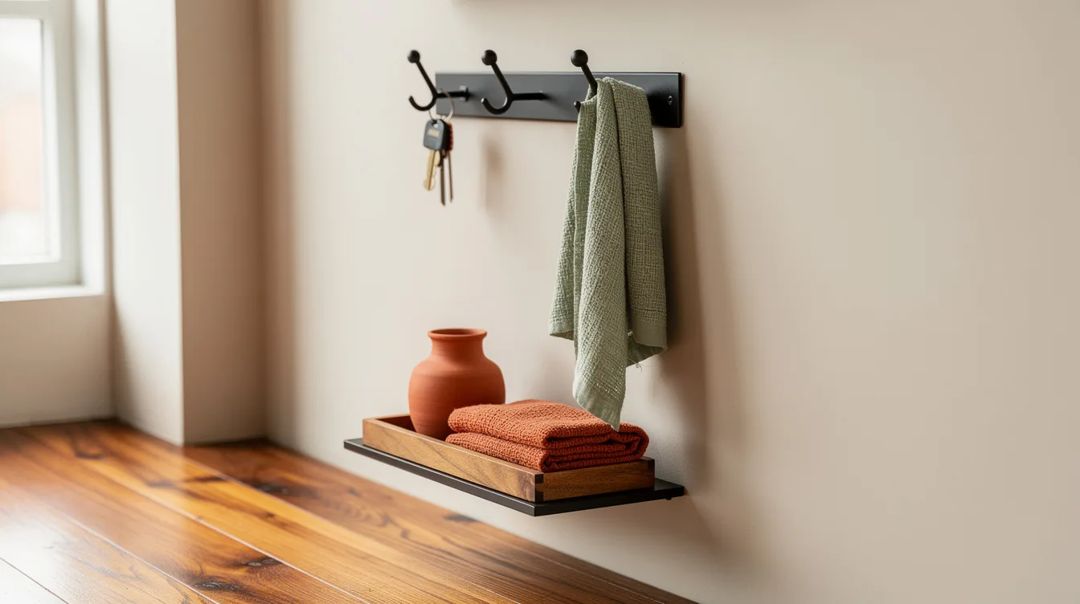
My dining table had become a mail station, laptop desk, charging dock, and place to eat, so it always looked defeated. A narrow Target entry tray near the door caught keys and receipts before they crossed the apartment.
Assign the table to meals and occasional work, then clear it at the end of the day. One lamp, a coaster, and a small bowl are plenty, because a tiny surface loses its usefulness when decor claims half of it.
Use One Rug to Anchor the Main Zone
A too-small rug makes furniture look as though it drifted apart during a move. I used a 5-by-8-foot wool rug under the front legs of the sofa and chairs, which gave the living area a firm boundary without adding a wall.
Choose a pattern with some movement if your upholstery is plain, but avoid a high-contrast design that competes with every other surface. A typical 5-by-8-foot rug costs less than replacing several undersized accent pieces that never settle the room.
Repeat Materials Instead of Adding More Decor
Small apartments get noisy when every purchase introduces a new finish, color, or texture. I repeated matte black hardware on curtain rods, lamp bases, and a wall hook, then let warm wood soften the sharper lines.
A linen curtain panel, one ceramic lamp, and a framed print can carry a room farther than a shelf full of tiny objects. Repeat what already works, and the apartment starts to feel intentional without looking staged.
Start with the route you walk most often, then remove or relocate anything that interrupts it. Once that path is clear, every decorating decision becomes easier to judge.