I Built My Dream Home Gym, Now I Never Want to Leave It
17 july 2026A dream home gym doesn't need a full basement wing or a $30,000 budget to feel finished. I built mine out of one bright corner after too many workouts squeezed between a dining chair and a laundry basket, and it's the first room I walk into now on purpose. Most home gym makeovers start with buying equipment. Mine started with daylight, a soft mood, and one calm idea of what the room had to feel like.
Don’t overthink: Map the mirror wall to double daylight.
Here's what it looked like before
Before I touched it, this part of the house had that familiar almost-room energy you probably know too well. A leftover side table. A lamp that belonged somewhere else.
One sad mat rolled behind the door. The light was good, but the setup was scattered, and I kept pretending I would work out there once I bought more gear.
I wouldn't. That was the problem.
The room didn't fail because I lacked equipment. It failed because nothing had a home, the floor felt temporary, and every session started with moving things out of the way.
If your dream gym still feels like borrowed square footage, you need structure before you need more stuff. The same logic that turns a forgotten corner into a cozy reading nook applies here: the room is doing the work, not the gear.
- Claim the sunniest corner before anything else
- Map the mirror wall to double daylight
- Lay rubber tiles in one clean grid
- Build a walnut rack for visible gear
- Add a bench that anchors the weights
- Mount the screen beside the cardio zone
- Install warm sconces over harsh overheads
- Paint the ceiling charcoal for focus
- Hang oversized art across the stretch wall
- Set a towel shelf by the door
- Hide recovery tools inside a low cabinet
- Finish with a water station nook
1Claim the sunniest corner before anything else
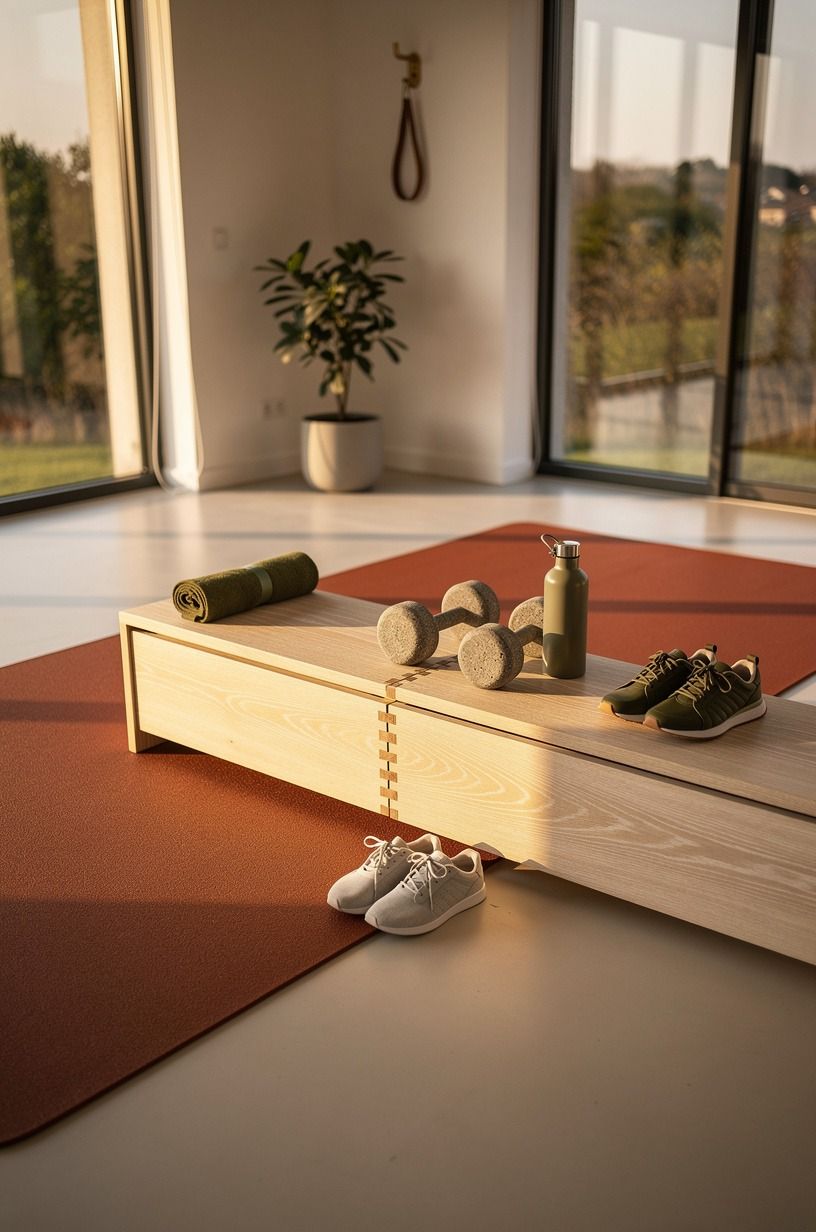
I started with the brightest diagonal corner in the room, not the biggest one, because the light changed my behavior faster than any piece of gear. Morning sun hit the window corner by 8, grazed the floor by 9, and made the whole zone feel awake before I was. If you are choosing between a dark spare room and one smaller sunny corner, I would take the light every time.
That first move set the palette too. I used a cerused white oak storage bench with an exposed dovetail joint, then kept the wall around it quiet so the grain could catch daylight instead of fighting it.
Shoes tucked below. Rolled mat on one side.
Foam roller on the other. You want the first thing you see to say start here, not sort this out first. And once the sun started landing there, I stopped negotiating with myself.
If your whole house has uneven light, a small space lighting plan can teach you the same move I used here: chase the daylight, then warm it up at night.
2Map the mirror wall to double daylight
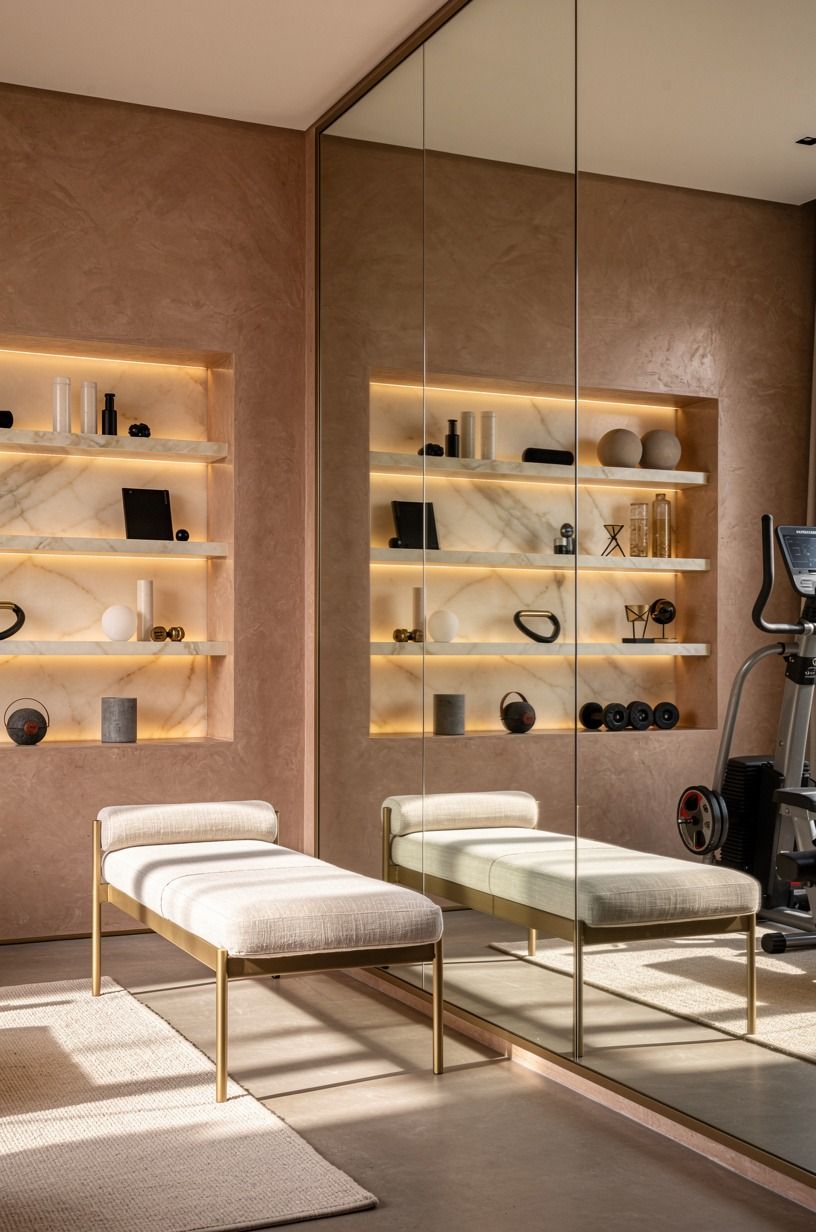
The mirror wall was the part I almost overdid. I thought bigger had to mean better, but a full mirror takeover can feel like a dance studio in the worst way.
So I mapped one clean mirror run at eye level where it would bounce the window back across the room, and I left breathing room on both sides. If you are placing yours, stand in the doorway first and watch where the daylight already wants to go.
I used a gym mirror in the typical $100-$400 range and lined the top edge so it felt deliberate instead of stuck on. That first-person doorway view matters more than people admit, because it's the shot you live with every day.
But don't center the mirror just because symmetry sounds right. I pushed mine slightly off the hard middle so the reflection would pick up the bench, the plant, and the floor lamp together. Suddenly the room looked twice as calm, and you could check form without staring at yourself the whole time.
The same off-center move shows up in our studio apartment layouts that actually work when square footage is tight and reflections need to do double duty.
3Lay rubber tiles in one clean grid
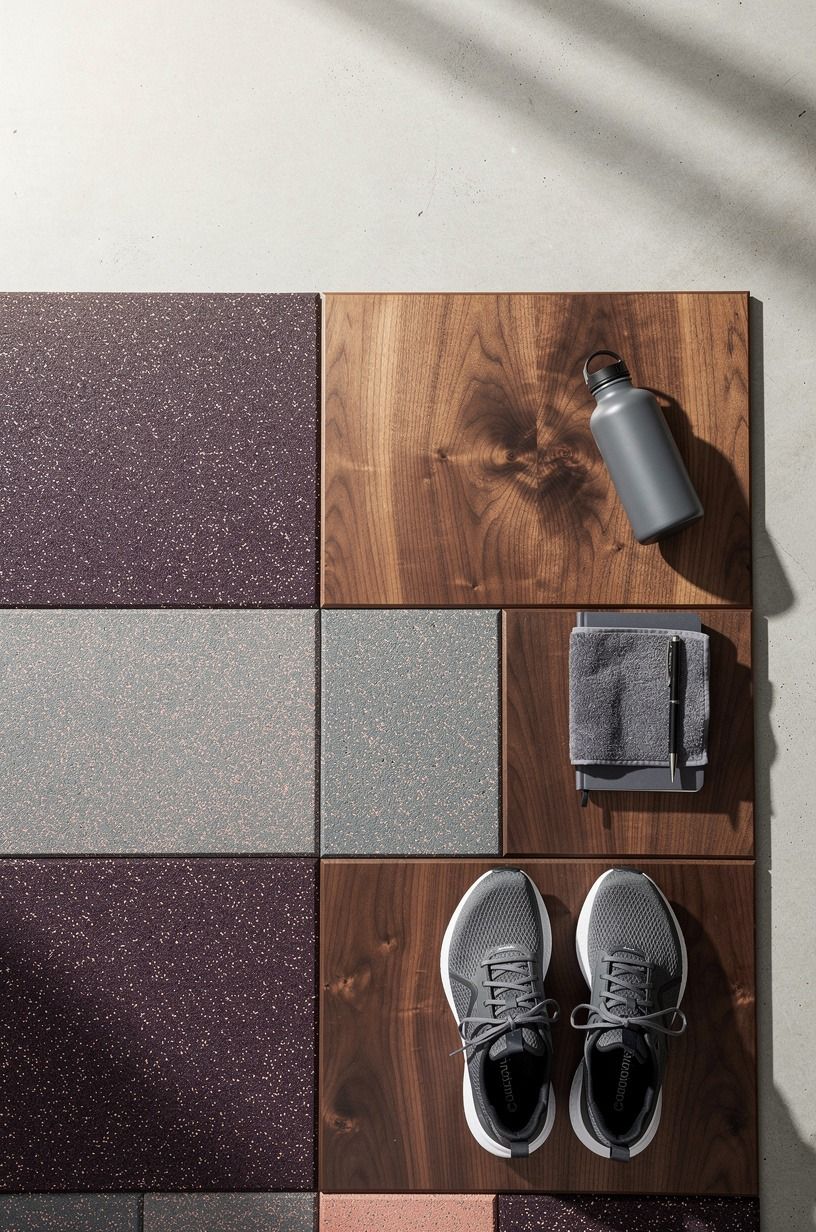
Rubber flooring was where the room stopped feeling temporary. I marked an 8x10 ft mat zone first, snapped chalk lines, and forced myself to keep the pattern in one strict grid instead of trimming around every awkward edge. If your floor plan is messy, your eye reads the whole gym as messy too.
I bought rubber flooring in the typical $2-$8 per sq ft range and kept the seam direction consistent so the overhead view stayed clean. The part that worked was leaving open floor around the grid instead of covering every inch wall to wall. You need that little halo of bare floor so the mats read like a destination.
But don't mix puzzle mats with thin yoga foam to save a few dollars. You feel the wobble immediately, and the room never looks settled after that.
The same grid logic that anchors a cozy breakfast nook bench anchors this floor: one honest rectangle, then breathe around it.
4Build a walnut rack for visible gear
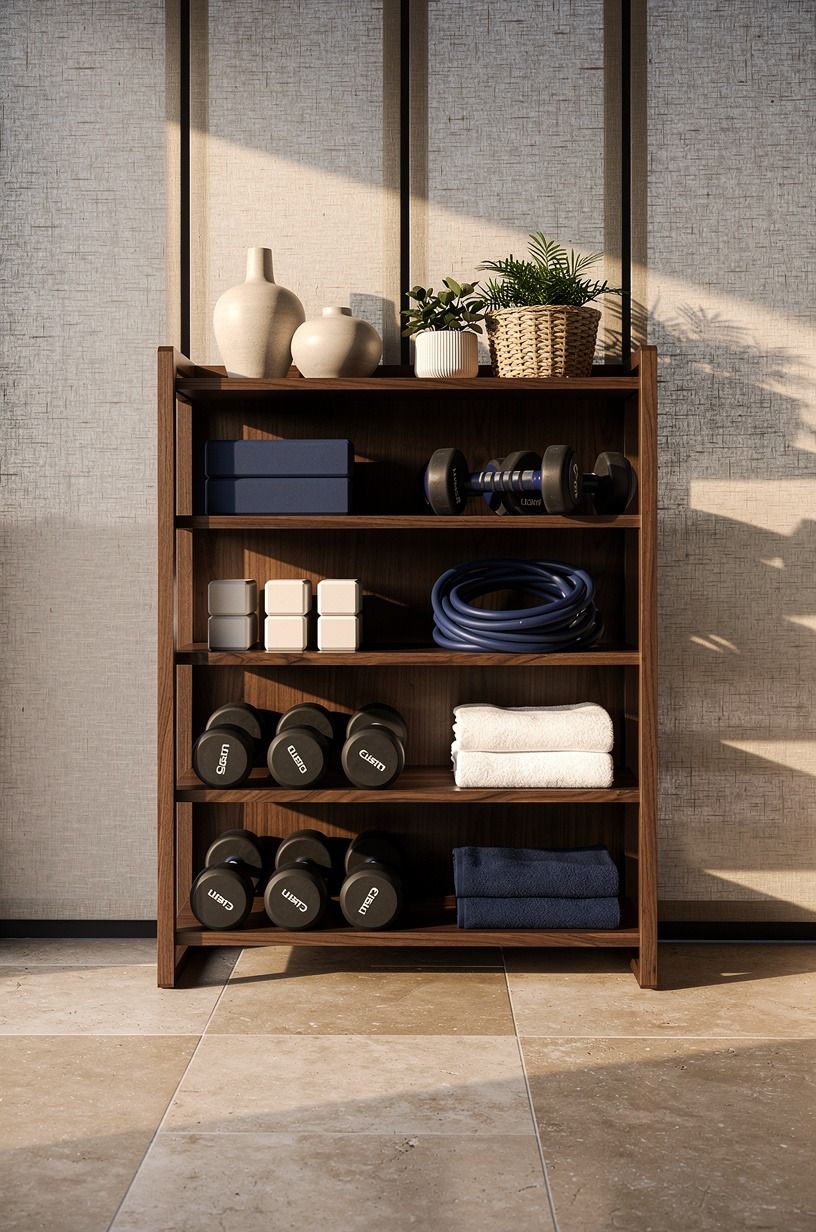
Visible storage sounds simple until you realize exposed gear can read like garage clutter in about five seconds. I built a narrow wall rack in walnut veneer tones so the dumbbells, yoga blocks, resistance bands, and ankle weights had one frame around them. That frame was the whole point.
If your equipment is going to stay out, you need it edited like decor.
I used the discipline I wish I had used earlier: only the tools I touched every week earned open display. Adjustable dumbbells low.
Bands rolled in one basket. Cork blocks stacked clean. A Target Brightroom bin on the bottom shelf for the ugly stuff I still needed.
And yes, I skipped the rainbow set of mismatched bands. They work, sure, but the color noise kept pulling my eye away from the room itself. You want visible gear, not visual static.
The same edit-first mindset shows up in our guide to small kitchen cabinet ideas that maximize storage: the closed and open doors do different jobs, and the room only works when you decide which is which.

5Add a bench that anchors the weights
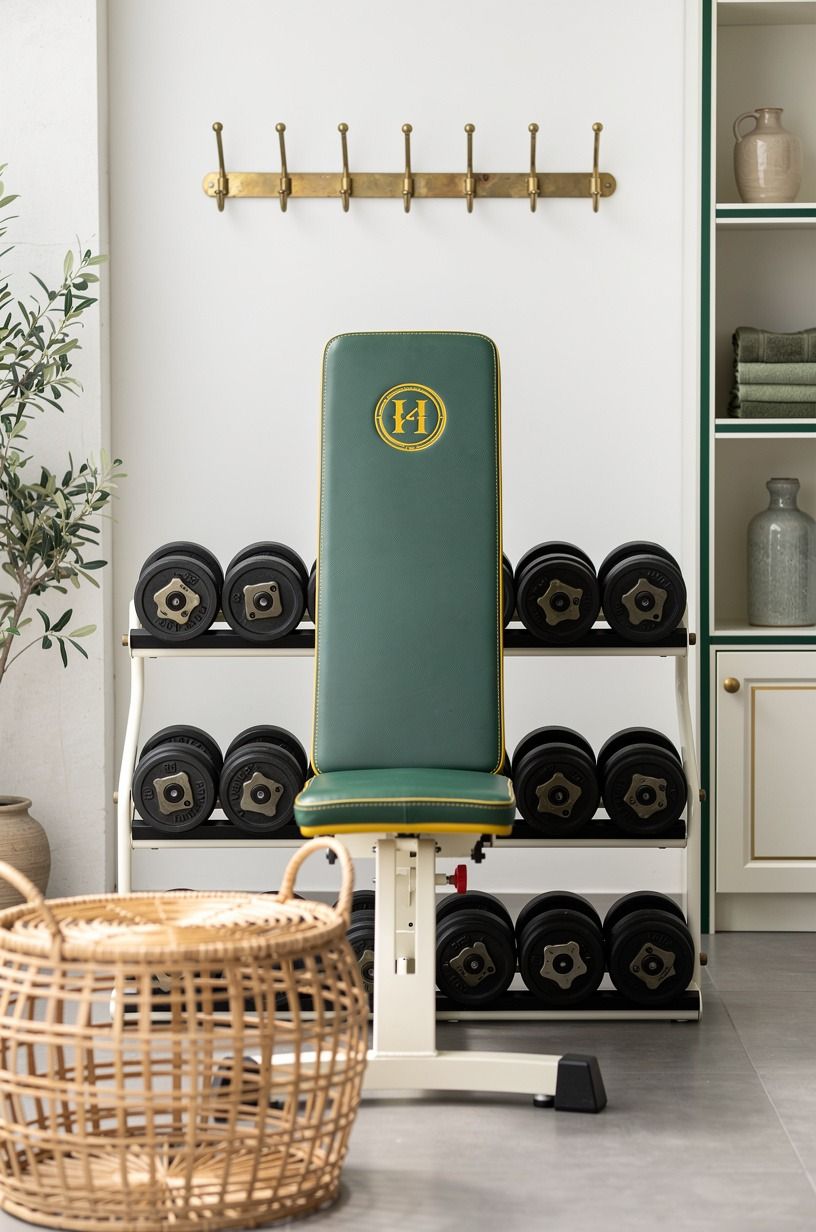
The bench changed the whole room because it gave the weights gravity.
6Mount the screen beside the cardio zone
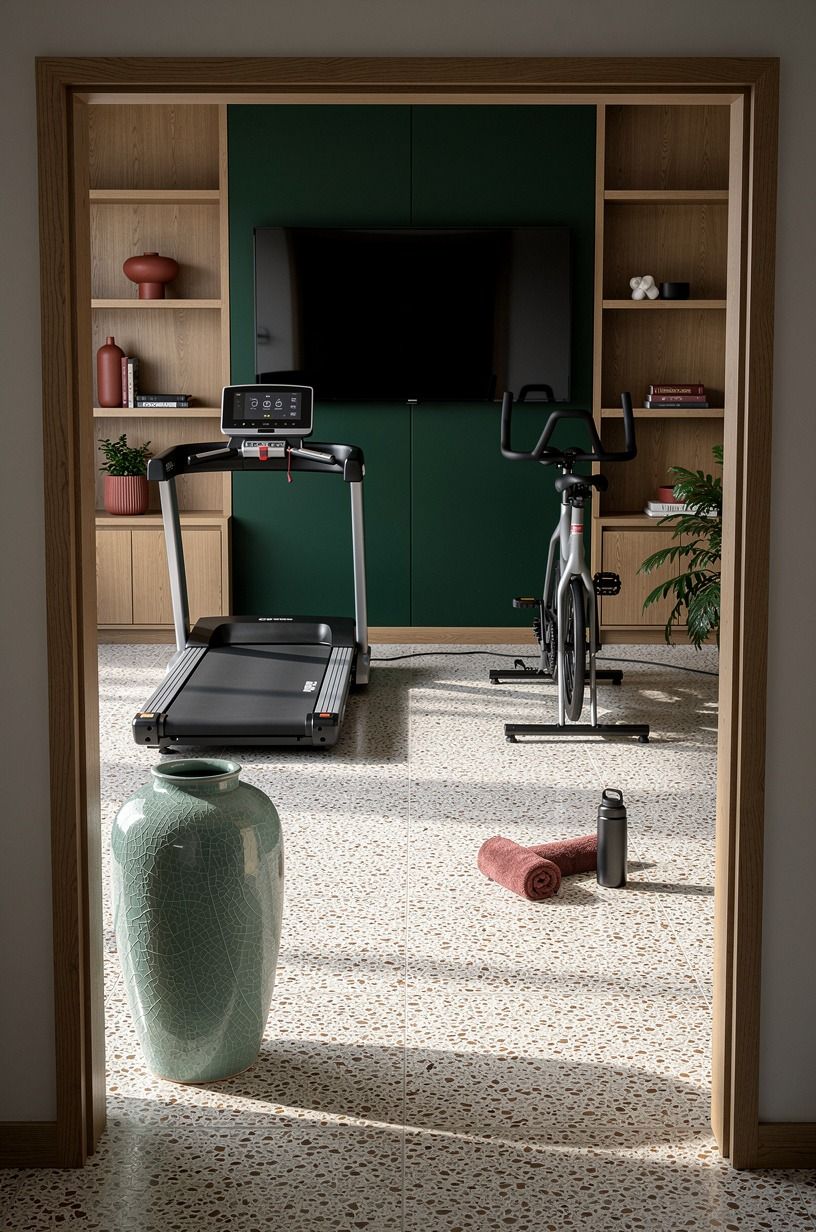
I didn't want the screen to dominate the room, and I really didn't want the whole setup to feel like a waiting area with a treadmill. So I mounted it beside the cardio zone instead of directly in front of it, which let the treadmill, bike, and basket of towels read as one calm layer when you looked through the doorway. If you are adding a screen, think companion, not centerpiece.
That placement helped with glare too. Daylight from the mirror wall stayed useful, and the screen never became the brightest thing in the room.
I kept the cardio footprint to about 6x6 ft and used a Samsung Frame style screen because its off-state looked quieter than the glossy black rectangle I had before. But I would never mount it high just to keep it safe.
Your neck pays for that every single ride! Keep it low enough to glance, high enough to clear the handles, and the room stays human. The same "supporting actor, not the lead" rule guides our outdoor kitchen lighting ideas for evening cookouts when you want the fireplace, not the fixtures, to win the night.
7Install warm sconces over harsh overheads
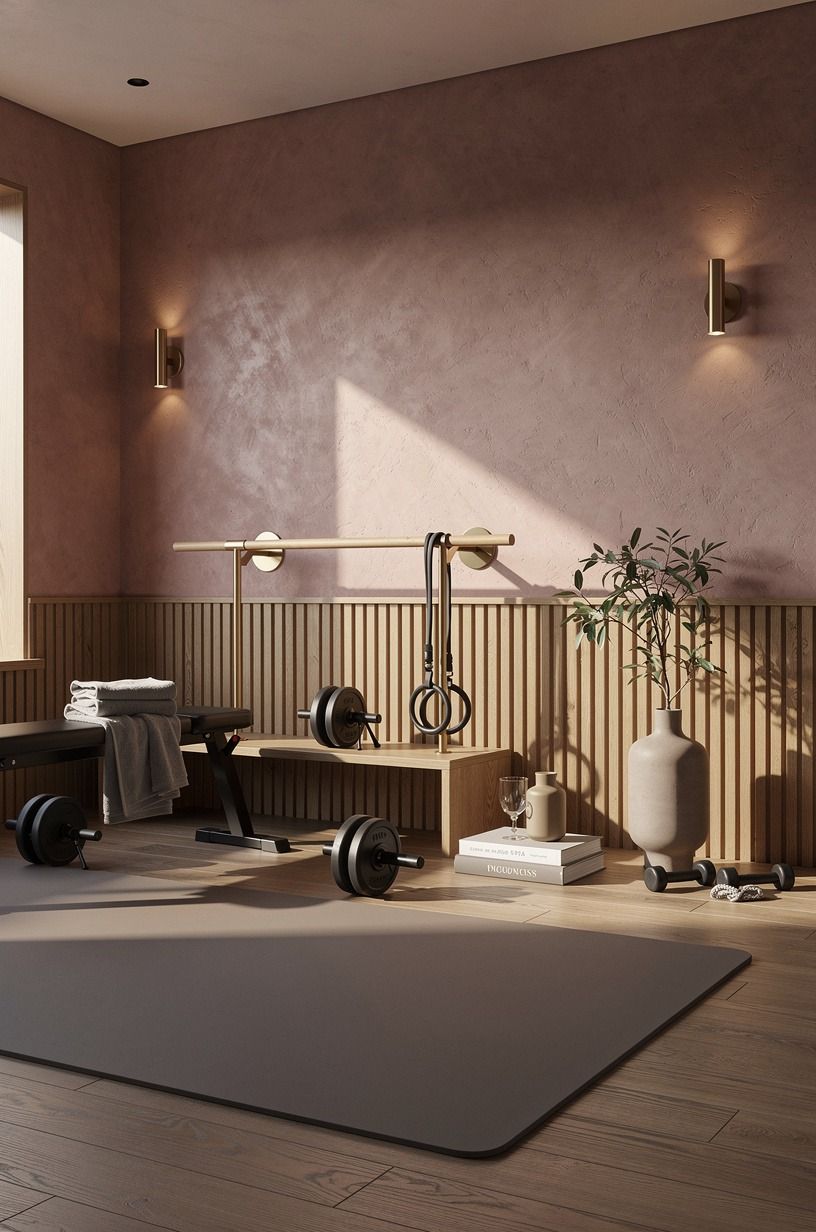
The overhead can lights were brutal. Flat, cold, and weirdly judgmental at 6 a.m.
I swapped the mood by adding warm sconces along the workout wall and treating the ceiling light like a backup, not the lead. If your home gym only has one lighting mode, that is usually why you avoid it at night.
I chose unlacquered brass sconces with warm bulbs and put them where they could wash the wall instead of blasting my face. The amber spread across the rubber floor was softer, more gentle, and the room finally looked like somewhere you'd want to stay after the workout ended.
One corner lamp. Two wall lights.
Overhead off unless I needed to clean. That's the full stack. And once that glow kicked on, I stopped thinking of the room as a utility zone and started treating it like part of the house.
For a moody, evening-first setup, the same brass-on-warm-wall logic anchors our breakfast nook lighting ideas with pendants and sconces.
8Paint the ceiling charcoal for focus
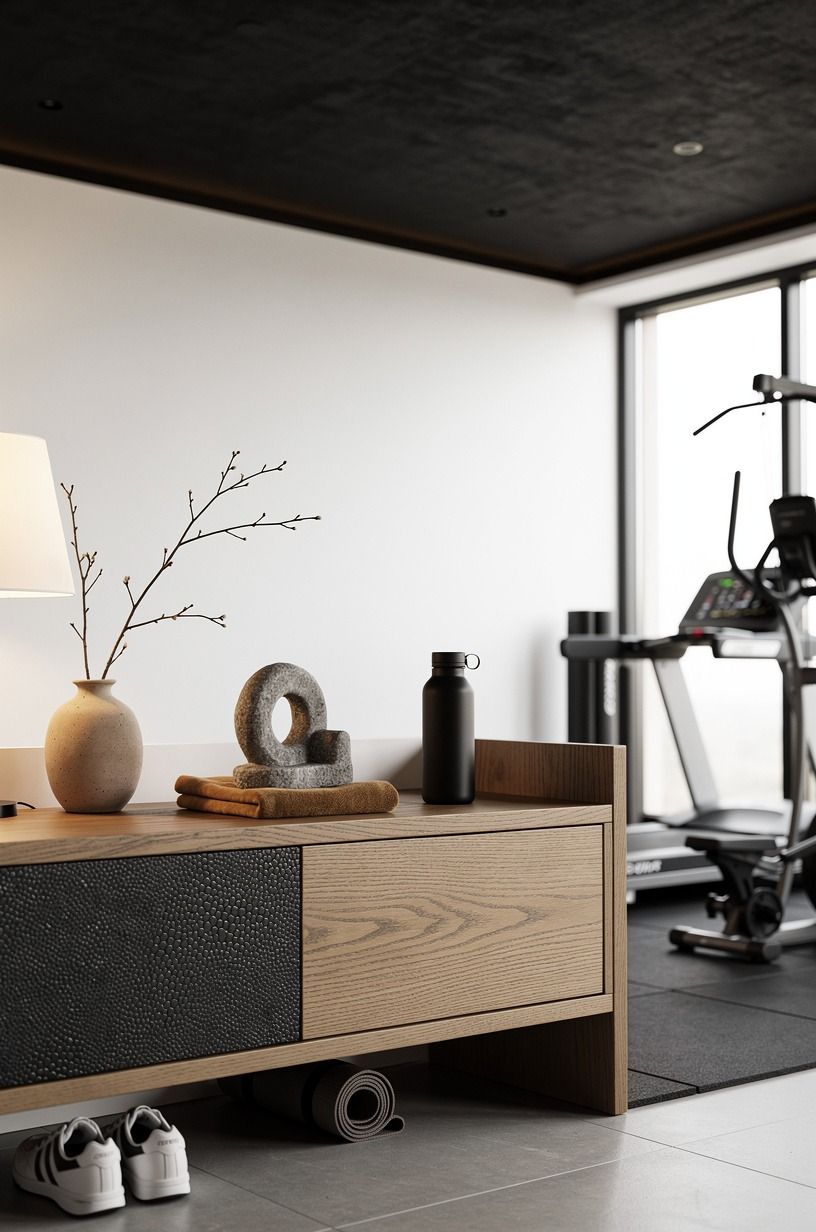
Painting the ceiling darker felt risky until I realized the white ceiling was doing all the wrong work. It pulled your eye up, flattened the room, and made every wall feel less grounded. I painted mine in Benjamin Moore Kendall Charcoal HC-166, and the whole training zone snapped into place in one afternoon.
If your ceiling sits in the standard 8-9 ft range, a charcoal tone can make it feel more intentional instead of lower, especially when the walls stay lighter. I tested Sherwin-Williams Iron Ore SW 7069 and Farrow & Ball Down Pipe No. 26 too, and I would choose Kendall Charcoal again because it held depth without going muddy by late afternoon.
But this only works if you keep the trim crisp and the lights warm. Dark ceiling, blue bulbs, white glare.
That's a dead combo. Dark ceiling, amber light, pale walls.
That's focus. The same ceiling-as-fifth-wall move shows up in our high ceiling bedroom ideas when you want the height to feel like a feature, not a problem.
9Hang oversized art across the stretch wall
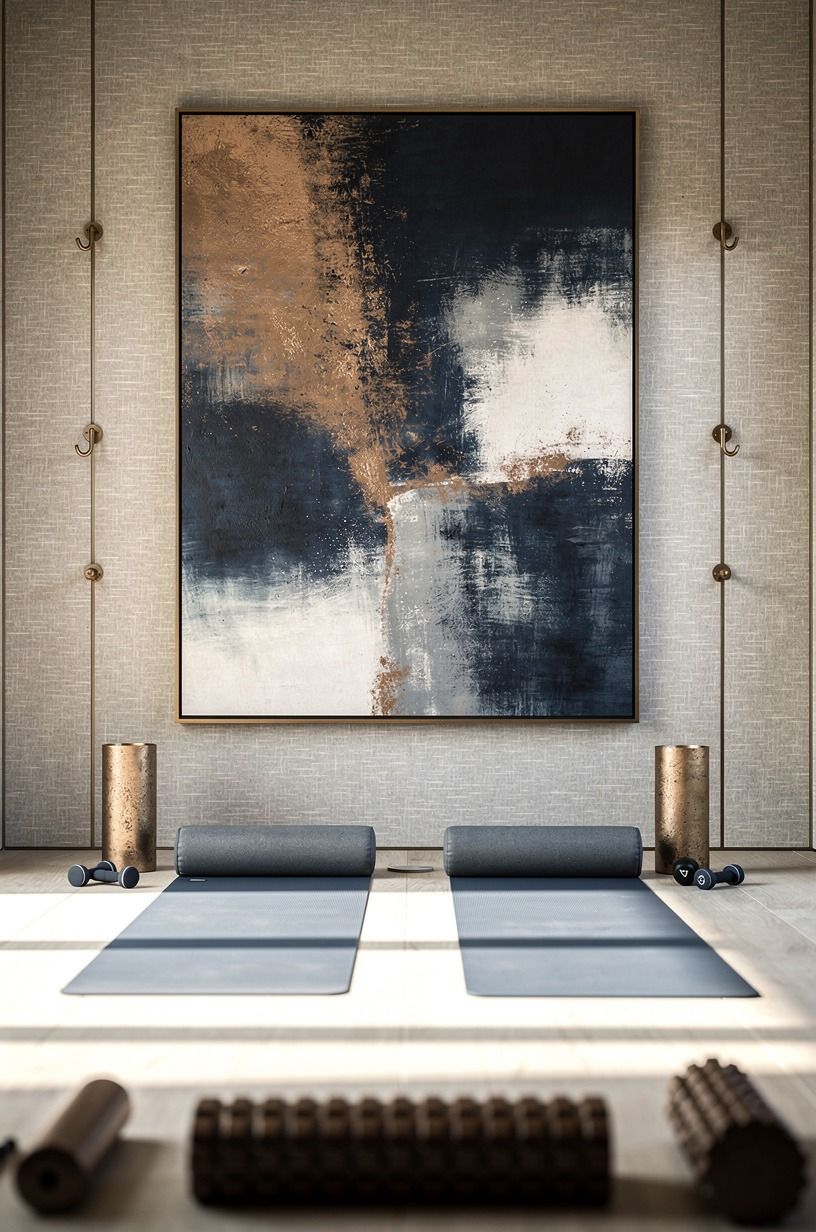
The stretch wall needed more than a mat and good intentions. It needed a reason to hold the eye while I cooled down, and one big piece of art did that faster than five small ones ever could. I hung oversized work above the mats so the low floor view felt finished from edge to edge.
If you are staring at a blank wall while stretching, you will feel the emptiness every time.
I went with a tonal abstract in oak gallery frame proportions that echoed the bench and rack without matching them too neatly. One big move.
That's enough. You want the art to steady the room, not turn it into a mood board.
But don't hang it too high just because it's gym space. Keep it related to the mat line so your body and the wall still feel connected. The second I lowered mine by a few inches, the whole zone clicked.
The "one oversized piece, hung low" rule is the same rule our accent wall bedroom guide walks through for the room next door.
10Set a towel shelf by the door
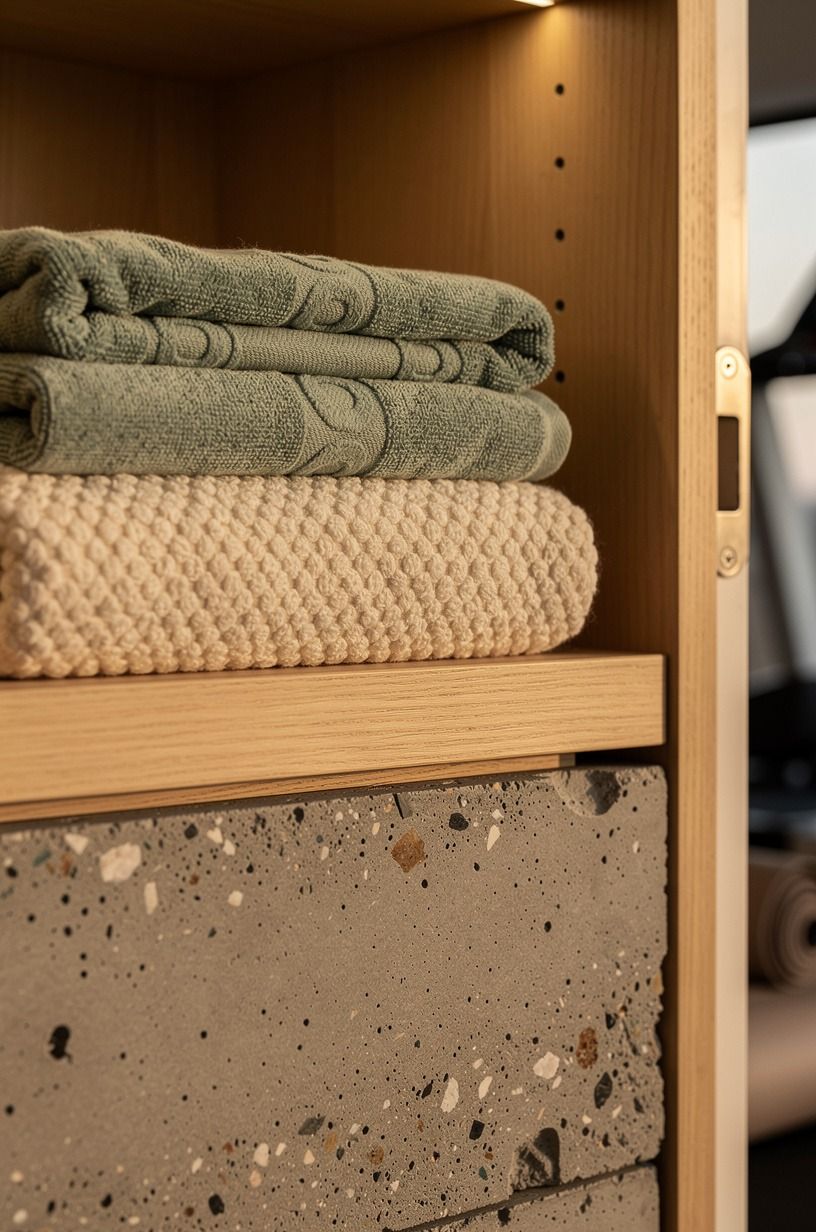
This was a small move, but you feel it every single session. I added a door shelf with folded towels, a catch tray, and one candle, and suddenly the room had an arrival moment instead of a rushed one. If your gym starts with digging through a linen closet, you are already making the habit harder than it needs to be.
The shelf itself was simple, painted in Benjamin Moore White Dove OC-17, but the styling made it work: sage towels, warm cream ceramics, one lidded jar for hair ties, and a little aged-bronze hook below. I used 600gsm Turkish cotton towels because thin ones always looked limp by noon.
And yes, I know that sounds fussy for a gym. It isn't.
The minute you can grab a fresh towel without leaving the room, the whole setup feels thought through. The same "one zone by the door does the work" idea is what we use in our pillow storage ideas guide for bedrooms, where a single tray replaces five minutes of morning hunting.
11Hide recovery tools inside a low cabinet
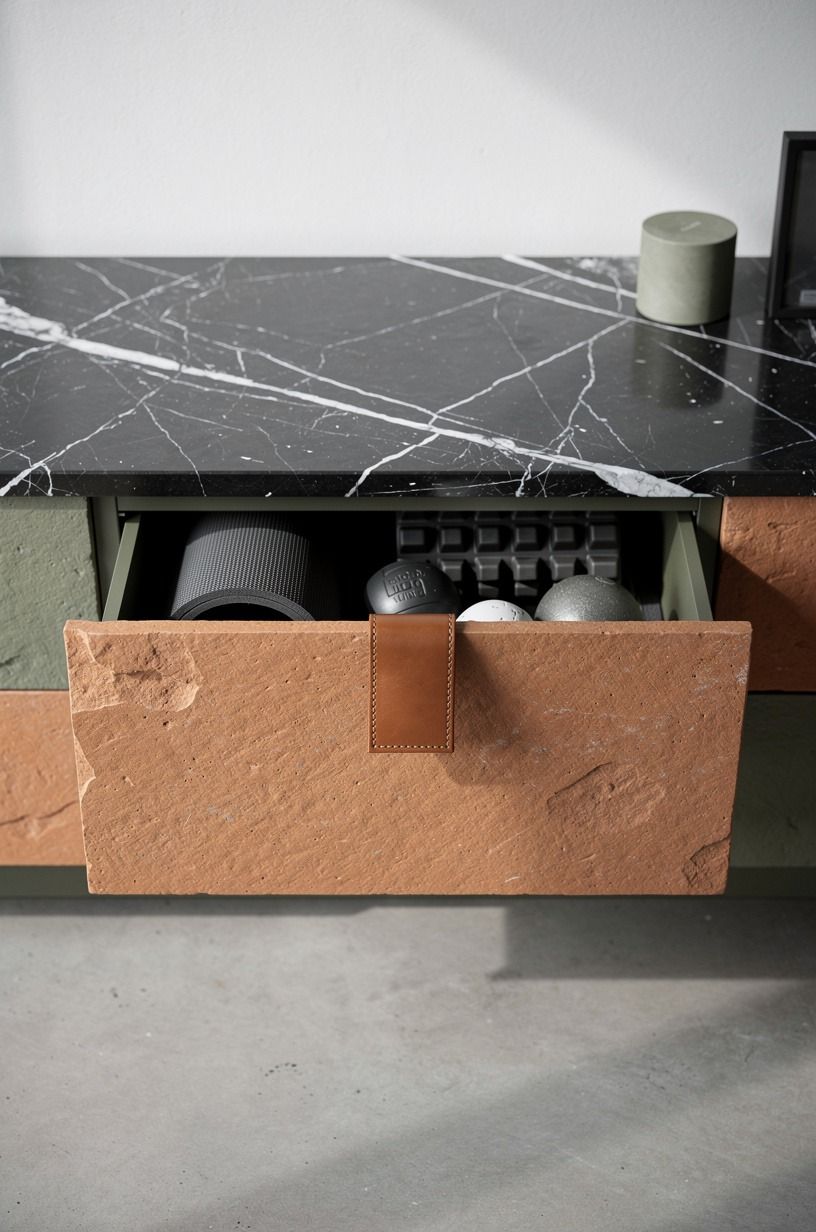
Recovery gear is where good rooms go to die. Massage gun, straps, sliders, lacrosse balls, mini bands, knee sleeves.
Useful, yes. Pretty, no.
I hid all of it in a low cabinet with push-latch doors so the top could stay calm and the mess could disappear in one motion. If your cooldown tools stay visible, the room never fully exhales.
I used a IKEA TONSTAD style cabinet profile because the low line kept the window free and gave me a long horizontal surface for a lamp and small plant. Top drawer: bands and straps.
Bottom shelf: massage tools in lidded boxes. Side cubby: extra mat. But I would skip open baskets here unless you are disciplined enough to refold everything every day, and I wasn't.
Closed storage bought me back the visual quiet that open racks couldn't. If you want the same calm look in a smaller footprint, our closet organization ideas walk through the same "one push, one exhale" storage logic from a different room.
12Finish with a water station nook
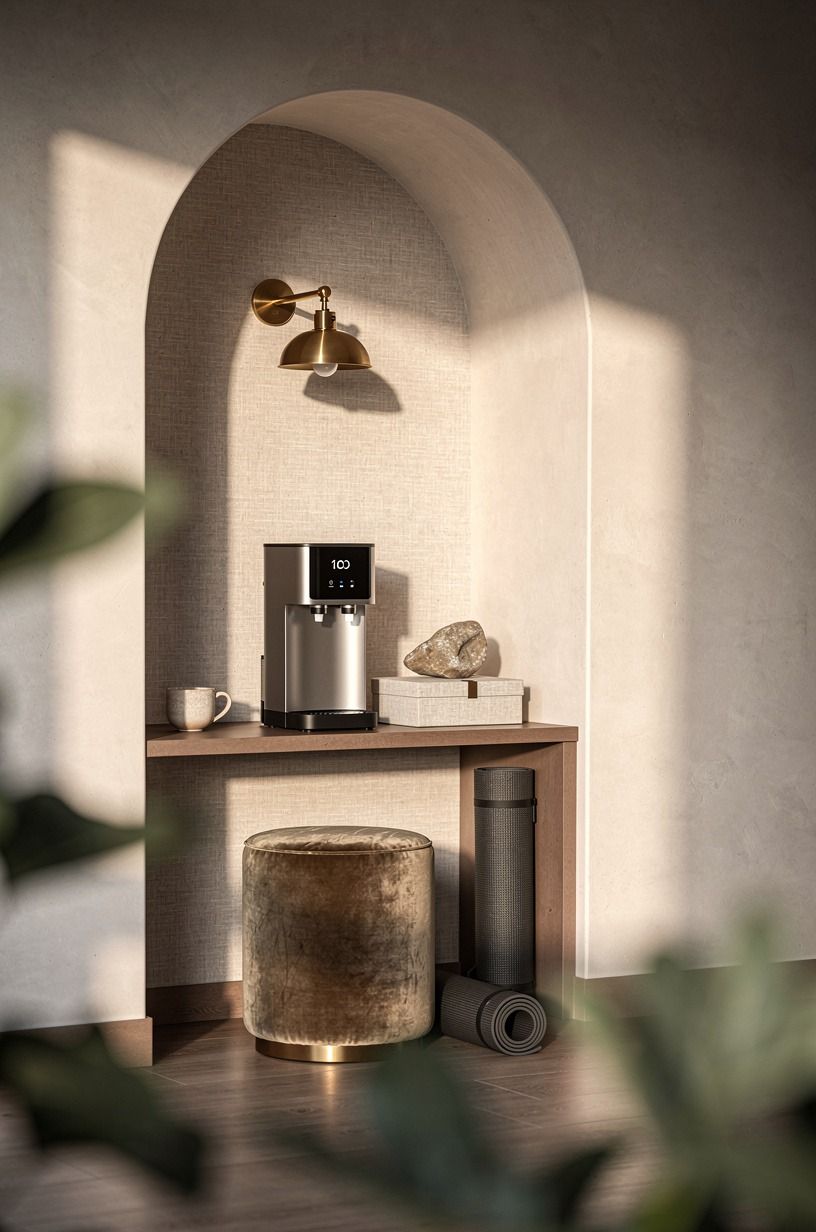
The last layer was the water station nook, and it mattered more than I expected. Once I gave the room a small landing spot for the bottle, filtered pitcher, glass, and electrolyte tin, I stopped leaving mid-session to wander into the kitchen. If your workout space makes you break focus for basics, it isn't done yet.
I tucked the station into a shallow niche beside the arch, added a Studio McGee tray, and let a little indoor foliage soften the edge so the corner looked lived in instead of clinical. Glass bottle. Small stacked cups.
Linen runner. One branch in a stone vase. You don't need a mini fridge unless you are building at the high end. You need one reachable place that says stay a little longer.
But don't crowd this nook. The negative space is what makes the ritual feel easy. The same "one quiet corner that does the holding" rule is the engine behind our moody green home office ideas, and it works just as well in a gym.
What happens when the room still feels off after all this?
Honestly, this is the part nobody warns you about. You do the floor, the rack, the mirror, the sconces, the bench, the art, the cabinet, the towel shelf, the water nook.
And you walk in one morning and the room still feels like a waiting room. Not broken.
Just inert. That usually means the room is too symmetrical, too quiet, or too even.
Mine did this for a week after I finished.
The fix was small: I moved a single object off-center. The plant went two inches to the left of the rack. The bench shifted so the mirror caught it at an angle instead of straight on.
The lamp went to the corner that wasn't getting any evening light. Three moves, ten minutes, and the whole room exhaled. If your home gym inspiration basement fantasy still feels flat, the problem is almost never another purchase.
It's usually that everything you own is sitting in the exact middle of the room, doing nothing dramatic. A slightly imperfect, organic arrangement will always feel more inviting than a showroom layout.
Our how to make a large backyard feel cozy not empty guide walks through the same "shift the weight off-center" idea at a much larger scale, and the principle translates.
The Single-Zone Budget Method
I kept my spending in one zone instead of trying to outfit the whole fantasy version of a modern luxury home gym at once. That saved me! If you spread your money across ten half-finished ideas, you get a room that still feels unfinished.
If you build one complete corner first, you get momentum, proof, and something you will use while the rest catches up.
Mine sat firmly in the middle tier because the rubber floor, mirror wall, and lighting did the heavy lifting. The free moves helped too: using the sunniest corner, editing what stayed visible, and refusing to buy duplicate gear.
If you've got less to spend, start with the mat zone, the mirror, and the towel shelf. I would wait on fancy cardio every time, because the room has to invite you in before the equipment matters.
If you want a similar budget-first framework for a different room, our oak kitchen cabinet guide shows the same "finish one zone, then expand" pattern at a different price point.
The Mirror Mood Method That Finally Made the Room Stick
I learned something annoying while building this room: discipline wasn't my main problem. Friction was.
I used to think I needed better habits, a louder coach in my ear, or one more purchase that would finally make me consistent. But the truth was smaller and less flattering. I kept creating spaces that asked me to work around them.
Move the chair. Roll out the mat.
Fetch the towel. Find the band. Turn on the ugly overhead.
Who wants to start a workout by hunting for a band? By the time I started, I had already burned the easy energy.
That's why the mirror-and-mood rule ended up mattering more than any single product. If a room reflects light back to you and gives you one warm cue to begin, your brain reads it as ready. That's not fluff. That's behavior.
I don't need my home gym inspiration basement fantasy every morning. I need a place where the first thirty seconds feel simple.
Mirror catches daylight. Bench holds the obvious gear. Towel shelf greets me. Water station keeps me there.
Sconces soften the edges. One clean floor grid tells my body where to stand. The same "first thirty seconds decide the rest" rule shows up in our basement guest bedroom ideas where the doorway view, not the bed, is what makes a guest feel welcome.
I also learned what wasn't worth the money. Giant equipment too early.
Overhead glare. Open storage for everything.
Big promises from gear I wasn't going to use. I would rather spend on flooring, lighting, and one honest storage piece than chase a showroom look that falls apart by week two. You can feel that difference right away. The room stops asking for decisions and starts offering a rhythm.
The same "edit, then invest" logic anchors our minimalist bedroom ideas that feel collected, and the principle travels.
And that's the part people miss when they copy a dream gym photo. The best rooms aren't packed.
They're resolved. You should be able to walk in half awake, set your bottle down, and know where your next move goes. When a room gives you that kind of certainty, you come back.
Not because you are suddenly a new person. Because the space finally stopped getting in your way.
If you want the same sense of a room that quietly holds you, the warm, intimate feel in our moody mid century modern bedrooms is built on the same bones, just softer.
The Questions I Get Asked Most
What is the best home gym layout for a small room?
The best small-space version is a bright corner with a mirror, one bench, and edited storage because clarity beats quantity. Think compact pieces. IKEA cabinet low, adjustable dumbbells tight, towel shelf by the door.
Enough to use daily, not enough to crowd you.
Where can I buy home gym pieces on a budget?
Start with IKEA, Target, and Wayfair because you can mix clean basics without chasing luxury pricing. Add one secondhand stop too.
Facebook Marketplace for benches and mirrors, thrift for trays and shelves, then spend new money on flooring where wear matters most. The same "new money on what wears, secondhand on what holds" logic works in any room.
How much does a home gym makeover cost?
Most home gym makeovers land somewhere between $300 and $8,000 depending on whether you are building a corner or a full room. The free wins count. Better light, edited storage, and moving into the sunniest spot cost nothing, and they change more than you'd think.
Can I build a home gym on a tight budget?
Yes, and the cheapest moves are often the smartest because layout does real work. Brightest corner first.
Open floor in one clean grid. Towels and recovery gear organized before you buy more equipment.
That is how you make a budget room feel settled fast!
Is a home gym worth it in a small space?
Yes, because a small room forces better decisions. You edit faster, buy less junk, and give each item a job. Keep about 6x6 ft around your main training spot, then let one mirror wall and one low cabinet do the visual heavy lifting.
Is a home gym a good idea for a rental?
Yes, if you lean on no-damage layers. Removable mirror film, plug-in sconces, tension shelves, freestanding racks, peel-and-stick hooks by the door.
You can still get the mood, the order, and the flow without asking permission from the lease. The same renter-friendly mindset is what makes our studio apartment ideas that make small feel intentional work for anyone on a one-year lease.
Where I'd Start First: The Sunlight Method
If I had to pick one, I'd start with the sunny corner. Light changes behavior faster than gear because it pulls you in before motivation shows up.
Pin that move for later and build the room around the spot that already feels alive. If you want to see what one corner, treated well, can do for a different kind of room, our sun soaked terracotta spaces guide is the same idea, walked through slowly.