14 Ways to Dress High Ceiling Windows So the Room Feels Finished
25 november 2026High ceiling windows usually need curtains mounted higher than you think, with fabric that reaches the floor and enough width to stack beside the glass. I once hung panels at the top of the window instead of the ceiling, and the room looked shorter overnight. These 14 ideas fix that proportion with warm texture, useful measurements, and choices you can live with.
- Hang the Rod Near the Ceiling for a Taller Curtain for High Ceiling Living Room
- Layer Sheers Under Full Panels for Soft Daylight
- Build the Three-Height Light Stack
- Float Full-Length Panels Outside the Glass
- Choose the Two-Wood Rule Over a Matching Set
- Swap Short Curtains for Long Curtain Living Room Panels
- Frame the View With a Wide Roman Shade
- Paint the Window Wall for a Moody Contrast
- Anchor the Curtains With a Low Sofa
- Use a Ceiling Track Instead of High Curtain Rods
- Mix Linen and Velvet for Fall Warmth
- Add a Cornice for Architectural Weight
- Layer Art Beside the Window Instead of Above It
- Style the Window Seat With Practical Texture
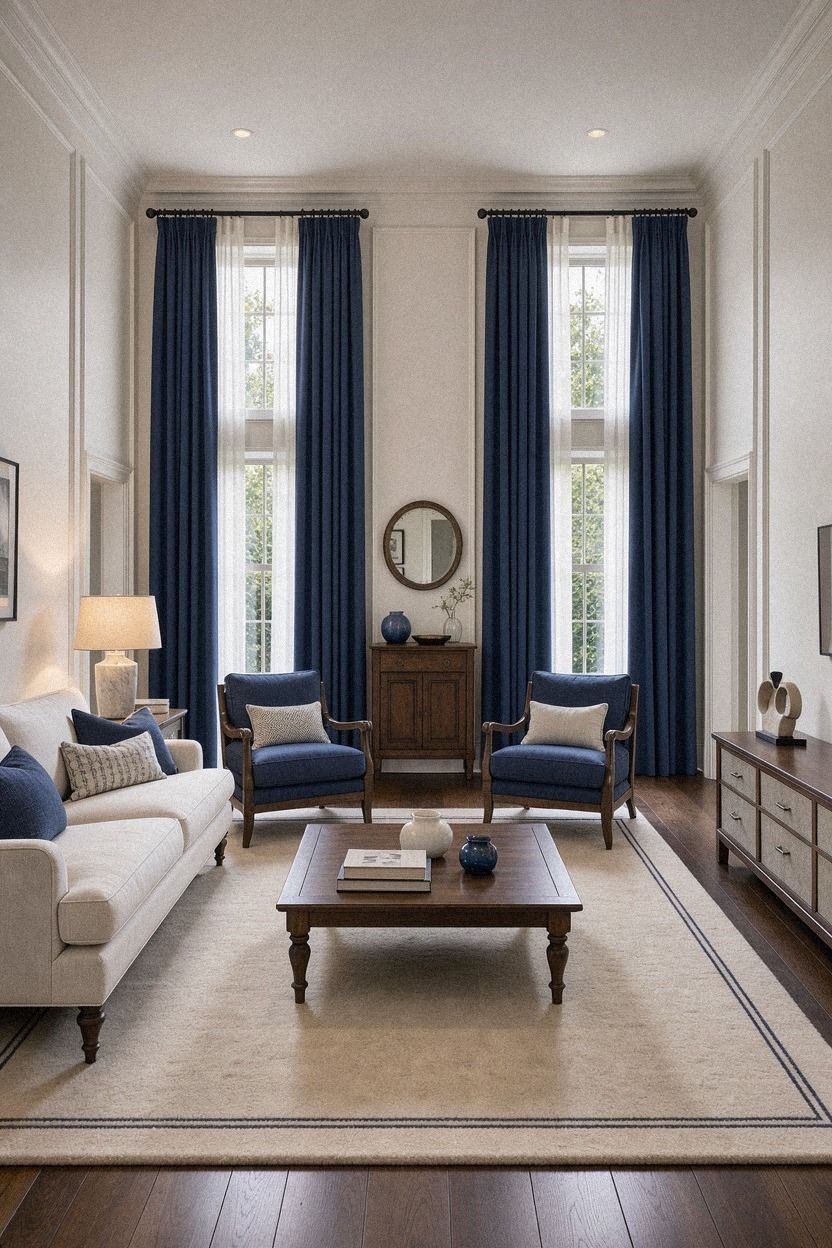
1Hang the Rod Near the Ceiling for a Taller Curtain for High Ceiling Living Room
Mounting the rod close to the ceiling gives your windows a longer visual line, especially when the glass stops several feet below the crown molding. I like placing the rod 4 to 8 inches below the ceiling when the architecture allows it. You’ll want enough clearance for the rings or grommets, so measure the hardware before drilling.
A dark walnut curtain rod looks especially polished with navy walls, white trim, and warm wood furniture.
The panels should reach the floor with a slight break, not hover above the hardwood. If you’re working with navy paint, try soft white shagreen-textured panels rather than stark white polyester.
The subtle surface catches afternoon light and keeps the tall wall from feeling hollow. That small adjustment can make the whole room feel elegant and finished!
If you’re repainting too, our fall mantel decor ideas can help you connect the window wall to the fireplace. You’ll see the relationship more clearly when the trim, mantel, and curtains share one calm visual rhythm.
2Layer Sheers Under Full Panels for Soft Daylight
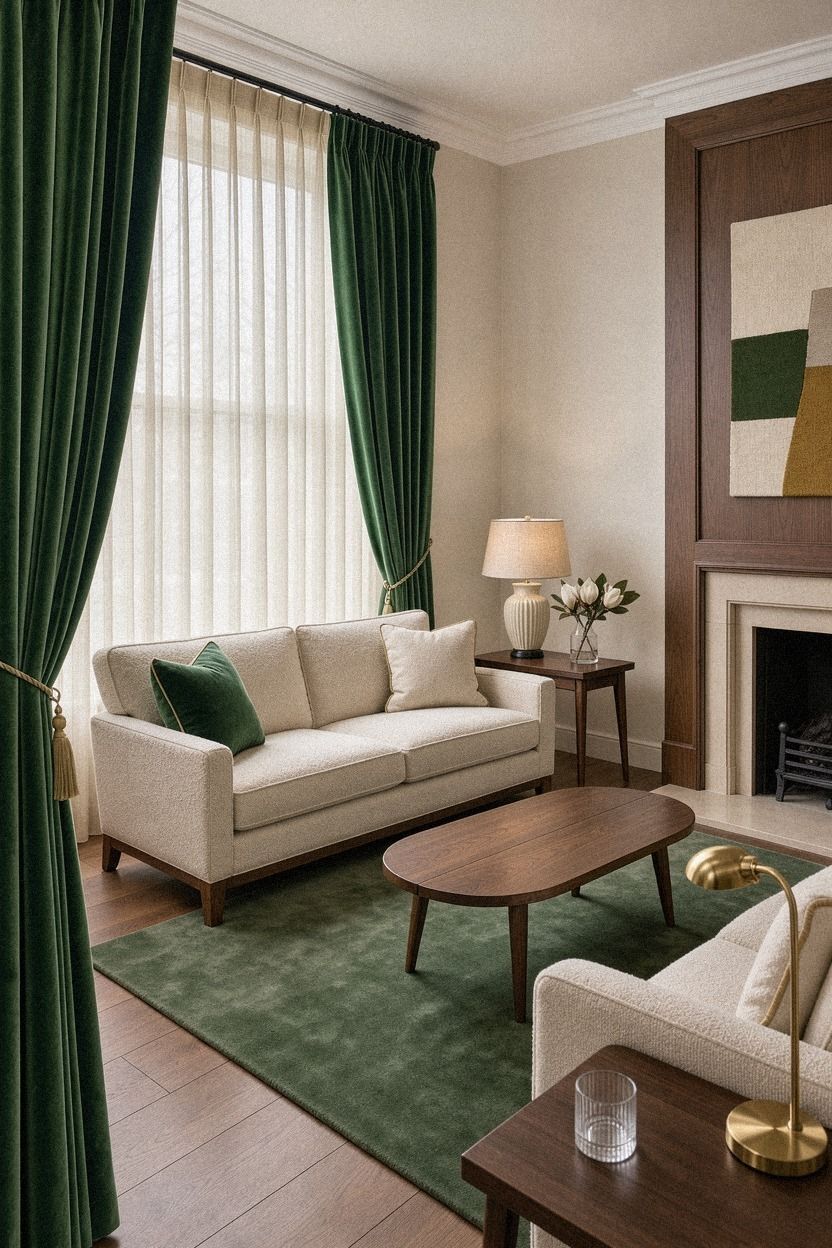
Layering a sheer curtain beneath a heavier panel gives you privacy without making the windows feel shut.
3Build the Three-Height Light Stack
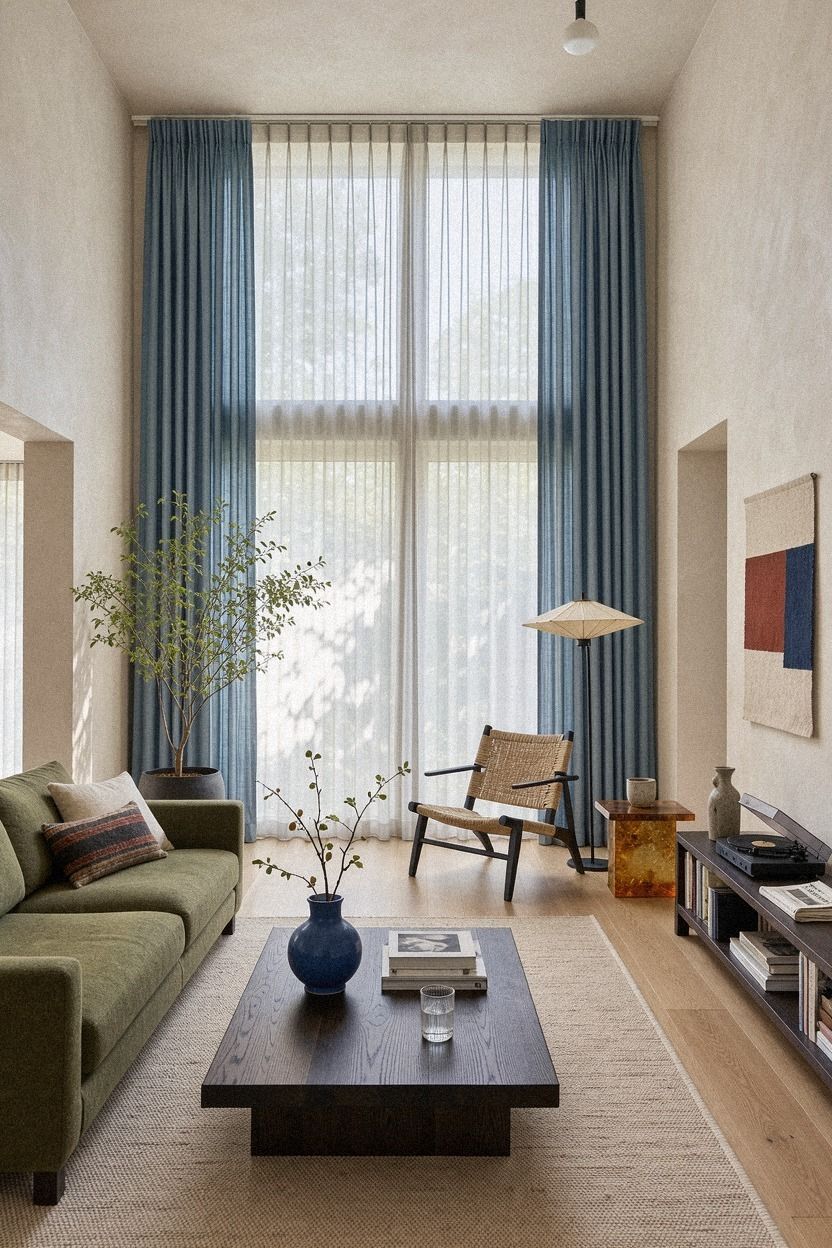
High windows can make the upper half of a living room feel bright while the seating area stays dim. The Three-Height Light Stack solves that by combining a ceiling fixture, a middle-height floor lamp, and low table lighting. I’m fond of a forest-green linen drum pendant overhead, a natural oak floor lamp around 60 inches tall, and a small bouclé-shaded lamp near the sofa.
The point isn’t to flood your room with light. You’re creating separate pools so the curtains still look soft after sunset. A rust ceramic table lamp gives you a warm glow near the seating, while an organic bouclé floor shade stops the window wall from turning into a black rectangle at night.
Don’t place every light directly in front of the glass. Offset one lamp by 18 to 24 inches, and your room will feel more layered and less staged. Our high-waisted jeans article is not a decor guide, but its advice about proportion applies here: placement matters more than the label.
You’ll notice the improvement immediately!
4Float Full-Length Panels Outside the Glass
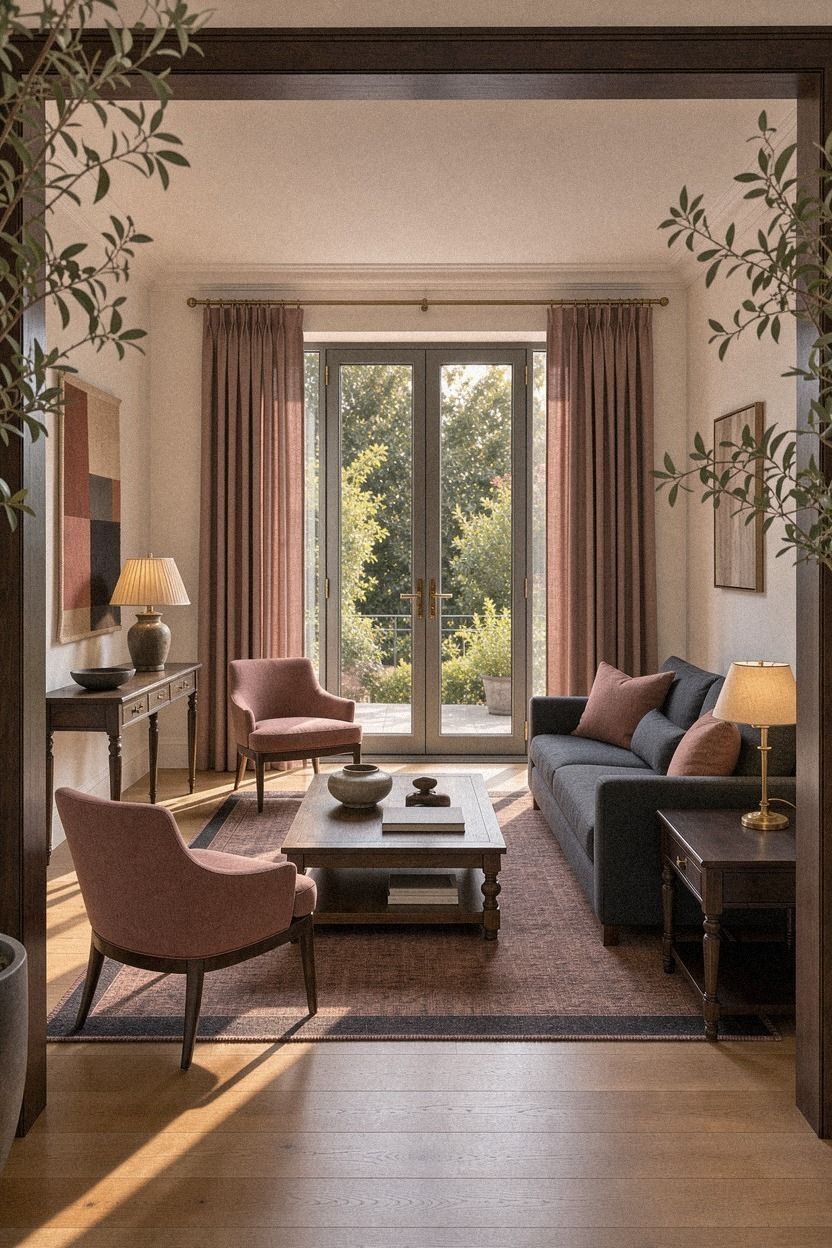
Mounting the panels outside the window frame lets the glass remain visible when the curtains are open. You’ll need enough wall space for the fabric to stack without covering the window, usually 10 to 15 inches on each side depending on the fullness. I’d rather see a little wall than lose the daylight behind bulky charcoal linen curtains.
Choose panels at 1.5 to 2 times the rod width so they’ll look full when closed. If you’re covering a 72-inch opening, a total curtain width of roughly 108 to 144 inches gives you better folds. For very tall windows, 108-inch panels can work in rooms with standard ceilings, but measure from the actual hardware to the floor before buying.
The wrong choice is one narrow panel on each side. It makes the windows look underdressed and leaves the tall wall feeling unfinished.
A pair in dusty rose linen with brass hardware will work with pale floors, charcoal seating, and both modern and traditional furniture. You’ll notice the difference as soon as the fabric frames the view instead of interrupting it.
5Choose the Two-Wood Rule Over a Matching Set
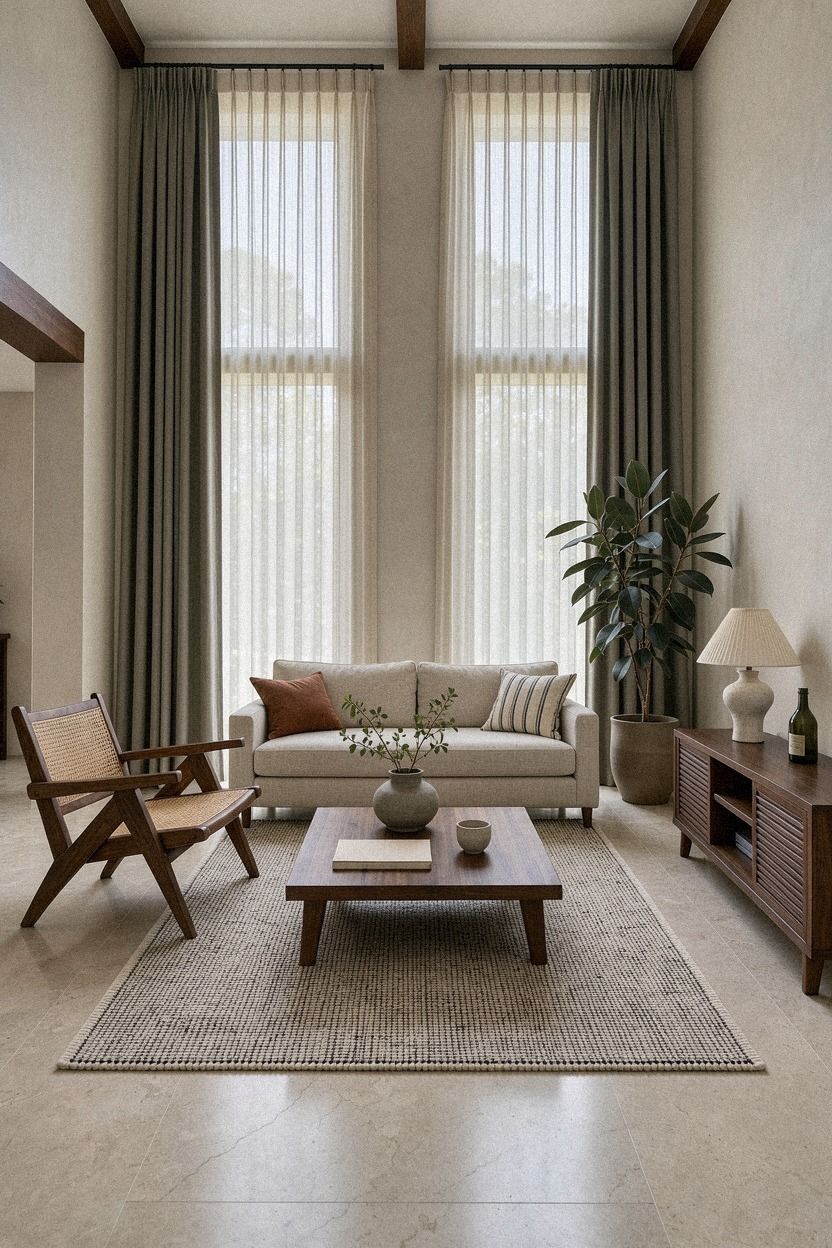
When your living room has tall windows, the curtains become part of a large composition that includes the floor, trim, and furniture. The Two-Wood Rule keeps the palette from looking flat: pair one dominant wood with one supporting wood, then let the window fabric bridge them. I’ve used warm white oak with camel upholstery and black side tables, and the contrast made the curtains feel intentional without matching every surface.
If your floor is pale wood, skip orange-toned rods and furniture. They’ll make the room feel yellow by late afternoon.
A black curtain pole or dark hardware gives the eye a graceful pause. You can use a deep-pile mohair velvet panel between the two woods, especially if the walls are warm white.
That combination is dramatic but still comfortable, and it won’t require a complete furniture replacement. You’ll get more depth from three related finishes than from one coordinated showroom set.
If you’re choosing between a matched collection and a more collected room, I’d choose the latter every time. It feels more personal.
Our minimalist dressing story makes a similar case for fewer, more useful choices. The idea translates beautifully to a window wall.
6Swap Short Curtains for Long Curtain Living Room Panels
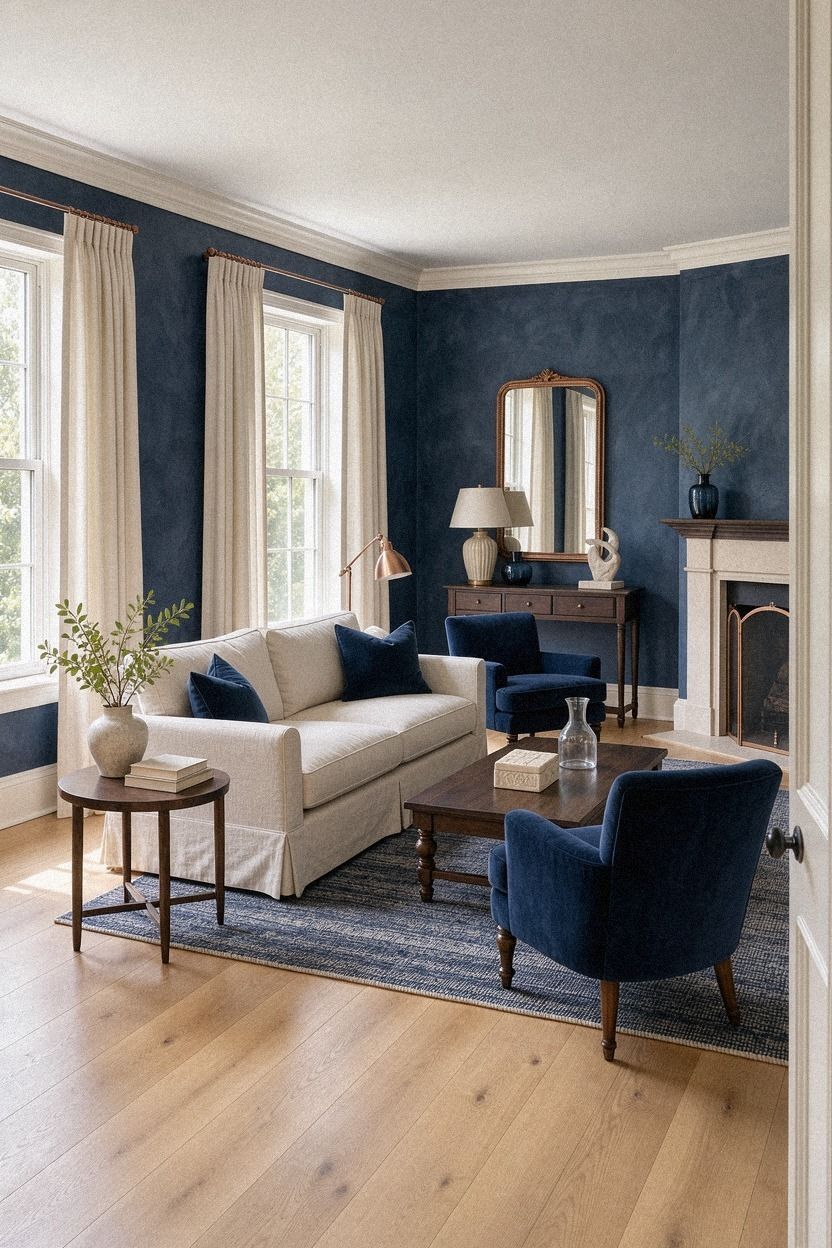
Short curtains are rarely kind to high ceilings.
7Frame the View With a Wide Roman Shade
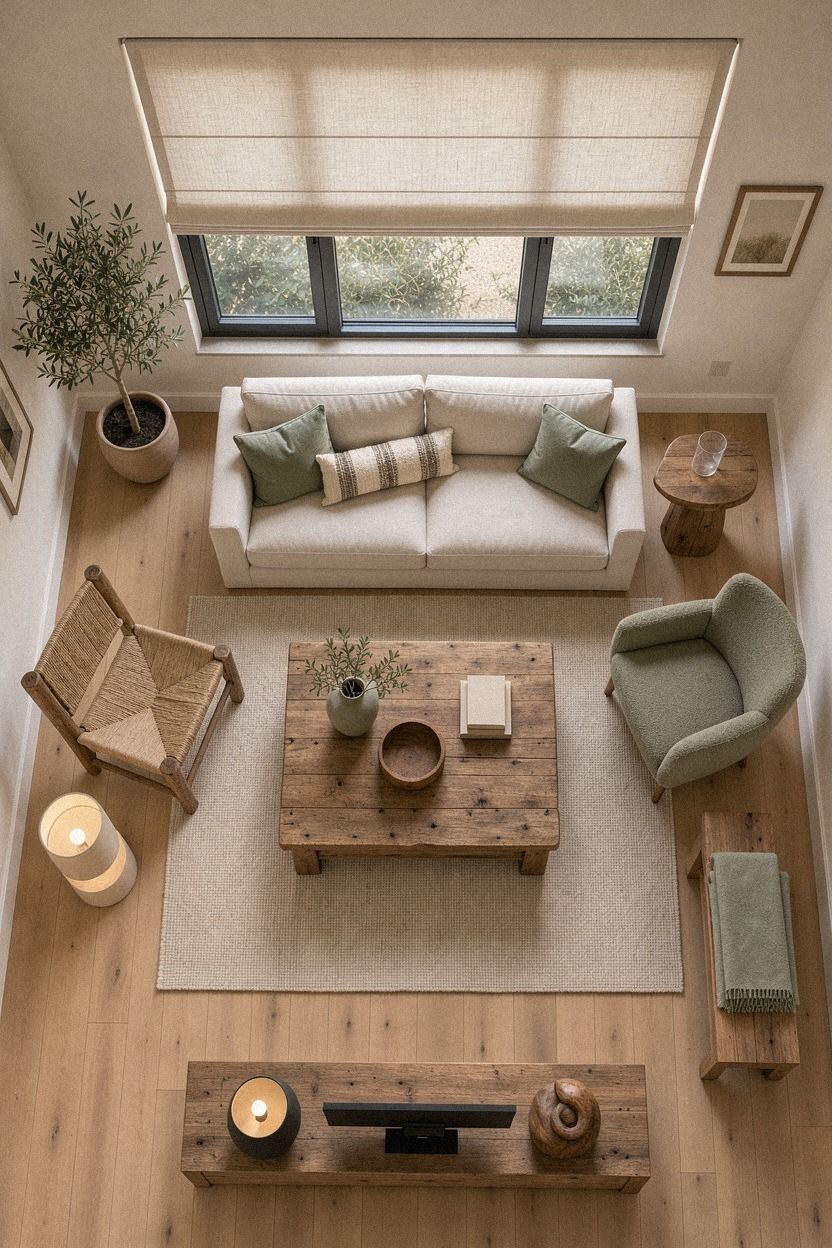
A wide Roman shade works when you want fabric texture but don’t need curtains extending to the floor. Choose this option when the lower portion of the wall already has a sofa, built-in, or console that would make full panels feel crowded. A sage-green Roman shade in soft linen keeps the upper window clean and adds a gentle horizontal line.
You’ll need to mount the shade either inside the frame or above it, depending on the depth and trim. Inside mounting looks tailored, but outside mounting can make a smaller opening appear wider.
I’d avoid a tiny shade centered in a giant wall. It’ll look like a postage stamp.
Instead, use a shade that spans the full window bank or combine two shades with matching fabric. If you’re choosing between bright white and warm cream linen, pick cream when your room has natural wood, reclaimed teak, or tan leather. The undertone will save you from a cold, disconnected window.
Our high-waisted jeans article is another reminder that proportion changes how a shape reads. You’ll want the shade to relate to the full wall, not only the glass.

8Paint the Window Wall for a Moody Contrast
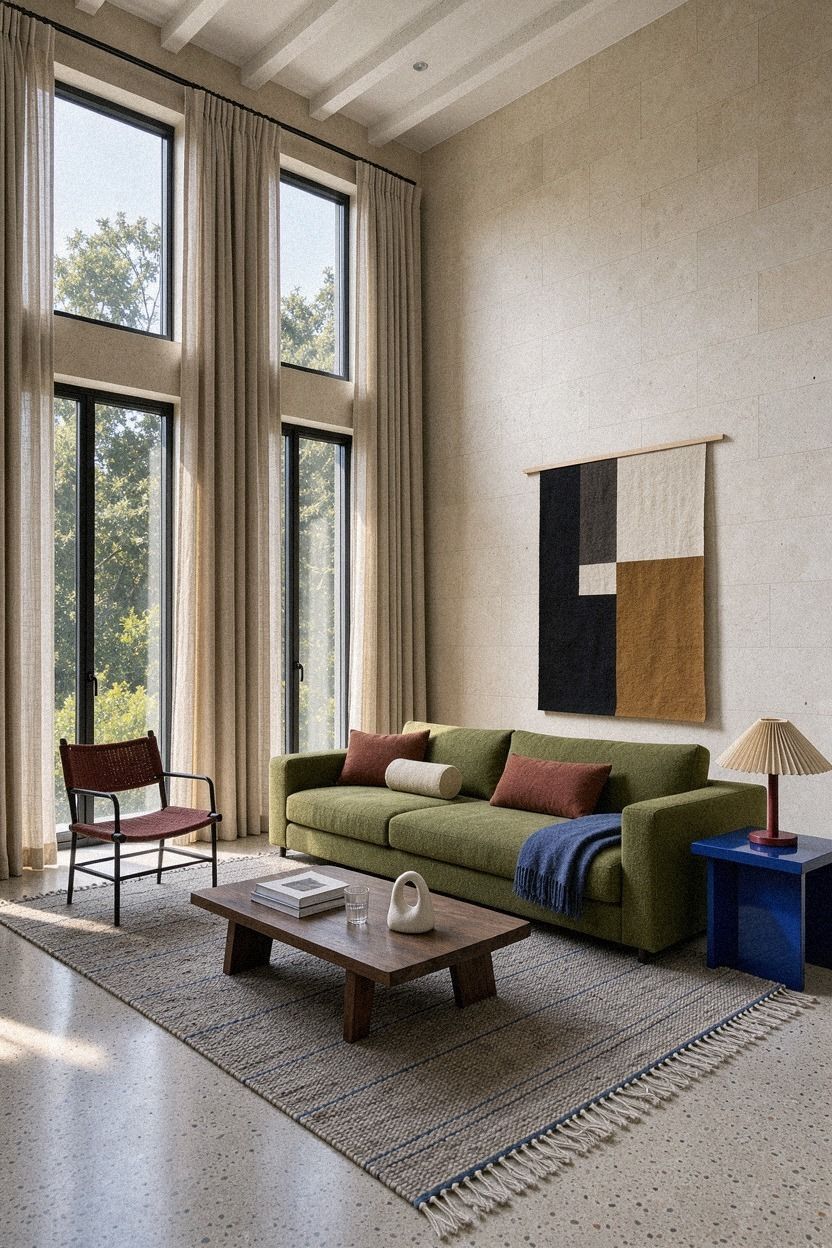
Painting the wall around high windows can make the architecture feel deliberate instead of oversized.
9Anchor the Curtains With a Low Sofa
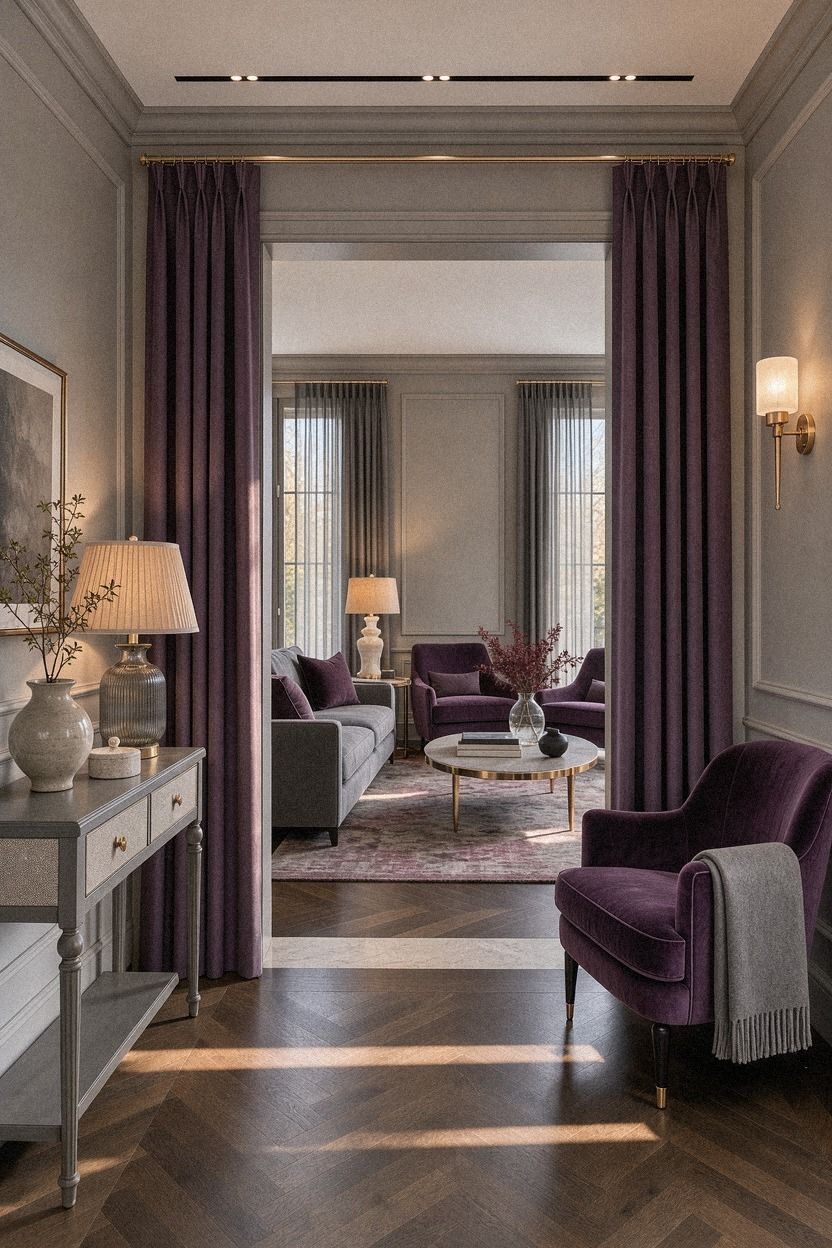
Tall windows need a strong horizontal line below them, and a low sofa can provide it. Look for a sofa depth between 35 and 40 inches, with a back that doesn’t compete with the bottom of the glass. A clay-colored sofa in washed linen gives you a grounded shape while the curtains carry the eye upward.
The spacing matters. Keep enough room for the panels to close without pressing against the sofa arms, especially if the fabric is lined. You’ll want the sofa at least a few inches forward of the wall so the curtain can fall freely.
I made the mistake of pushing a deep sofa directly beneath a window once, and the panels bunched behind it every day. It looked fine in the room and annoyed me every morning. A low profile, open space, and one aged brass side table will make the whole arrangement feel warm instead of crowded.
Our barrel-leg style article explores how a rounded silhouette can soften a strong shape. You can use the same thinking here, especially when the window wall feels severe.
10Use a Ceiling Track Instead of High Curtain Rods

A ceiling track is the cleanest answer when the window wall is unusually tall or wide.
11Mix Linen and Velvet for Fall Warmth
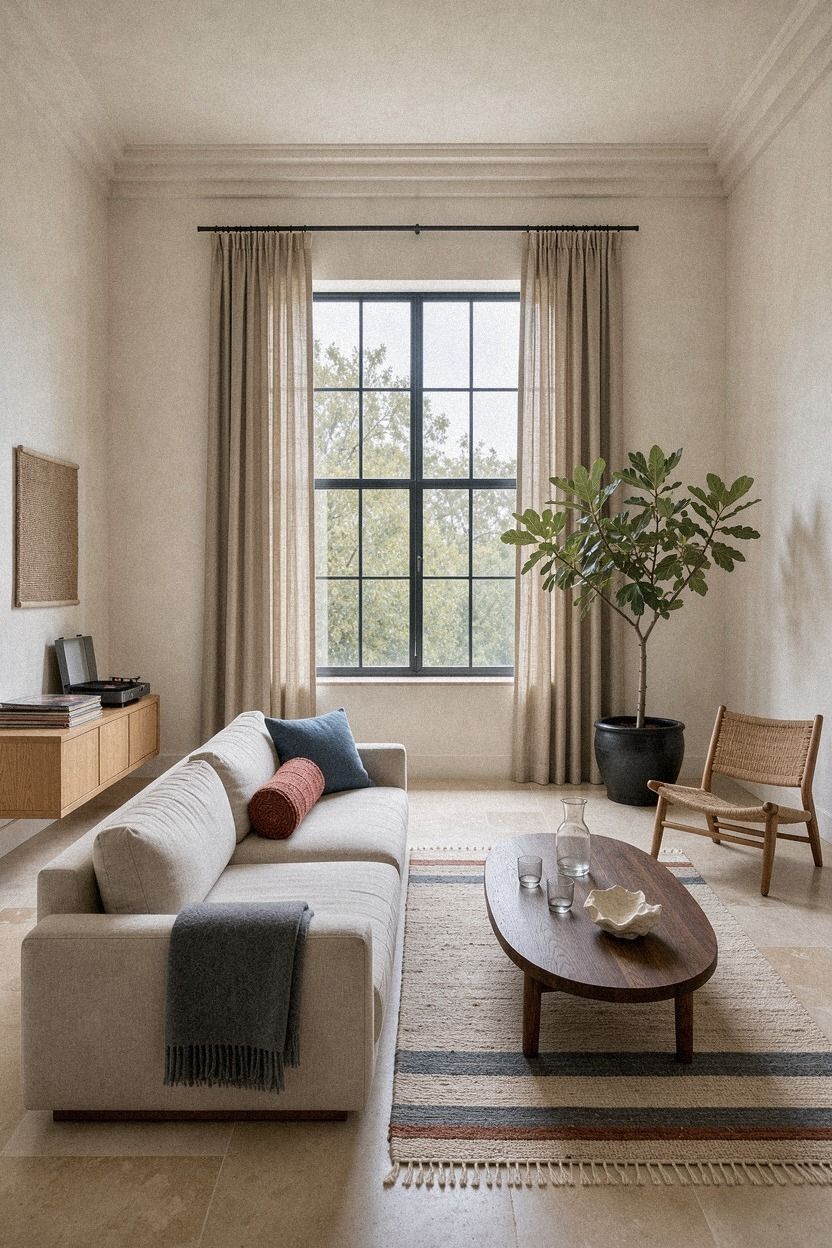
Fall is when high windows can start feeling chilly, both visually and physically. Mixing a lighter base fabric with a heavier side panel gives you warmth without turning the room into a dark theater. Try white linen sheers behind midnight-blue velvet panels, then repeat the velvet in one pillow or a small ottoman.
I’d use this combination only where the room needs extra insulation or evening softness. In a sunny space, velvet can absorb a lot of light and feel too weighty by noon. You’ll want to check how the fabric looks against your floor, because blue velvet beside warm walnut can become muddy.
An ivory wool rug and book-matched walnut table will give the colors breathing room. For a richer seasonal layer, look for a 9x12 wool rug when the seating arrangement allows it. That size can hold the front legs of the sofa and chairs, which makes the window wall feel connected to the rest of the room.
Our tested high-end perfume roundup deals with another kind of sensory choice, but the useful lesson is similar: richness works best when you give it room to breathe.
12Add a Cornice for Architectural Weight
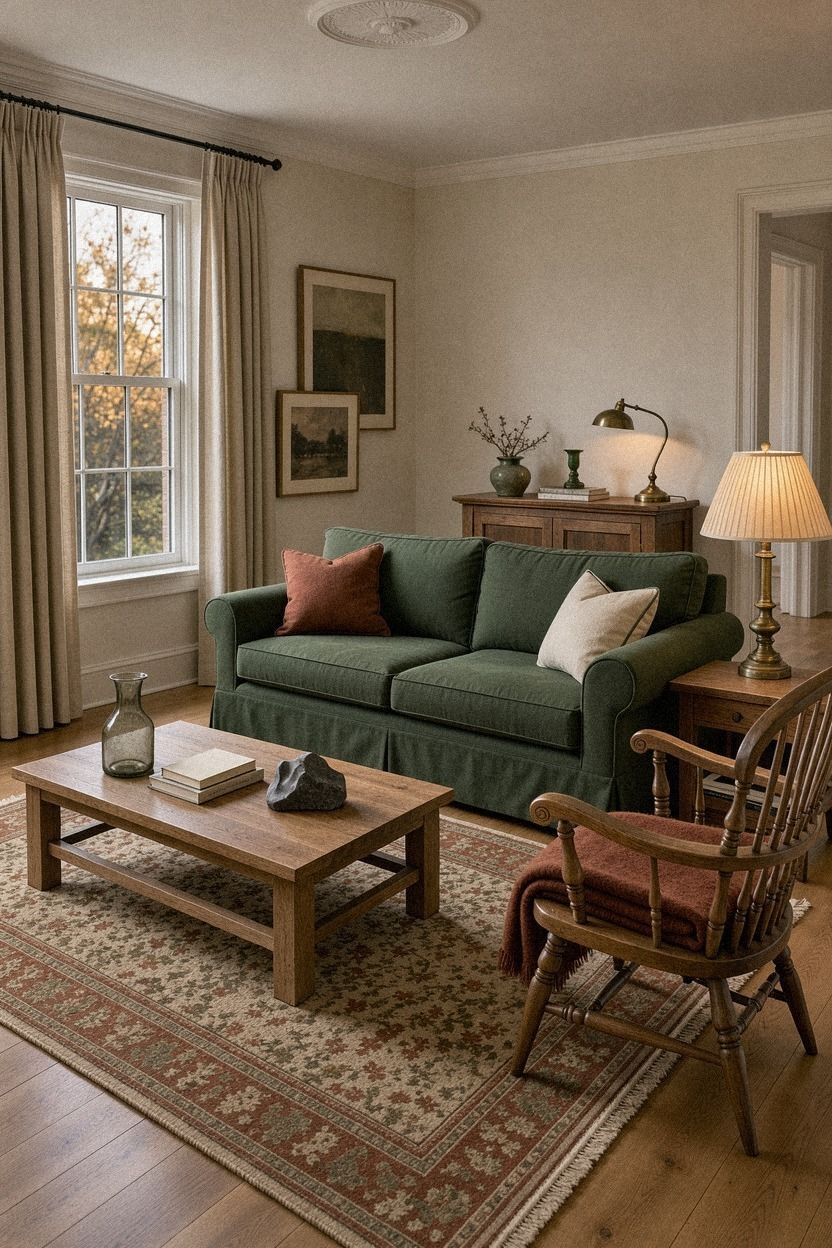
A cornice can hide curtain hardware and add a strong finished edge above very tall windows. Use one when the room has crown molding, built-ins, or traditional details that need another architectural note. A cream-painted cornice with subtle bouclé upholstery nearby will look built-in, while a gold-toned cornice creates a more luminous statement.
The cornice should be deep enough to clear the rod and fabric, but not so deep that it projects like a shelf. You’ll want to measure the stacked curtains before ordering the box. If you’re using blackout lining, the folds may need more room than expected.
I’d skip ornate carving in a contemporary living room. A simple squared profile will look polished and won’t compete with the view. If you’re already planning a mantel update, our fall mantel decor ideas can help you repeat the same gold or paint finish nearby.
That repetition makes the room feel considered. You won’t need matching cornices, tables, and shelves everywhere. One related finish is usually enough.
13Layer Art Beside the Window Instead of Above It
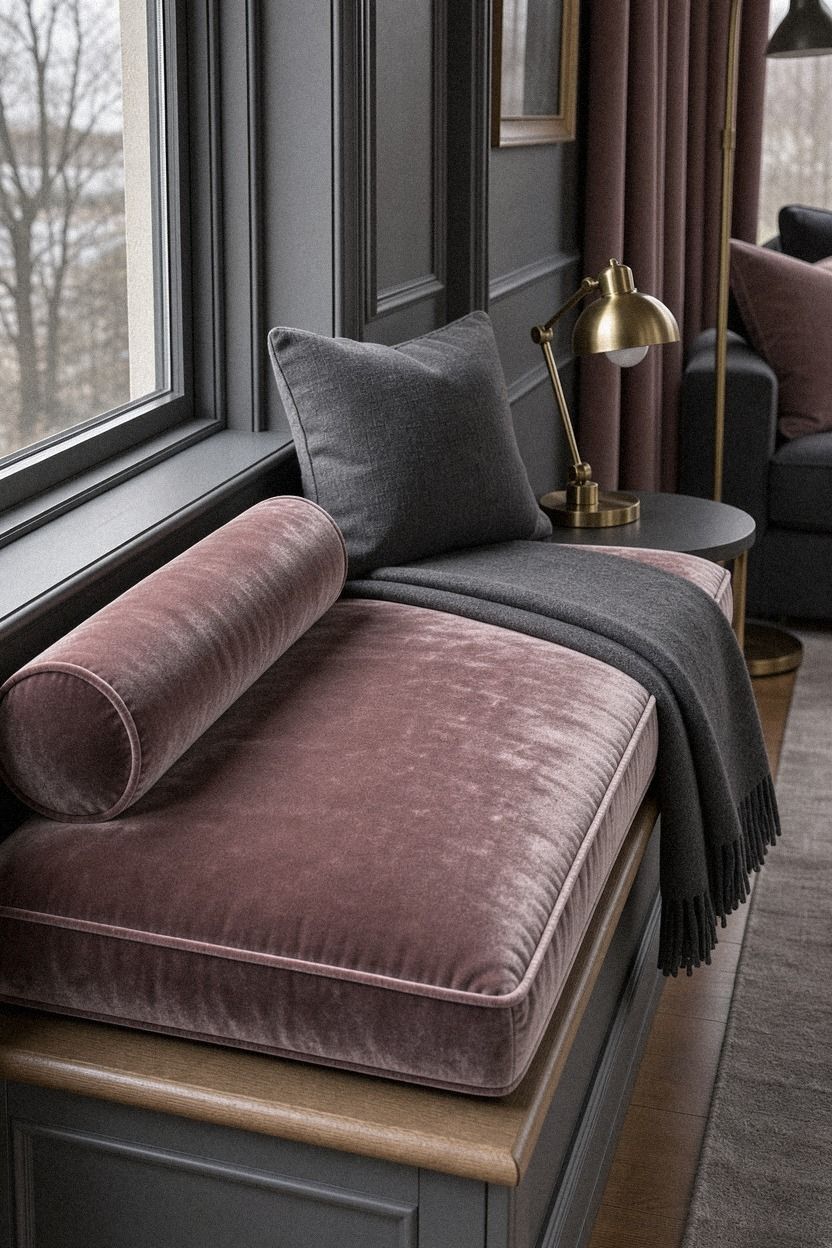
High windows often leave narrow vertical areas that are too small for furniture but ideal for art. Hang one tall painting or a pair of narrow prints beside the window, not directly above the glass. This gives the wall a second point of interest and keeps your curtains from doing all the visual work.
A forest-green painting with rust, natural oak, and unlacquered brass can echo the outdoors without looking themed. You’ll want the center of the art around eye level from the seating area, even if the frame extends higher. I’d avoid several tiny frames scattered up the wall because they make the architecture feel nervous.
One 24-by-36-inch piece or a slim pair will read more clearly. If your view is already dramatic, choose quiet art.
If the view is plain, a bold abstract can provide the color your curtains don’t. The room doesn’t need every surface competing for attention.
Our minimalist dressing story is a useful reminder that restraint can still feel expressive. You’ll get a more serene room when every object has enough visual space.
14Style the Window Seat With Practical Texture
If your high windows include a ledge or built-in seat, treat it as a useful extension of the living room rather than a display shelf.
What the Window Refresh Usually Costs
Your window treatment budget can stay modest if you’re keeping the existing layout, but the total rises quickly when you add custom panels, a ceiling track, or built-in millwork. These typical US room costs are useful planning ranges, not a promise for every retailer or project.
For the window pieces themselves, linen drapes for a pair typically run $120-$400, while a performance-fabric sofa can land between $1,200 and $4,000. You’ll save money by measuring carefully, using ready-made 108-inch panels, and choosing a standard rod.
The part worth paying for is installation when the windows are unusually tall. A crooked rod will be visible from every seat, and you won’t enjoy fixing it later. Our tested high-end perfume roundup is about a different kind of purchase, but the same rule holds: spend where repeated daily use makes the difference obvious.
The Window Rule I Keep Coming Back To
I used to think tall windows needed tall decoration. More fabric, larger art, heavier furniture, and a dramatic pendant seemed like the obvious answer.
Then I worked on a room where every object was oversized, and the windows disappeared inside the competition. The space felt expensive but strangely tense.
You couldn’t rest your eye anywhere.
Now I start with the line of the curtain and ask what should happen below it. If the fabric reaches the floor, the sofa can stay low.
If the wall is dark, the art can be quiet. If the view is wide, the hardware should nearly vanish.
You’re not filling height just because it’s available. You’re giving the architecture a rhythm your furniture can support.
I’ve also learned that expensive custom drapes aren’t automatically better. A well-measured washed linen panel with a generous hem can look more relaxed than stiff lined fabric that stops too high. I’d rather see a $200 refresh with correct proportions than a $2,000 treatment mounted at the wrong height.
That opinion has cost me a few arguments with decorators, but it keeps proving itself.
The most successful room I’ve seen used only three main materials: linen, oak, and aged metal. The texture did the work. You could feel the difference in the quiet drag of the curtain across the track, the warm grain beneath your hand, and the way evening light settled into the folds.
That’s what you should chase. Not more objects, but a window wall that feels connected to how you live. Our fall mantel decor ideas can help you carry that same connected feeling into the rest of the room.
The Questions I Get Asked Most
What is the best way to dress high ceiling windows in a small living room?
Full-length panels mounted close to the ceiling are usually the best choice because they draw your eye upward without using much floor space. I like IKEA HILJA panels or a simple ivory linen blend for a light, airy result. You’ll want to stack the fabric beside the glass, not directly over it.
Where can I buy high ceiling window pieces on a budget?
IKEA, Wayfair, and Target all carry ready-made curtains, rods, and shades in useful lengths. I’d also look for a solid wood curtain pole and linen panels through Facebook Marketplace or a local thrift store. Our minimalist dressing story has a good reminder to buy fewer, more useful pieces.
How much does a high ceiling window makeover cost?
A basic refresh usually costs about $100 to $300 for ready-made panels, hardware, and steaming supplies. I’d first rehang existing curtains higher and widen their placement before buying anything. Custom treatments, ceiling tracks, and professional installation raise the price quickly, but they can be worthwhile when the windows are unusually tall.
Can I create this look on a budget?
Yes, and you can start with three low-cost moves: raise the rod, steam the panels, and move the fabric outside the window frame. A secondhand wood curtain pole, simple cotton panels, and one floor lamp can change the proportions without replacing your furniture. Save our budget-friendly barrel-leg style article for another lesson in using shape before spending.
Is dressing high ceiling windows worth it in a small space?
Yes, because the vertical fabric uses wall height without taking much usable floor area. I’d mount the rod high, keep the panels narrow when open, and choose a pale material such as cotton voile.
You’ll get privacy and softness without making the seating zone feel crowded. It’s one of the most effective small changes you can make!
Is this a good idea for a rental?
Yes. I’d use a tension rod for lighter panels, removable hooks for small shades, and a ceiling-height track only when your lease allows drilling.
You can also choose peel-and-stick window film for privacy while keeping daylight. Before changing hardware, check your rental agreement and patch small holes when you leave.
Where I’d Start First
If I had to pick one, I’d start with full-length linen panels mounted near the ceiling. The extra height fixes the room’s proportions before you buy anything else. Pin this idea for later, then measure your wall from ceiling to floor before shopping.
Our barrel-leg style article offers a final reminder about silhouette: the right shape can change how everything around it feels. Get the line right first, and the rest of your window wall will become much easier to finish.