9 Dinosaur Birthday Party Games for a Group of 15 Kids
17 november 2026A dinosaur party for 15 children works best when games are short, visible, and easy to reset. You can divide the group into three teams of five and rotate them through turns or stations. This structure limits waiting, gives each child a clear role, and helps you adjust the pace for different ages.
Use large, lightweight props, mark movement boundaries with painter’s tape, and keep snacks and drinks away from active play. Each game below includes an illustrative planning estimate of 5–12 minutes.
Timing is flexible. You’ll know when the group is still engaged, and you can repeat a favorite round if the room remains organized.
The table below gives a simple starting plan. These are illustrative planning estimates, not measured prices or fixed requirements. Set a supply budget only after checking your cupboards.
The optional cost rows describe what you might need to buy; borrowed props can make those costs zero. Check age labels before deciding whether a cheap prop offers good value.
A paper game is often worth choosing when a specialist toy would be used once.
1Build the Fossil Dig Relay With the Two-Bin Rule
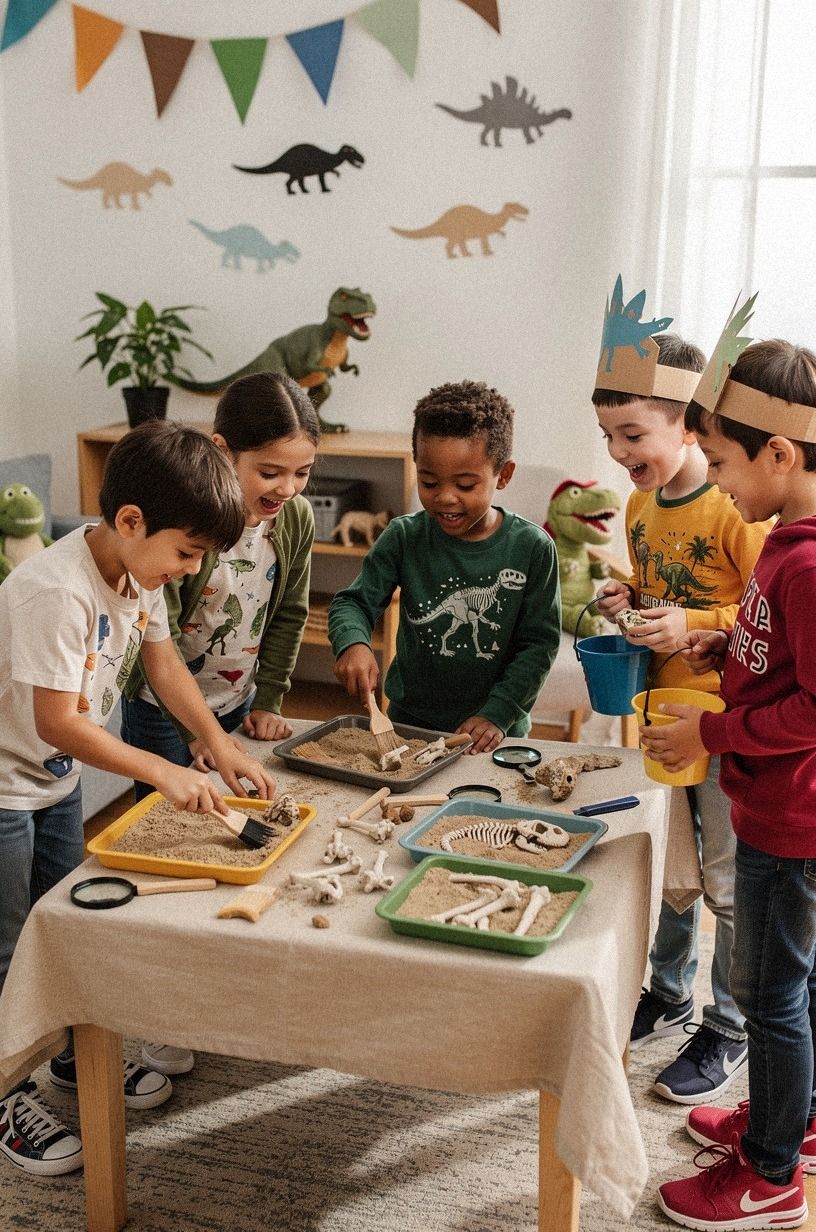
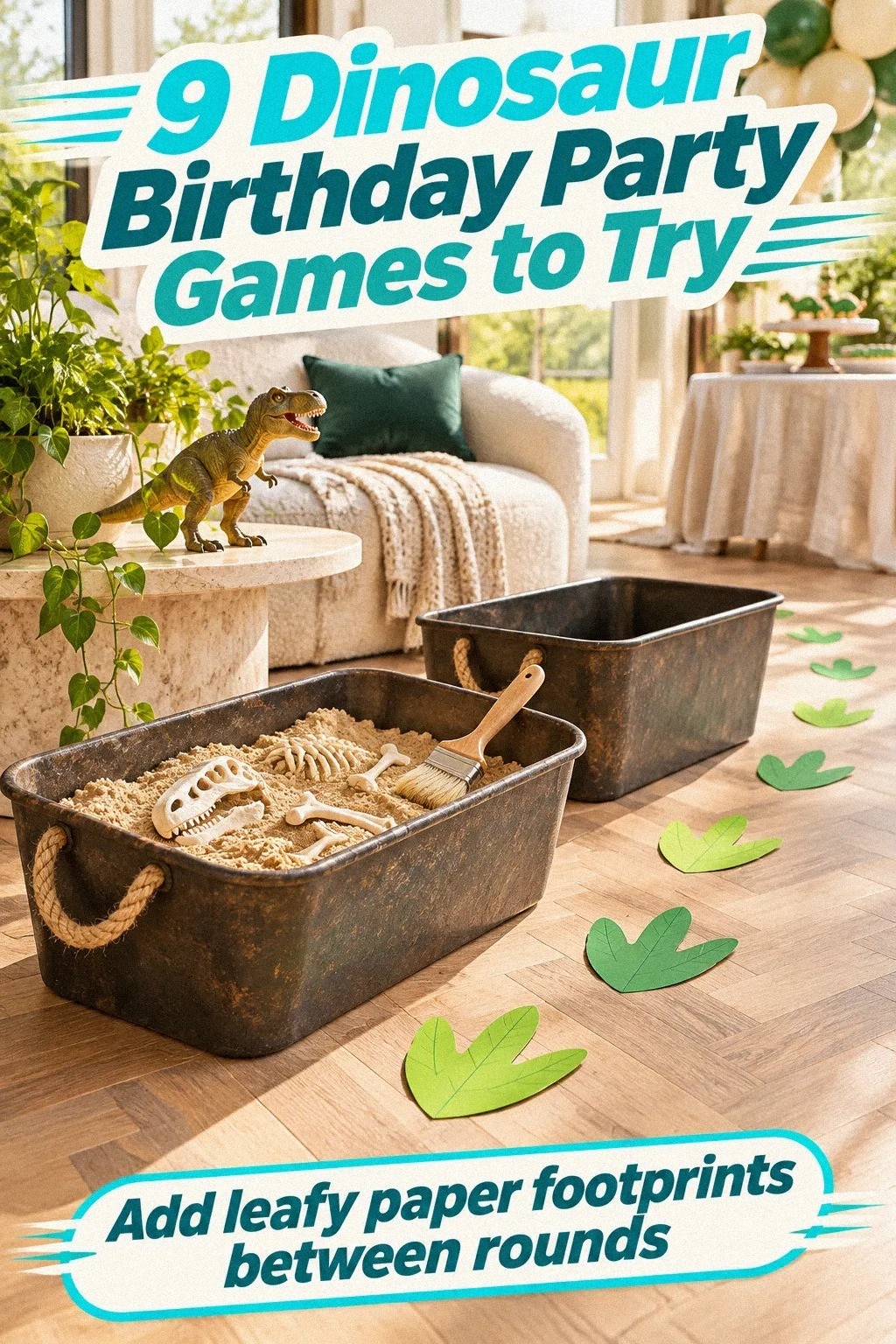
Materials include one shallow bin, clean play sand, kinetic sand, or shredded paper, large plastic dinosaur bones, laminated dinosaur cards, and an empty collection bin. Hide the bones in the first bin and place the second bin about six feet away. Mark a start line so children carry one item at a time rather than crowding the dig area.
Estimated round: 6–8 minutes. Divide the children into three teams of five.
One child from each team digs, carries a bone across the space, and sorts it into the correct collection bin. Rotate diggers after each turn.
You can give waiting children roles as paleontologist, timer, museum labeler, or team encourager. They’ll stay involved without gathering around the bin.
Large bones are safer and easier to find than beads or tiny pieces, particularly for younger children. Keep the filler inside the bin and check the floor after each round.
For older children, add matching cards or ask them to sort items by dinosaur type. Children who don’t enjoy sensory play can use tongs or a card-matching version instead.
The tradeoff is that sand creates more cleanup than shredded paper. A useful alternative is a paper fossil search using large bones hidden under cushions or towels. You can keep the dinosaur theme clear while avoiding loose filler altogether.
2Race Through the Dinosaur Footprint Trail
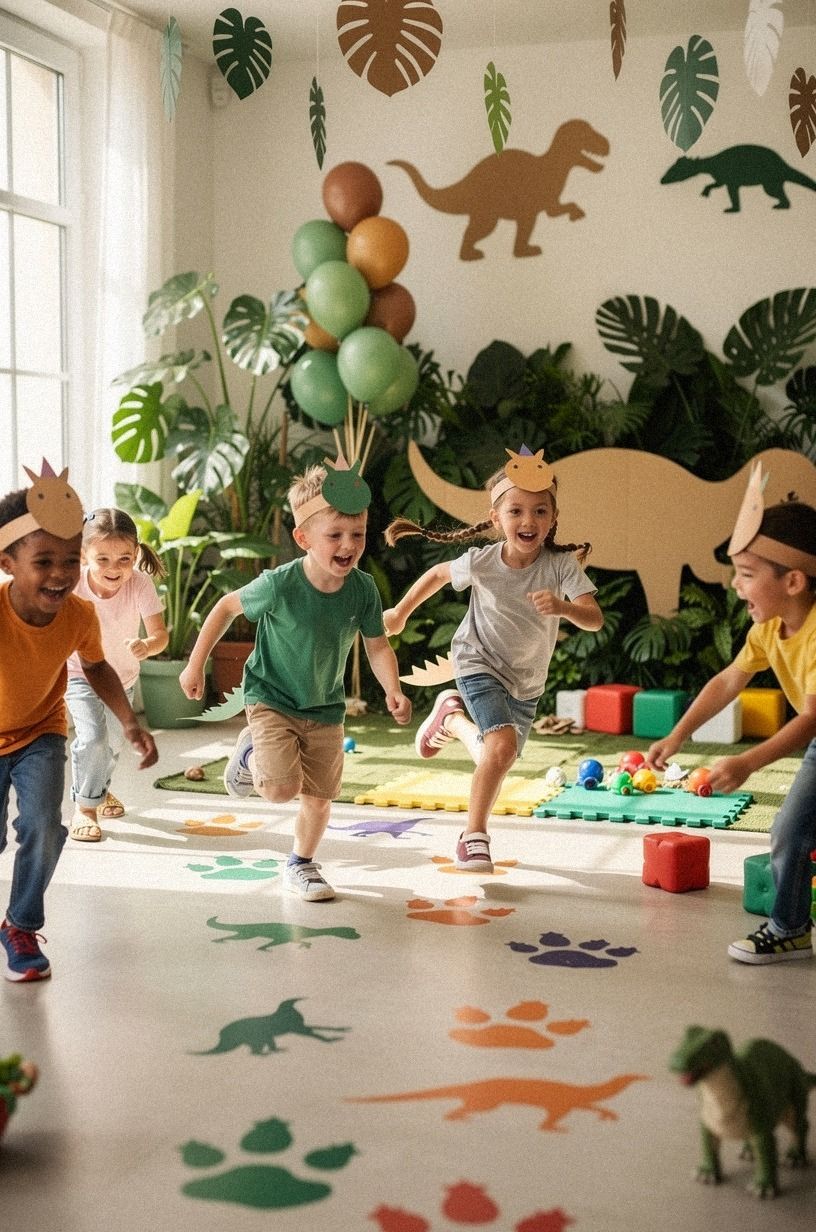
Cut large dinosaur footprints from cardstock or craft foam and place them in a winding path. Use small, medium, and large prints, but keep the trail flat.
You shouldn’t use furniture as stepping platforms. Painter’s tape can hold the edges in place on a smooth floor.
Leave a clear margin around the route, and make sure you can see the finish line from the starting point.
Estimated round: 5–7 minutes. Divide the children into three teams of five and send one child from each team through the trail at a time.
Call “small,” “medium,” or “large,” and require the player to step only on matching prints. After a few turns, switch to a slow dinosaur walk, sideways steps, or a backward-looking walk with an adult nearby.
You’ll get movement and pretend play without asking children to sprint.
The game encourages movement without requiring full-speed running. For younger children, space the prints closely and use only two sizes.
You can add a memory rule for older children: show a short sequence, cover it, and ask players to follow the same order. If a print curls or slides, remove it immediately.
Children shouldn’t jump over furniture or race around corners.
A winding trail uses more floor space than a straight lane, but it feels more like an expedition. If your room is narrow, create a seated footprint sequence. Place the prints on a table or mat, then ask children to tap the matching print with a hand or foam dinosaur claw.
You can also let children move a dinosaur figure from print to print while they wait for a walking turn.
3Ask Which Dinosaur Stole the Egg?
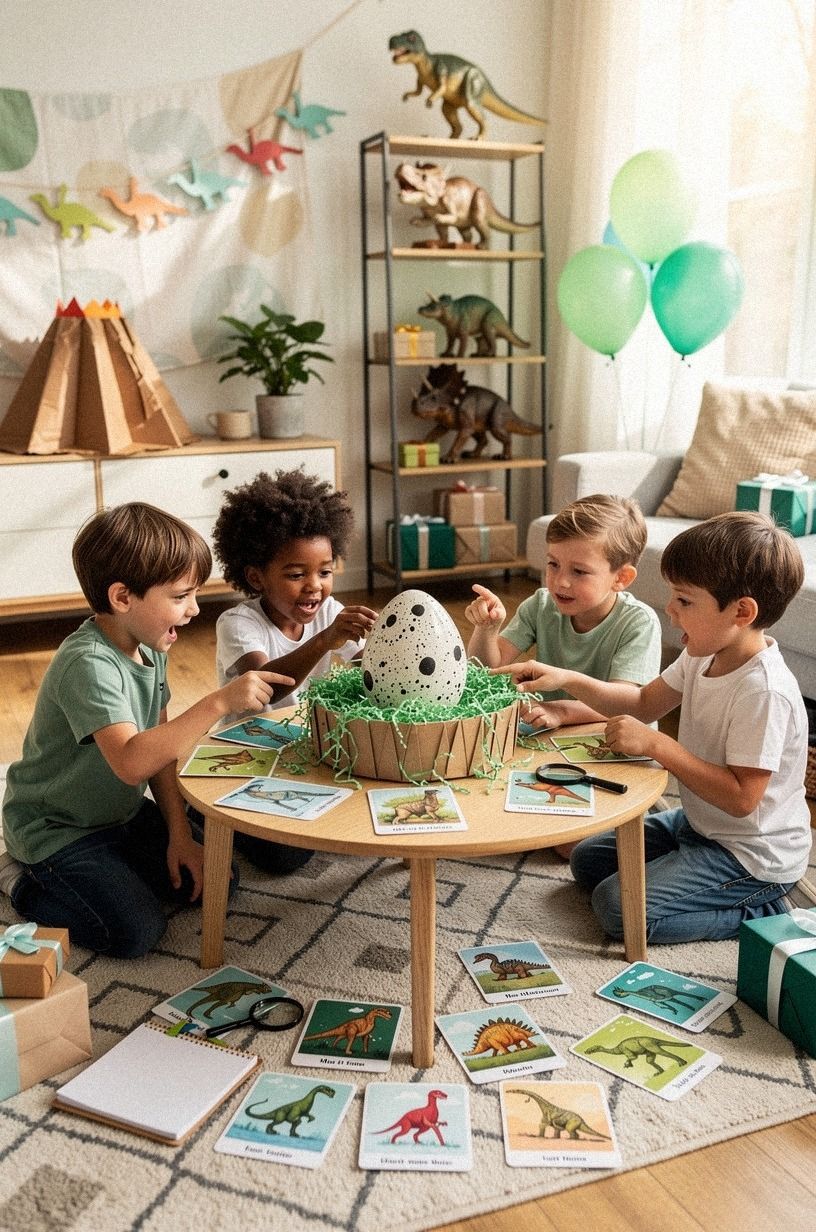
Prepare three paper nests, large foam eggs, and picture clues. Place one egg in each nest.
A detective looks away while a helper moves one egg to an approved hiding spot. The detective gets five yes-or-no questions and one guess. Rotate roles every case; allow 6–10 minutes for the round.
With 15 children, let three small groups play their own cases while adults supervise. Younger children can point to picture clues.
Older children can add a footprint or color clue. No climbing, cupboard searches, hiding behind doors, or private rooms.
Use eggs too large to swallow.
For a quieter alternative, arrange five dinosaur objects on a tray. Let the group look for 20 seconds, cover the tray, remove one item, then ask “What Changed?” Children may answer together instead of competing for a turn.
4Run the Nest Guard Challenge
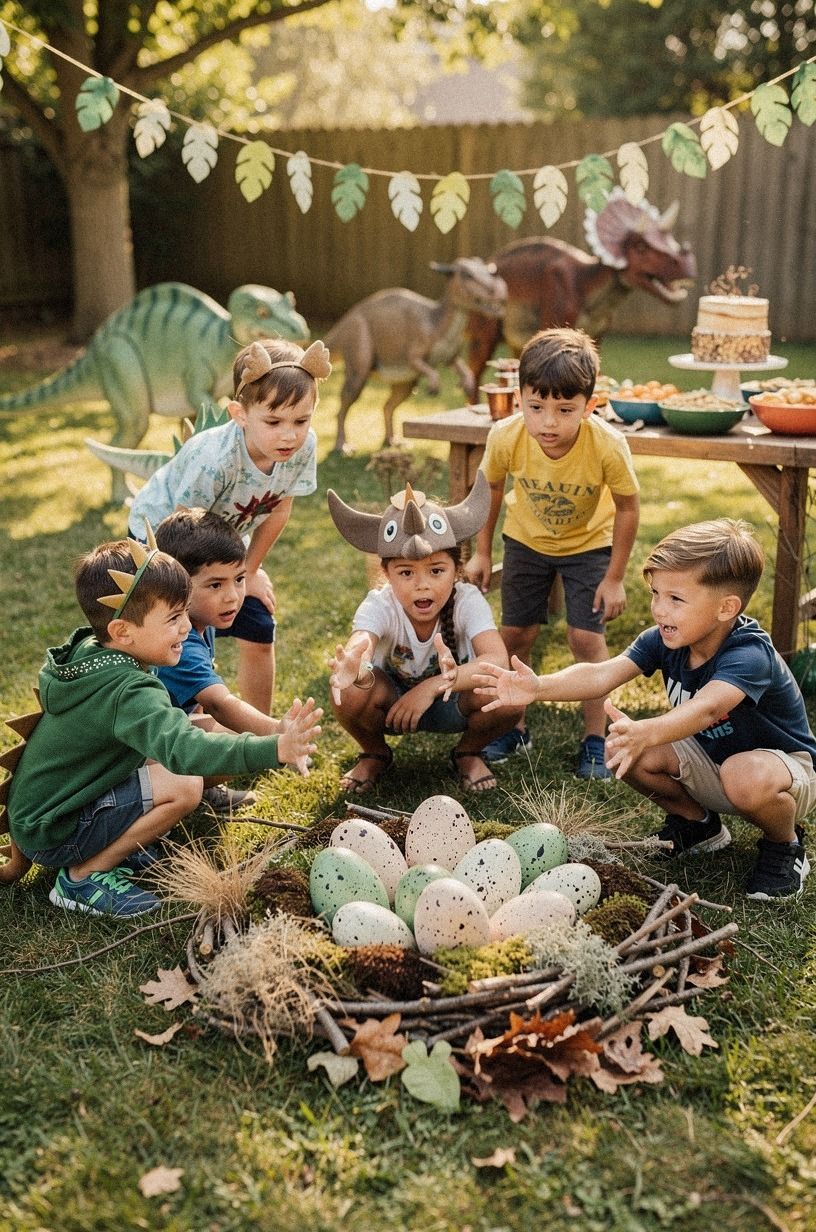
Use a paper nest, lightweight foam eggs, painter’s tape, and a clear floor area. Mark an outer circle for the eggs and a smaller inner circle for the nest.
One guard protects the nest while the other children carry eggs from the outer circle to the center. The guard may tag players gently with a hand or a soft dinosaur token. You’ll need enough space for players to pass without squeezing together.
Estimated round: 7–9 minutes. Divide the group into three teams of five.
One team can guard while the other two teams move eggs, then rotate roles after two minutes. Require the guard to walk rather than run.
Add a movement rule such as stomping like a sauropod, waddling like a hatchling, or shuffling sideways. You can also let children choose their dinosaur movement before each round.
Use soft, lightweight eggs and remove hard objects from the play area. A hand signal or small bell can mark a tag; indoor whistles are unnecessarily loud.
Younger children can play without tagging, with the guard simply pointing to players who must return an egg. Older children can carry two eggs only if the area remains calm.
If the floor gets crowded, pause the game and reset the circles.
The tradeoff is that tagging creates excitement but can lead to collisions in a crowded room. A useful alternative is a timed collection challenge.
The guard counts slowly while players move as many eggs as possible, with no tagging at all. You’ll still have a nest-protection story, but the rules become easier to manage.
For children who prefer quieter roles, offer a basket manager, egg counter, or round caller position. A child can also be the nest narrator and announce when the dinosaur family needs another egg.
You don’t need to remove a child from play because of speed, balance, or comfort. Keep the goal focused on moving safely and helping the nest.
5Play the Volcano Toss
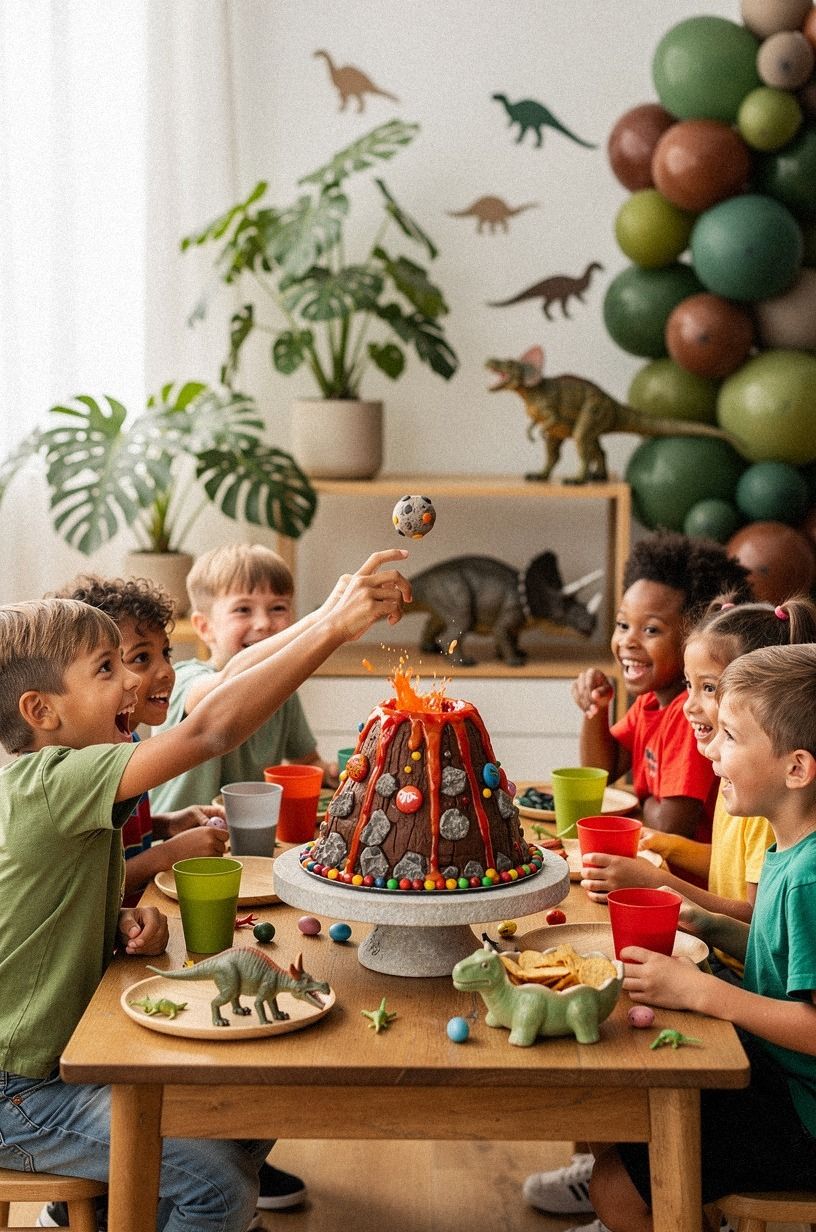
Make a cardboard volcano from a shipping box or cereal boxes covered with brown paper. Cut two or three large openings and place the volcano against a wall or sturdy surface.
Use soft foam balls or fabric balls in three colors. Mark a throwing line with painter’s tape and keep the target at a height suitable for the youngest player.
Estimated round: 5–8 minutes. Divide the children into three teams of five. Each child gets three throws, then the team collects its balls before the next team plays.
Assign simple values, such as one point for red, two for green, and three for blue, or skip scoring and count successful throws together. You can let a waiting child be the ball collector or score caller.
Use a shorter distance for younger children and a longer line for older children. Keep the balls soft enough for indoor play, and make sure no child stands near the target while another throws.
A helper can return balls and record scores, giving waiting children a clear responsibility. Don’t allow children to retrieve balls until you signal that the throwing turn has ended.
The tradeoff is that scoring can motivate some children but frustrate others, especially when throwing skills vary. A useful alternative is a cooperative volcano rescue.
The group gets one lava token for every ball that lands inside and tries to fill a marked cup before time runs out. You’ll preserve the eruption theme without ranking children.
6Draw a Jurassic Escape Map
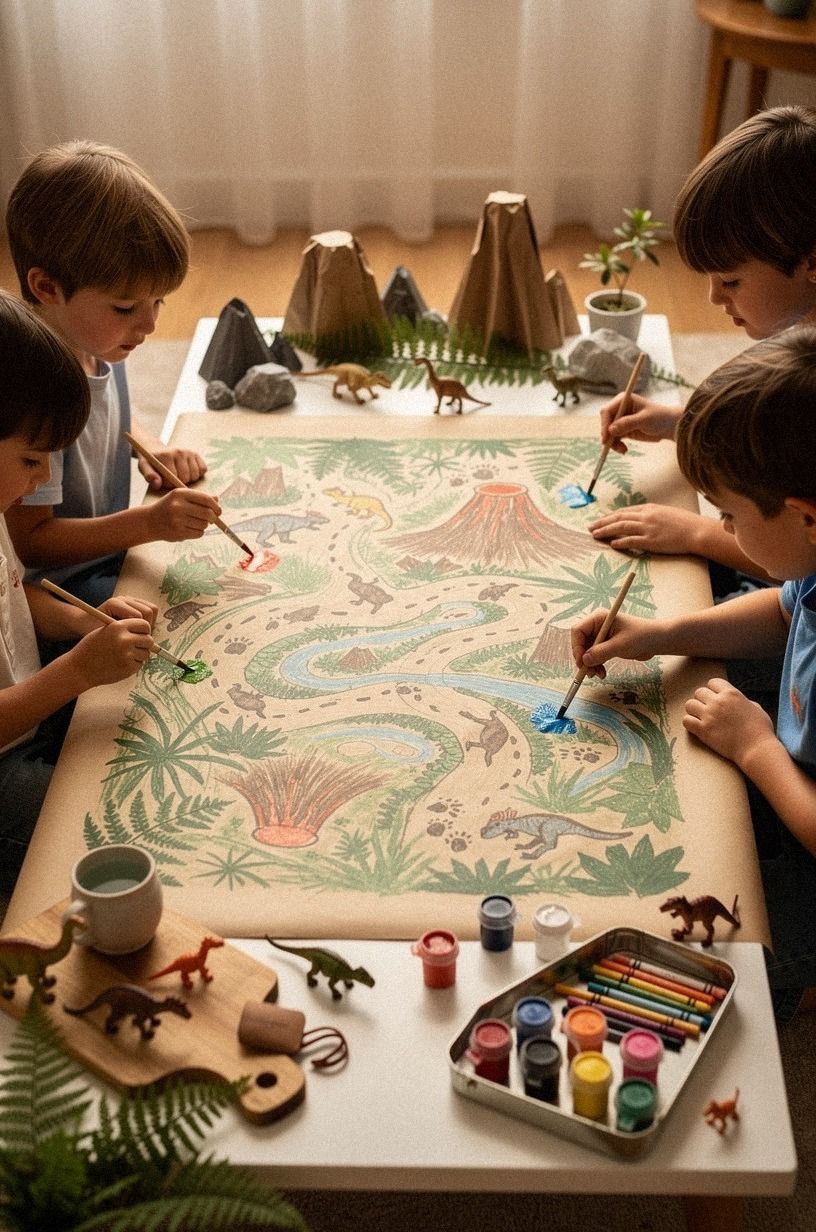
Materials include one large sheet of paper, washable markers or crayons, painter’s tape, and a large foam die. Draw a winding path with a volcano, river, cave, and dinosaur valley before the party.
Leave open spaces so children can add landmarks. Place the map on a washable tablecloth or a clear floor area.
You can sketch the first few features in advance so the activity starts quickly.
Estimated round: 8–12 minutes. Divide the group into three teams of five. Each team adds one feature, such as a bridge, nest, swamp, or safe zone.
Once the map is complete, teams take turns rolling the die and moving a dinosaur marker along the path. At certain landmarks, everyone performs a short action, such as freezing near a sleeping dinosaur or roaring at the volcano.
You’ll create a shared story without needing complicated rules.
Use crayons for younger children who may press hard, and washable markers for older children who want more detail. Keep the map shared rather than giving each child a separate station. That reduces supply clutter and encourages cooperation.
An adult can write labels if needed. You can ask children to describe what lives in each area, but avoid requiring drawing skill.
Add a few simple map instructions. A river might require a slow crossing.
A cave might require a quiet tiptoe. A nest might require one player to place a dinosaur card beside it.
Keep each action brief so the map remains a game rather than a long craft project. Children who don’t want to draw can roll the die, move the marker, or choose the next landmark.
The tradeoff is that a large map requires table or floor space and may not suit a tight room. A useful alternative is a small paper map on a tray, with children moving picture cards instead of drawing directly. You can also prepare the landmarks on separate cards and let children arrange them into a Jurassic escape route.
7Balance Play Without Raised Obstacles
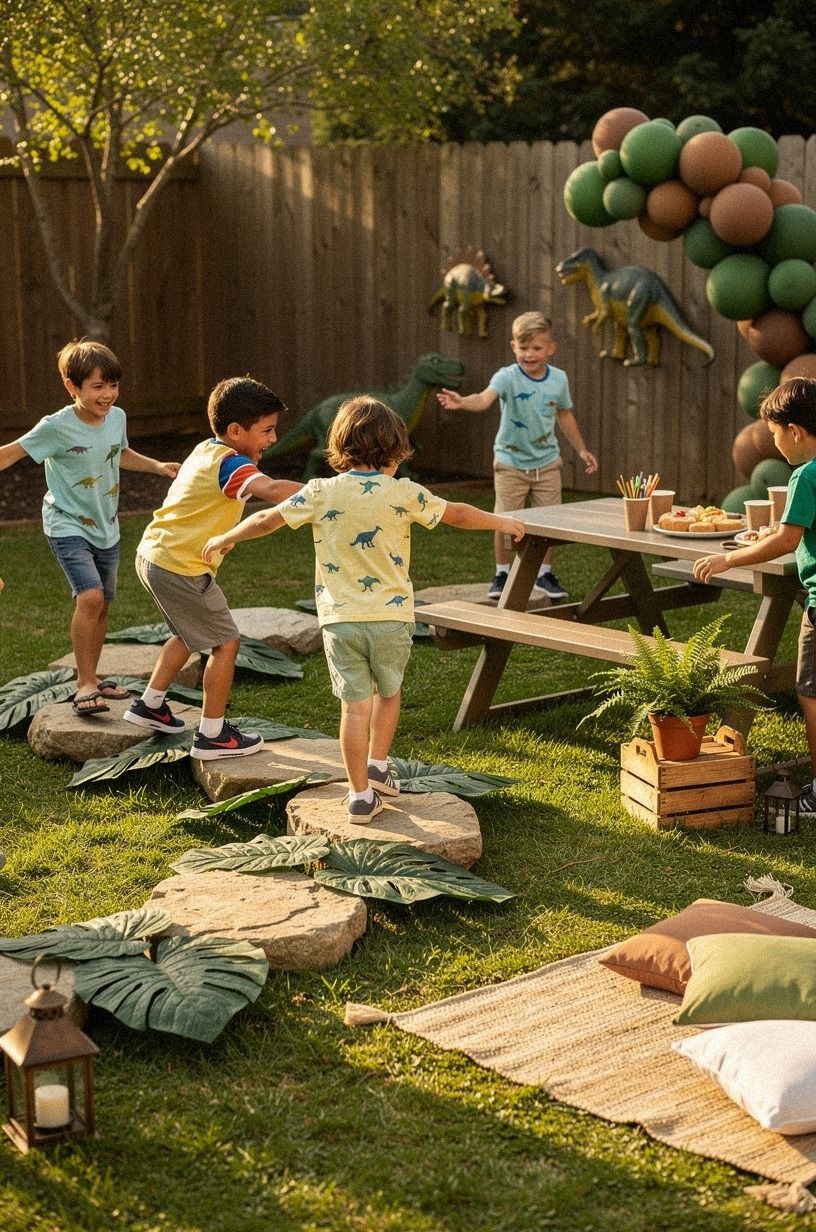
Create a pretend swamp with green paper leaves, flat foam rocks, and dinosaur cards. Arrange the pieces in a path across a hallway or open strip of floor.
Place a basket of cards at the start and an empty basket at the finish. Players cross without touching the floor, collect one card, and return along the route.
Estimated round: 6–9 minutes. Split the children into three teams of five and send one player from each team at a time. Move two leaves or rocks after every few turns to create a new route.
Younger children can use closely spaced pieces and walk beside an adult. Older children can carry a card on an open palm or follow a color sequence.
You’ll keep the challenge flexible without making speed the main goal.
Choose large, stable pieces with no sharp edges. Avoid real stones if they are small, jagged, or likely to slide. Keep a wall or chair nearby for visual support, but don’t require children to hold hands.
If a player steps off the path, the child returns to the last piece and tries again rather than leaving the game.
The tradeoff is that balance games need careful spacing and supervision. A useful alternative is a “lava river” version using two long paper strips as banks.
Children jump or step between marked safe zones without carrying anything. You can make the route shorter, wider, or seated according to the space and the children’s comfort.
8Conduct a Dinosaur Roar Orchestra
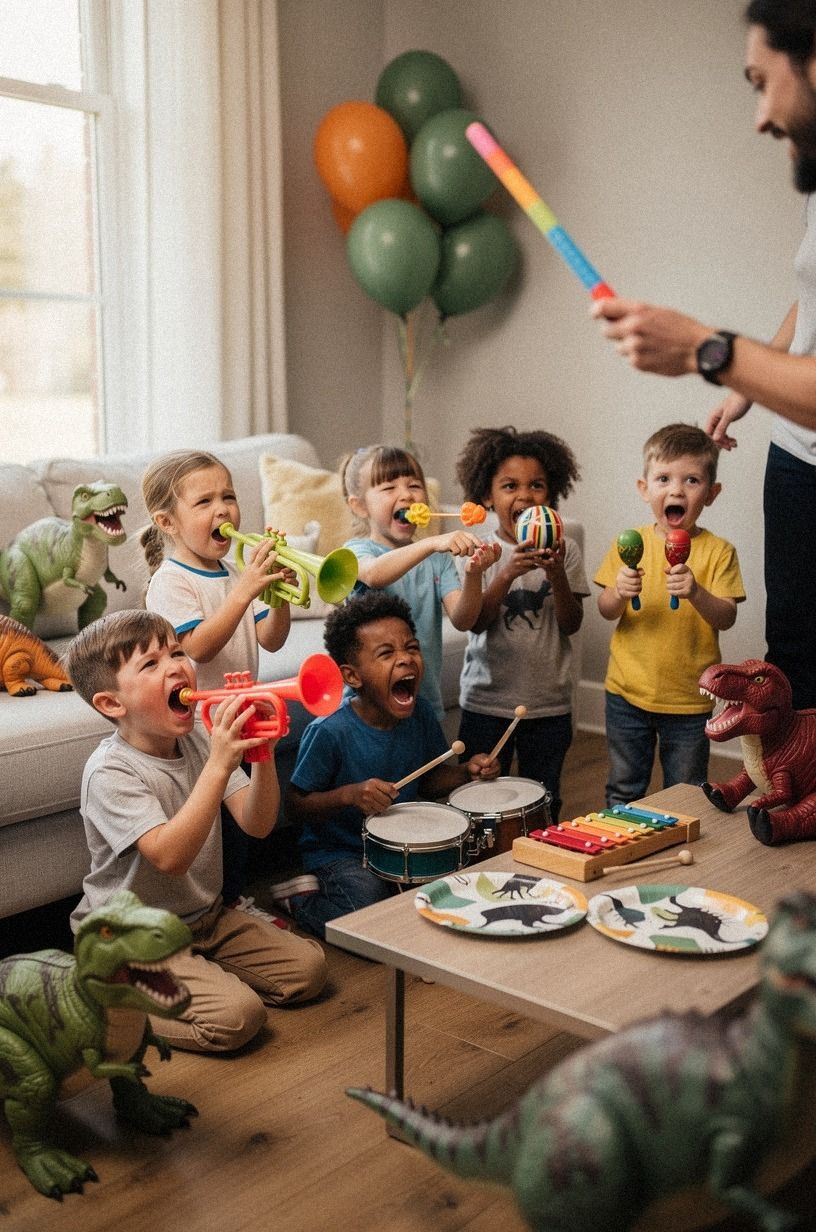
Prepare large sound cards showing a roar, stomp, wing flap, tail swish, hiss, or sleeping dinosaur. Add safe percussion items such as wooden spoons, cardboard tubes, plastic containers, or hands and feet.
Arrange the children where every player can see the conductor’s signals. You’ll have an easier time stopping the sound when the visual cards remain visible.
Estimated round: 5–8 minutes. Divide the group into three teams of five, assigning each team a sound family. The conductor points to teams to start, stop, grow louder, or become quiet.
Build a three-part performance: a soft beginning, a dramatic middle, and a silent sleeping-hatchling ending. Rotate the conductor and allow children to switch sound cards.
You can invite each team to select its dinosaur sound.
For younger children, use pictures and only two volume levels: quiet and loud. Older children can follow a simple pattern, such as stomp-stomp-roar-pause. Keep hard objects away from faces and limit the loudest section to a few seconds.
Ear-sensitive children can use a quiet card, clap softly, or become a visual conductor’s assistant. Don’t require anyone to make a loud sound.
The tradeoff is that the game can become noisy quickly, particularly in a small room. A useful alternative is a silent dinosaur orchestra in which children perform the movements without sound while an adult points to the cards. You can add gentle background music if that suits the room, but silence works well too.
Give the conductor a clear stop signal, such as both hands held overhead. Practice it before the first performance.
Children can also help by holding up the quiet card when the group needs to settle. You’ll create useful transitions between loud and calm moments instead of ending the activity abruptly.
9Frame the Fossil Freeze Dance
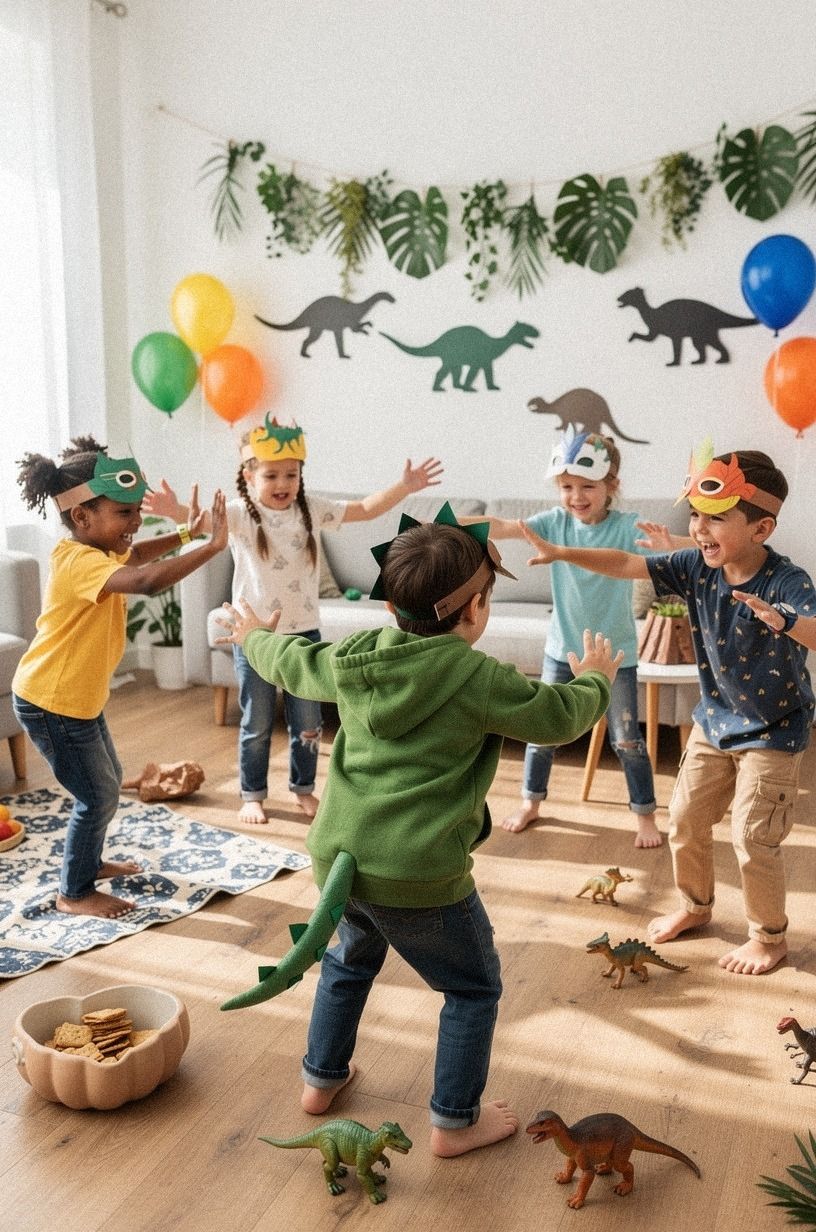
Play dinosaur-themed music and clear a generous movement area. Mark the boundary with paper leaves or painter’s tape.
Prepare pose cards showing sleeping, roaring, flying, digging, hatching, and hiding. When the music stops, draw or call a card and have everyone freeze in that pose.
You’ll need a dependable way to pause the music quickly.
Estimated round: 6–10 minutes. Divide the children into three teams of five, but keep all teams dancing together if the room allows. Rotate jobs among music starter, pose caller, boundary helper, and card holder.
Children who move during a freeze remain in the game and receive a helper role instead of being eliminated. That keeps the mood welcoming and avoids pressure.
Use a slower song and seated poses for younger children or children who need reduced movement. Older children can add a memory challenge by repeating the last two poses in sequence.
Remove hard toys from the floor and avoid slippery socks or loose costume pieces. Keep the final round seated or curled up like sleeping hatchlings before moving to water or snacks.
The tradeoff is that music adds energy but requires a dependable way to pause it. A useful alternative is a voice-led fossil freeze.
An adult calls “move” and “fossil” without using music, making the game suitable for quieter spaces. You can also use a hand drum, clapping pattern, or visible stop card.
Give children several ways to move. A flying dinosaur might use arm motions while staying seated.
A digging dinosaur might tap the floor with two fingers. A hiding dinosaur might crouch beside a chair without going underneath it.
You’ll make the activity accessible while keeping the dinosaur theme explicit.
End before children become overtired. A final sleeping-hatchling pose creates a natural transition to calm breathing, water, or the next party activity.
You don’t need to declare a winner. The goal is a short burst of imaginative movement with clear boundaries and a comfortable finish.
Practical Preparation Checklist
- Clear the largest floor area and remove sharp, fragile, or easily swallowed objects.
- Mark movement boundaries, throwing lines, rest areas, and team starting points with painter’s tape.
- Divide the children into three teams of five before the first game. Use colored stickers or dinosaur cards for quick identification.
- Prepare one labeled basket for paper supplies, one for soft props, and one for floor pieces.
- Make all clues, cards, footprints, nests, and score sheets before guests arrive.
- Choose large props for younger children and check every item for loose parts, sharp edges, and breakable surfaces.
- Keep a water station outside the active play zone, with cups spaced apart to reduce spills.
- Place snacks and cake away from the movement area.
- Assign adult roles if possible: one person watches active play, one manages supplies, and one supports children who need a quieter option.
- Keep a simple backup ready for every game, such as seated matching, drawing, or a voice-led version.
- Plan a quiet transition after every two or three active rounds. Offer water, a short snack, or a seated dinosaur story.
- Stop a game early if the floor becomes crowded, the rules are no longer clear, or children begin pushing.
- Leave enough time for bathroom breaks and handwashing before food.
A Few Things Worth Answering
What ages suit these dinosaur birthday party games?
Most games can work for preschool and early elementary children with shorter rounds and simpler rules. Younger children need closer supervision, larger materials, and more space between players. Older children can handle clues, scoring, memory rules, and team responsibilities.
You can simplify any game by reducing choices and shortening turns.
How should 15 children be divided?
Three teams of five provide a practical starting point. Keep teams mixed by age and energy when possible. Rotate team colors and jobs so the same children aren’t always running, throwing, guarding, or leading.
You can also combine teams for quiet games such as the map or orchestra.
What supplies are essential?
Painter’s tape, cardstock, large paper, washable markers, cardboard boxes, foam balls, lightweight eggs, dinosaur cards, and a few dinosaur figures cover most of the games. Reuse household containers and blankets when suitable.
No furniture purchases or permanent room changes are necessary. You don’t need every supply listed for every activity.
How can these games work in a small room?
Use seated or low-movement versions, shorten the footprint trail, and run only one active team at a time. The fossil dig, dinosaur detective, volcano toss, map, and roar orchestra can all be adapted to a table or compact floor area. You’ll have more control if you keep the active boundary visible and remove unused props.
What safety changes help younger children?
Avoid small bones, beads, marbles, fragile eggs, climbing, and fast chasing. Use soft materials, keep paths clear, supervise throwing games closely, and provide a seated option.
Children should never be required to join a movement that feels uncomfortable. If you’re unsure about a prop, choose a larger, softer alternative.
Should prizes be included?
Prizes are optional. Team roles, dinosaur cards, applause, and a shared finishing cheer provide recognition without creating pressure or arguments.
If small favors are used, choose age-appropriate items and distribute them equally. You can also let each child take home a paper fossil or dinosaur drawing made during the party.
Your Next Step
Choose three active games and two quieter backups before the party. Begin with the fossil dig relay or footprint trail while the children are fresh.
Follow with the dinosaur detective, map, or orchestra game, then save the freeze dance for a final burst of movement. You’ll have a smoother schedule if you prepare the materials in labeled baskets and explain one rule at a time.
Keep the group in three teams of five, use short rounds, and offer clear boundaries. Check the floor between games, refill water, and give children a quieter role when they need one.
If a game stops feeling organized, switch to its seated alternative. A prepared dinosaur activity, a calm reset, and a practical next choice are enough to guide the party from one prehistoric adventure to the next.


