How to Style a Japandi Travertine Bathroom for Warm Minimalism, No Clutter - 15 Ideas
01 august 2026The short answer: you style a Japandi travertine bathroom by choosing the stone first, then letting every other decision obey it. I've styled a lot of bathrooms, and the serene ones never happen by accident. They happen when you stop buying things you like and start editing around one warm, earthy anchor. Travertine is that anchor. Here's the order that works, fifteen steps, no clutter anywhere.
- Start with the stone, not the paint chip
- Seal the travertine before anything touches it
- What wall color does your travertine actually want?
- Anchor the room with a floating wood vanity
- Keep to the Two-Wood Rule
- Choose one warm metal and ban the rest
- Hang a wabi sabi mirror instead of a medicine cabinet
- Layer light at three heights
- Open up the shower with glass instead of a curtain
- Warm the floor underfoot
- Mix towels in linen and waffle cotton
- Add one living thing
- Edit surfaces with the three-object rule
- Hide everything else
- Finish with one imperfect handmade piece
1Start with the stone, not the paint chip
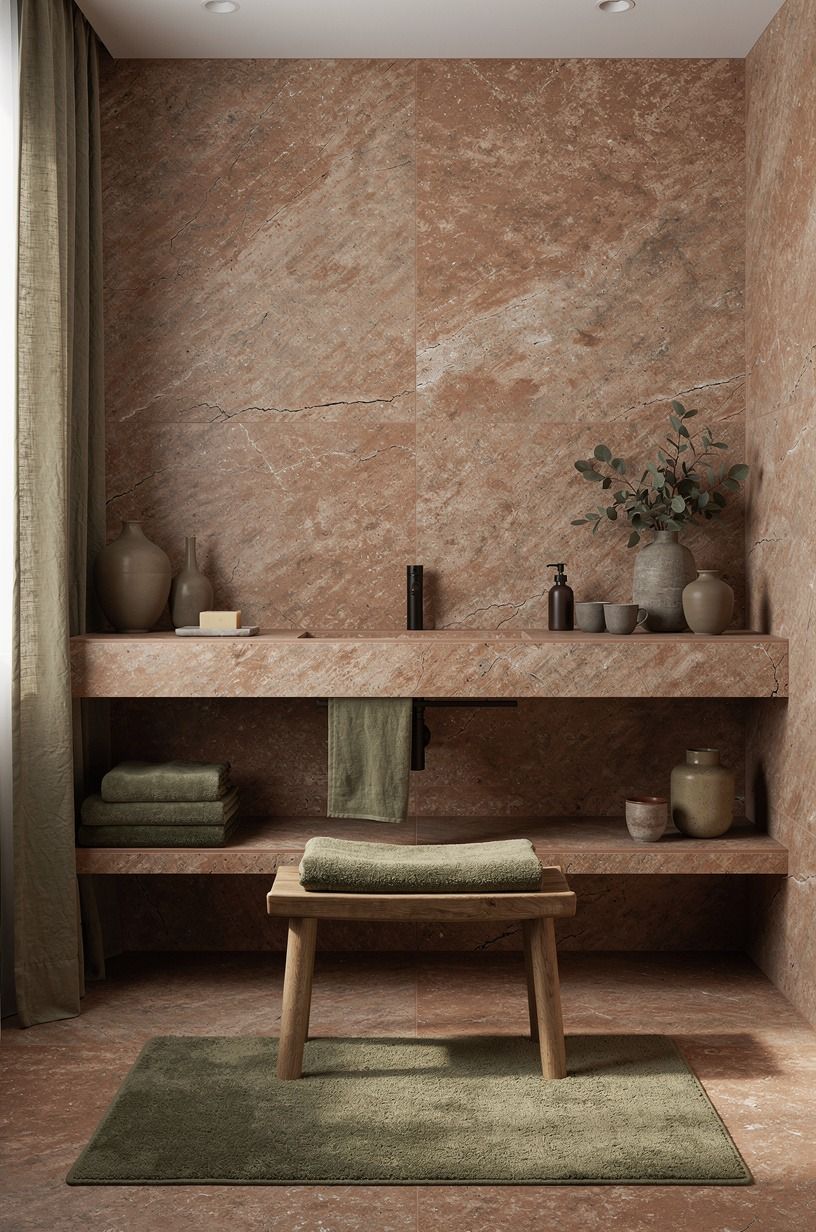
Most people pick a wall color, then go tile shopping. Backwards. Travertine can sit warm and quiet beside terracotta, stone, and olive, and its undertone decides your whole palette before you've bought a single towel.
So bring home three samples and live with them for a week, next to a length of washed Belgian linen if you can.
Look at them at 8am and again at 8pm. Honed ivory travertine reads creamy and calm in morning light, then goes almost golden under warm bulbs at night. If your sample leans greener or more clay-like, keep the room in that terracotta-stone-olive family instead of forcing a cool gray scheme that fights it.
One more thing people skip: check the pitting. Natural travertine has small holes and troughs in the surface, and that texture is exactly what makes it feel organic instead of sterile.
Filled and honed gives you a smoother, more refined look. Unfilled is rustic and raw. For a Japandi bathroom, honed and lightly filled wins, because you want warmth without the farmhouse roughness.
2Seal the travertine before anything touches it
I limewashed a wall before sealing the stone below it once. The splash marks soaked in within a day, and I spent a Saturday with a poultice pulling stains back out. Seal first.
Travertine is porous, more porous than porcelain or marble, and a bathroom is the wettest room in your house.
A penetrating impregnating sealer runs about thirty to fifty dollars a bottle, and one bottle covers a typical bathroom floor twice, which is what you want. Two thin coats, not one thick one. Let each cure for the time on the label, usually a full day.
You'll reseal every one to two years depending on how steamy your showers run. It sounds like maintenance.
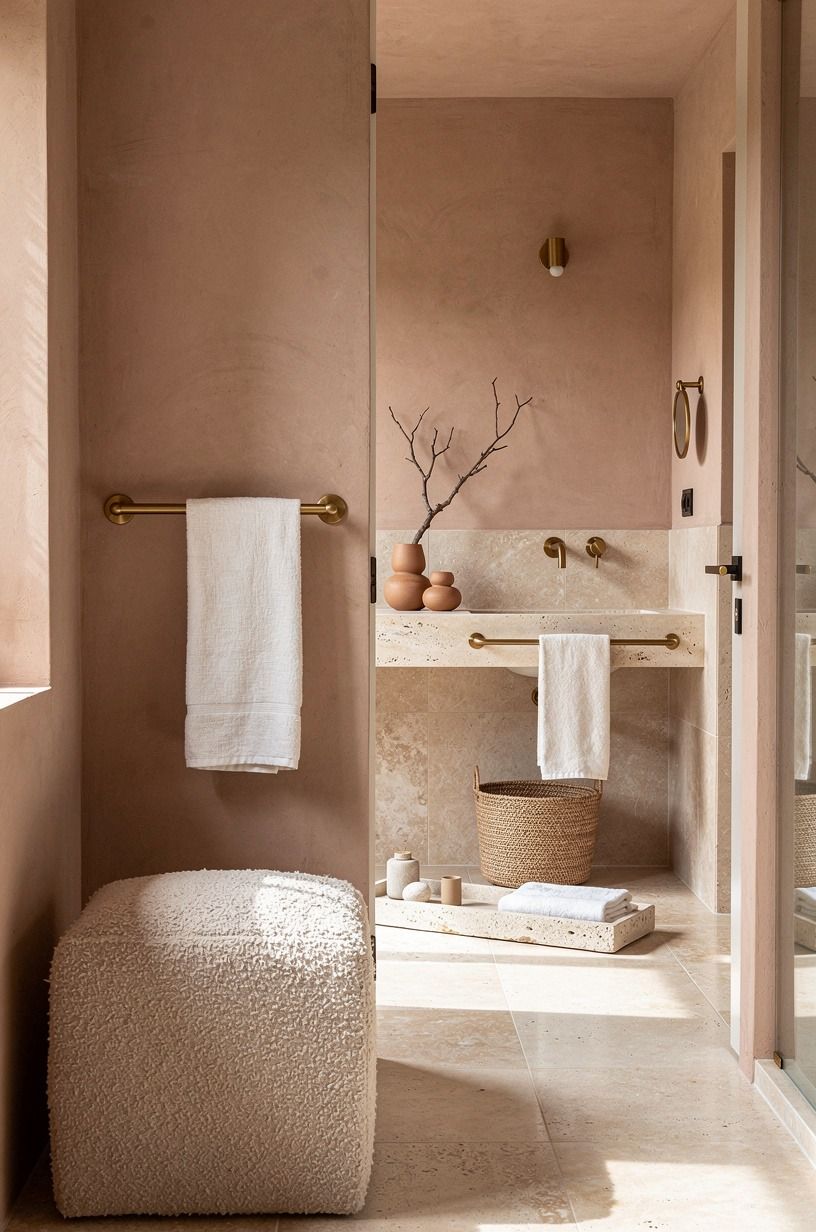
It is. But it's also why your stone still looks soft and inviting in year five instead of blotchy and tired, even next to clay plaster, linen towels, aged brass, or one organic bouclé stool.
Skip this step and nothing else on this list will save the room.
3What wall color does your travertine actually want?
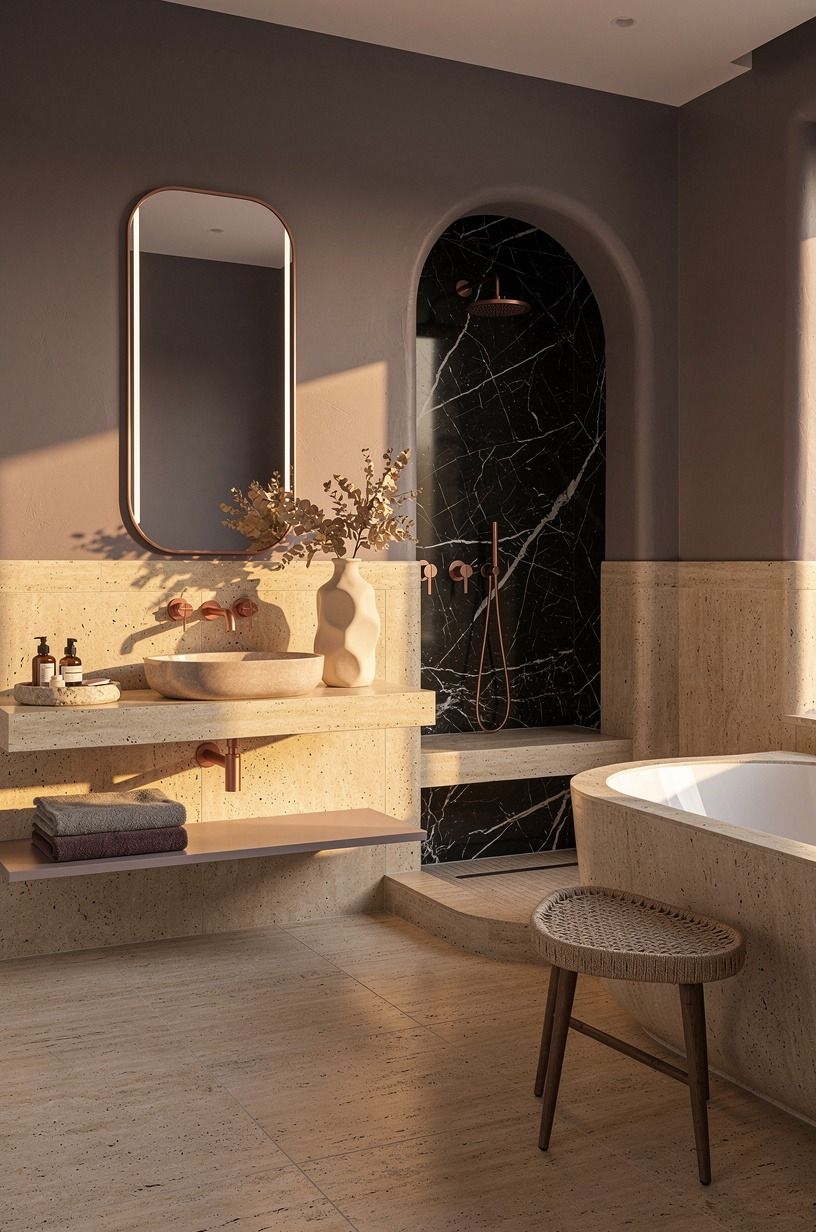
Hold your tile sample against paint swatches and the answer usually announces itself. If the room is drifting plum, grey, and rose gold, choose colors that deepen that mood instead of dragging it back to beige. Farrow & Ball Sulking Room Pink gives a muted rose-plum that makes pale stone feel warmer and more intentional.
If your travertine leans cooler, keep the walls in the grey-rose lane. Benjamin Moore Chelsea Gray HC-168 is steady and tailored, while Sherwin-Williams Agreeable Gray SW 7029 stays softer for a small bath that still needs light. Both sit well near rose-gold accents without turning sweet.
And if you want drama, a dark vanity wall in a plum-charcoal tone can be breathtaking against stone with strong white veining, especially if there's a Nero Marquina marble note nearby. Dark, moody, sophisticated.
But one wall only. Paint the whole room that deep and your travertine disappears into the gloom, and you'll wonder where the warmth went. I'd skip the all-dark version unless your bathroom gets serious natural light.
4Anchor the room with a floating wood vanity
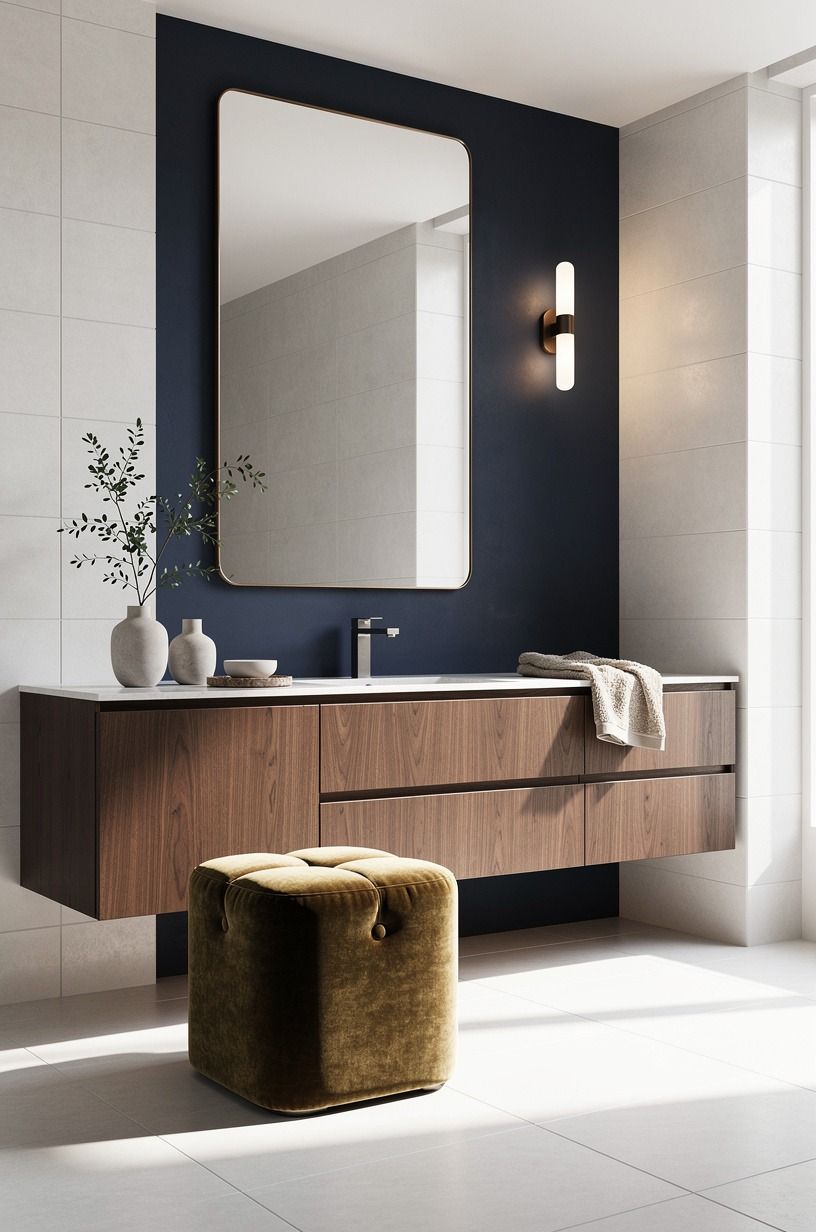
The vanity is the second biggest surface in the room, and it sets the furniture tone for everything. A floating walnut vanity is the classic Japandi bathroom vanity move when the room runs navy, white, and walnut: clean lines, floor visible underneath, enough depth to ground pale stone.
Wall-mount it at 32 to 36 inches, standard vanity height. If you're tall, go 36. Your back will thank you every single morning.
A simple white floating cabinet with walnut drawer fronts does this look for less, and honestly, paired with real travertine, nobody guesses it wasn't custom.
One opinion I'll defend: skip the vessel sink. It looks sculptural in a showroom and splashes water onto the wood every time you wash your hands.
An undermount basin in matte white keeps the counter line calm and the walnut dry. If there's a small stool nearby, a deep-pile mohair velvet seat can carry the navy note; in a warm minimalism bathroom, the peaceful counter is still the point, not the object sitting on top of it.
5Keep to the Two-Wood Rule
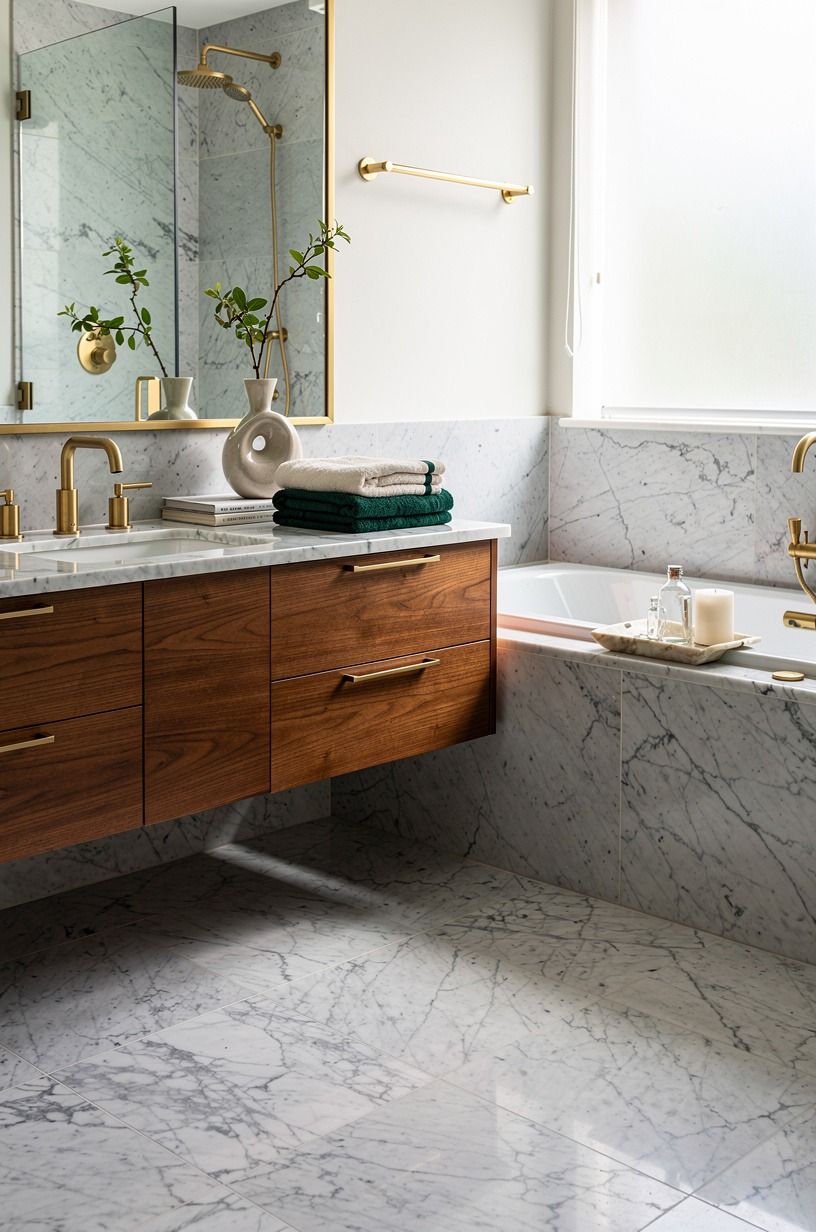
Here's a rule I made up after ruining one bathroom of my own: a Japandi room holds exactly two wood tones. Cream towels, emerald accents, a little gold, and Carrara marble with subtle grey veining don't count as wood; they're the quiet background that lets the two woods stay legible.
6Choose one warm metal and ban the rest
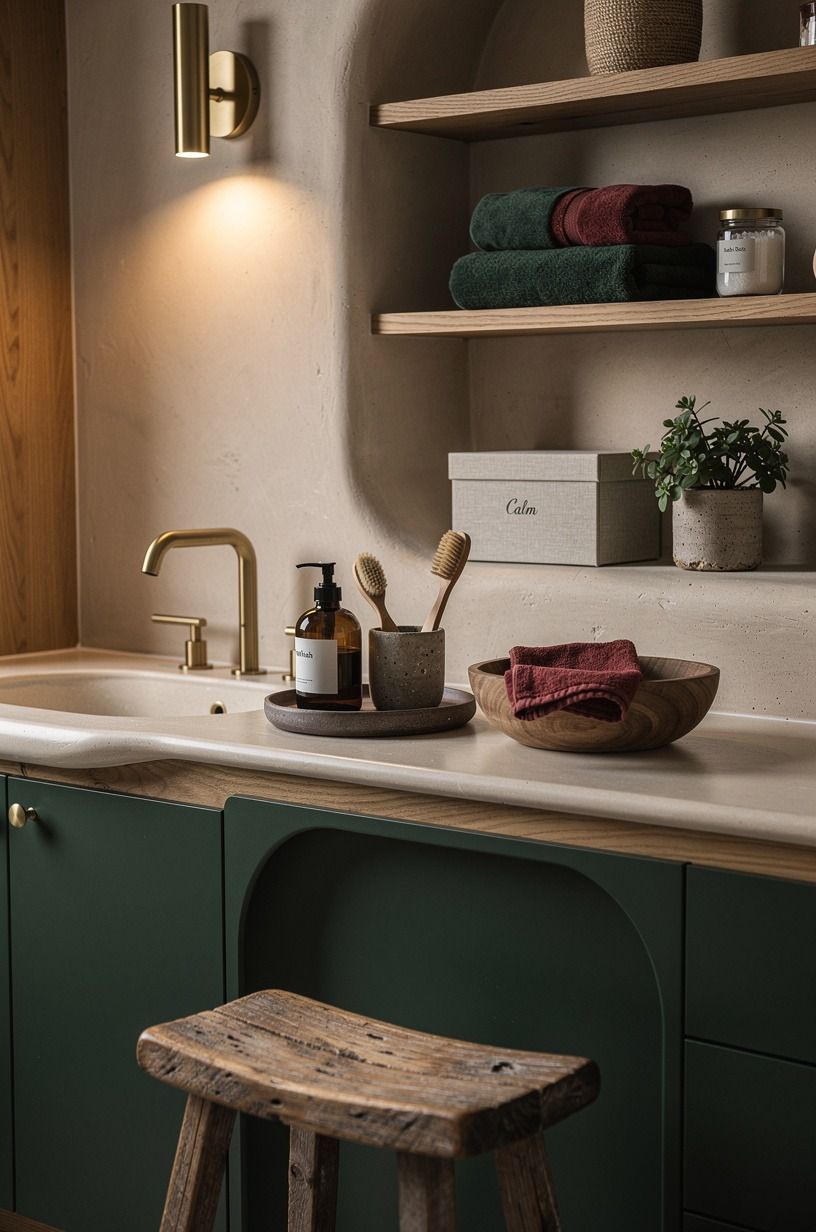
Call it the One-Metal Discipline. Japandi rooms fall apart visually when chrome, brass, and black all show up in the same sightline. Pick one finish and let it appear on the faucet, the shower fittings, the towel hooks, and the mirror edge if it has one.
My pick, every time: brushed brass, especially aged or unlacquered beside forest green, rust, natural oak, or reclaimed weathered teak. A good brushed brass faucet runs $120 to $450 depending on the brand, and the warm tone sits perfectly against ivory stone. Unlacquered brass goes further and develops a soft patina over the years, which is basically wabi sabi in hardware form.
Chrome is the loser here, and I'll say it plainly. It's cool, it's clinical, and it makes warm travertine look slightly dirty by comparison. Matte black is acceptable if your stone is silver-toned.
But if you bought ivory or walnut travertine and you're about to install chrome, stop. Brass.
You'll see the difference the second it's in.
7Hang a wabi sabi mirror instead of a medicine cabinet
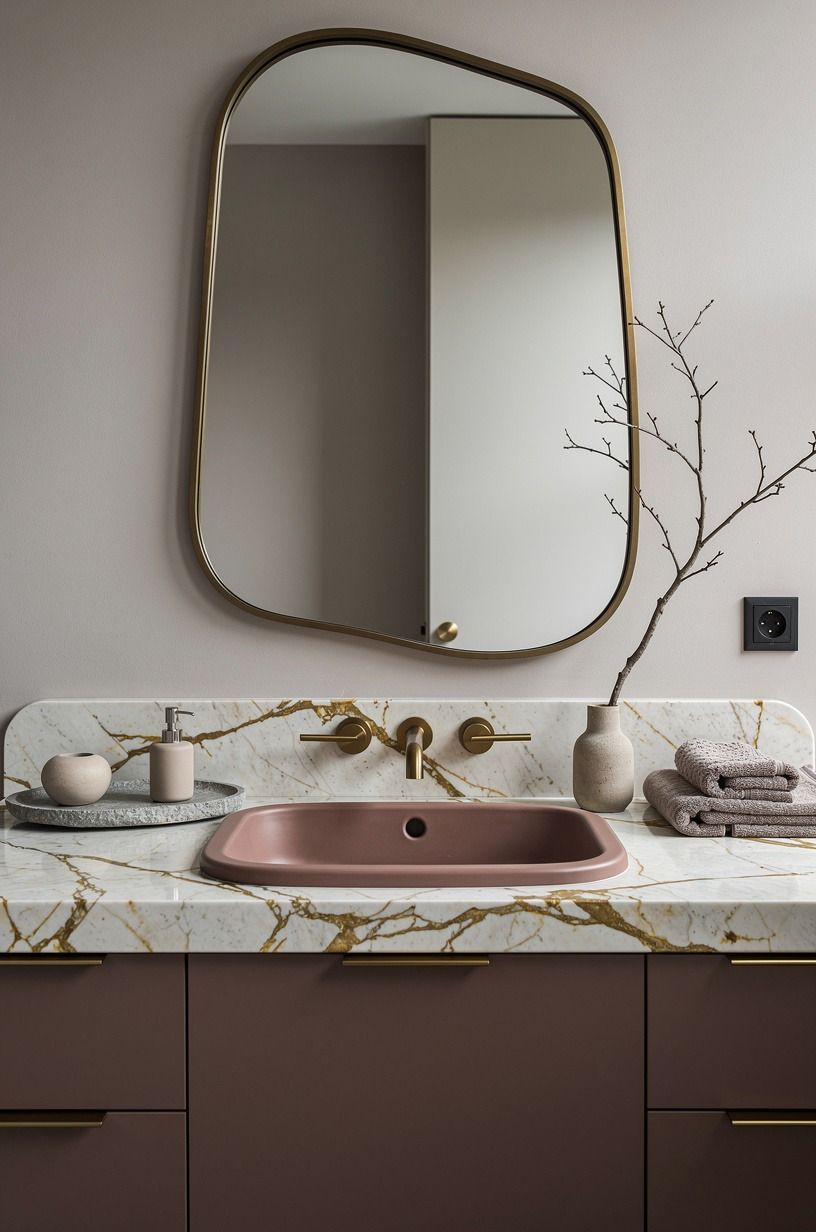
Standard builder bathrooms come with a mirrored medicine cabinet, and it's usually the coldest object in the room. Choose an irregular brass-edged mirror instead, then keep the surrounding story tight: dusty rose, charcoal, and a Calacatta marble note with gold veining if there's a shelf or splash ledge nearby.
8Layer light at three heights
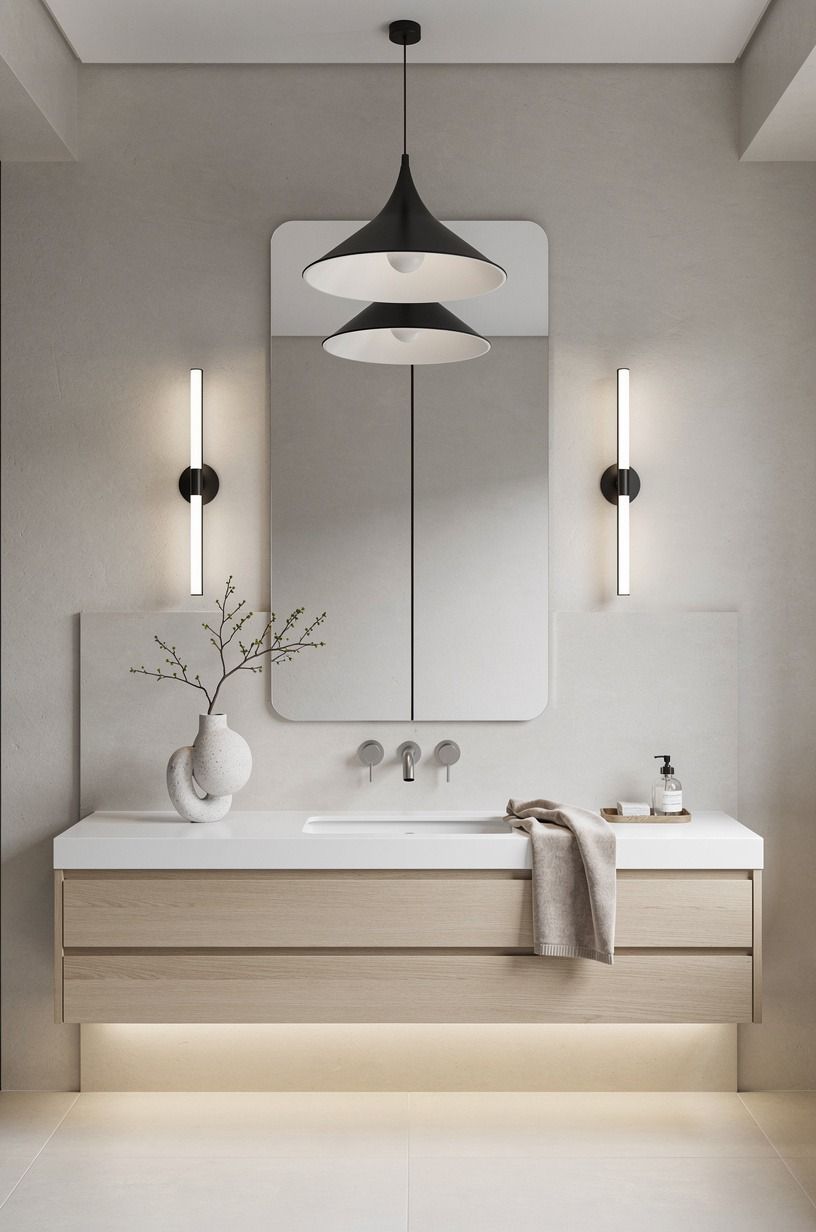
One ceiling light is why most bathrooms feel like interrogation rooms. The fix is the Three-Height Light Stack: light at the ceiling, light at the face, and light near the floor. Three sources, all warm, nothing above 2700K.
Ceiling: a simple flush mount, dimmable. Face: a pair of warm-white sconces flanking the mirror at roughly eye height, with small black accents if the room needs a little edge, so your face gets light from both sides without shadows. Floor: a small lamp on a cerused white oak shelf or a low glow near the tub, camel and warm white rather than bright.
That low light is the one people skip and the one that matters most. It's what makes the room feel like an evening instead of an errand.
Battery sconces exist if you're renting or don't want an electrician. Warm, dimmable bulbs only.
Blue-white light on travertine is a crime I'm tired of witnessing.
9Open up the shower with glass instead of a curtain
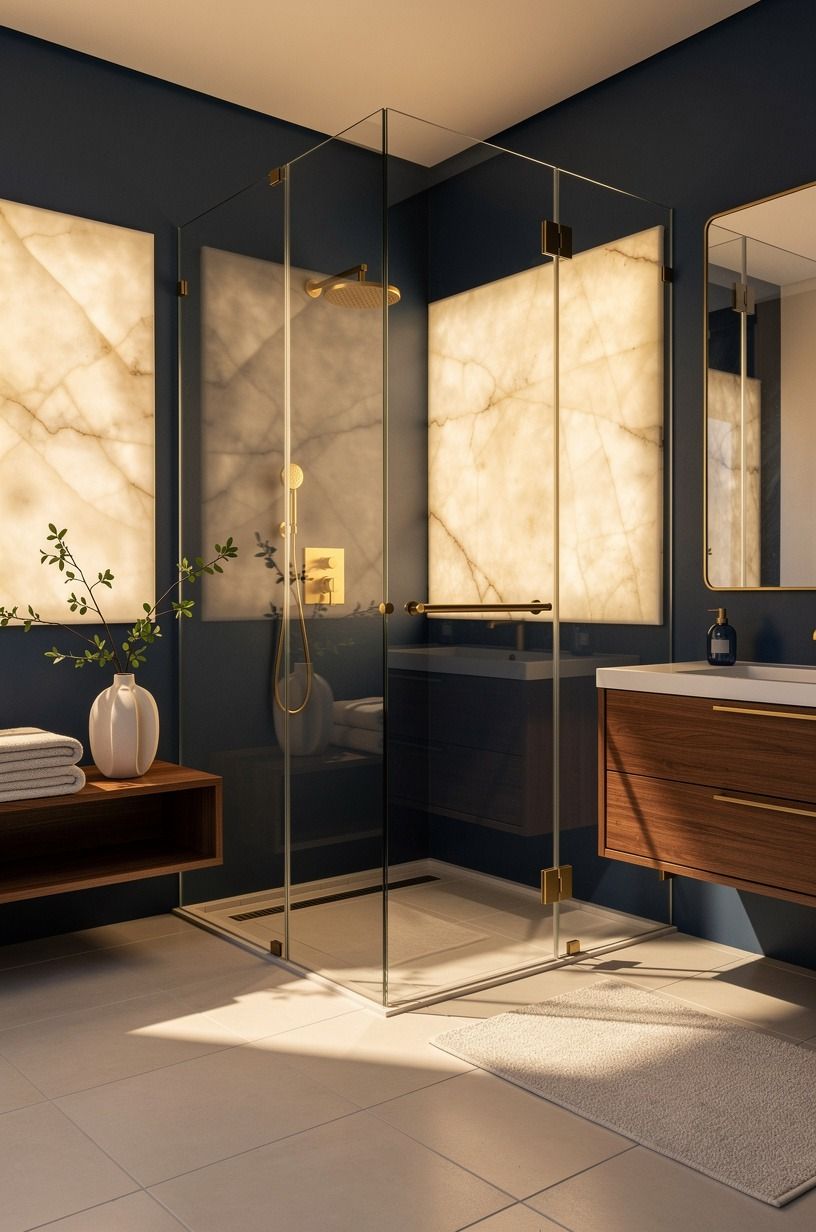
A fabric curtain cuts your bathroom in half visually, and in a small Japandi washroom design that lost space is everything. A frameless clear glass panel keeps the sightline running from the door all the way to the back wall, so the room reads as one serene volume, even if the palette leans midnight blue, copper, and ivory.
If you're renovating, a comfortable shower starts at 36 by 36 inches, and that's also the smallest size where a fixed glass panel works without a door. Walk-in, no hinge, no track.
Fewer parts, fewer lines, less to clean. Very Japandi.
If one wall has a glowing translucent onyx quality, clear glass is even more worth it.
Renting and stuck with a curtain rod? Then pick your curtain like it matters, because it does.
Undyed ivory flax linen on a simple rod, hung as high and wide as the wall allows, in a tone that matches your towels. It won't disappear like glass, but it won't shout either.
Plastic liner on the inside, obviously. Linen alone is a mold farm.
10Warm the floor underfoot
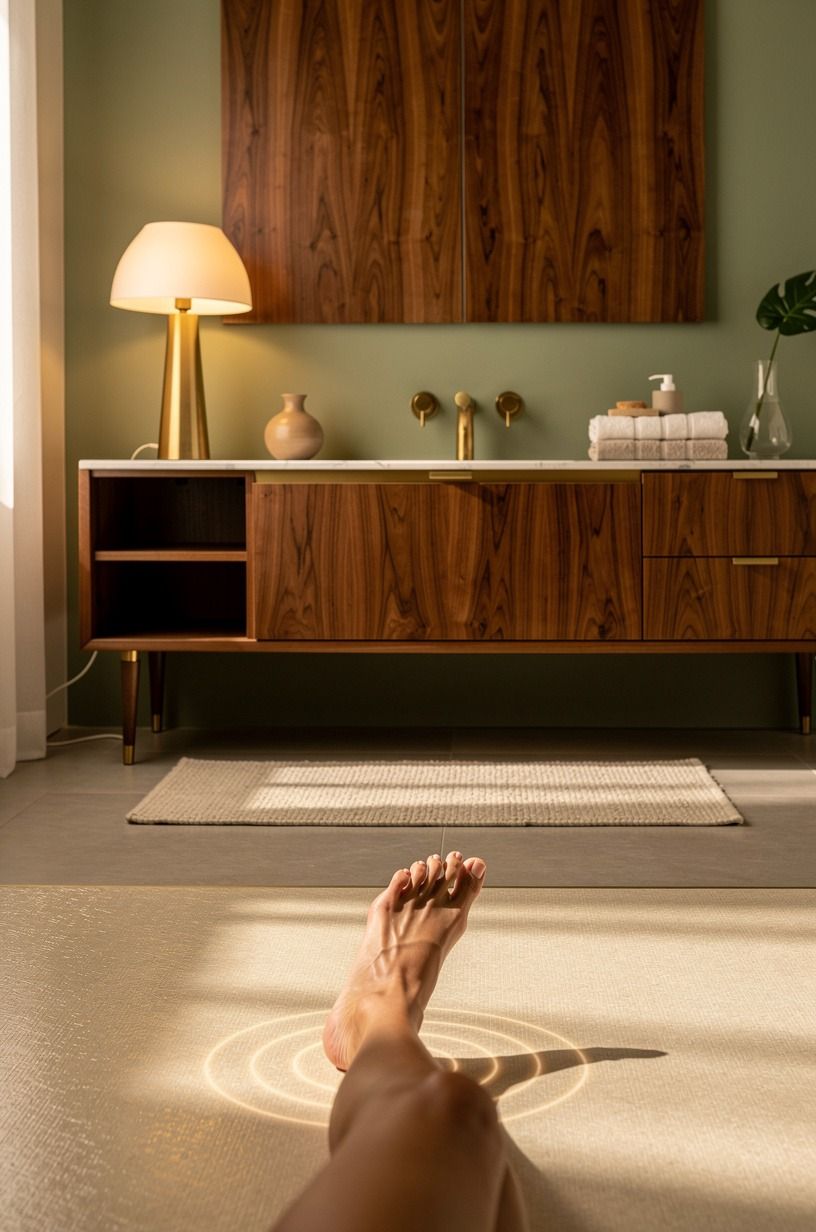
Stone floors are cold. That's physics, not a design flaw, but you'll feel it every January morning. If you're renovating, electric radiant heat under travertine is the single most luxurious thing on this list, and it runs roughly ten to fifteen dollars per square foot installed.
Not renovating? Fine.
A flat-weave cotton or Turkish cotton bath runner in sage green or warm cream does more than any fluffy bath mat. Runners look intentional; fluffy mats look like a dorm.
Washable, low pile, no rubber backing that'll trap moisture against your sealed stone. Natural wood and book-matched walnut elsewhere will carry the warmth.
And put the small rug where your feet actually land: in front of the vanity first, tub second. I see people center a tiny mat in the middle of the floor like a museum piece. Your feet aren't in the middle of the floor.
They're at the sink, twice a day, every day. Dress for where you stand.
11Mix towels in linen and waffle cotton
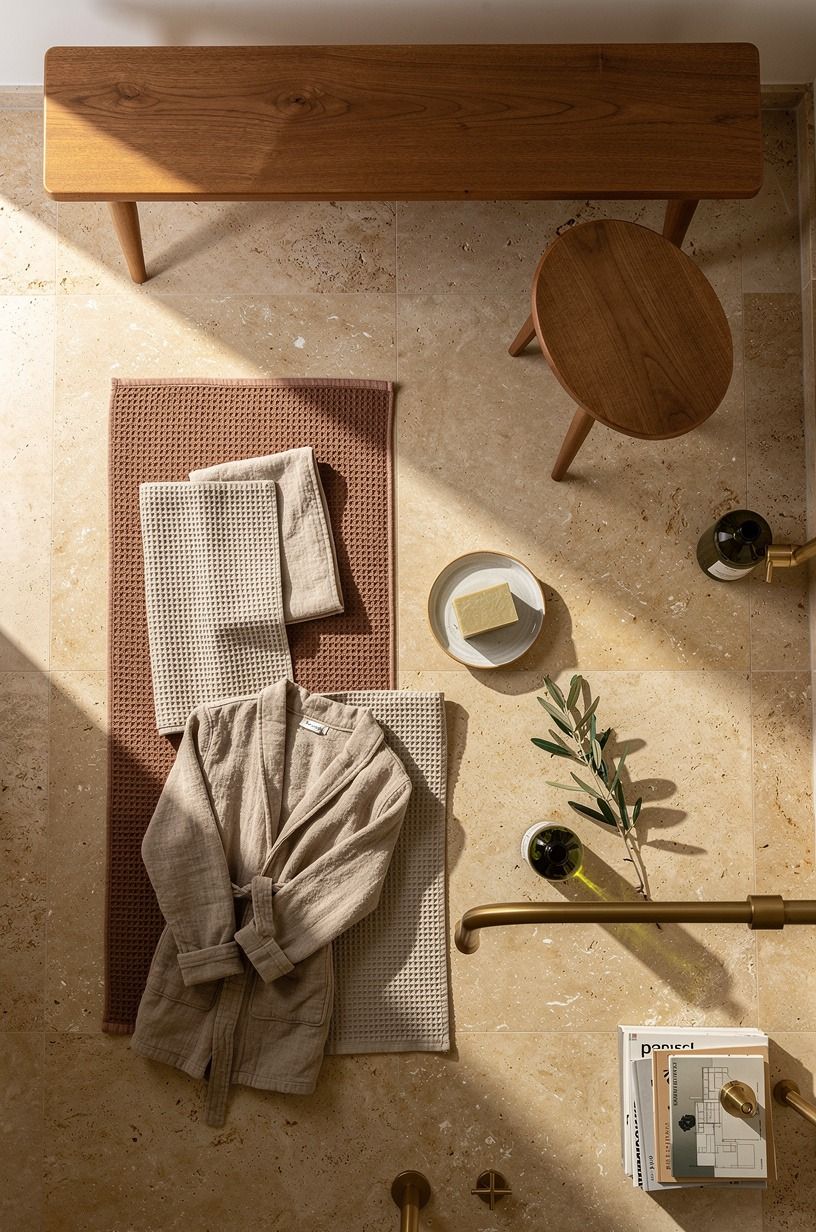
Matching towel sets are a hotel habit, and Japandi isn't a hotel. Keep the pile uneven on purpose: washed linen, waffle cotton, maybe one terracotta, one stone, one olive, all quiet against warm travertine.
12Add one living thing
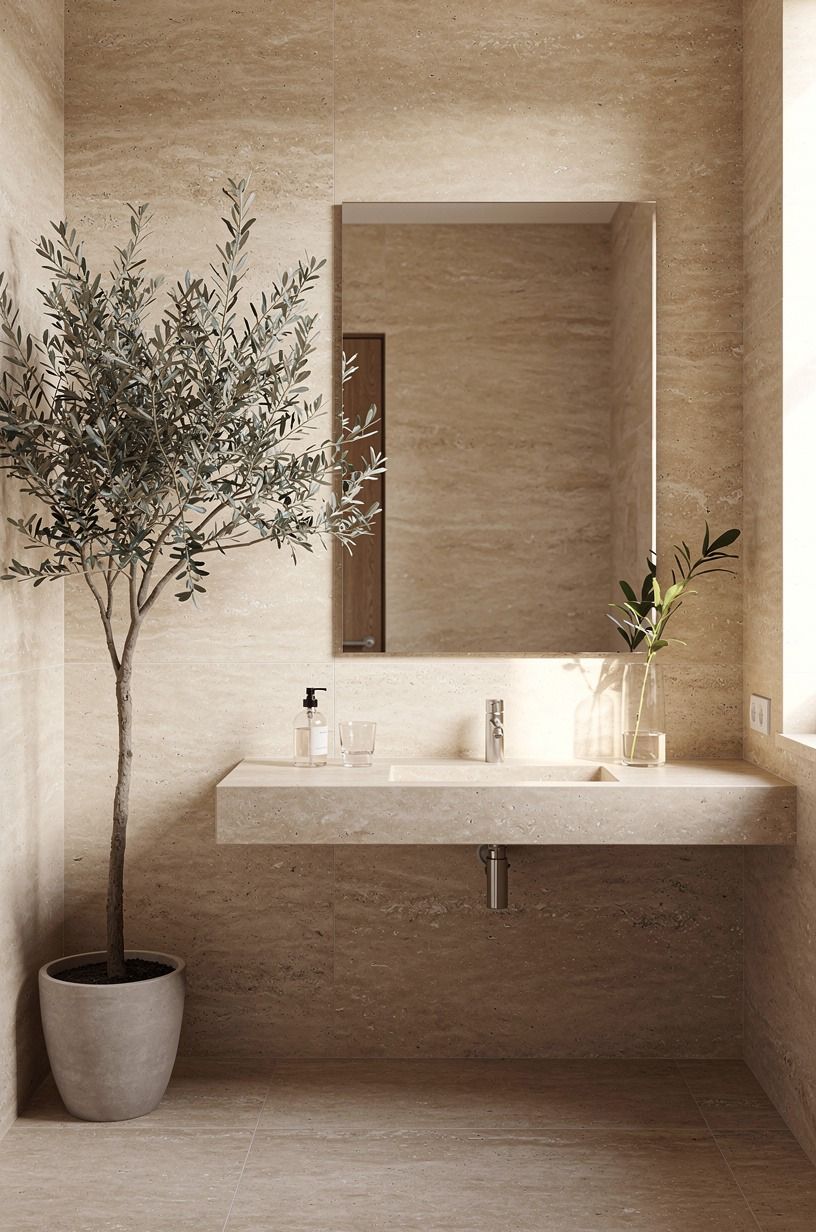
One. Not a shelf of succulents. A single plant with real presence does more for a warm minimal bathroom than five small ones scattered on every surface, because Japandi is about breathing room, and plants obey that rule too.
Bathrooms with a window: a potted olive tree in a clay pot if the room is big enough, or a trailing pothos on a high shelf if it isn't. No window at all: a vase of dried stems, eucalyptus or pampas, which gives you the organic shape without the slow plant death in the dark.
Terracotta is the right pot material here, by the way. Its matte, earthy surface sits beautifully next to travertine pitting, like the two materials came from the same hillside.
Aged linen tones and unlacquered brass developing patina also belong in this corner. Glazed ceramic works if it's matte and neutral.
Shiny colored pots, no. They pull the eye for the wrong reason, and in a tranquil room the eye should move slowly.
13Edit surfaces with the three-object rule
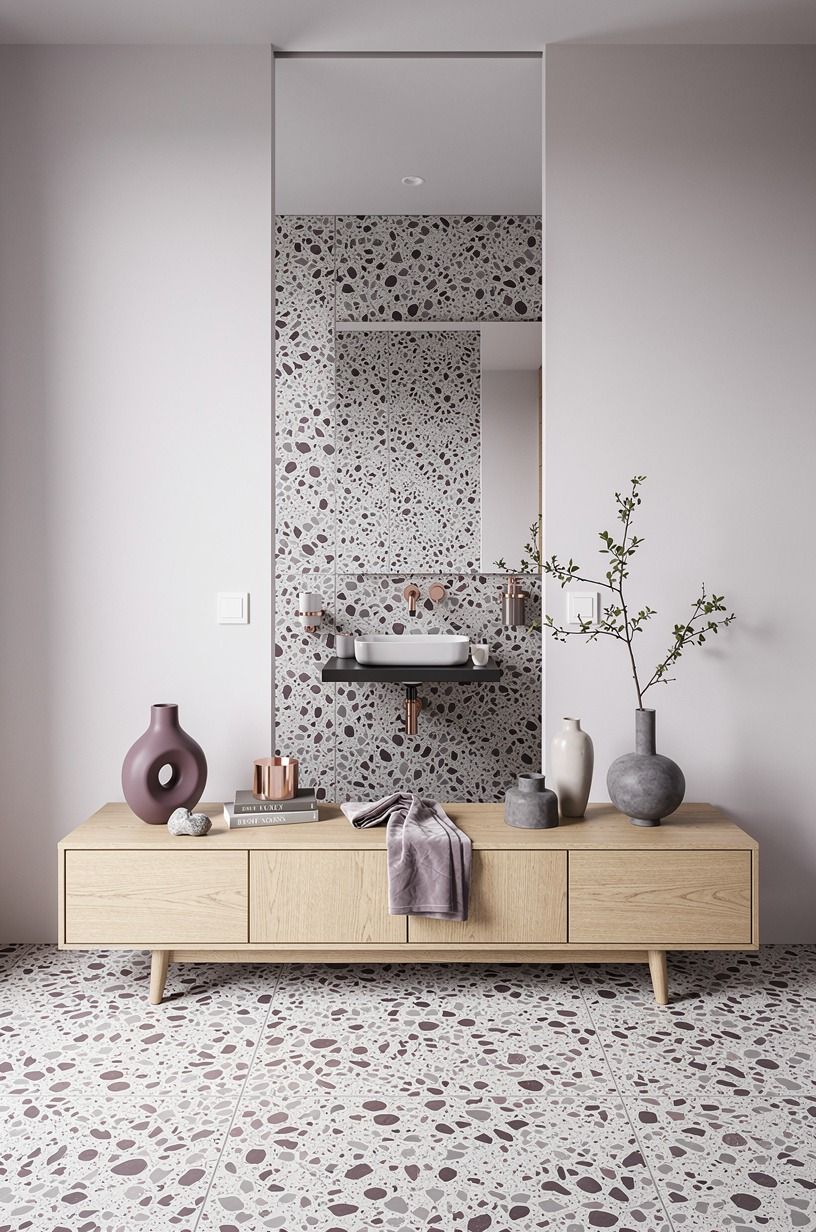
Every horizontal surface in this bathroom gets a maximum of three objects. Counter, shelf, stool, tub edge.
Three. It's arbitrary and it works, because two looks styled and four starts looking like a store display.
On the vanity counter, my usual trio: an oversized-chip terrazzo tray, one small plum or grey vessel, one candle with a rose-gold note. On the tub edge: a wooden bath caddy, one candle, one folded towel.
That's it. The stone and the wood need empty space around them or they stop looking special.
This is the step where warm minimalism is actually won or lost (and yes, I count "actually" carefully, it earns its place here). You can nail every material choice and still end up with a cluttered room because you kept adding nice things. Pretty clutter is still clutter.
When you're tempted to add a fourth object, remove one instead. Every single time!
14Hide everything else
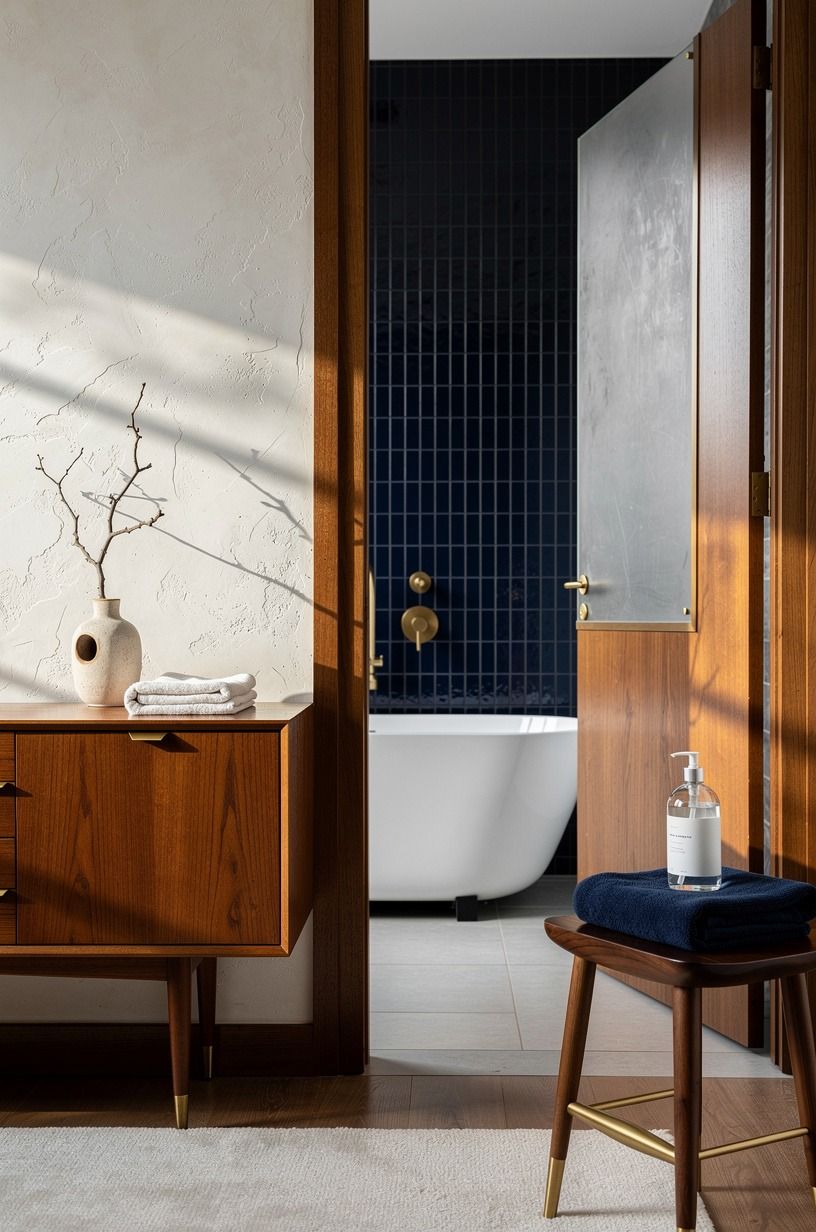
Decluttering advice that just says "own less" is useless in a bathroom, because you need the stuff. Give it doors: walnut-front drawers, white or navy closed storage, and one calm hand-applied Venetian plaster wall so the practical things disappear and the room stays soft.
15Finish with one imperfect handmade piece
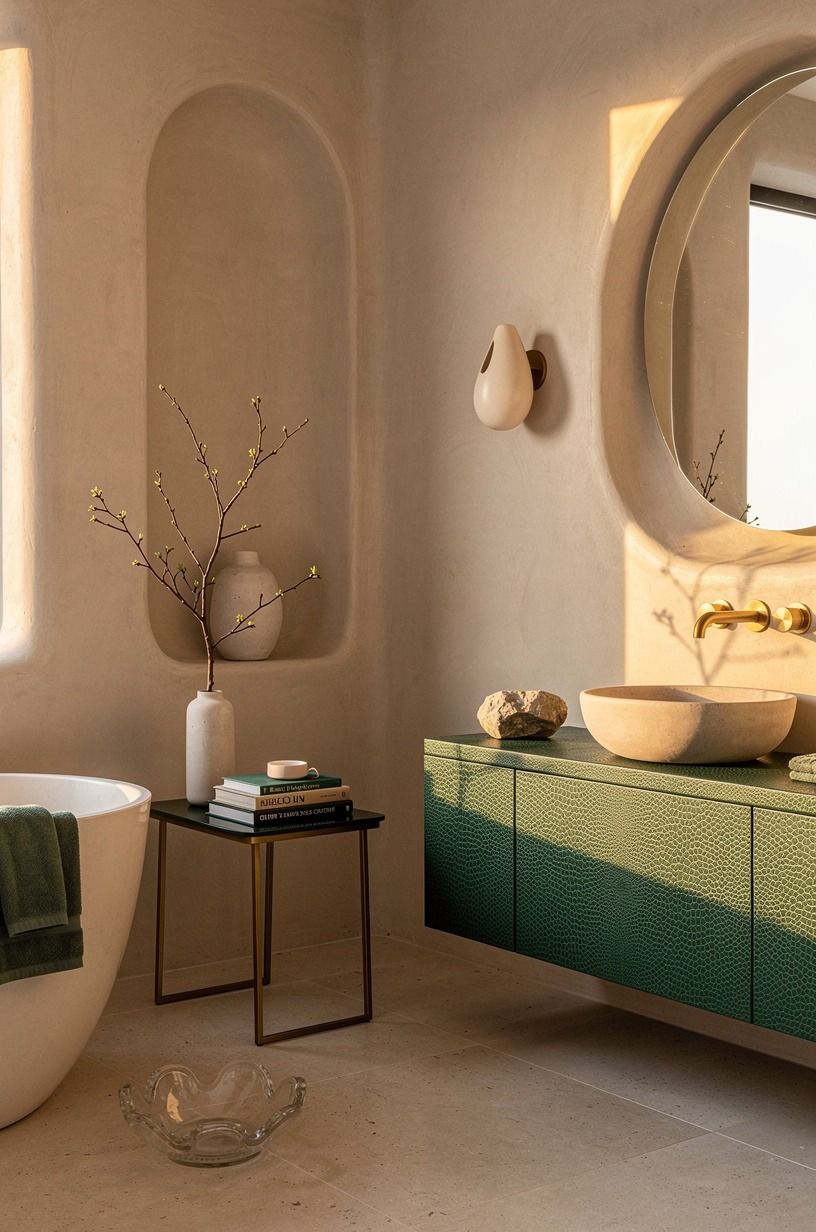
Last step, and it's the soul of the whole thing. Add exactly one handmade object with visible irregularity: a hand-thrown ceramic cup for toothbrushes, a rough-carved wooden bowl, a small studio pottery vase in cream with an emerald glaze. If the room already leans richer, one small shagreen-accent box with gold hardware can play that role, as long as it feels collected rather than matched.
Why this matters: travertine, oak, brass, and linen are all quiet, refined materials, and a room of only quiet refined things can tip into showroom. One handmade piece breaks the polish just enough to make the room feel lived-in and welcoming instead of prepared for a listing.
Etsy, local potters, craft fairs, your own shelf of things you've collected. The piece should have a thumbprint in the glaze or a wobble in the rim.
If it's perfect, it's wrong for this room. Funny how that works: the flawless bathroom needs one flaw to feel finished.
What this actually costs
Depends entirely on whether you already have the travertine. Styling an existing travertine bathroom the Japandi way (paint, mirror, faucet, textiles, one stool, one handmade piece) sits in the budget tier below. Installing the stone from scratch moves you up fast.
For context on the materials themselves:
Why this pairing works when most bathroom trends don't
Here's my honest read after years of watching bathroom trends cycle. Japandi and travertine work together because they're both corrections to the same mistake.
The mistake was the cold, gray, glossy bathroom of the 2010s: polished porcelain, chrome everything, LED-bright, a room that felt like a very clean laboratory. People lived in those rooms for a decade and quietly hated them, and warm minimalism is the market correcting itself. Travertine is ancient, Romans built with it, and Japandi borrows from two traditions (Japanese and Scandinavian) that both treat the bathroom as a place to slow down, not a utility closet.
The trend isn't new. The hunger for it is.
Now my mistakes, because I made them so you don't have to. Mistake one: I bought the accessories first.
Baskets, towels, a stool, all before I'd chosen the stone, and when the travertine arrived it clashed with half of it. Stone first, always. Mistake two: I once specified polished travertine for a floor because it looked elegant in the showroom.
Polished stone plus water plus bare feet is an ice rink. Honed for floors, polished only on walls if you must.
Mistake three: I underestimated the metal discipline and mixed brass taps with chrome towel bars "temporarily." Temporary lasted two years and bothered me every single day.
The bigger lesson: this style looks effortless and it isn't, but the effort is all in restraint, not in money. The cheapest version of this bathroom, paint, one mirror, one plant, edited surfaces, outperforms an expensive version with cluttered counters. I've seen both.
The disciplined cheap one wins. That's the whole philosophy, really: warmth comes from material honesty, and calm comes from editing.
Travertine just happens to deliver both in one surface, which is why designers keep reaching for it and why, fifteen steps later, your bathroom finally feels like the room you meant to build.
What People Always Want to Know
What is the best Japandi travertine bathroom setup for a small bathroom?
Go lighter and floating. Honed ivory travertine on the floor, a wall-mounted oak vanity at 32 to 36 inches, one round mirror, clear glass in the shower. Small rooms reward restraint more than big ones do.
Where can I buy Japandi travertine bathroom pieces on a budget?
Start with IKEA for the oak vanity and bamboo drawer dividers, Target for waffle towels, and Facebook Marketplace for wood stools and handmade ceramics. Travertine-look porcelain from big box stores fools most guests at a tenth of the cost.
How much does a Japandi travertine bathroom makeover cost?
A styling-only refresh (paint, mirror, faucet, textiles, one plant) lands around $200 to $1,200 on a typical US budget. New stone and a vanity pushes into the $3,000 to $9,000 mid tier. Paint and editing are free or nearly free.
Can I create this look on a tight budget?
Yes, and cheaply. Paint the walls a warm buff, swap in one brushed brass faucet, decant bottles into matching dispensers, edit every surface to three objects. Under $300, one weekend, and the room already reads Japandi.
Is a Japandi travertine bathroom worth it in a small space?
Yes, and small spaces are where it shines. Fewer surfaces mean fewer decisions, and the warm stone makes a compact room feel intimate instead of cramped. Keep the sightline open with a floating vanity and frameless glass.
Is this style a good idea for a rental?
Very. Peel-and-stick travertine-look vinyl on the floor, a tension rod with a flax linen curtain, battery sconces, and a freestanding stool. Zero damage, full deposit back, and the whole look packs into two boxes when you move.
Where I'd Start First
If I had to pick one step, I'd start with the stone itself. Everything else, the paint, the brass, the wood, either obeys the travertine's undertone or fights it forever.
Choose that right and the other fourteen steps get easy. Pin this for later and go order your samples.