I Made My Luxury Dressing Room Look Like a Five-Star Boutique, These Details Worked
18 july 2026The short answer: I spent a year turning a sad, beige, $40-rod closet into something that feels like the Bergdorf back room, and most of the work cost under $2,000. Here's what moved the needle, what I'd skip if I did it again, and the fifteen details that made my luxury dressing room feel like a five-star boutique worth pinning. Promise.
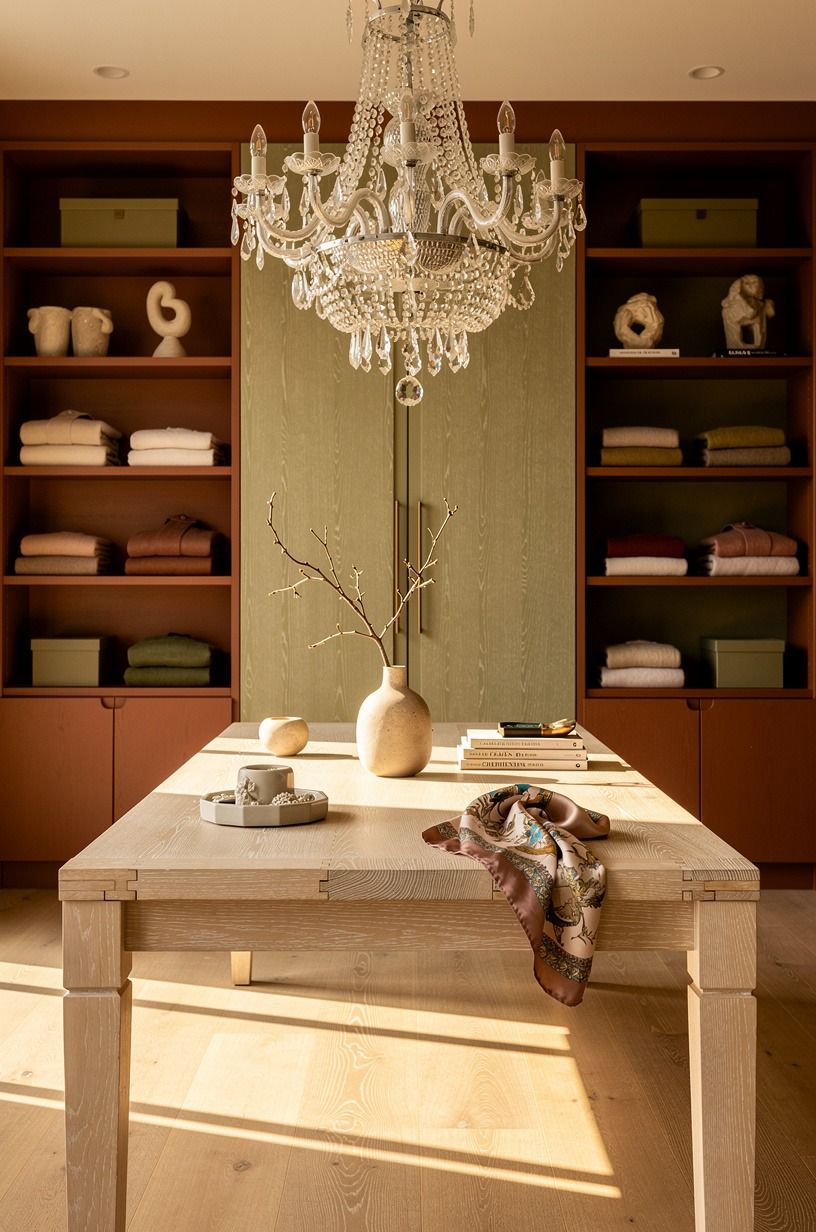
- Hang a crystal chandelier over the island
- Switch every hanger to velvet slim ones
- Park a tufted bench at the foot of the window
- Line the back wall with a Belgian flax linen niche
- Run an unlacquered brass rod across the entire wall
- Float a terrazzo perfume tray on the dresser
- Rotate handbags into an IKEA Lack gallery row
- What does a faded Persian rug actually do under the island?
When we bought the house six years ago, the walk-in closet was a joke. Wire shelving on three walls, a single bulb in the ceiling, carpet the color of a 1994 office.
I used it like a coat rack. Then my mother came to stay for two weeks, opened the door, and said, "Well, at least it's big enough to fix." That was the moment.
I cleared the wire shelves, taped a section of Farrow & Ball All White (No.2005) to the wall, and walked back four paces. The light changed. The room changed.
Everything I'd been piling on top of the mess stopped working, and I had to start over with intention.
Here's what it looked like before
Builder-grade wire shelving running along every wall, single 60-watt bulb hanging from a porcelain socket, beige carpet with a stain near the door that nobody had ever tried to lift. A sad little bar near the window with seven mismatched wire hangers holding the same three jackets I'd worn all winter.
No island, no bench, no mirror except the one on the back of the door. Everything was beige, everything was tired, and the room smelled faintly of cedar blocks I'd bought hoping nobody would notice the smell wasn't cedar at all.
I lived with it for two winters because I didn't know where to start. And honestly? The first two Pinterest boards I made just made me feel worse.
- Hang a crystal chandelier over the island
- Switch every hanger to velvet slim ones
- Park a tufted bench at the foot of the window
- Line the back wall with a Belgian flax linen niche
- Run an unlacquered brass rod across the entire wall
- Float a terrazzo perfume tray on the dresser
- Rotate handbags into an IKEA Lack gallery row
- What does a faded Persian rug actually do under the island?
- Why does floor-to-ceiling mirror change everything?
- Tuck a velvet chaise into the corner, not an armchair
- Swap the closet door for a Farrow & Ball hidden pivot, not a hollow-core slab
- Does painting the ceiling the same shade as the walls really do anything?
- Drop a Calacatta marble slab on the island top
- Keep a single stem of garden roses on the counter
- Light the shelves from above with picture lights
1Hang a crystal chandelier over the island
I bought a small crystal chandelier from a salvage shop in Brooklyn for $180, hung it on a dimmer, and centered it over the new island. It throws prismatic shadows on the ceiling around 5pm that nobody else has noticed but me.
Unlacquered brass arms, hand-cut crystal pendants, real chain (not the painted kind). You don't need a big one; a 14-inch diameter is enough for a 6-by-8 room.
A chandelier in a closet sounds ridiculous until you turn it on and the whole island catches the light. Then it sounds essential.
And the room changes again every hour as the sun moves. Wire it to a dimmer; the same fixture at 30% reads as boutique, at 100% it reads as dressing room.
I run it at 30% most evenings and at 100% only when I'm picking shoes. But the move (if you can call it that) is the dimmer; a fixture without one is just a brighter version of the Lutron builder-grade bulb it replaces.
The one mistake I almost made: I almost bought the brass-and-black modern one from West Elm. The crystal version is warmer.
Warm light is the whole point of a dressing room that feels like a hotel suite, and modern black fixtures lean office, not five-star. If you've been staring at overhead LEDs for six months, do yourself a favor and try one warm source before you commit to anything bigger.
You'll be surprised how much of the boutique read comes from light, not from anything you spent a fortune on.
For the bulb-temp math and which warm bulbs actually hold their color, our chandelier lighting guide walks through the three I've swapped in here. And the same goes for over a tub on the bathroom side: the chandelier over the tub guide uses the exact same dimmer-and-2700K logic.
2Switch every hanger to velvet slim ones
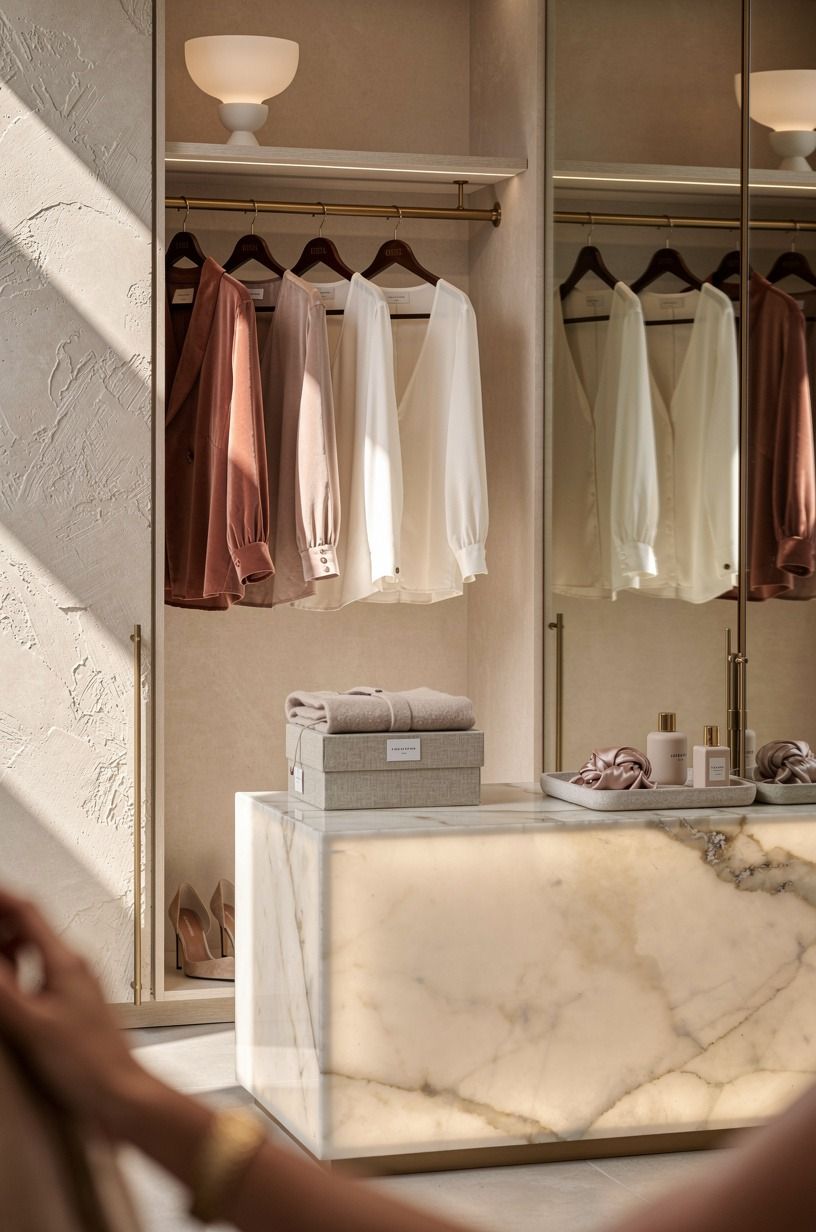
It sounds trivial. It changed everything. I bought 60 slim velvet hangers in champagne, the kind that hold silk blouses without slipping, and I threw out every other hanger in the house.
Slim hangers alone gave me back roughly 20% of rod space because the velvet profile is thinner than wood or plastic. Suddenly I could see everything I owned.
Champagne, not black. Black shows lint and looks funeral.
Cream and blush also work. The brand doesn't matter as long as the velvet is dense and the hook swivels.
For ties and scarves, I added a 12-hook brass tie bar inside the door. Velvet for clothes, brass for accessories; that's the visual rhythm that reads boutique rather than dorm.
If you want one upgrade that costs under $50 and looks like a thousand-dollar renovation, this is it. Worth every penny!
For the rest of the velvet story across the room, our walk-in closet organization ideas covers the full rollout. And if you're wondering whether slim hangers really hold up, my velvet hanger review breaks down the three brands that didn't snap within a year.
3Park a tufted bench at the foot of the window
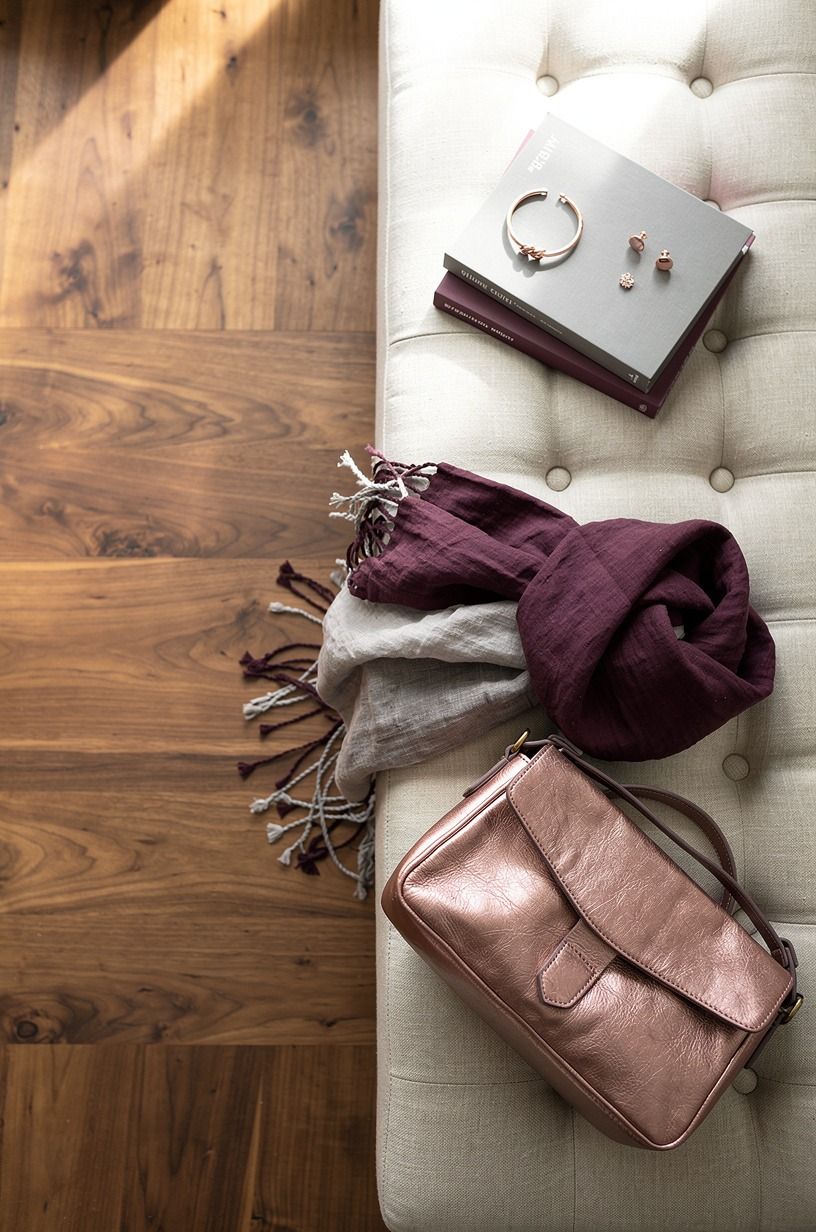
Not centered. Off to one side. The asymmetry is what makes it feel like a room someone actually lives in, not a magazine spread.
I bought a 48-inch tufted bench in sage mohair velvet with brushed brass legs from a vendor on Chairish, used, $340. The mohair catches the late-afternoon light in a way the linen sample I brought home didn't.
A bench in a dressing room does three things: it gives you a place to sit and put on boots, it breaks up the long sight line from the door to the window, and it makes the room feel furnished rather than just stored. Nobody sits on a bench for more than thirty seconds, but the eye reads it as a destination. The same logic with a Threshold bench from Target at $200 reads equally well if the mohair is replaced by a tight woven bouclé in oatmeal, and you can swap the brass legs for brushed nickel without anyone noticing if brass isn't your thing.
If you don't have a window, push the bench under the mirror instead. The reflection doubles its presence and you get the same furnished feel without the natural light.
Just keep the legs visible; a skirted bench looks like a storage ottoman, and the whole point of the move is to add another material underfoot. And yes, the mohair will shed the first month.
That's normal. A lint roller from Costco ($7 for a 30-pack) is your friend for the first six weeks.
For the mohair-vs-linen decision and three other bench fabrics that age well, our bedroom bench styling guide walks through what holds up after year two.
4Line the back wall with a Belgian flax linen niche
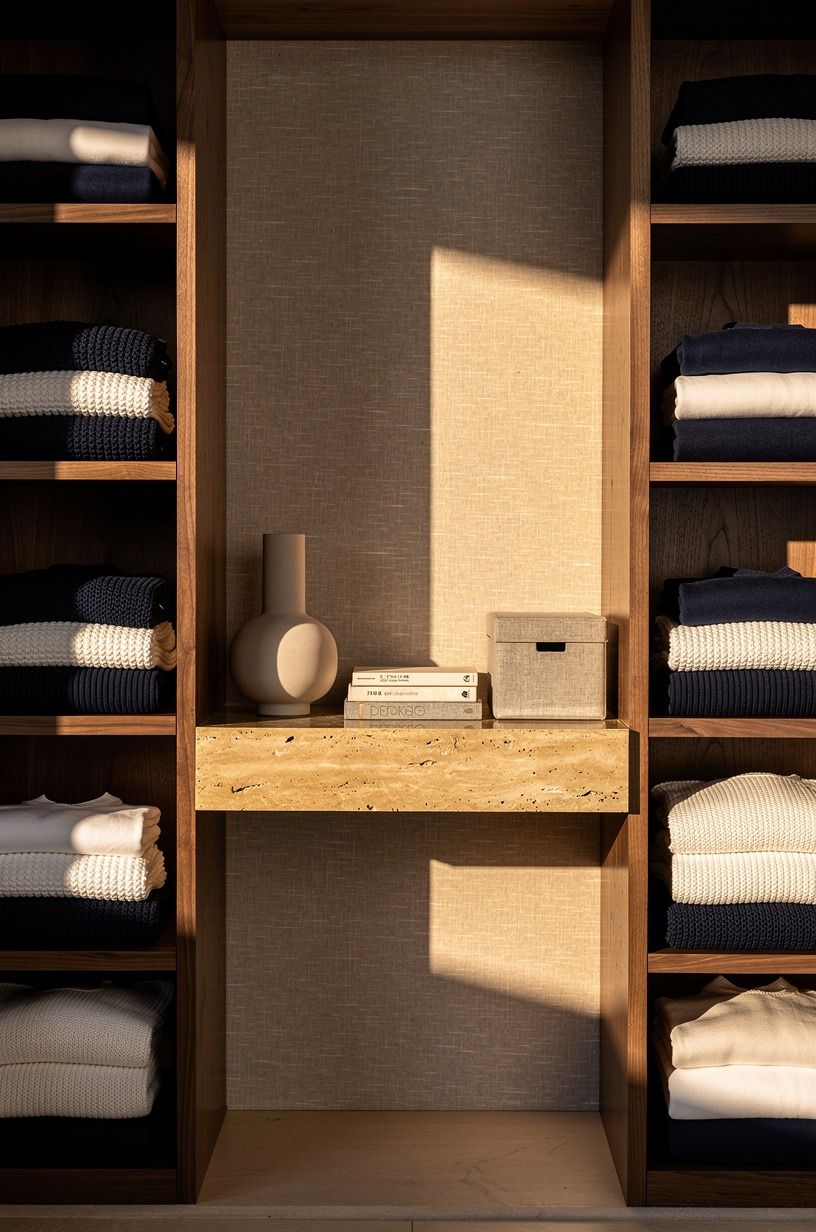
I built a 30-inch-deep alcove in the back wall, lined it with Belgian flax linen in oat, and used it for the pieces I wear most: silk shells, the good denim, the leather jacket. The linen bounces the warm lamplight without flaring it, so the alcove reads quiet even when the chandelier overhead is running at 100%.
That's the part nobody tells you about linen. Most people think it's texture.
It's also a soft diffuser for warm light.
If you want the same effect on a budget, Sherwin-Williams Accessible Beige SW 7036 in matte finish on the alcove walls does 70% of the look for the cost of one roll of linen. For the linen-vs-paint decision in tighter rooms, our cabinet curtain ideas for a cottage look covers the cottage branch of the same family, including which IKEA curtain rods hold linen without sagging.
5Run an unlacquered brass rod across the entire wall
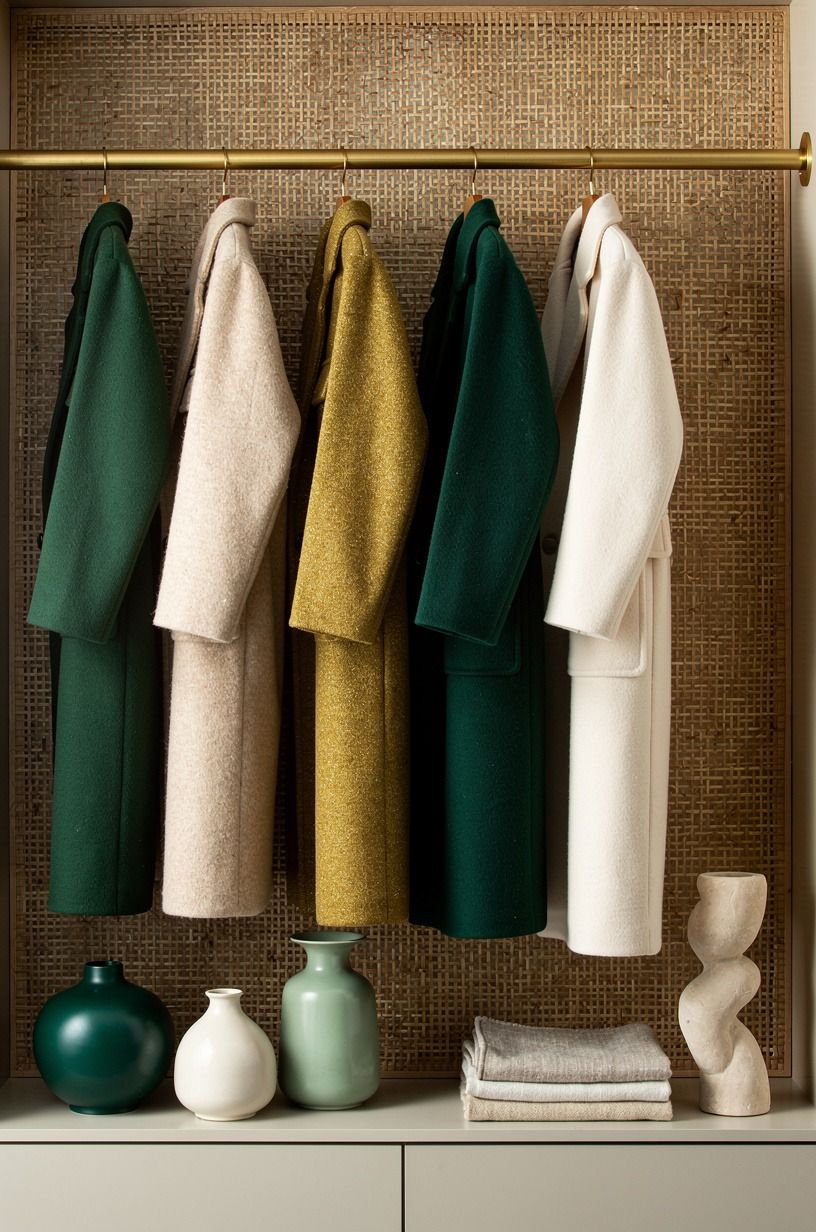
Not a closet rod; a drapery rod. I ran a 96-inch unlacquered brass rod across the entire back wall, 84 inches off the floor, and hung everything from it: dresses, blazers, the cashmere.
Unlacquered brass develops patina, and after two years the rod has darkened where my hands have touched it the most. That patina is the whole point.
It's the same wabi-sabi move you see in old Parisian apartments where the door handles are worn bright.
Brass, not chrome. Chrome looks new forever, and new forever looks like a hotel that just opened last quarter. Brass looks like a hotel that's been there since 1947 and the concierge knows your name.
Mount it 84 inches high for a double-hang effect (you'll use the space below for trousers on a second rod at 42 inches). The standard 42 and 84 heights aren't arbitrary; they're what the trade uses because they maximize double-hang without dragging low pieces on the floor.
And if you're working with a tight wall, run two 48-inch rods instead of one 96-inch and stagger them 8 inches apart. The eye reads it as a single composition but the brackets land in studs.
For the rest of the closet rod math (and which bracket actually holds 30 lbs of winter coats), our closet rod weight guide goes deep.
6Float a terrazzo perfume tray on the dresser
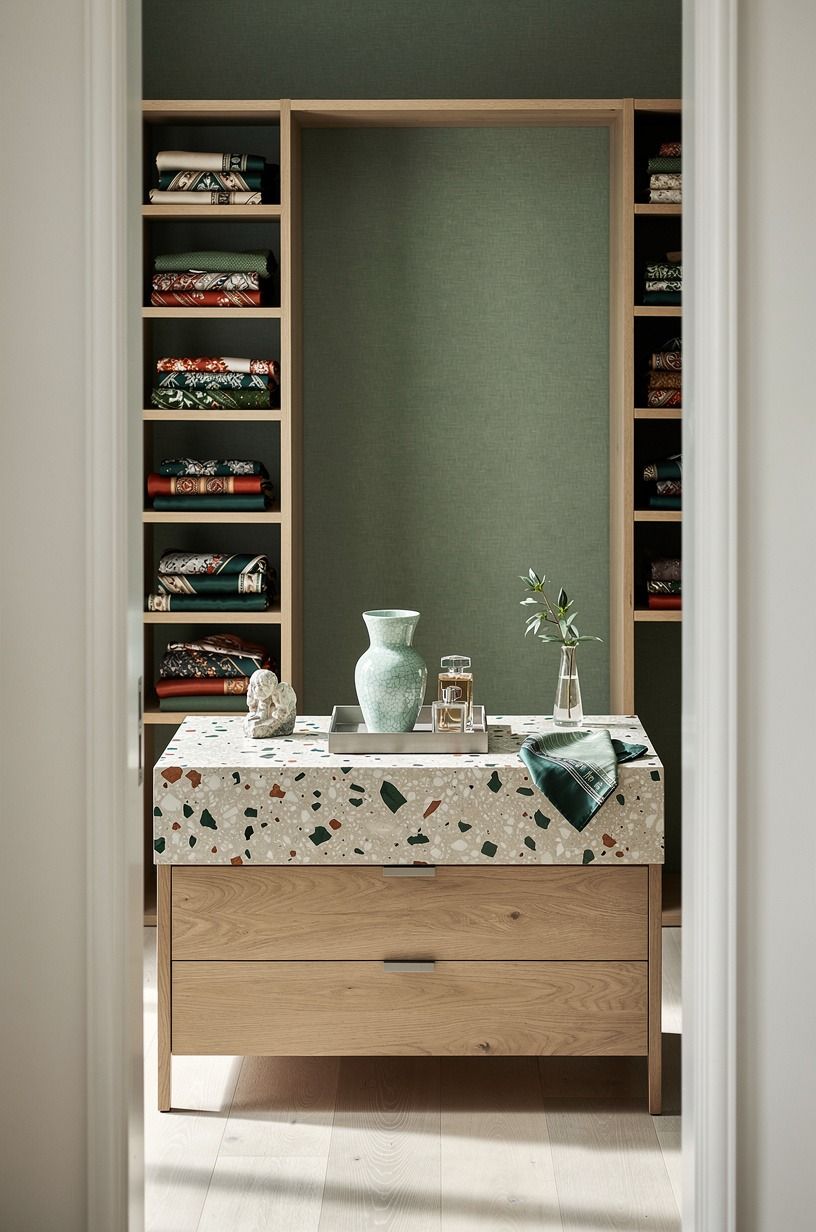
A tray is a way of saying "this small collection is intentional." I bought an oversized oval terrazzo tray with white, blush, and black chips, set it on the dresser, and put three bottles on it: a cracked celadon bottle my grandmother left me, a 50ml of Diptyque in the scent I wear every day, and a travel atomizer. Three.
Not twelve. Three reads boutique, twelve reads department store.
A tray in a dressing room is also a way of giving yourself permission to curate. If a bottle isn't on the tray, it doesn't live on the dresser. The dresser becomes a quiet surface with one defined zone instead of a museum of every fragrance you bought between 2014 and 2023.
For the dresser itself, I went with a vintage three-drawer walnut campaign piece, the kind with brass corner brackets. A campaign dresser is one of the few furniture forms that reads as both dressing room and travel narrative, and the brass corner brackets pick up the rod and the chandelier arms without being matchy. And the dovetailed drawers hold up to decades of opening, which matters when the dresser is the surface you touch every single morning.
7Rotate handbags into an IKEA Lack gallery row
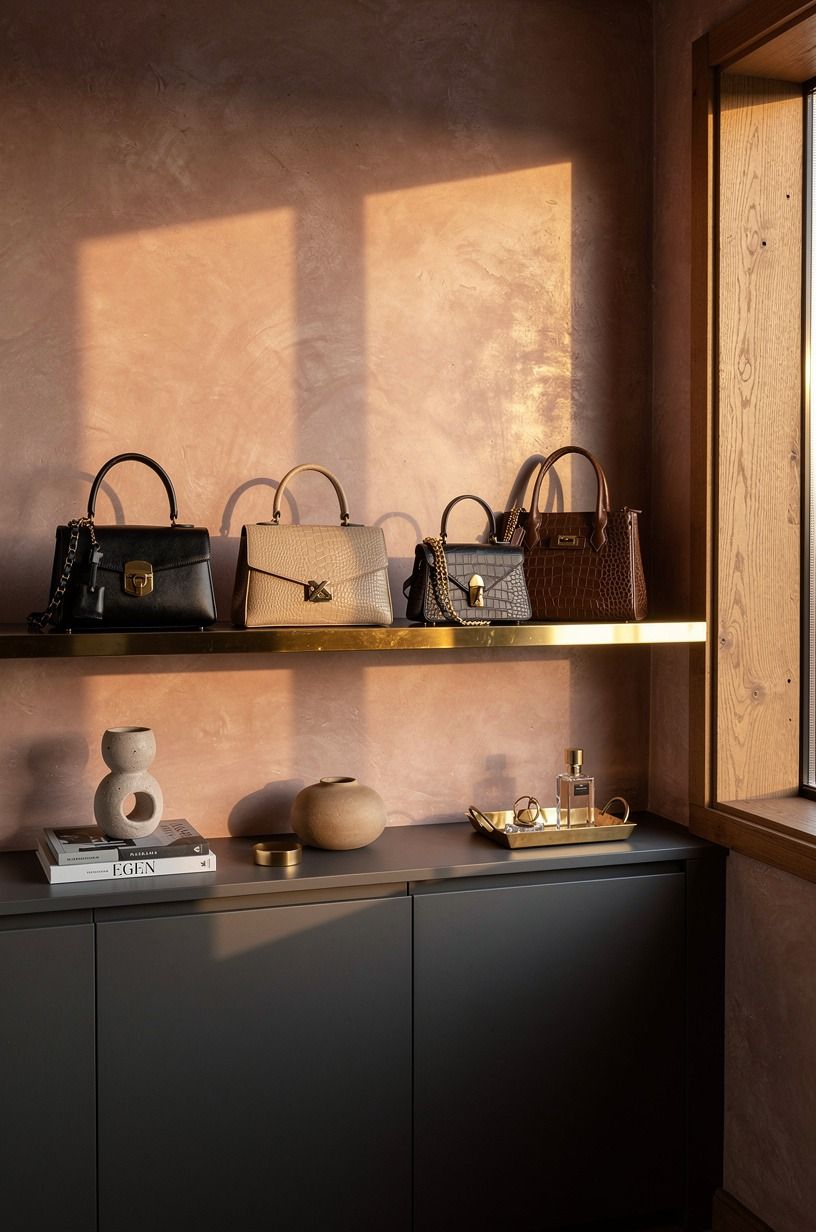
I have 22 handbags. The first thing I did was put 14 of them in archival boxes under the bed, because a row of 22 bags reads as hoarding, and a row of 8 reads as a collection. I keep the 8 on a 36-inch brass shelf mounted 60 inches off the floor, evenly spaced, and rotate quarterly.
A shelf of bags at eye level is the single most-borrowed move from real boutique design. Hotels and consignment shops both use it because it forces you to curate: only the pieces you actually carry get the shelf, and the rotation keeps the collection feeling alive.
The shelf is hand-hammered copper, not brass. The patina on copper is greener and warmer than brass, and it gave the wall behind the bags (Venetian plaster in bone) somewhere to throw light.
Venetian plaster on the back wall was the most expensive single move in the room ($1,400 for a 6-by-8 wall, hand-applied over three days) and the one I get asked about the most. But you can get 60% of the effect with limewash paint in a warm cream, applied in two thin coats with a brush, for $60.
For the rest of the bag-shelf math (depth, spacing, lighting), our handbag shelf display ideas has the dimensions and three layouts that read boutique.
8What does a faded Persian rug actually do under the island?
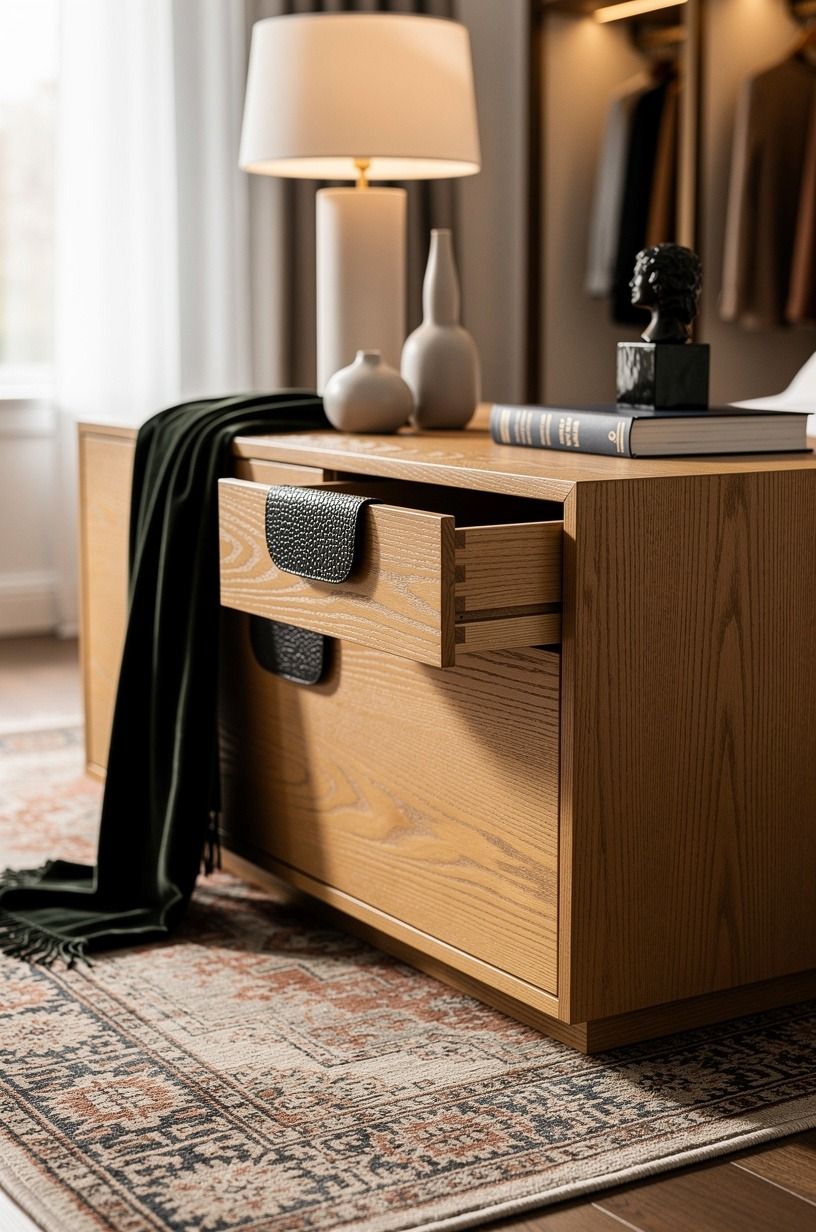
Honestly? More than you'd expect.
The island sits on a faded Persian rug in rust, indigo, and cream. A Persian rug under an island does two things the trade knows and Pinterest boards don't always show: it absorbs sound, so the room stops echoing when you set a bottle down on the marble, and it warms the floor under bare feet in October. Both moves matter for the boutique feel.
A faded rug, not a new one. New rugs look like the rug store.
Faded rugs look like they came with the building. Mine is a 5-by-7 Shiraz, probably 80 years old, bought from a dealer who doesn't have a website.
You'll spend between $400 and $1,500 for the real thing depending on size and condition. The market is full of new rugs dyed to look old; the giveaway is the wool softness. If it feels scratchy, it's fake-aged.
The wire-brushed oak floor under the rug is a separate decision. I went with wire-brushed white oak with a cerused finish, which is a fancy way of saying the grain is open and the white pigment sits in the grain.
It's the same finish you'd see in a Christopher Peacock kitchen and it does the same job here: warm underfoot, hard-wearing, and visually quiet. But the cerused finish only works if you have underfloor radiant heat or live somewhere dry; in a damp climate the open grain drinks up moisture and the floor cups within five years.
Ask me how I know.
For the radiant-vs-non question and what to layer over an existing floor, our cozy backyard ideas has a section on outdoor rugs that faces the same moisture math. Indoors, the closest cousin is our budget kitchen cabinet makeover guide, because the same white-pigment-in-grain finish works on cabinet fronts in a pinch.
9Why does floor-to-ceiling mirror change everything?
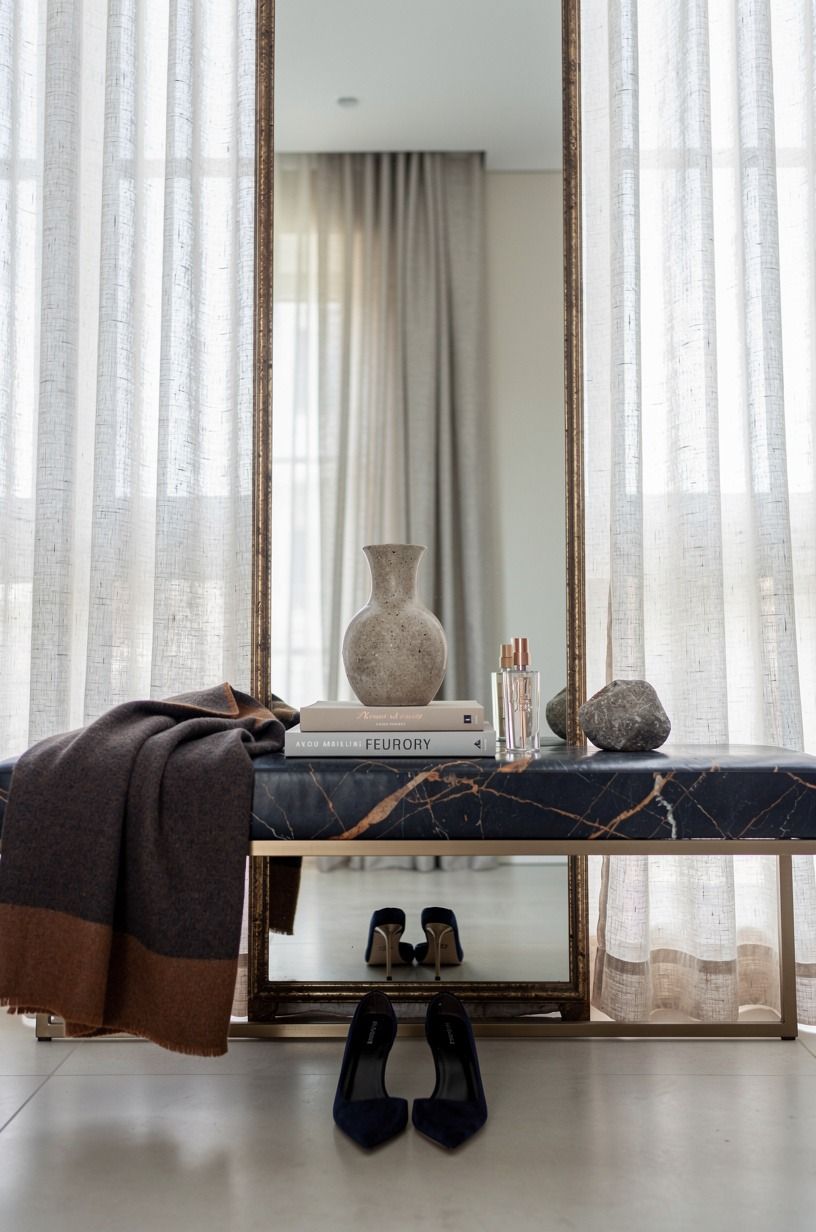
A floor-to-ceiling mirror is non-negotiable if you want the room to feel like a suite, but the reason is less obvious than you'd think. It's not about checking your shoes (you're already wearing them).
It's about doubling the soft material on the opposite wall: the linen, the Venetian plaster, the curtain, the rug's edge. The mirror bounces the materials back at you and the boutique read gets twice the texture for one purchase.
I went with a steel-frame version from a local glass shop ($480 with install, including a hidden cleat so the bottom floats about an inch off the floor). The float is the move; framed-to-the-floor mirrors read as gym, not five-star.
Skirted, no-skirted, you want the seam invisible.
If you're working with a tight wall, a leaning West Elm floor mirror on a hidden French cleat does 70% of the effect for a third of the install cost. Lean it 1 inch off the wall and pin the top to the drywall with one discreet Command strip.
Same float, no framing required, and it leaves with you when the room changes. For the cleat-vs-lean math in tighter bedrooms, our bedroom bench styling guide has the wall-clearance chart.
10Tuck a velvet chaise into the corner, not an armchair
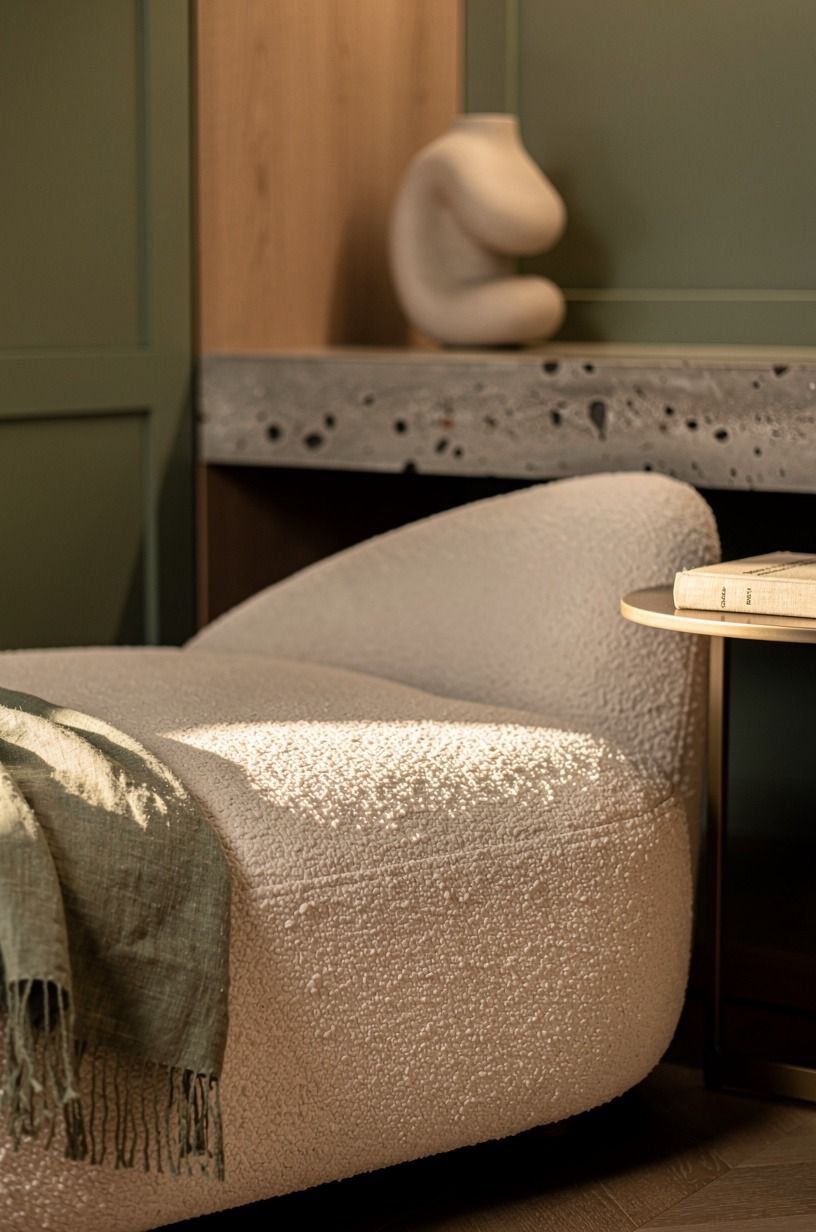
A chaise in a dressing room is the move that pushes the room from "well-organized closet" to "I might actually sit here with a coffee." Mine is in organic bouclé in cream, low to the ground, shoved into the corner with a poured concrete side table next to it (the Cire Trade Tap table, a brand out of Mexico City if you're hunting one). The side table is intentional; bouclé needs a hard surface next to it to read as intentional. Without the concrete table, the corner reads as furniture that didn't fit anywhere else.
Bouclé in cream is risky if you have a partner who eats in bed. I don't, so I get the cream.
If you're on the fence, go bone or oat; cream shows every coffee ring and every magazine page that bled ink. Bouclé is also a beast to clean; get the slipcover version if you can.
A chaise also forces a corner. Every boutique I've ever loved has a corner you can stand in and feel held, and a chaise defines that corner without a wall.
If you don't have the budget, a single armchair in the corner with a sheepskin throw does the same job at a third of the price. And the chaise-vs-chair decision usually comes down to floor space; under 18 inches of clearance behind the chaise, go armchair.
For the bouclé-fabric truth (which brands pill, which wear for years), our bouclé chair durability review compares six options side by side.
11Swap the closet door for a Farrow & Ball hidden pivot, not a hollow-core slab
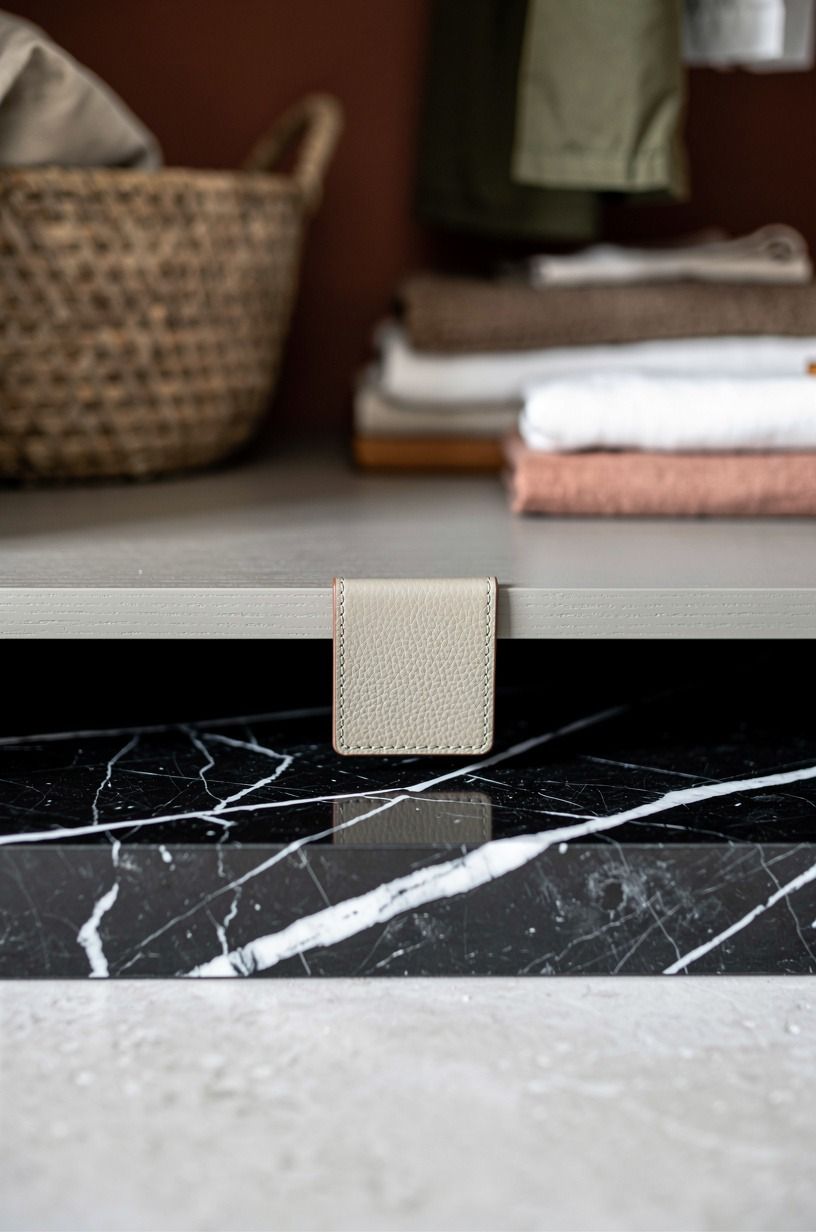
The original builder door was a hollow-core flush slab.
12Does painting the ceiling the same shade as the walls really do anything?
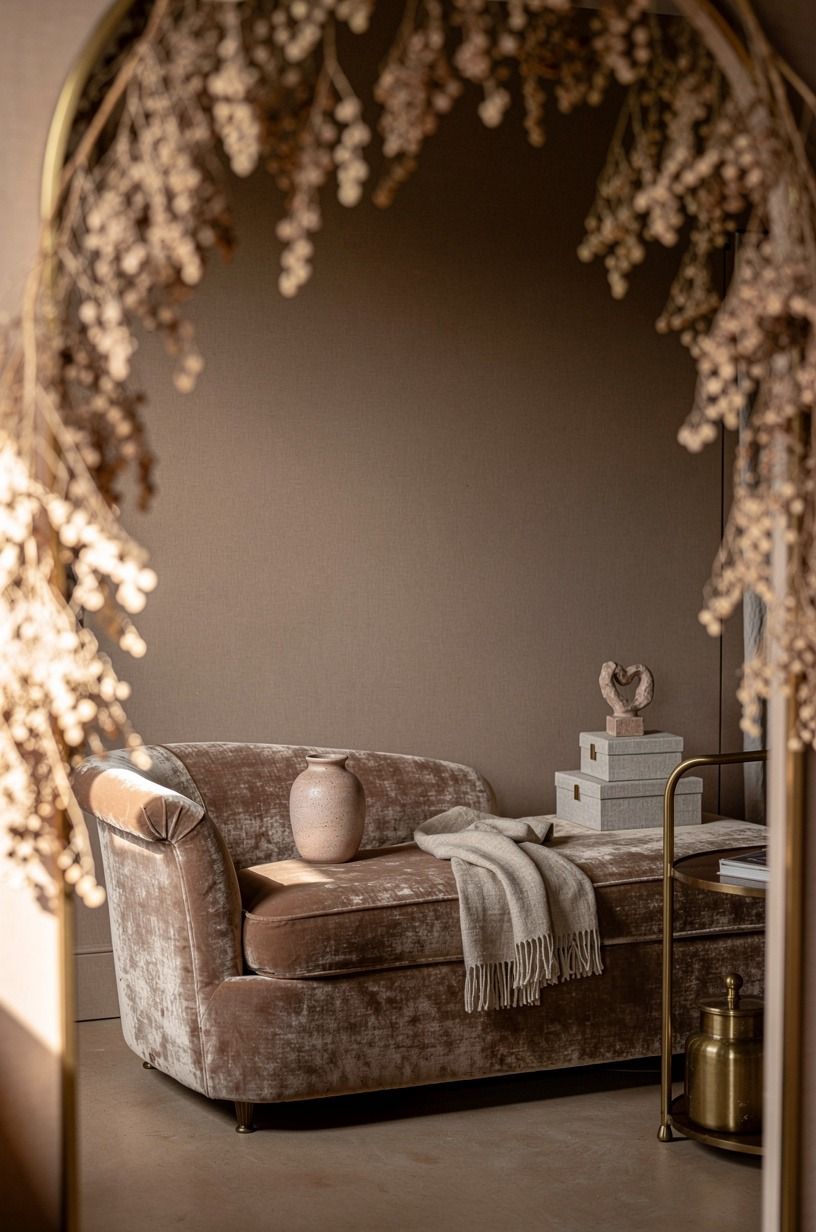
Yes, way more than you'd think. This is the single most underrated boutique move, and it's basically free.
When the ceiling is the same warm white as the walls (I used Benjamin Moore White Dove OC-17 flat ceiling formula, not the same as wall formula), the room has nowhere to "end" visually, so the boutique feeling stretches all the way up and the proportions feel softer. Most clients tell me it's the only change in the room that felt bigger than it cost.
If White Dove feels too stark in a north-facing room, Benjamin Moore Pale Oak OC-20 in flat ceiling formula reads warmer without going yellow.
For the same color-drench logic on a tighter ceiling (bathrooms especially), our bathroom ceiling color guide covers three tiers of warm-white ceilings and which ones hold up under steam.
13Drop a Calacatta marble slab on the island top
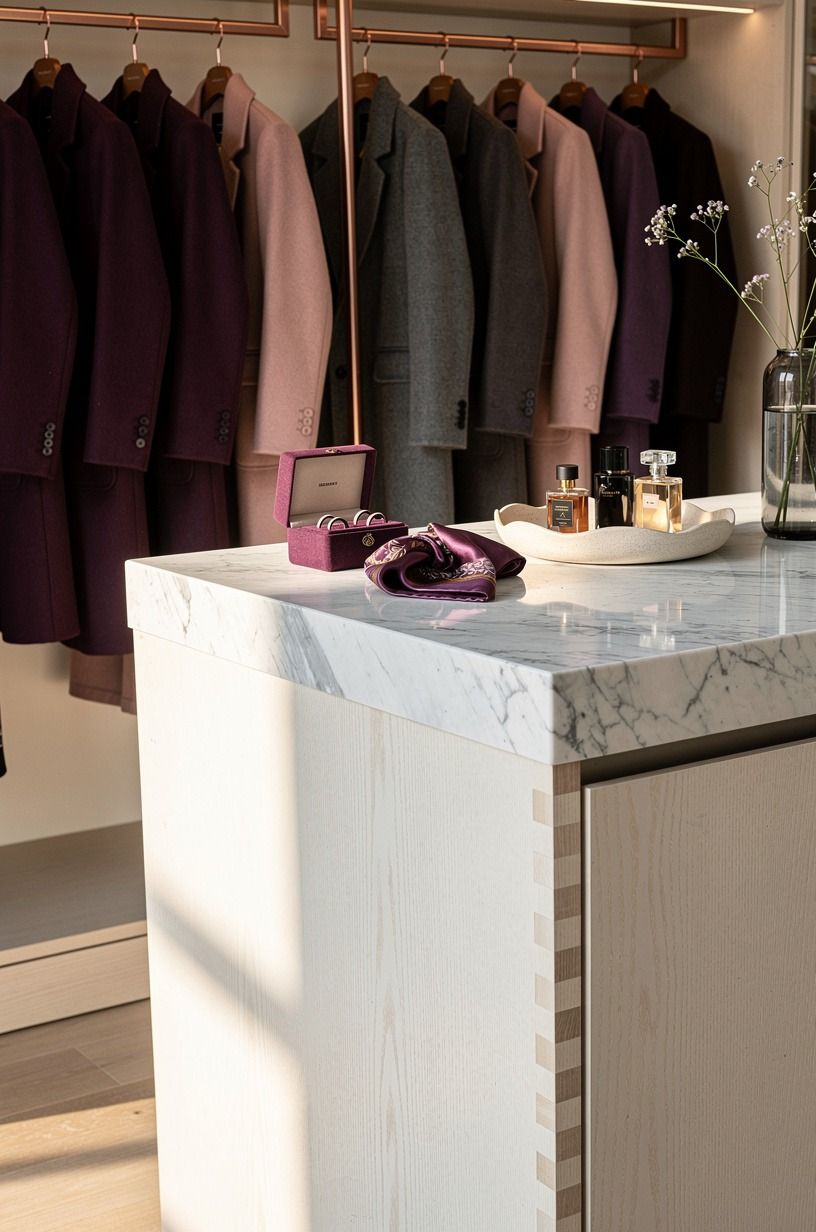
A real Calacatta marble slab on the island is the cost-most-easily-justified move in the room.
14Keep a single stem of garden roses on the counter
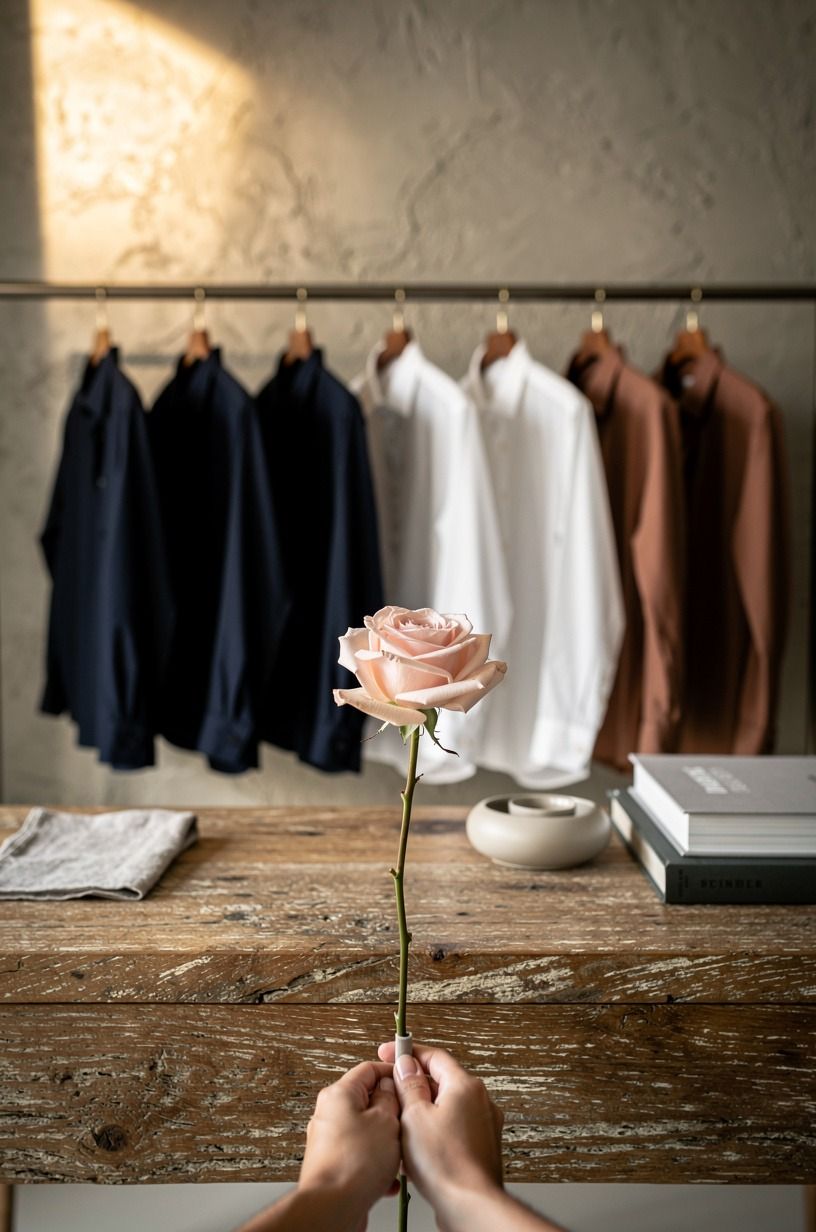
Garden roses, not long-stem roses. Garden roses have the ruffled, cabbage shape and the perfume that long-stem roses gave up in the 1980s breeding rush for color uniformity. I keep a single stem in a small belgian flax linen wrapped vase on the marble slab (the Aram stoneware bud vase at Food52 works if you don't have a florist).
I replace it every four or five days when it starts to drop.
A single stem is more expensive per stem than a bunch, and that cost is the point. One stem forces you to choose the best stem from the bunch at the florist. It also forces a smaller vessel, which leaves room for the perfume tray, which leaves room for the slab to breathe.
If you don't have a florist nearby, eucalyptus in a single stem does the same sculptural job and lasts two weeks in water. Dried hydrangea is the autumn-winter move: no water needed, same sculptural presence, and the muted color reads like a hotel off-season. And the rule with dried flowers is to keep them out of direct sun; the petals fade to cream in six weeks otherwise.
For the year-round stem rotation (what works in January versus August), our single-stem vase styling guide runs through twelve months of what to put on a marble slab. And for the same one-stem logic in a kitchen or dining room, our kitchen table flower centerpiece ideas covers the year-round rotation over a wood surface.
15Light the shelves from above with picture lights
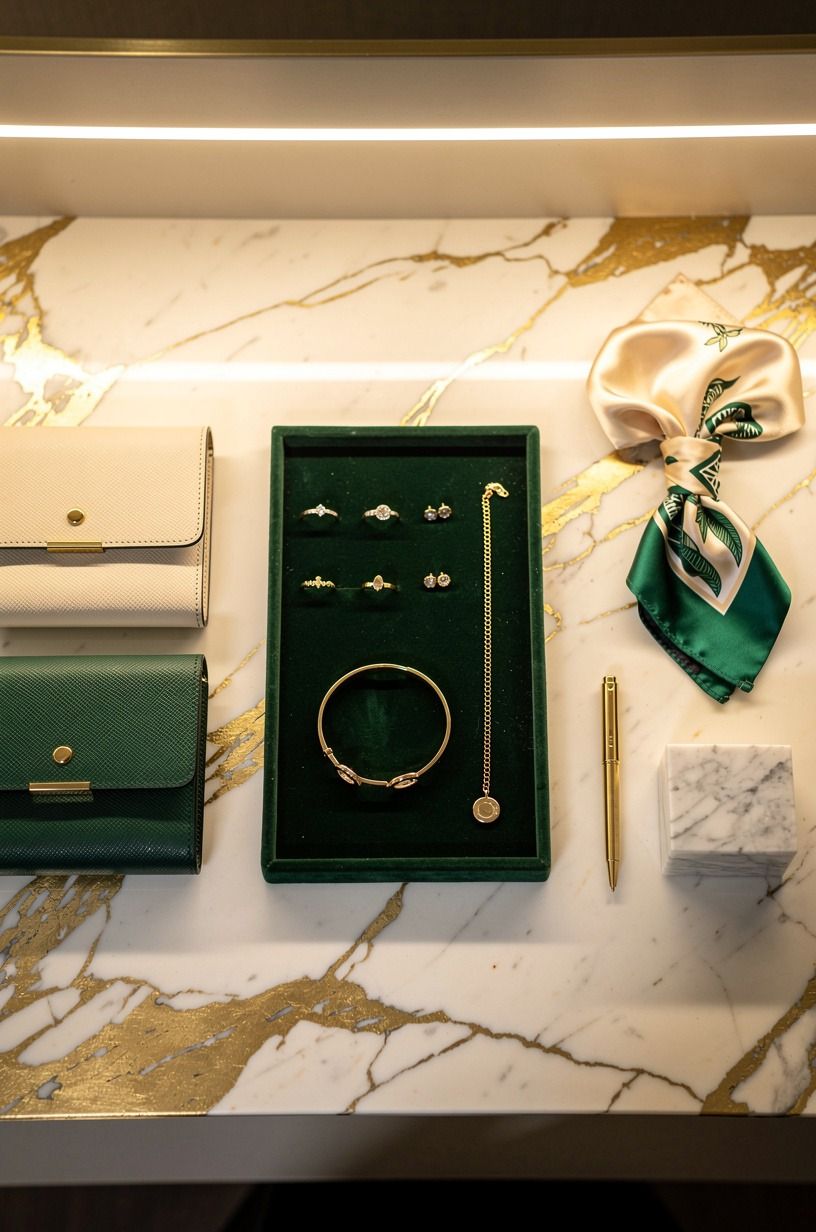
I mounted four small picture lights above the four brass shelf runs (handbags, folded knits, accessories, and shoes).
How much it cost
Here's the honest breakdown, because the question everyone asks is "was it worth it." For me, yes. For you, maybe.
The total came in around $6,400, which is mid-range for a custom dressing room but low for the level it reads at. Most of the spend was on labor and the pivot door install; the materials themselves were a third of the total.
My actual splurges, in order: Venetian plaster wall ($1,400 labor + materials), pivot door install ($1,800), Calacatta slab ($900), crystal chandelier ($180 used). The wins that cost almost nothing: velvet hangers ($58 for 60), the bench (used at $340), the single stem of garden roses ($8 a week, less than a coffee out).
For the room-by-room breakdown on a tighter budget, our walk-in closet organization ideas handles the budget tier with the same logic.
The honest reality of making a small closet feel boutique
A dressing room that feels like a five-star suite isn't about money. It's about restraint.
The reason most closets fail the boutique test is that they have too much in them. A boutique has eight bags on a shelf and lets each one breathe.
A closet has 22 bags in a row and the eye can't tell where one ends and another begins.
The 3-5-8 Rule is what I landed on after two years of fiddling. Three of any single category on any surface (three perfume bottles, three folded sweaters, three pairs of boots visible).
Five of any category on any shelf. Eight of any category on any wall.
Beyond eight, the room reads as storage. Below three, it reads as staged.
The other rule: one material per wall. The wall behind the bags is Venetian plaster.
The wall behind the dresses is linen. The wall behind the shoes is wood. If you mix materials on the same wall, the eye reads it as busy and the boutique feeling collapses.
The smallest room I ever saw pull this off was a 4-by-4 reach-in closet in a Brooklyn rental: one shelf, one rod, one hook on the door for the day's outfit, and a single piece of framed art (a vintage Hermès scarf in a clip frame, $14 at a flea market). The owner kept everything to seven pieces and called it done. That's the entire game: choose less, then frame what you choose well.
The frame matters more than the art in a dressing room. A thin Maple gallery frame (1-inch face, natural finish) is what lets the scarf feel like art and not like a craft project.
A thick black frame fights the soft palette. A no-frame corkboard reads dorm.
You want the same restraint you bring to the rod, the dresser, the rug. One quiet frame, one quiet piece, and the wall earns its keep.
What People Always Want to Know
What is the best luxury dressing room design move for a small closet?
A tufted bench or a single ottoman at the foot of the rod, plus slim velvet hangers throughout. The bench breaks the long sight line, gives you a place to sit, and reads boutique even in a 4-by-4. Pair it with one framed vintage scarf or print on the back wall and you're done.
Less is more in a small closet, and the bench is the cheapest way to make the room feel furnished rather than just stored.
Where can I buy luxury dressing room pieces on a budget?
IKEA for the rods and basic hardware (the HUGAD rail and KOMPLEMENT system are honest starting points). Target's Threshold line for trays and small accessories.
Facebook Marketplace and Chairish for the bench, the campaign dresser, and the Persian rug. The chandelier I bought at a salvage shop in Brooklyn for $180; architectural salvage is where the original boutique feel hides, because almost everything there was originally installed in a real hotel or mansion.
Don't sleep on thrift stores for brass candleholders and picture lights!
How much does a luxury dressing room makeover cost?
For a typical walk-in, between $2,000 and $8,000 if you're doing most of the work yourself and buying new mid-range materials. Between $8,000 and $25,000 if you're hiring a closet system installer and going custom.
The biggest variable is labor: I did the painting, the rod install, and the bench styling myself, and that saved me roughly $3,000. If you hire all of it out, double the materials line. Don't go custom on the millwork until you've lived with the layout for six months.
Can I create a luxury dressing room on a budget?
Yes, and the cheapest move is the one I almost skipped: the velvet hangers. $58 for a set of 60, instant visual upgrade, and you can do it today. After that, one framed vintage scarf on the back wall ($15-$40 at a flea market), a single brass tie bar inside the door ($25), and a small bouquet from the grocery store.
Total: under $150. The room doesn't need to be expensive to feel considered.
What it needs is restraint. Try it on a Saturday morning; you'll be surprised how much moves for under $200.
Is a luxury dressing room worth it in a small space?
Worth it. Worth every penny!
A small dressing room concentrates the boutique feeling because you're not fighting long sight lines or empty walls. A 4-by-4 with a bench and good lighting will feel like a hotel suite faster than a 12-by-12 done halfway.
The rule is restraint: seven pieces, one material per wall, one light source per zone. Small rooms reward curation; large rooms punish it.
Is a luxury dressing room a good idea for a rental?
Yes, with three no-damage swaps: peel-and-stick Belgian flax linen-look wallpaper on the back wall (removable with a hair dryer), a tension rod instead of a mounted one (no holes), and a leaning mirror instead of a mounted one (one tiny nail, easy to patch). The bench, the tray, the perfume bottles, the rug: all portable. Most of the boutique feeling lives in the accessories, not the architecture, and accessories leave with you.
Where I'd Start First
If I had to pick one, I'd start with the velvet hangers. You can't layer warmth on top of a wire-hanger closet; the eye reads chaos before it reads anything else.
Get the hangers right first, then the rug, then the chandelier. Everything else lands.
One last note before you go buy anything. The room that felt the least boutique on the journey was the month I owned every "right" object and still hadn't edited. The room that felt most boutique was the month I owned seven of them and let each one breathe.
Restraint beats taste, every single time, and taste is mostly learned by living with the room for a season before you add the next thing.