17 Japandi Kitchen Sink Ideas for a Seamless Minimal Look
09 july 2026Japandi kitchen sink ideas for a seamless minimal look usually cost less than people think to start, with cosmetic kitchen updates often landing around $300 to $1,500. I learned that after overstyling one sink wall with pretty things that kept making the room feel busier, not calmer. The fix was not more decor. It was better materials, tighter editing, and a few choices that let your eye settle. If you want the broader room context first, modern Japandi kitchen ideas sets up the mood, and the deeper philosophy lives in what a Japandi kitchen actually means.
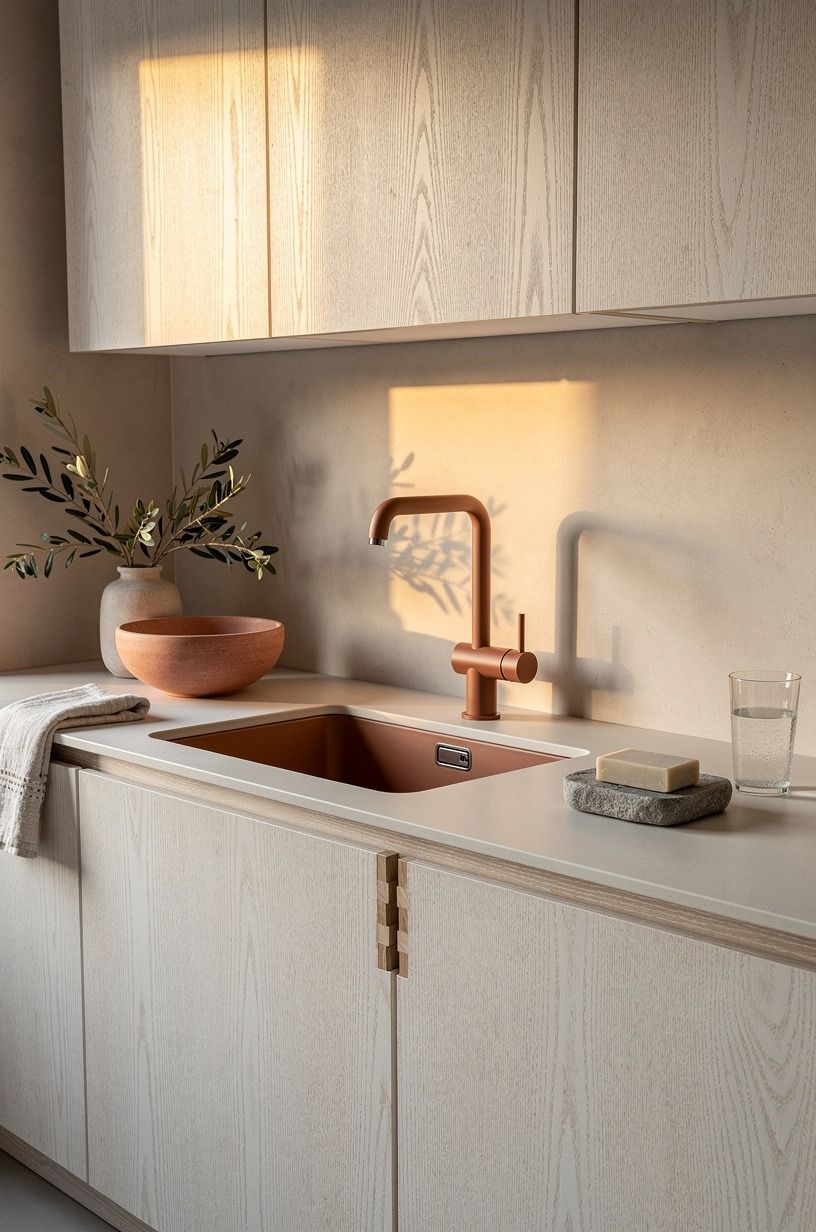
- Undermount a clay sink into pale quartz (The Quiet Edge Rule)
- Frame the basin with fluted white oak (The Warm Rhythm Rule)
- Pair soapstone counters with a matte black faucet (stone over shine)
- Tuck a ledge sink under open oak shelving (The Two-Breath Shelf Rule)
- Choose an off white counter with soft veining (too plain, or exactly right?)
- Run microcement backsplash behind a stone basin (The Soft Wall Strategy)
- Add a slatted oak panel below the sink (The Cabinet Sock Move)
- Mount a wall faucet over a rectangular basin (The Counter Saver Move)
- Set a ribbed farmhouse sink into flat fronts (The Soft Apron Contrast)
- Layer linen cafe curtains beneath the sink (too soft for a working kitchen?)
- Mix honed granite with warm beige cabinets (The Evergreen Fog test)
- Center a single bowl sink on a waterfall island (The One-Bowl Rule)
- Use a thin brass rail for sink towels (The One-Line Accent)
- Wrap the sink wall in limewash texture (The Hand-Finished Calm)
- Float a stone drainboard beside the basin (The Dry-Side Discipline)
- Ground the sink zone with charcoal zellige (The Dark Base Move)
- Style one wooden tray beside the faucet (The Last-Thing Rule)
1Undermount a clay sink into pale quartz (The Quiet Edge Rule)
An undermounted clay sink is one of the easiest ways to make your sink wall feel softer because you lose that hard rim line sitting on top of the counter. If you want your japandi countertop to read calm, not clinical, pale quartz is the better partner than busy stone. You get the smooth wipe-down surface you need, and your eye stays on the warm clay bowl and the cerused white oak cabinetry instead of on a seam.
I made the mistake of trying a thicker reveal once, and it looked fussier right away. You want the sink edge tucked cleanly under the quartz so your sponge can clear crumbs in one pass across a standard 36 in counter.
And if your cabinets are pale oak, keep the quartz soft white with only a little movement, never a loud marble impersonation. Pair it with an IKEA KALLAX birch-effect uppers nearby if you're renting, and you'll get the same calm for under $400. If you're rethinking the whole material mix, what a Japandi kitchen actually means gives you the wider design logic.
It's the move I'd do first.
2Frame the basin with fluted white oak (The Warm Rhythm Rule)
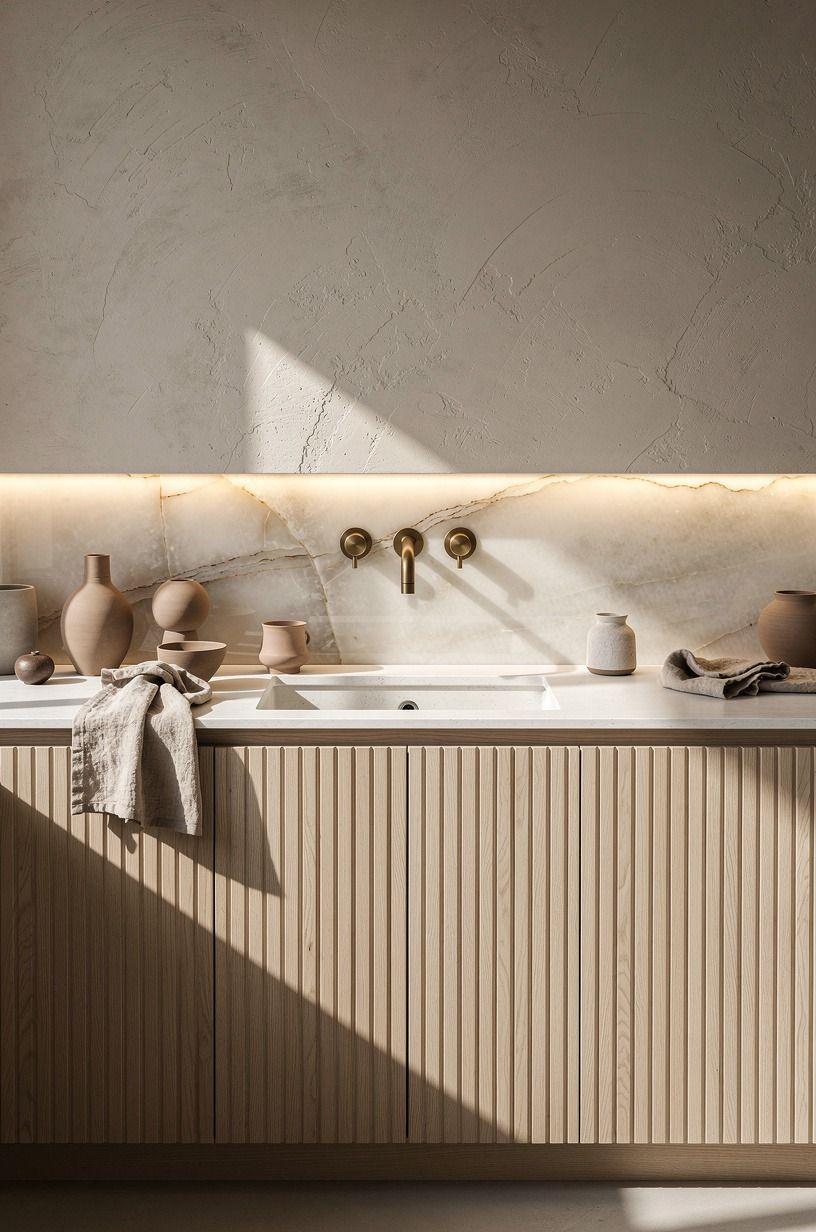
Fluted white oak millwork around the basin gives you texture without clutter, which is exactly what most sink walls are missing. The vertical ribs catch morning light at a low angle, and that's where the warmth comes from. A flat panel would do the same job functionally, but it wouldn't move the eye at all.
I'd keep the ribs shallow, around a quarter inch deep, so they read as a quiet detail instead of a feature wall. You can run them behind a wall-mounted faucet, beside a soapstone counter, or all the way up to the underside of an open shelf.
It still feels like Japandi because nothing is shouting. For more on why oak keeps showing up in calm kitchens, oak kitchen cabinet ideas for a warm modern look is a good sister read.
3Pair soapstone counters with a matte black faucet (stone over shine)
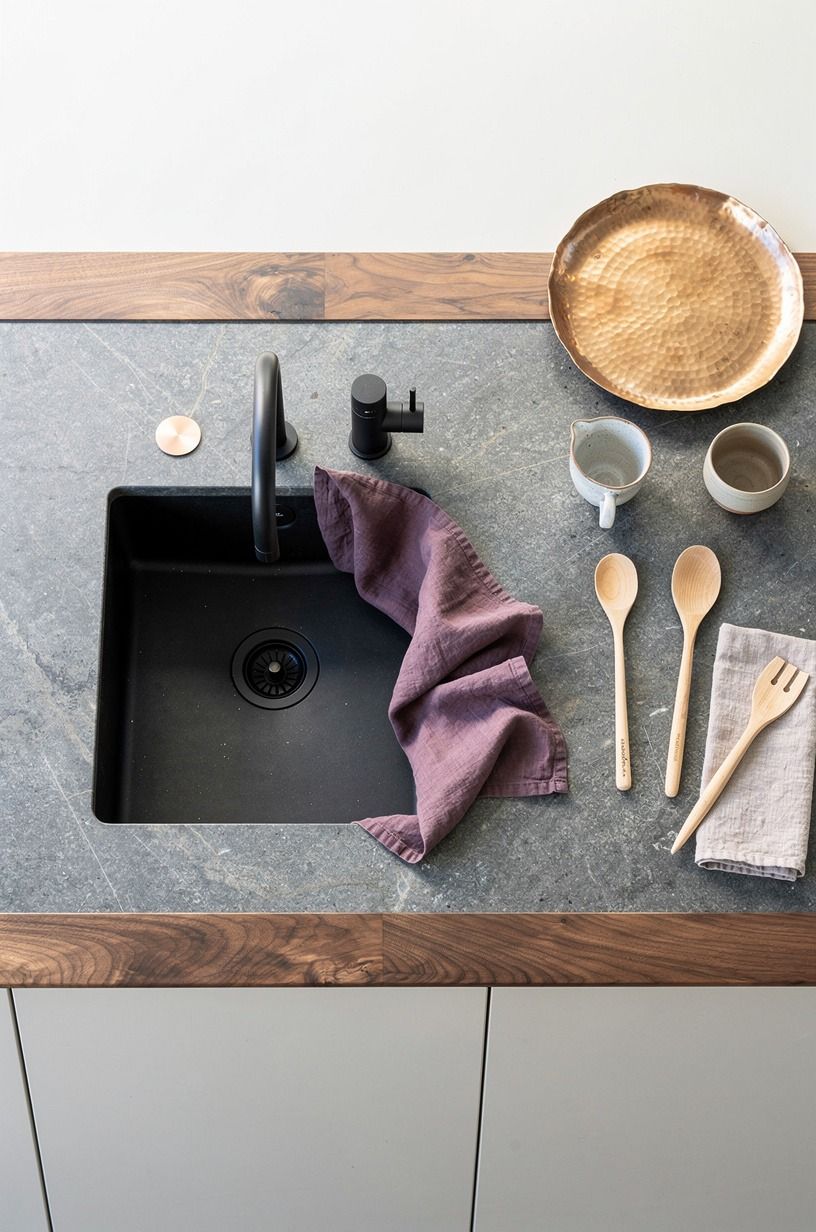
Soapstone is darker than the usual Japandi instinct, and that is why it works so well when you need the sink zone to feel grounded.
4Tuck a ledge sink under open oak shelving (The Two-Breath Shelf Rule)
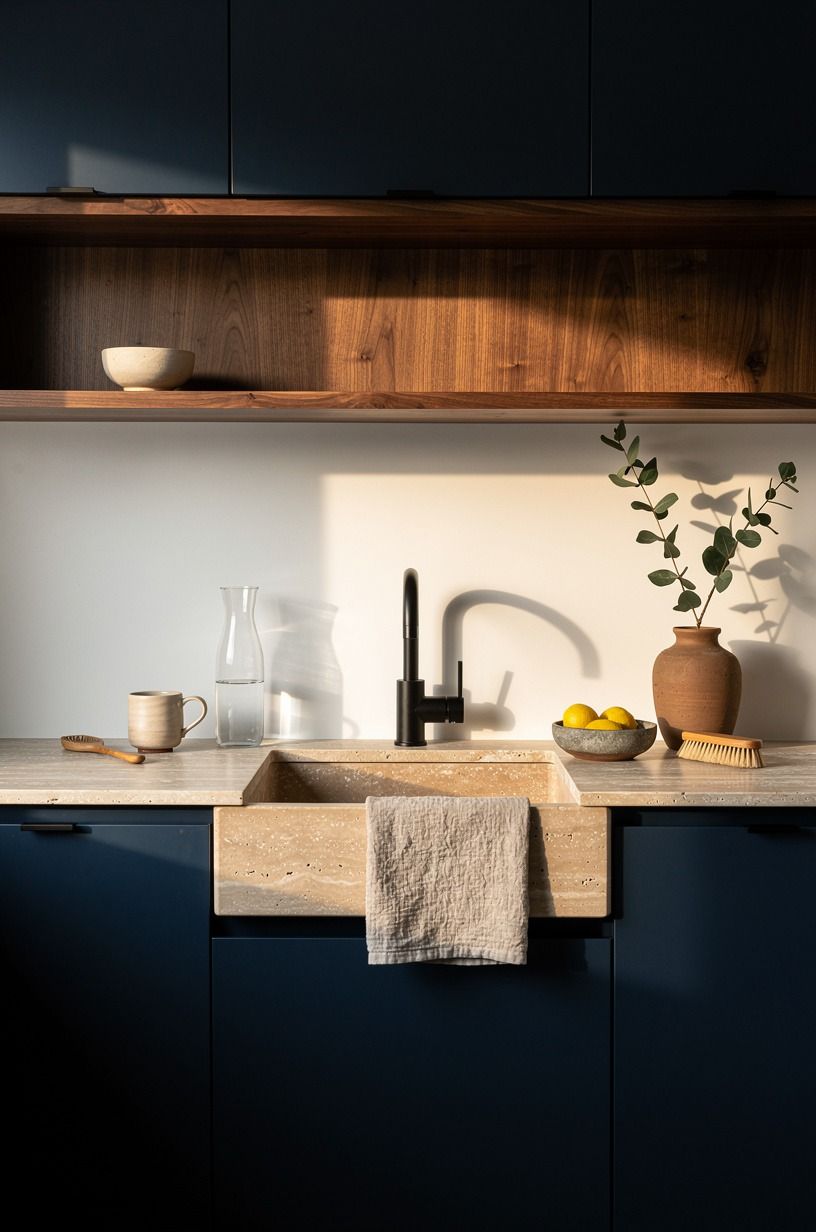
A ledge sink under open shelving works when the shelves stay airy and the sink keeps the daily tools close without looking crowded. The mistake is loading the shelves with eight visible objects. Two or three pieces, plenty of breathing room, and you're done.
I learned this the hard way after stacking my open shelves with cookbooks, vases, and a row of spice jars I'd never open. The whole wall felt like a store display.
Once I cut it down to one stack of bowls, a folded linen, and a small plant, the sink underneath finally got to be the hero. That's what I call the two-breath rule, where two real pauses between objects makes the whole shelf feel calm.
You'll see the same logic in japandi kitchen cabinet ideas for flat handle free calm, just applied to the lower run.
5Choose an off white counter with soft veining (too plain, or exactly right?)
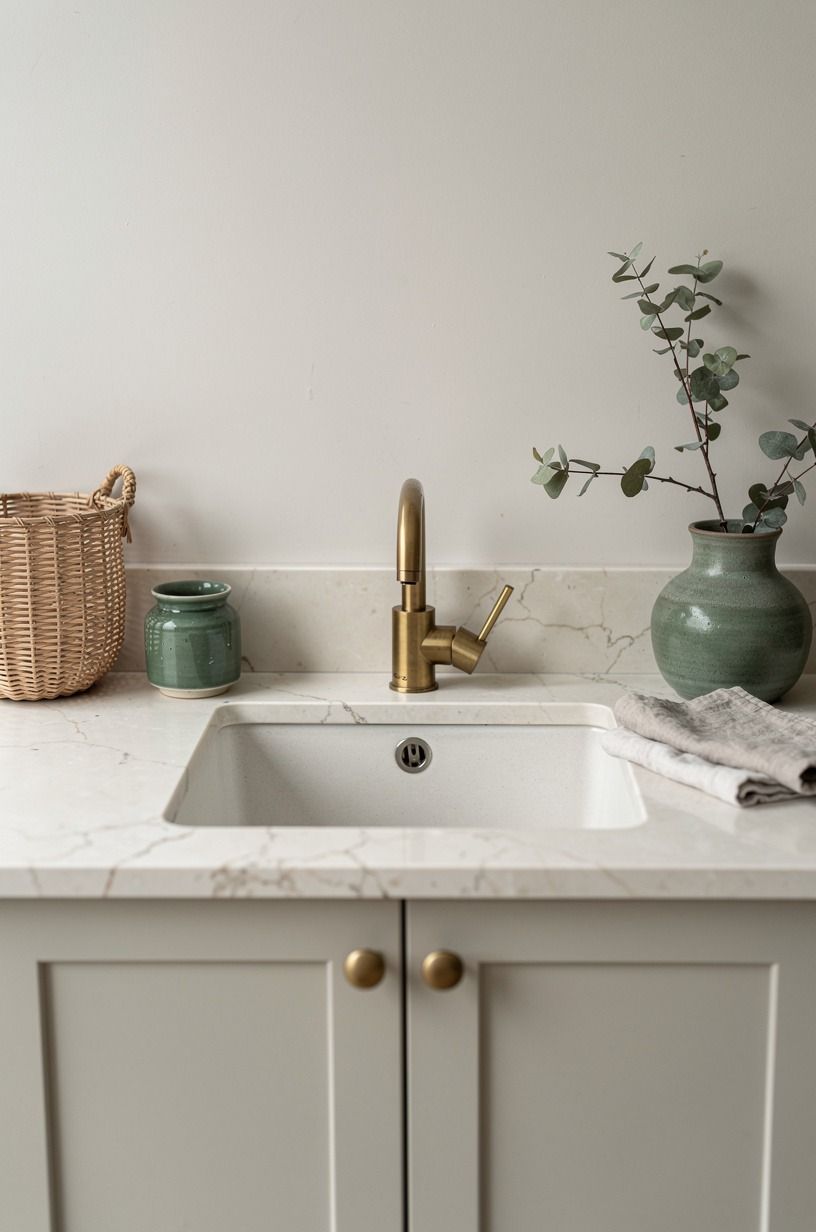
Off white countertops kitchen people call boring are often the ones that age the best because they don't compete with the cabinetry. A softly veined quartz countertop gives you enough movement to keep the surface alive, but it still lets your sink hardware, wood grain, and daylight do the emotional work. That matters if your whole goal is a seamless minimal look.
You want the veining to stay gentle, not stripy. Think one or two quiet passes across the slab, not a dramatic waterfall of gray.
And if your cabinets lean warm beige or pale oak, keep the counter from turning blue in north light by checking it beside Sherwin-Williams Evergreen Fog SW 9130 or a warm sample board. I have seen people buy a bright white slab that looked expensive in the store and icy at home by 3 p.m.
Soft always wins here. For more slab pairing ideas, japandi kitchen countertop ideas goes deeper, and paint colors that go with oak cabinets helps you nail the warm side of the room.
6Run microcement backsplash behind a stone basin (The Soft Wall Strategy)
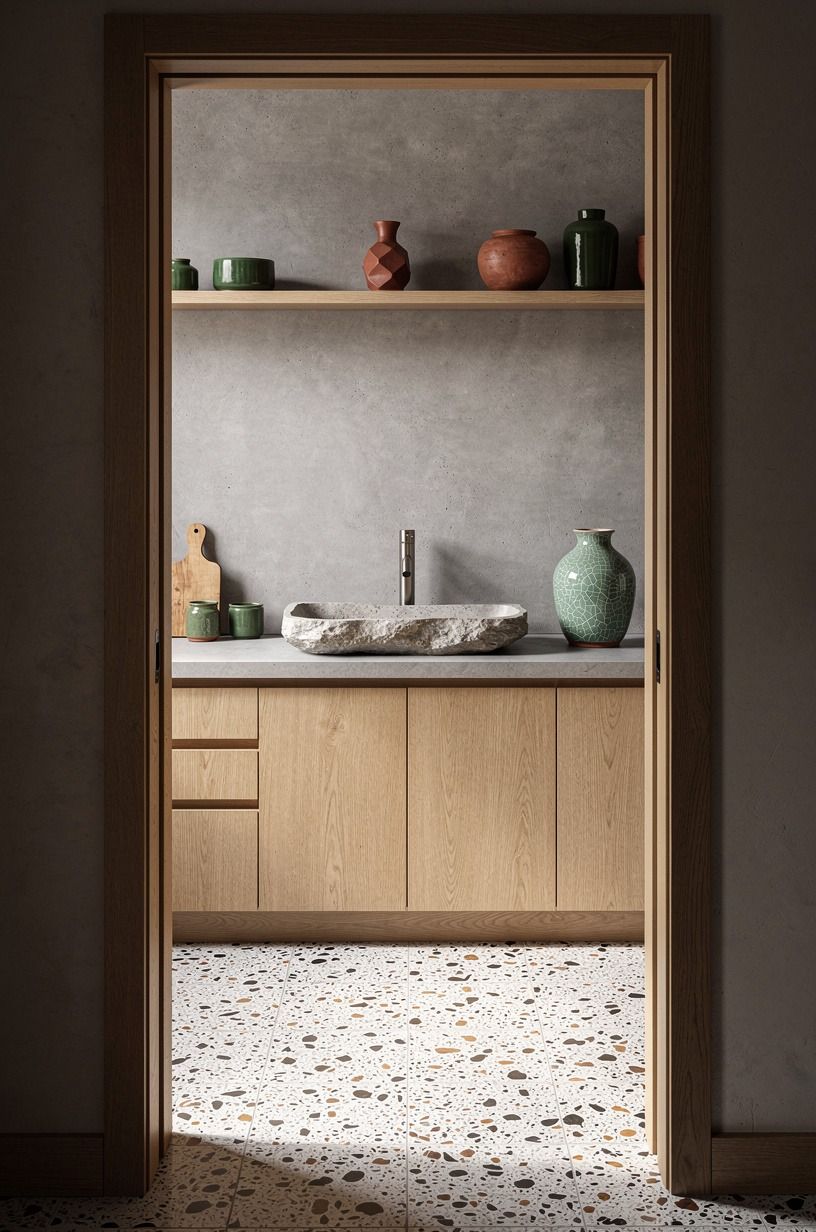
Microcement behind a stone basin works because it removes the visual stop-start you get from tile grout lines. The sink wall becomes one continuous matte field, which makes the basin feel quieter and more sculptural at the same time. If your kitchen already has enough pattern from oak grain or veining, this is the calmer move.
I like this best when the microcement tone sits close to the counter and just a shade lighter than the basin. You don't need a hard contrast.
You need a shadow shift. But seal it well.
I skipped sealing on a test board once and water marks showed up fast near the faucet splash zone. If you want the same low-noise feeling with more texture options, japandi kitchen backsplash ideas is the sister lane to study, and the japandi kitchen color palette guide helps if you are still choosing tones.
It's one of those small decisions you'll feel every single time you wash a dish.
7Add a slatted oak panel below the sink (The Cabinet Sock Move)
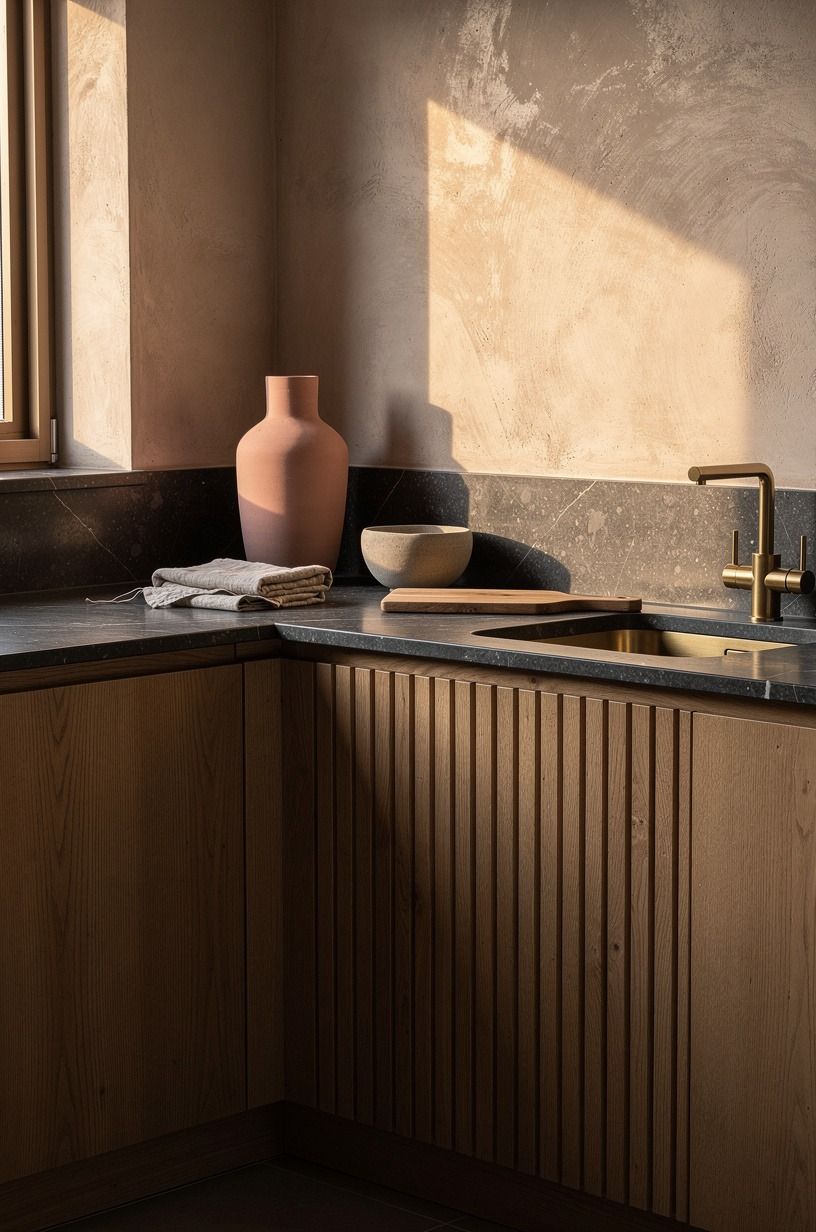
A slatted oak sink-front panel is what you use when the lower cabinets feel too flat but you still want the room restrained.
8Mount a wall faucet over a rectangular basin (The Counter Saver Move)
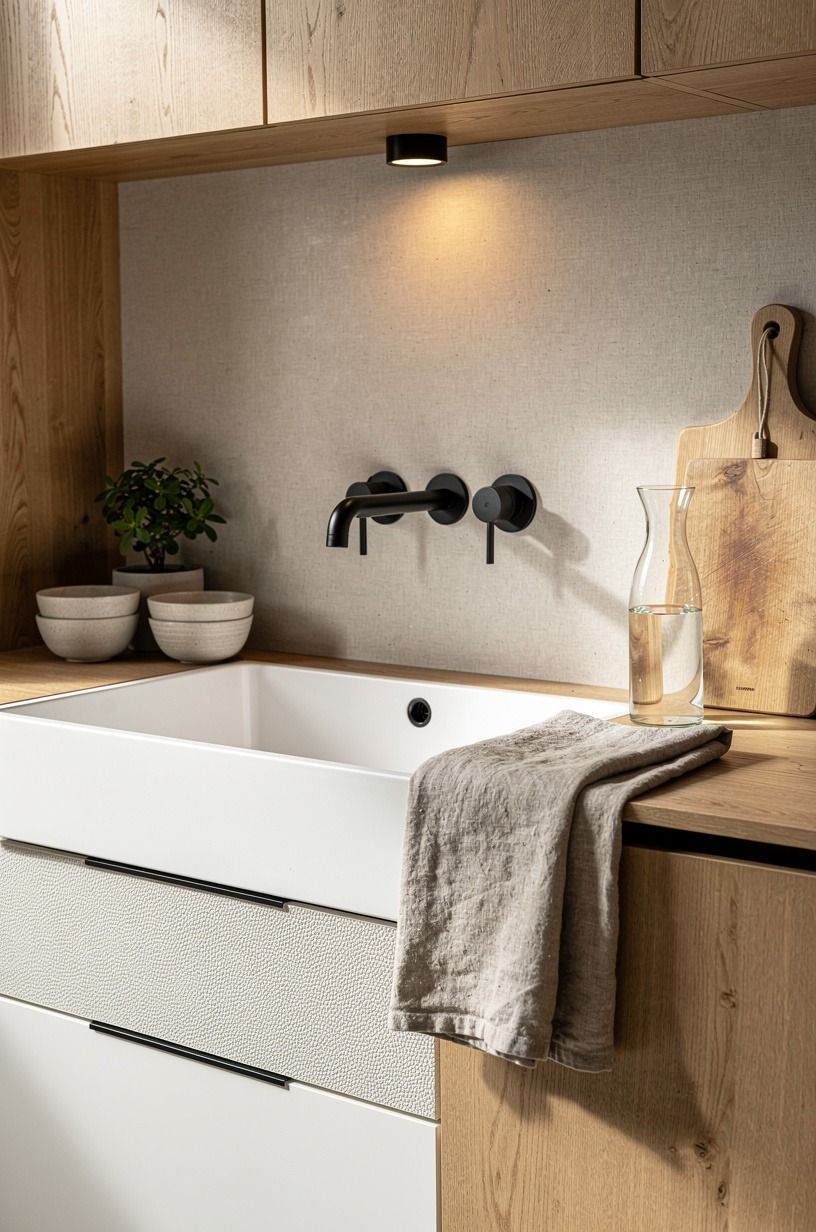
A wall-mounted matte black faucet makes a rectangular basin look more architectural because the hardware leaves the deck clear. You gain a little more breathing room on the counter, and that matters around a sink where soap, cloths, and dishes already compete for space. If your sink wall is narrow, this can buy you just enough calm to make the whole area feel simpler.
But your rough-in height matters. Set it too high and the splash gets annoying.
Set it too low and filling a tall pot becomes a chore. I like the spout centered with enough reach to land near the drain, especially if your basin is long and shallow. And yes, this works best when the wall finish is worth looking at.
Limewash, microcement, or plaster all make more sense here than a loud patterned tile that keeps fighting the clean faucet line. If you're working with a tighter footprint, japandi galley kitchen ideas handles the same wall-mount logic in a slimmer space.
It's a small detail, but the difference is noticeable!
9Set a ribbed farmhouse sink into flat fronts (The Soft Apron Contrast)
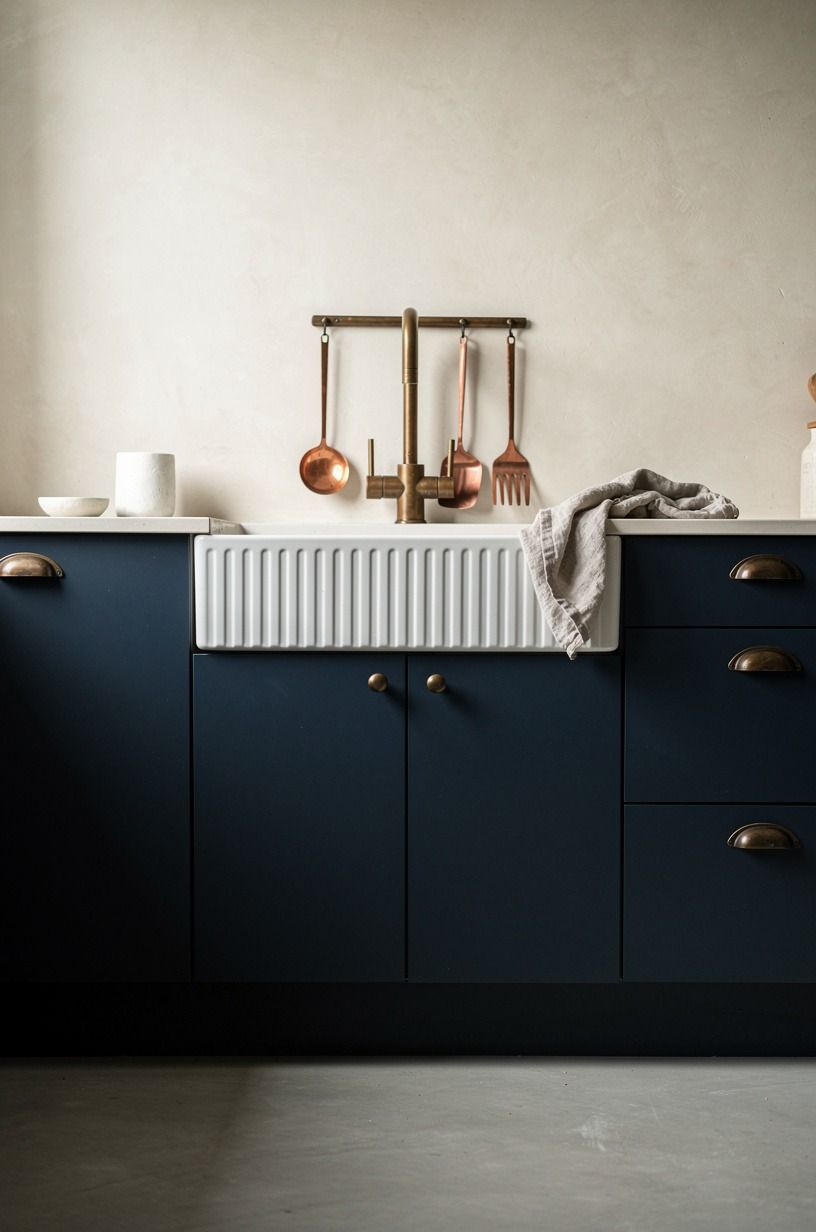
A ribbed farmhouse sink can still feel Japandi if the rest of the kitchen stays pared back. The ribbing adds hand-thrown warmth without ever becoming a centerpiece, and the apron keeps the silhouette honest. Pair it with flat cabinet fronts and you get contrast instead of clutter.
I'd skip the deep V-groove look because it leans country fast. Stick with shallow fluting that catches just enough light to feel alive, the same move you'd make on a small piece of stoneware.
It also photographs beautifully against a pale counter. For the wider material logic, honey oak kitchen cabinets is a useful read, and if you're shopping, an IKEA HEMNES base cabinet dressed with an oak front works for under $250.
10Layer linen cafe curtains beneath the sink (too soft for a working kitchen?)
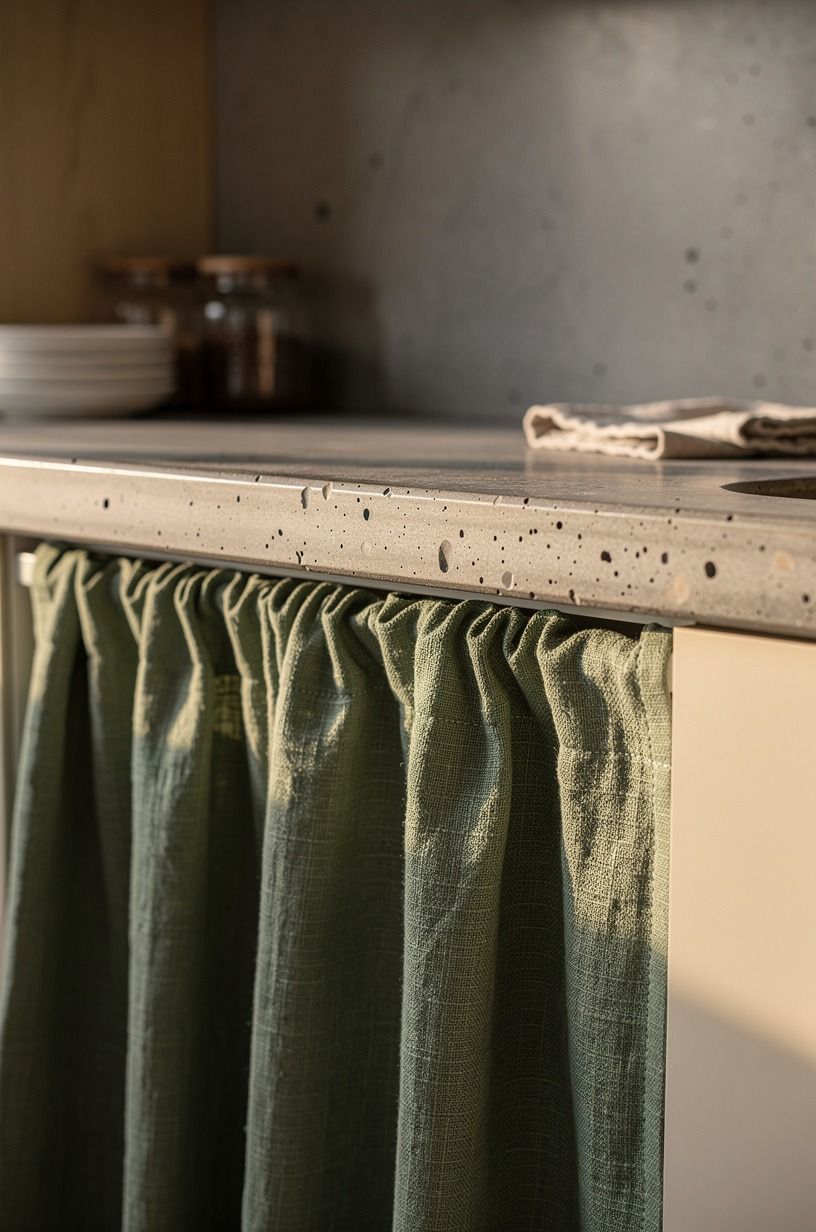
Cafe curtains under the sink sound decorative until you see what a little textile can do to hard kitchen lines.
11Mix honed granite with warm beige cabinets (The Evergreen Fog test)
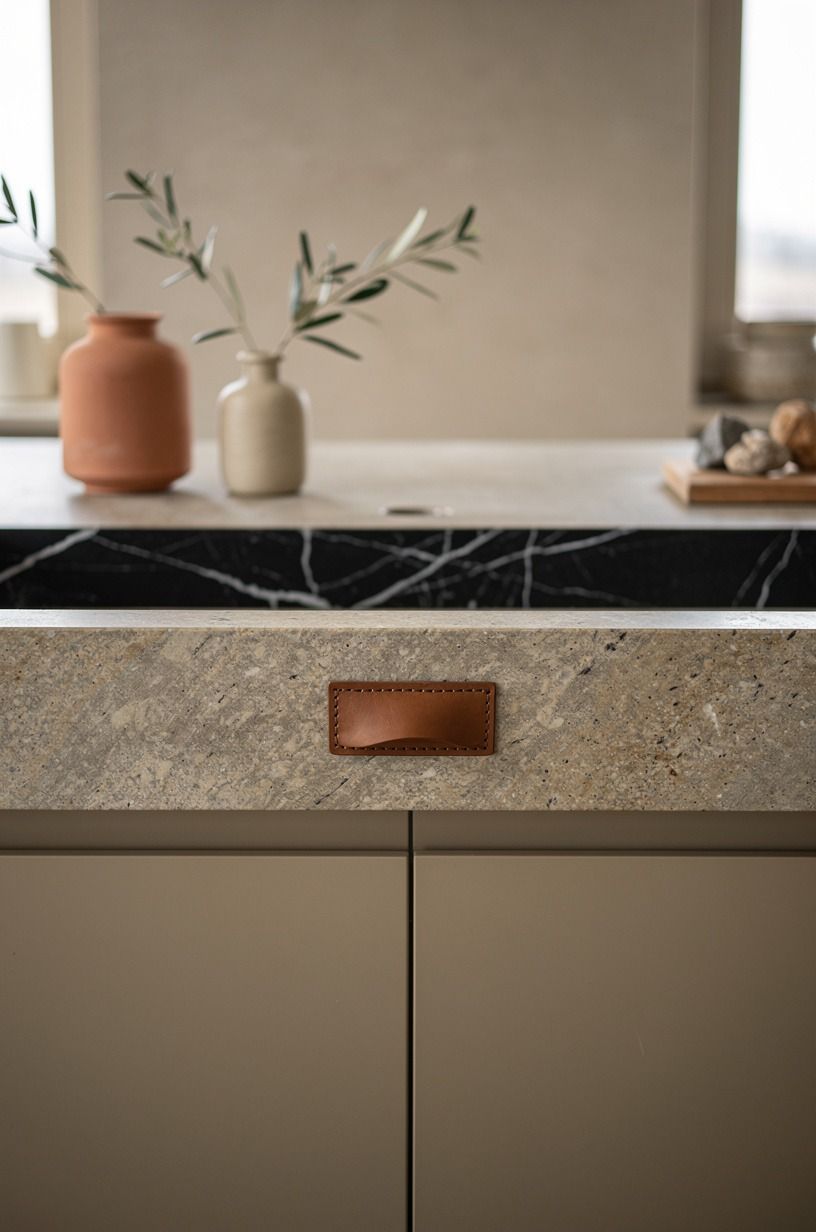
Honed granite countertops next to warm beige cabinets can feel richer than white-on-white because the finish absorbs light and lets the cabinetry hold the warmth. The granite reads soft instead of glossy, which is the move you want when the rest of the room is already pale.
I'd test the pairing with a sample of Benjamin Moore Chestertown Buff HC-9 on a cabinet door before you commit. That swatch tells you more than any Pinterest pin will. Granite also rewards patience.
A honed slab with one or two visible inclusions feels more honest than a perfectly matched engineered stone, and that honesty is what keeps the room calm. For more on the warm side of the palette, green and oak kitchen ideas is worth a save, and japandi kitchen dining ideas is the natural next stop if your sink opens onto a breakfast nook.
12Center a single bowl sink on a waterfall island (The One-Bowl Rule)
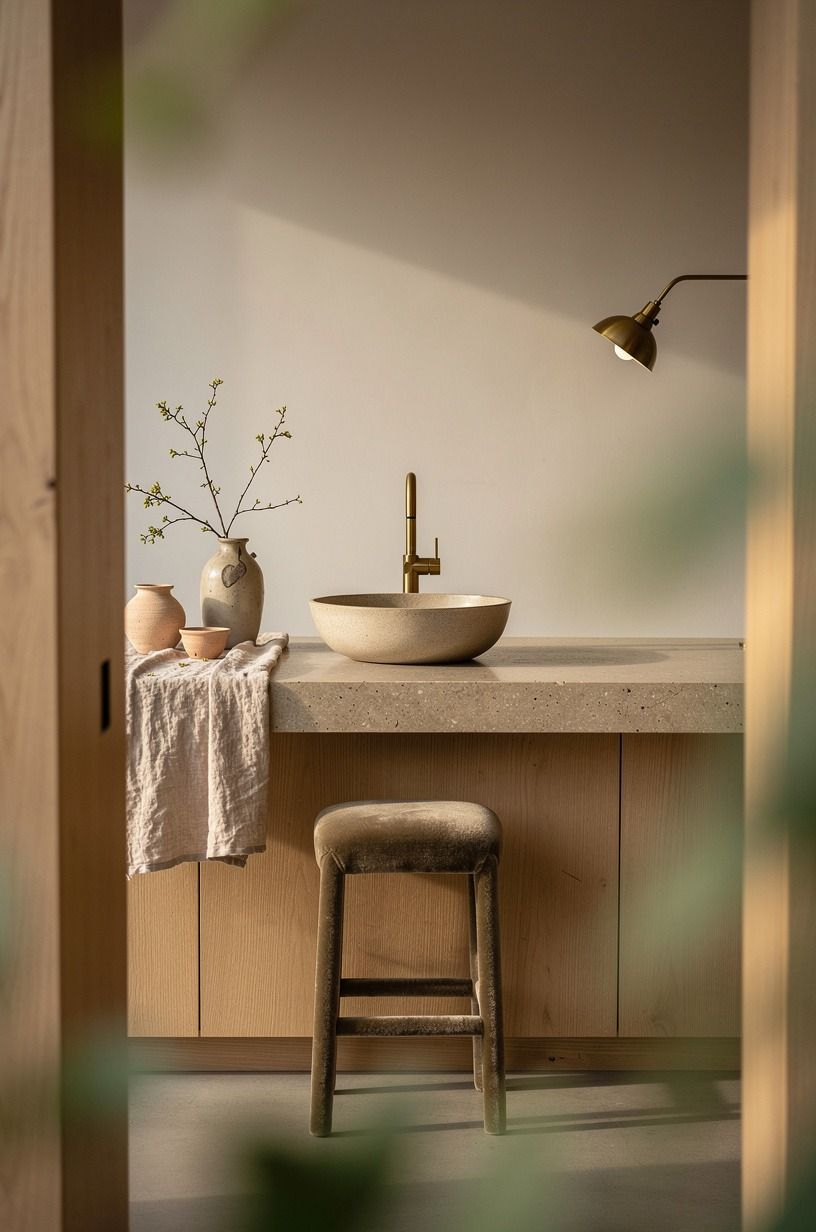
A single-bowl island sink feels better than a divided one in a minimalist kitchen because the basin reads as one clean cut in the surface, not as two little compartments.
13Use a thin brass rail for sink towels (The One-Line Accent)
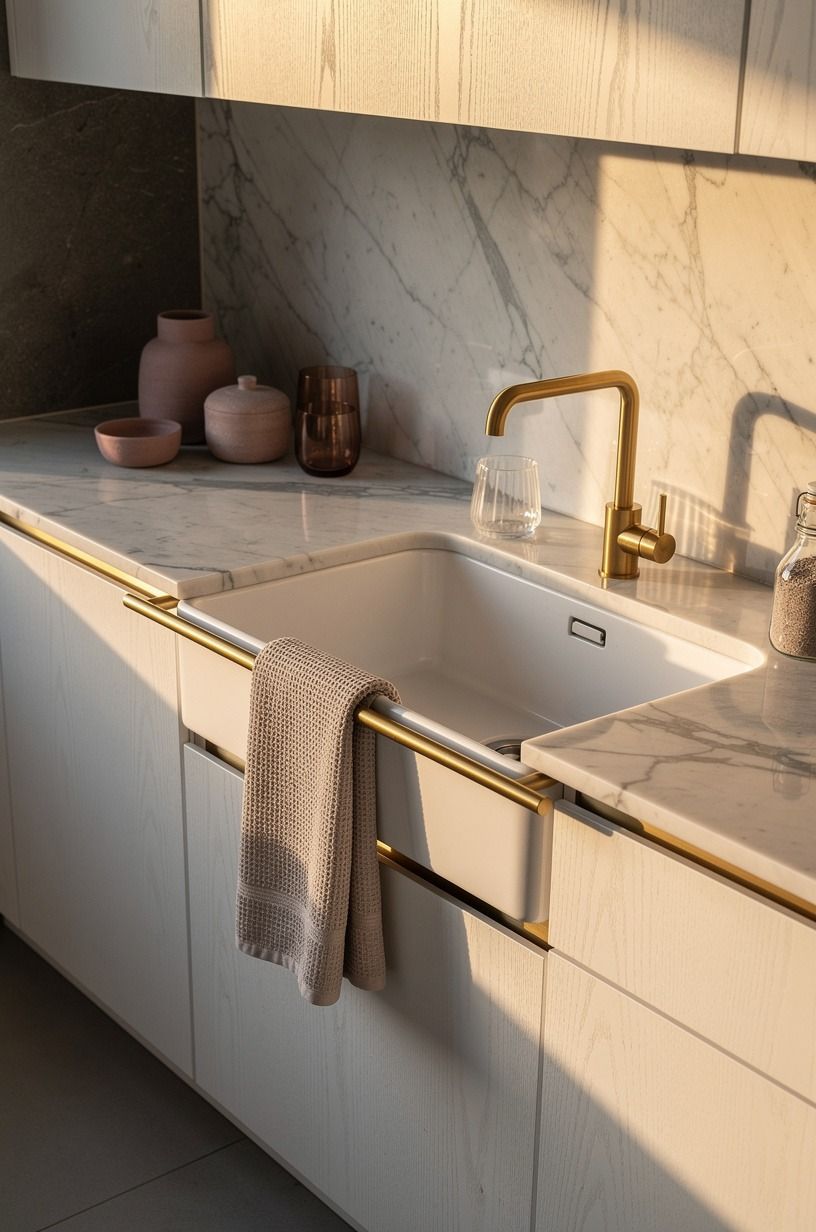
A thin unlacquered brass rail under the counter or beside the sink gives you one warm metallic line without turning the whole kitchen into a hardware showroom. That small accent is enough to hold a hand towel, introduce patina, and make the sink corner feel considered. If your faucet is black or steel, the brass rail adds a little softness without taking over.
Keep the brass unlacquered if you can. The slow patina is what makes it feel honest next to oak and stone. And keep the towel itself simple, maybe a textured linen or a 600gsm Turkish cotton hand towel in oat or clay.
You don't need stripes, fringe, or a pattern screaming for attention. One line of brass.
One practical towel. That is the whole move, and it is enough.
For a closer look at how a single accent pulls a wall together, bar tray styling looks every host is copying is the same principle applied to the drinks zone.
14Wrap the sink wall in limewash texture (The Hand-Finished Calm)
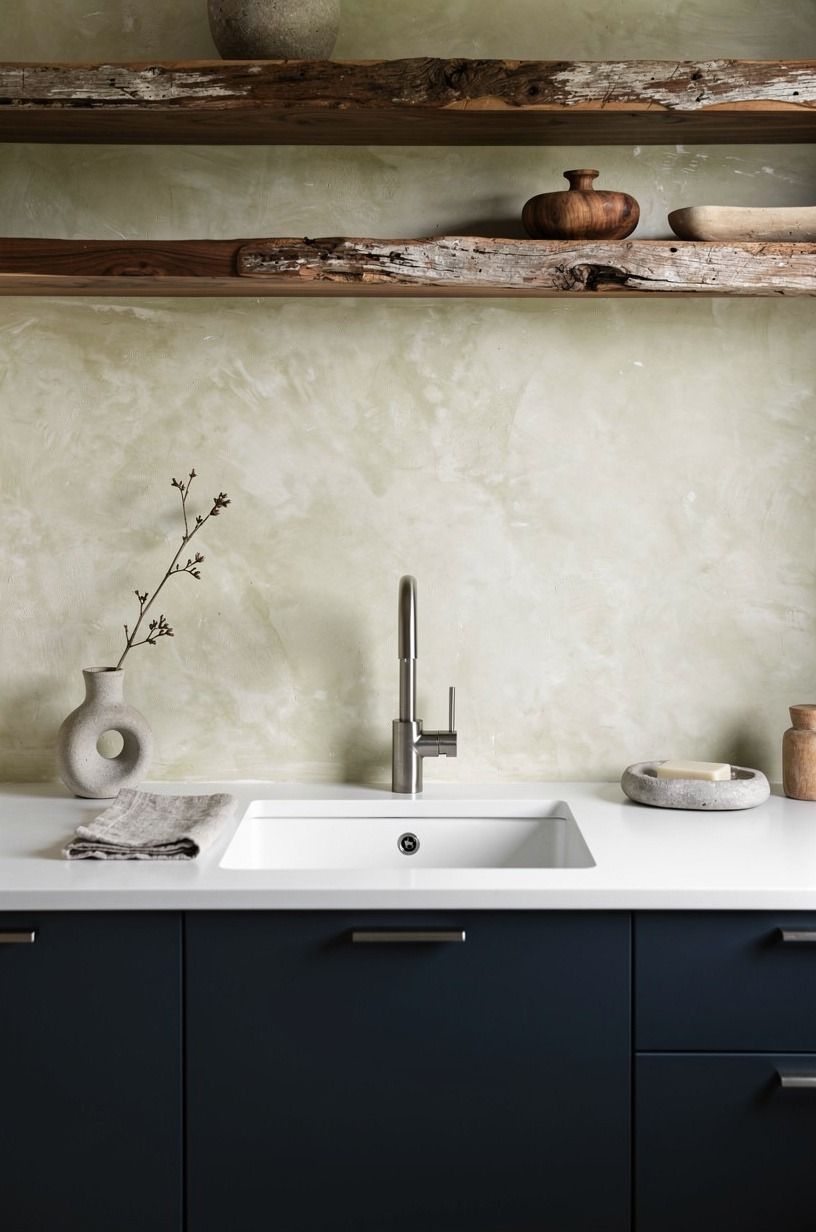
Limewash around the sink wall gives you something tile cannot always give you, which is atmosphere without a hard grid.
15Float a stone drainboard beside the basin (The Dry-Side Discipline)
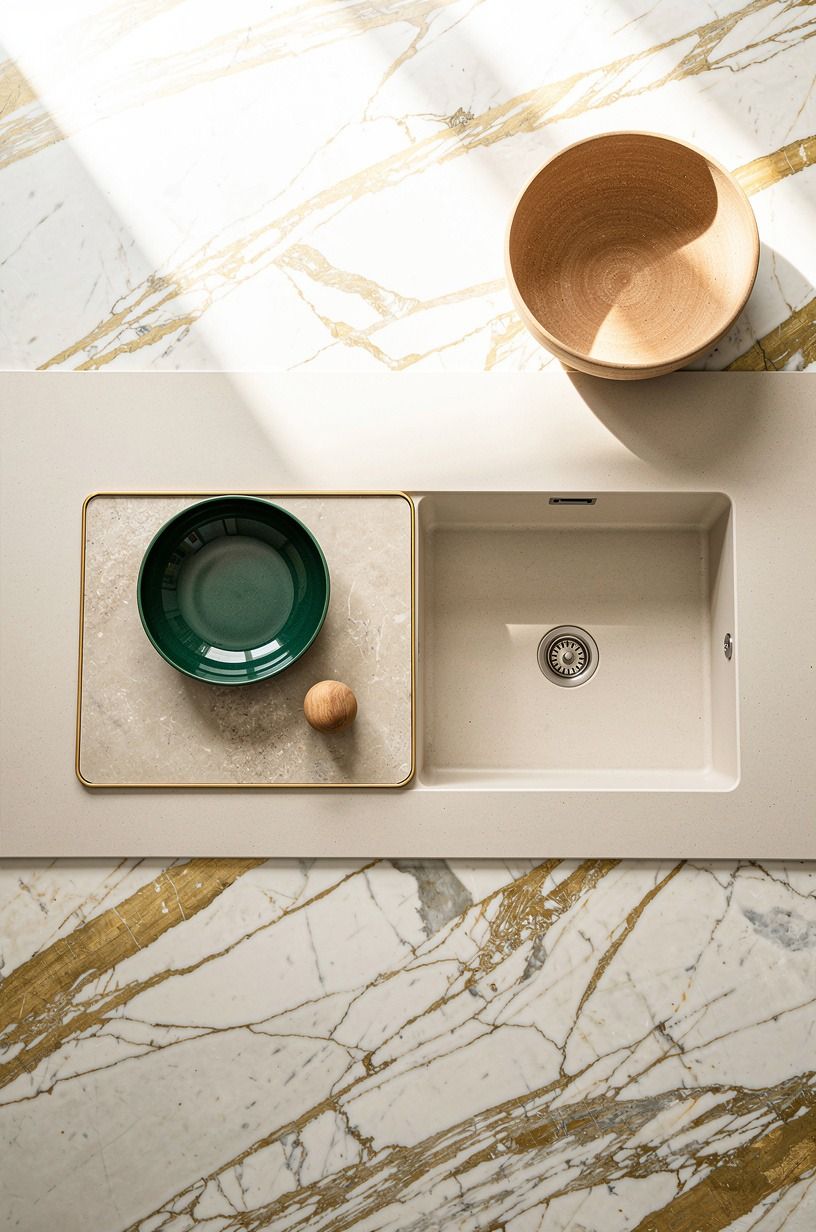
A floating stone drainboard is one of those practical details that instantly makes the sink zone feel calmer because it gives wet glasses and washed produce a proper landing spot. You stop draping things across the whole counter, and your sink setup starts working like a system instead of a scramble. In overhead view, that one dedicated stone panel also helps the sink composition feel intentional.
I like the drainboard in the same family as the counter but not always the exact same finish. A slightly rougher stone or a ribbed carving reads useful and tactile. And if you're short on depth, keep the board slim rather than letting it eat the whole counter return.
You still need some dry prep space. That is the discipline part.
This detail looks expensive because it quietly solves a problem instead of decorating around it. The cost, by the way, lands around $120 to $400 depending on stone, and that's a worthy splurge.
16Ground the sink zone with charcoal zellige (The Dark Base Move)
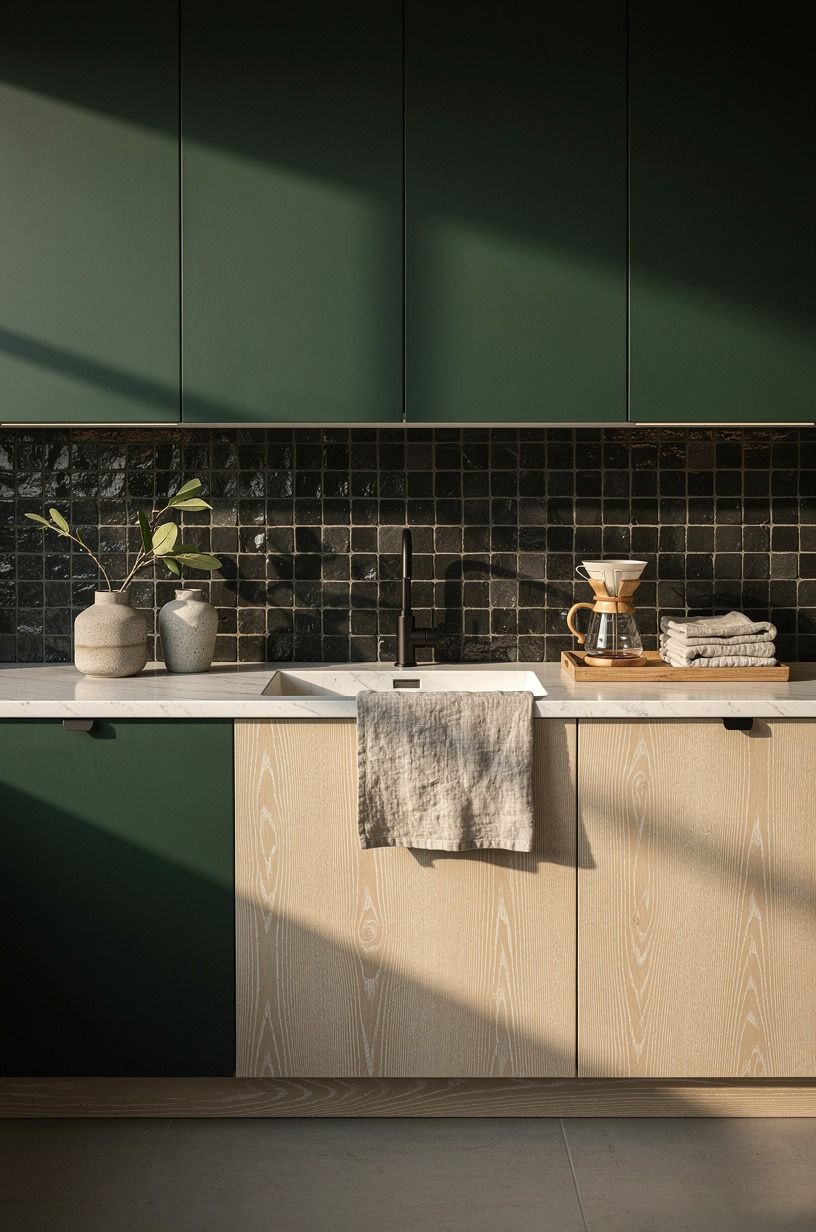
Charcoal zellige tile around the sink works when the rest of the kitchen is warm and pale because it gives the eye one stronger base note. The hand-glazed imperfections are what make it feel earned, not loud. A perfect subway would do the same job functionally, but it wouldn't carry the same weight visually.
I'd keep the grout close to the tile color so the field reads continuous. White grout with charcoal tile looks busy within a week. The variation between each zellige tile is the whole charm, so don't fight it.
If you want to see the same logic with a different palette, dark oak kitchen ideas breaks down how one dark surface can hold a whole room together. And for the maintenance reality, expect to spend around $18 to $32 per square foot installed.
17Style one wooden tray beside the faucet (The Last-Thing Rule)
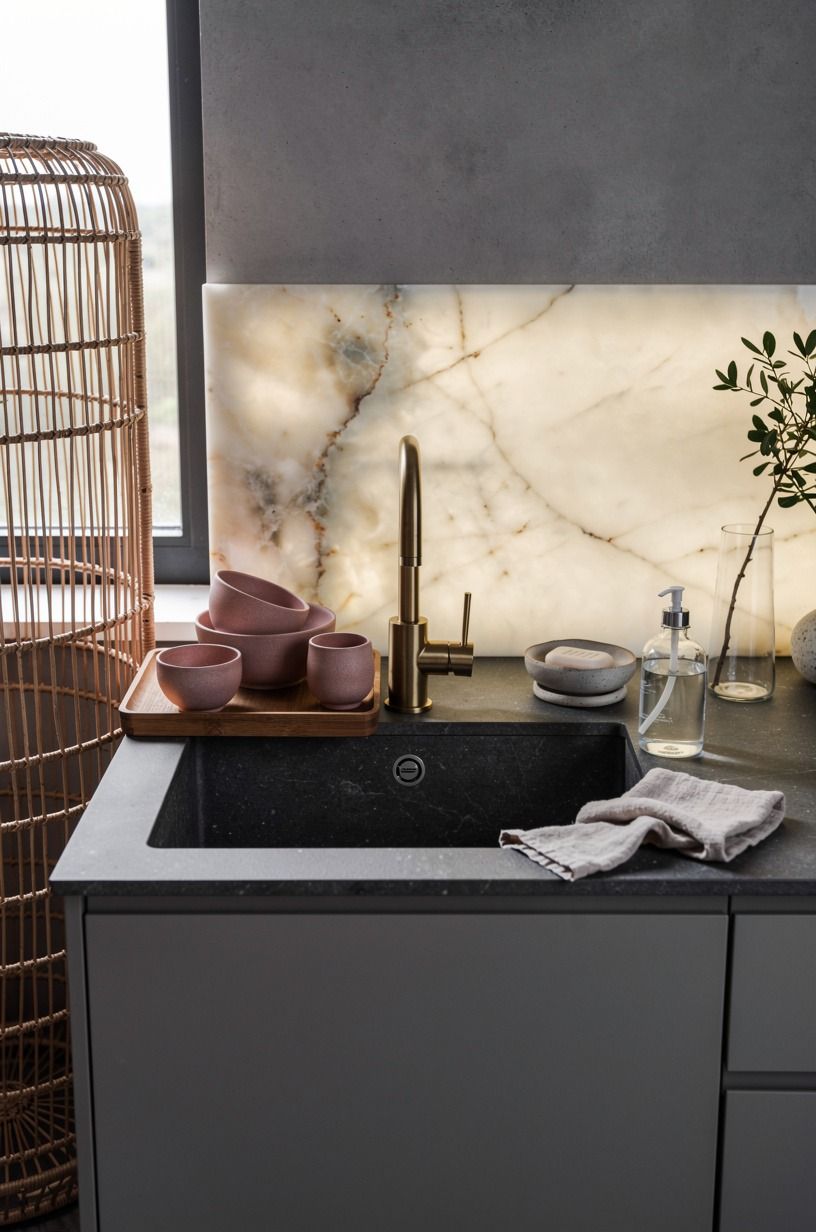
One wooden tray beside the faucet is usually all the styling a Japandi sink needs because it gathers the essentials and stops them from drifting across the whole counter. Soap, brush, maybe a tiny ceramic dish for rings. That is enough.
If you keep adding objects because the sink looks bare, you're probably fixing the wrong problem.
I use what I call the Last-Thing Rule here: if the tray is down, nothing else gets parked on the counter unless it earns its keep every day. That rule saved me from the usual pileup of bottles and random produce. And yes, the tray should feel warm and a little imperfect, not lacquered and precious.
A simple oak or walnut piece with one visible joint looks better because it feels used, not staged. If you're styling a similar zone elsewhere, bar tray styling runs the same logic with bottles and glassware instead of soap.
It's one of those tricks you'll actually use!
Why the best Japandi sink walls feel edited, not empty
The mistake I made for too long was treating the sink as a styling moment instead of a working zone that also had to look calm. I kept adding the little finishing touches people always recommend. A cute soap bottle.
Another small bowl. A second towel because the first one looked lonely.
Then maybe a plant, then a tray, then a candle because the tray suddenly looked bare. None of it was ugly by itself.
Together, it made the sink wall feel like it was constantly asking me to notice it.
What finally worked was deciding that the sink could have one hero material, one practical accent, and one softener. That is the whole framework I'd use again.
Maybe the hero is the clay basin. Maybe it is the fluted oak or the charcoal zellige.
The practical accent is the rail, the drainboard, or the tray. The softener is the linen, the limewash, or the off white counter with quieter veining. Once you pick those roles, everything else becomes easier to reject.
You'll see the same three-role thinking in japandi kitchen dining ideas, where the nook gets a hero chair, a small table, and one textile, and nothing else.
I also think people misunderstand minimal kitchens a little. You don't need the room to feel empty.
Honestly, empty can feel chilly if the materials are wrong. You need the room to feel edited. That is different.
Edited means your eye knows where to land first, where to rest second, and what can stay in the background. It means the faucet is not fighting the sink, the sink is not fighting the counter, and the counter is not carrying six tiny objects because you felt nervous about blank space.
Zen japandi kitchen ideas makes the same point from the full-room angle, and it's worth the read if you're rethinking the whole kitchen at once.
If I were helping you plan your own sink wall, I'd start with function and then protect the mood. Ask where the wet towel goes. Ask where the soap sits. Ask how you clear the counter fast after dinner.
Then choose the material that will carry the emotional tone. That order matters more than people admit. It is why one sink wall feels peaceful and another feels expensive but slightly annoying.
The good version is not louder. It is better behaved.
The bad version keeps demanding your attention, and that's not the same as calm.
What things cost before you overcommit
You don't need a full remodel to get most of this look, and that is the nice surprise.
If you're choosing where to spend, put the money into the surface you touch and see every day first. A new faucet, a quieter counter sample, or a better sink front usually does more than buying three extra accessories ever will.
That part surprised me too! For a broader budget breakdown, budget kitchen cabinet makeover ideas before after shows what a $1,200 refresh can actually look like, and ikea kitchen ideas for a clean budget look covers the same ground with a specific retailer.
The Questions Worth Answering First
What is the best Japandi kitchen sink idea for a small kitchen?
An undermount single-bowl sink in a pale counter is usually the best small-kitchen move because it keeps the deck cleaner and the sightline simpler. I'd pair it with one tray and a wall rail, then keep at least one side of the basin clear. In a tighter footprint, small japandi kitchen ideas shows the same edited approach.
Where can I buy Japandi kitchen sink pieces on a budget?
I'd start with IKEA, Target Threshold, and Wayfair for trays, rails, and simple towels, then check Facebook Marketplace for a real wood stool or vintage pottery. You don't need everything new. One older oak piece often looks better than three brand-new trendy ones, and the IKEA KALLAX in birch-effect is still the most underrated shelf at $79.
How much does a Japandi kitchen sink makeover cost?
A cosmetic sink-zone update usually lands around $100 to $300 if you're swapping towels, trays, paint, or one rail, while a broader kitchen refresh can sit inside the budget or mid-range tiers above. The free move is editing. Clearing the counter costs nothing and still changes the room, and that's the trick most people miss.
Can I create a Japandi sink zone on a budget?
Yes, and I'd start with the cheap wins first. One linen towel, one wood tray, and one paint sample board beside your existing counter.
Then remove two things from the sink wall before you buy a third. That order saves money because you can see what the room still needs, and you'll avoid the most common spending trap in the category.
Is a Japandi kitchen sink layout worth it in a small space?
Yes, because a small kitchen benefits more from visual discipline than a large one does. When your sink zone is quieter, the whole room feels easier to use. I'd keep the palette tight, the faucet simple, and the accessories limited so your eye can read the full space in one glance.
If your footprint is especially narrow, japandi galley kitchen ideas is worth a save too.
Is a Japandi sink wall a good idea for a rental?
Yes, if you stay reversible. A removable cafe curtain rod, peel-and-stick backsplash, a tray, and a better towel can shift the sink wall without damage.
I'd skip permanent stone changes and invest instead in portable pieces you can bring to the next place. Renters usually do best with the lighter-touch moves in open-plan japandi kitchen living room ideas too, and a single tray under $40 does more than most people expect.
Where I'd Start First
If I had to pick one, I'd start with the undermount clay sink in pale quartz. You cannot fake that quiet edge with styling layered on top. Pin this one for later and let the sink line do the calming before you buy a single extra accessory.
It's the move you'll feel every single day!