Cozy Vintage Fall Mantel Ideas for Collected Antique Charm
24 june 2026Vintage fall mantel ideas with antique, collected character work when your shelf feels gathered over time, not loaded up in one shopping trip. I learned that after styling one mantel with bright pumpkins that looked seasonal but not believable. You don't need more objects. You need older-looking weight, softer color, and a few details that make your fireplace feel like it has a memory (I learned that late). Here's the thing: a mantel that earns its keep in November should still earn it in April, with one swap.
Don’t overthink: Arrange tarnished silver trays with mini gourds.
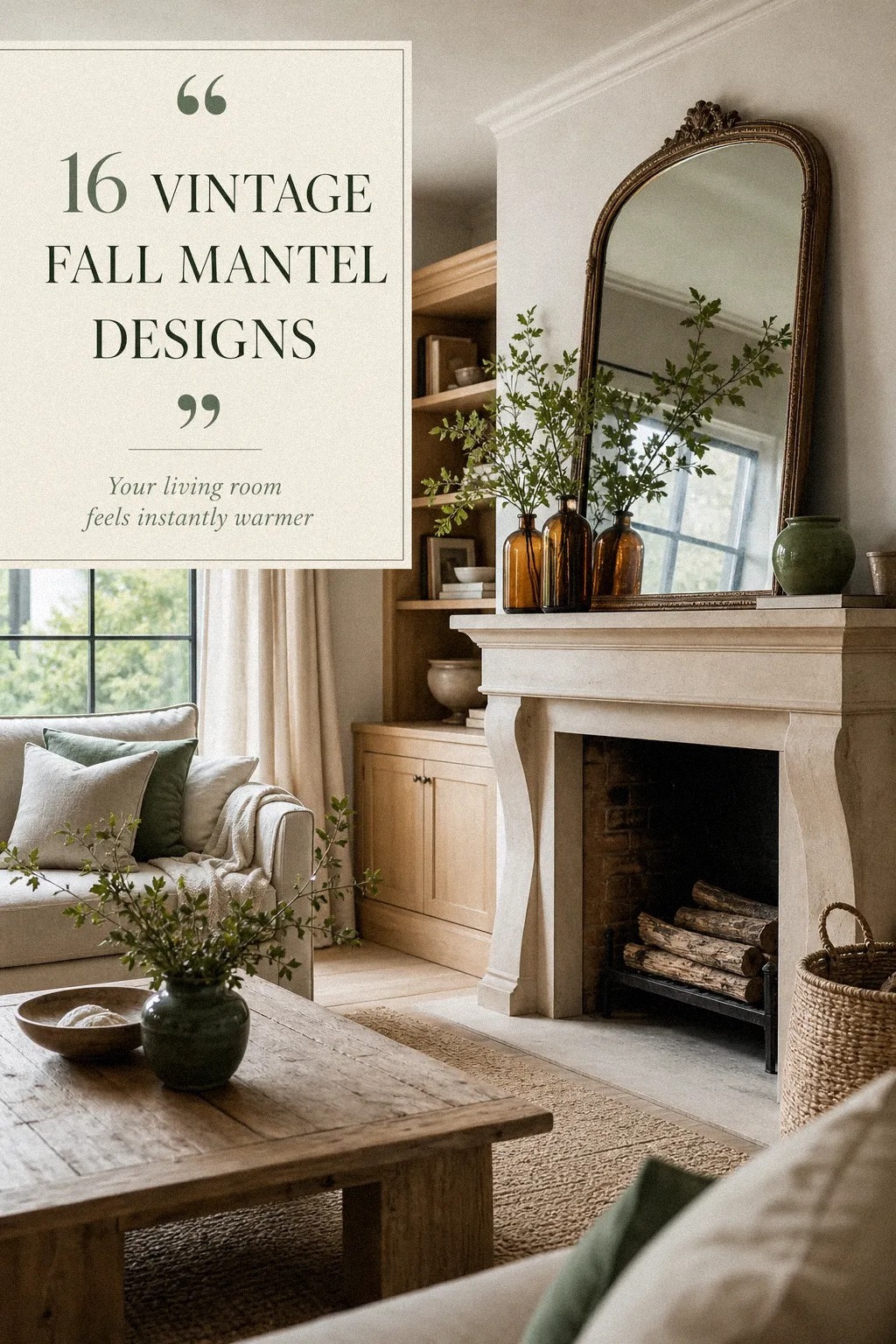
- Prop an antique mirror behind amber bottles
- Arrange tarnished silver trays with mini gourds
- Frame sepia family photos with dried bittersweet
- Layer lace runners beneath brass candle clusters
- Stack weathered books beside ironstone pitchers
- Drape magnolia leaves across a carved mantel
- Cluster transferware plates around velvet pumpkins
- Tuck pheasant feathers into copper bud vases
- Lean an old oil portrait above wheat
- Style crocks with burgundy mums and branches
- Hang a brass sconces pair beside garland
- Fill apothecary jars with acorns and cloves
- Anchor each end with aged wooden corbels
- Weave plaid ribbon through dried oak leaves
- Display antique clocks between cream taper candles
- Crown the mantel with a faded harvest wreath
1Prop an antique mirror behind amber bottles
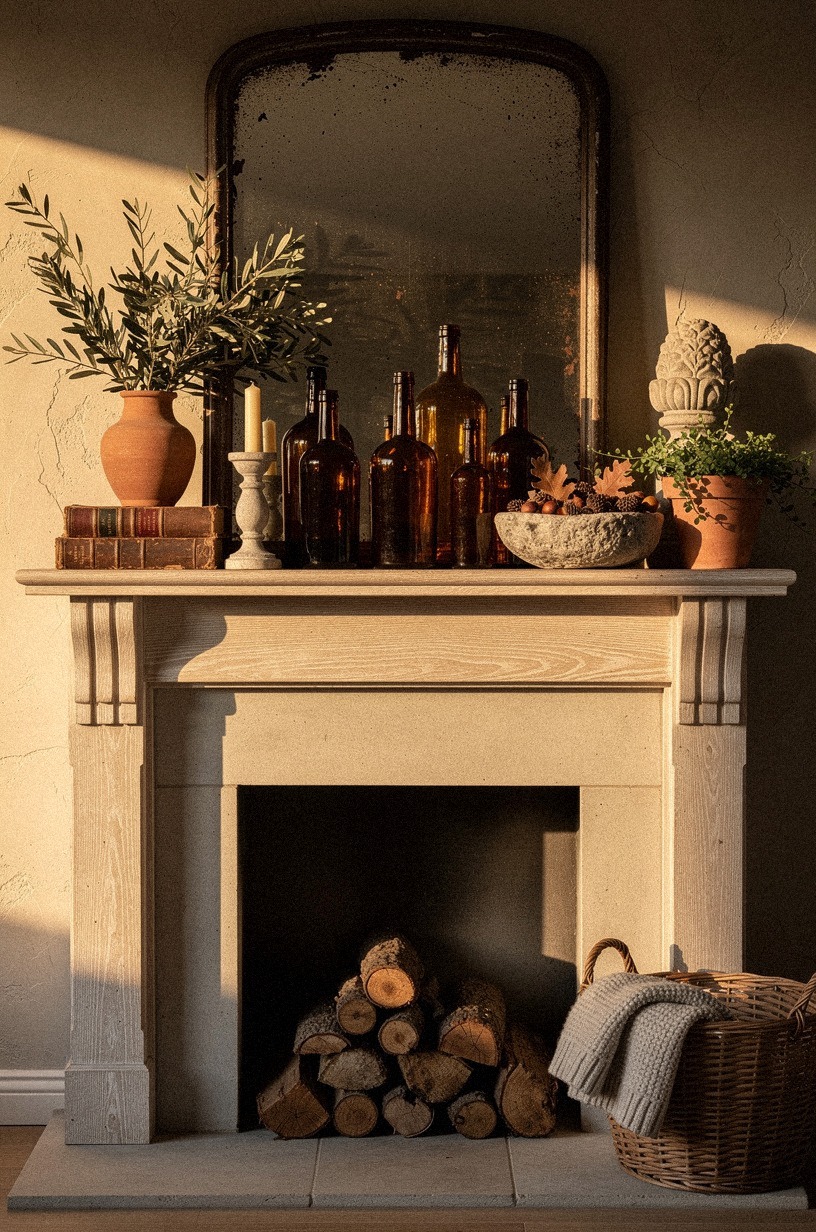
Lean the antique mirror first, then let the amber bottles do the glow work in front of it. On a cerused white oak mantel with exposed dovetail joints, that order matters because the mirror gives you height and the bottles keep the reflection warm instead of cold. I like the mirror slightly off center so the shelf feels collected, not posed.
But keep the bottles tighter than you think. Three is usually enough, with only a small height jump between them, because the reflection already doubles the visual weight.
Don't polish away every foxed spot. Age is the point.
See this bedroom guide for the same mirror-led logic in a sleep space, and if you like the amber glow idea, this warm lighting roundup covers the bulb temps that make the bottles sing.
2Arrange tarnished silver trays with mini gourds
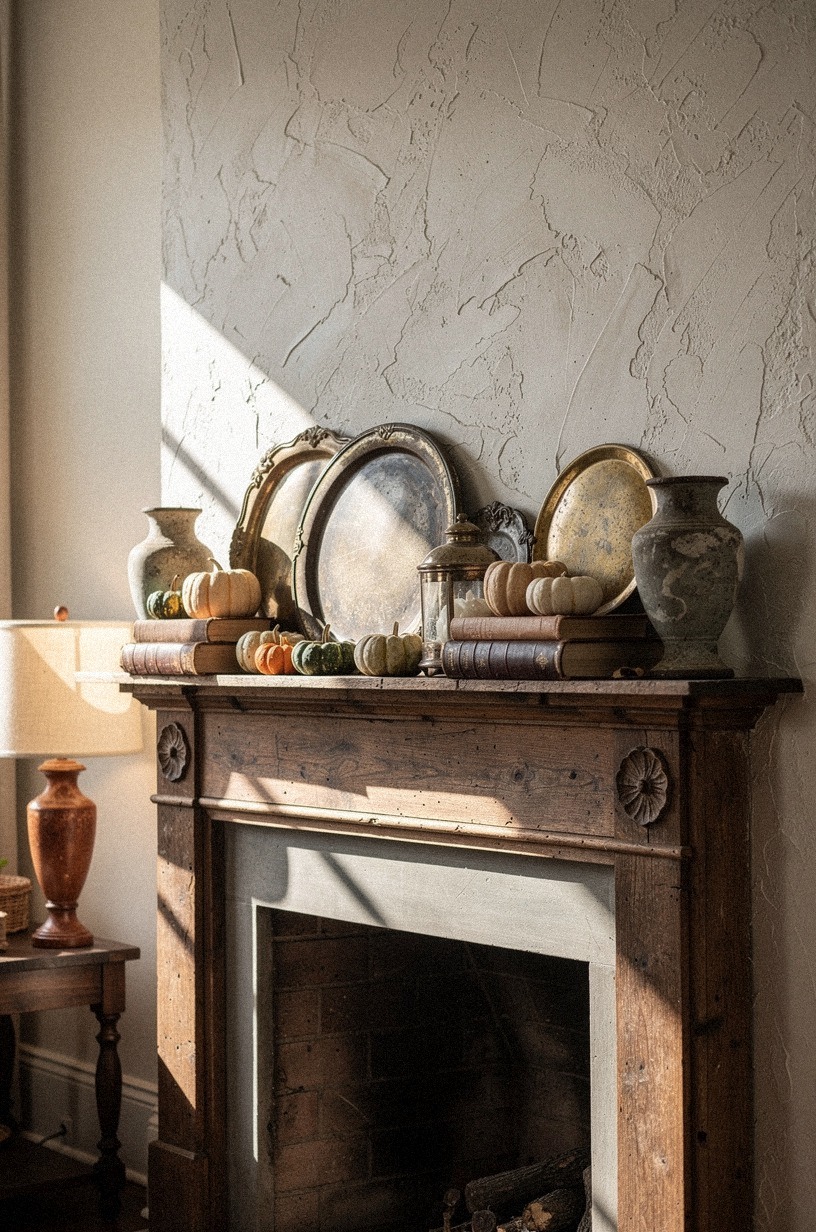
Silver is the cool counterpoint that keeps all this warmth from going flat. Set tarnished silver trays down first, then gather mini gourds on top so the tray edge still shows and the mantel reads intentional from the doorway. I prefer one oval tray and one smaller round tray because a full matching set gets formal fast.
Choose matte gourds in cream, muted green, and soft straw rather than loud orange. You want the patina on the silver to stay visible, because that worn finish gives your arrangement its old-house credibility.
And leave empty metal showing. That little pause is what makes your shelf breathe.
The same rule of "one cool note in a warm room" shows up all over these neutral coastal bedrooms if you want a second look.
3Frame sepia family photos with dried bittersweet
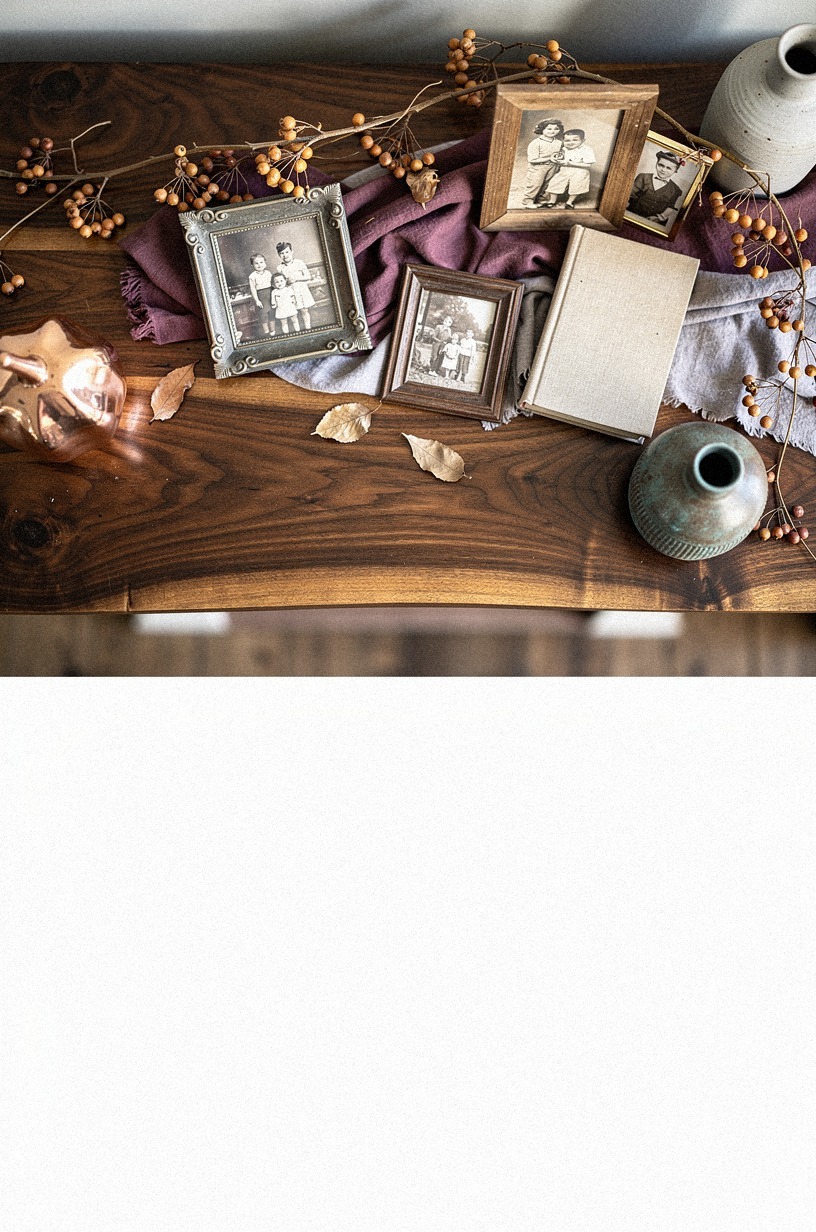
This is where the mantel starts feeling personal.
4Layer lace runners beneath brass candle clusters
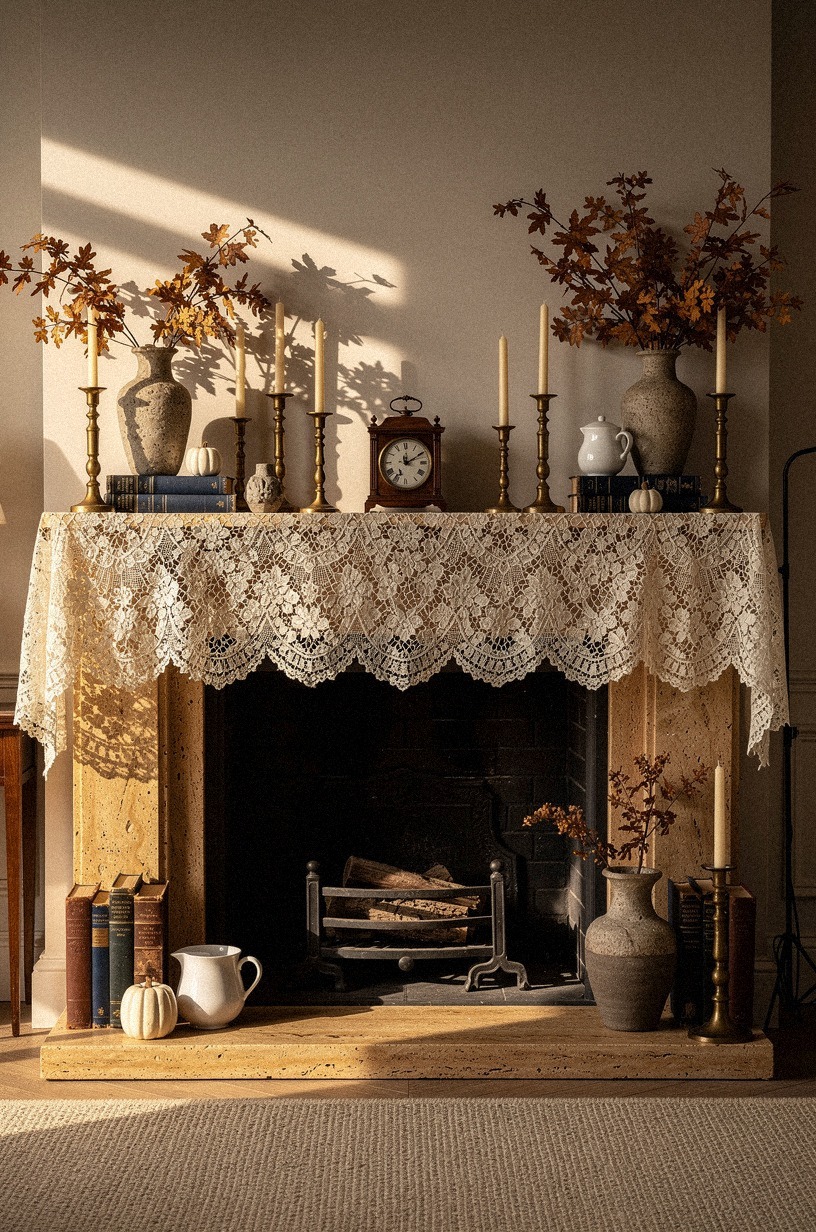
A narrow lace runner under a brass candle cluster softens the whole shelf in one move. On a warm travertine mantel, that matters even more because the stone already has movement and the lace keeps the metal from feeling sharp.
Let just an inch or two of the lace show. More than that and it starts reading tablecloth.
The candles should feel gathered, not lined up. One taller pair, one medium pair, then a shorter accent nearby is enough.
But skip bright polished gold if you can. A softer aged brass looks better with old lace every time.
Farrow & Ball Hague Blue No. 30 gives brass and cream a richer edge. Gorgeous at night!
See this neutral roundup for more on pairing warm metals with pale stone.
5Stack weathered books beside ironstone pitchers
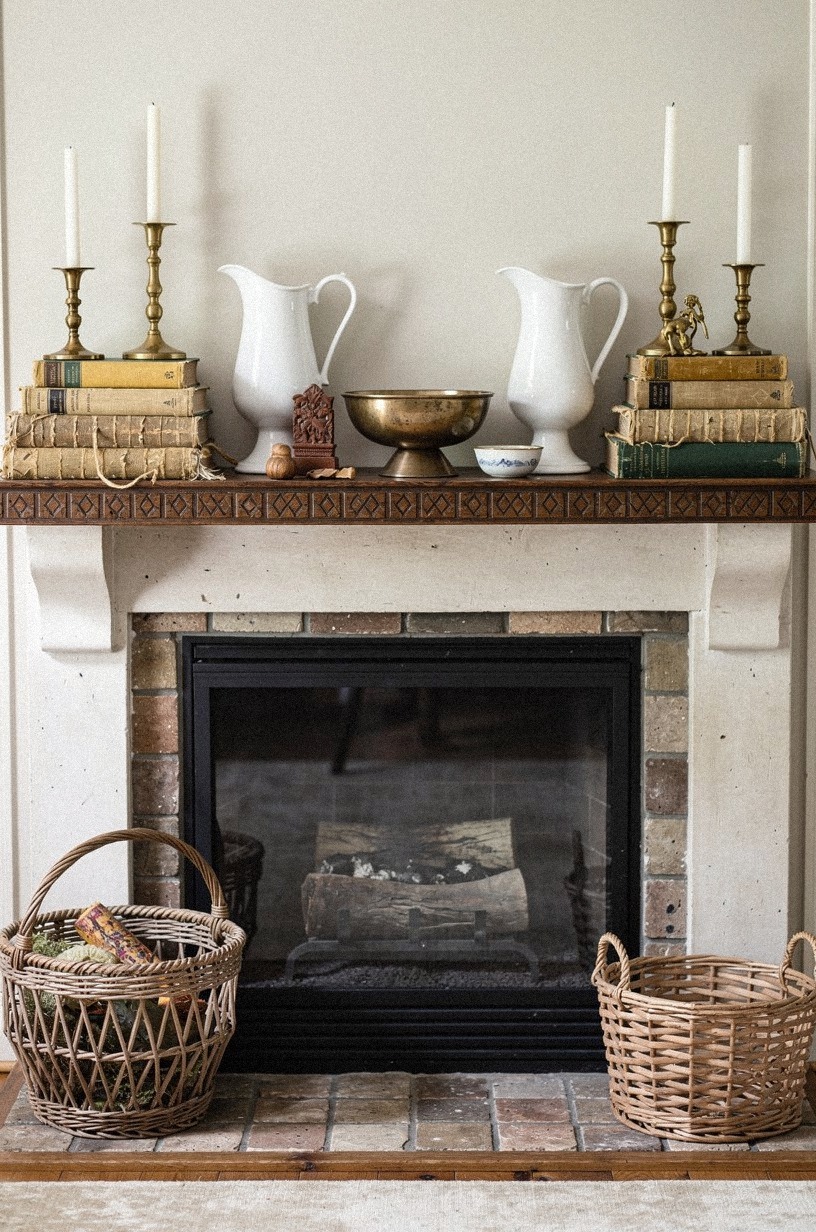
Books are the easiest shortcut to a collected look, but only if they feel used. Stack weathered books low, then place ironstone pitchers beside them so the chalky ceramic balances the rough paper. From a frontal mantel view, that low stack keeps the center from floating and gives the whole shelf a calm base.
I like faded brown, moss, and cream spines here, not rainbow stacks pretending to be vintage. The pitcher should have some real body too, maybe a little crazing or an uneven lip.
You can tuck in one branch if you need height, but I wouldn't force a full floral moment. Let the books do the texture work.
See these Japandi bedrooms if you're after the same "less but heavier" logic.
6Drape magnolia leaves across a carved mantel
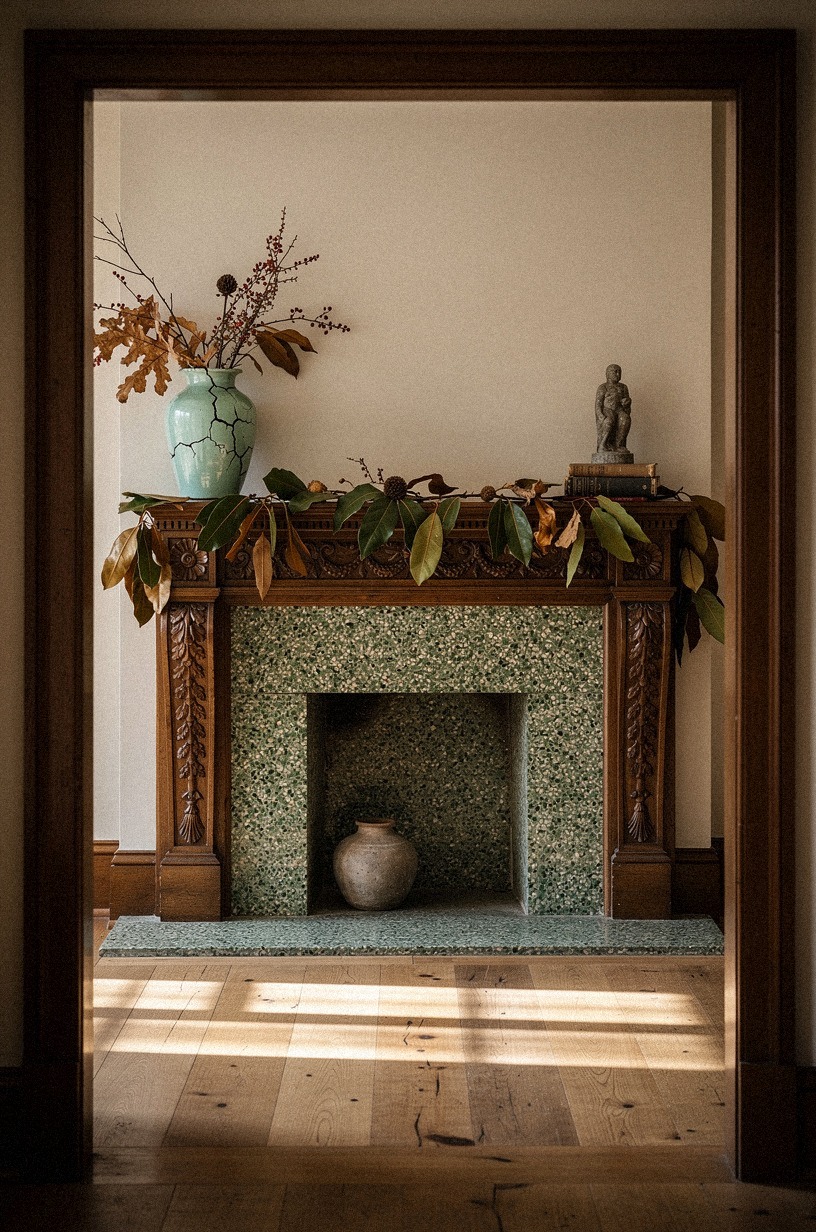
A carved mantel already has enough detail, so your greenery should follow the architecture instead of hiding it. Drape magnolia leaves in a loose line and let the brown undersides show, because that flip of green to tobacco is what makes magnolia feel expensive. In a centered doorway view, you want one quiet sweep across the shelf.
But don't puff them up too much. I did that once and the whole mantel looked heavy by sunset.
If the leaf line hugs the carving, the wood still gets to speak. And magnolia is better than eucalyptus here because it has more body and more antique mood.
Benjamin Moore Revere Pewter HC-172 is an easy win if your wall needs warmth.
See this moody-neutral room for the wall-color side of that story.
7Cluster transferware plates around velvet pumpkins
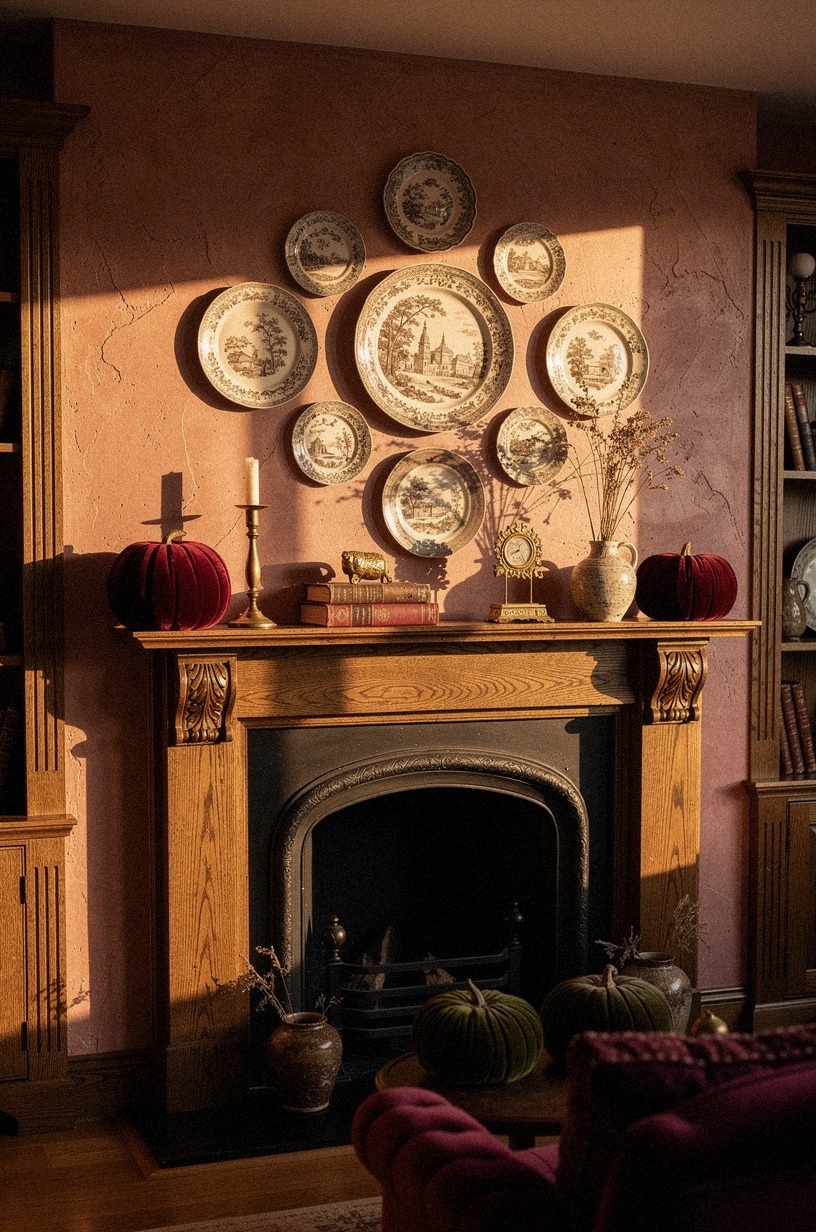
Lean the transferware plates first against the Venetian plaster wall, then gather velvet pumpkins low in front of them. The ceramic rims give you crisp pattern, and the pumpkins soften the whole setup before it goes too formal. That push-pull is what makes antique fall mantle decor feel layered instead of fussy.
Keep the plate pattern related but not identical. Small variation makes the wall feel inherited. For the pumpkins, tobacco, moss, faded plum, and soft rust all beat bright orange, especially on plaster with cream undertones.
Look for 18 oz cotton velvet or another dense matte finish that swallows light. And don't cram filler between the plates.
Let the wall breathe.
See these luxury rooms for the same "one quiet anchor, two soft neighbors" approach.
8Tuck pheasant feathers into copper bud vases
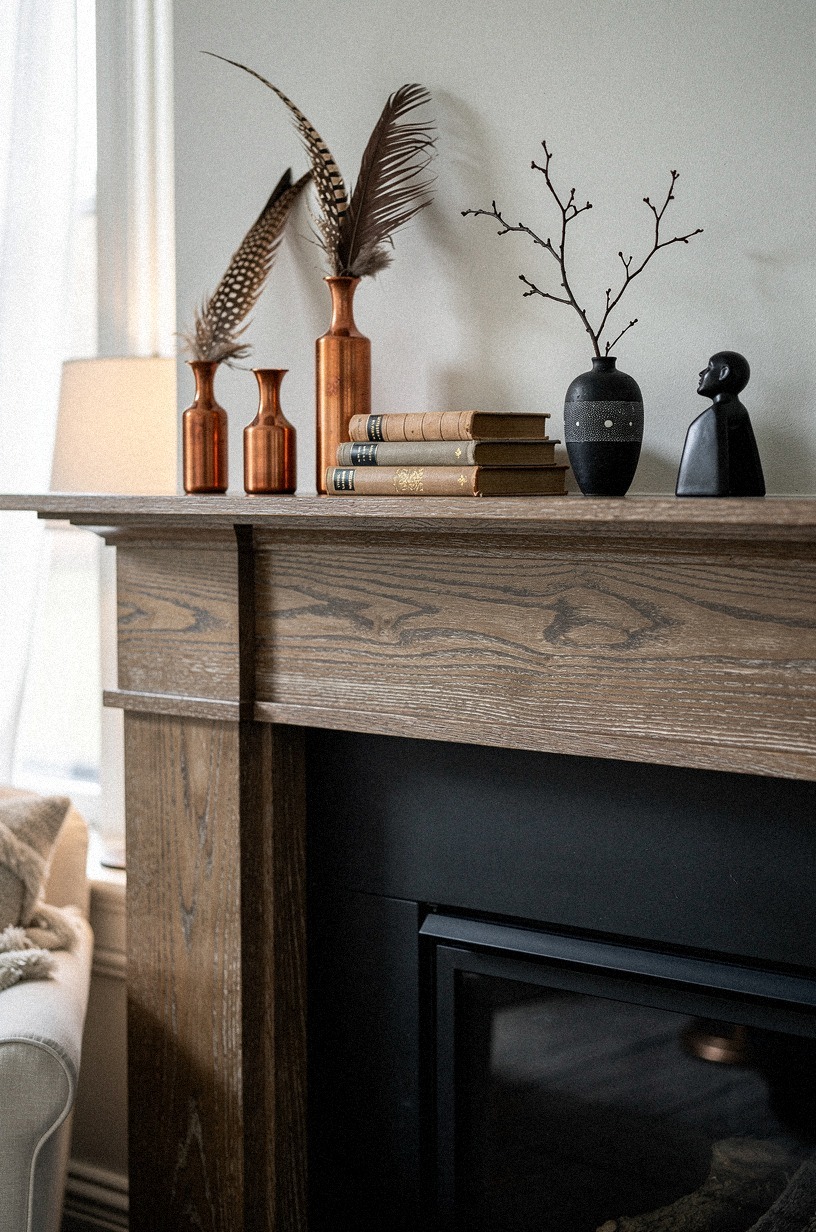
If you need height without a bulky arrangement, use pheasant feathers in copper bud vases. The copper gives you warm rhythm along a wire-brushed oak mantel, and the feathers catch the light differently every time you pass the room. In a relaxed three-quarter view, that small movement is what keeps the shelf from feeling static.
Use one or two feathers per vase, not a packed bunch. Too many and it starts reading costume instead of collected.
I also like copper more than brass here because the redder metal talks nicely to fall foliage without repeating the exact same finish everywhere. And if your room already has a sofa in the 35 to 40 inch depth range, slimmer mantel objects are the smarter counterweight.
If the copper is doing the warm-metal job, these luxury bedrooms show what that temperature looks like in a quieter space.
9Lean an old oil portrait above wheat
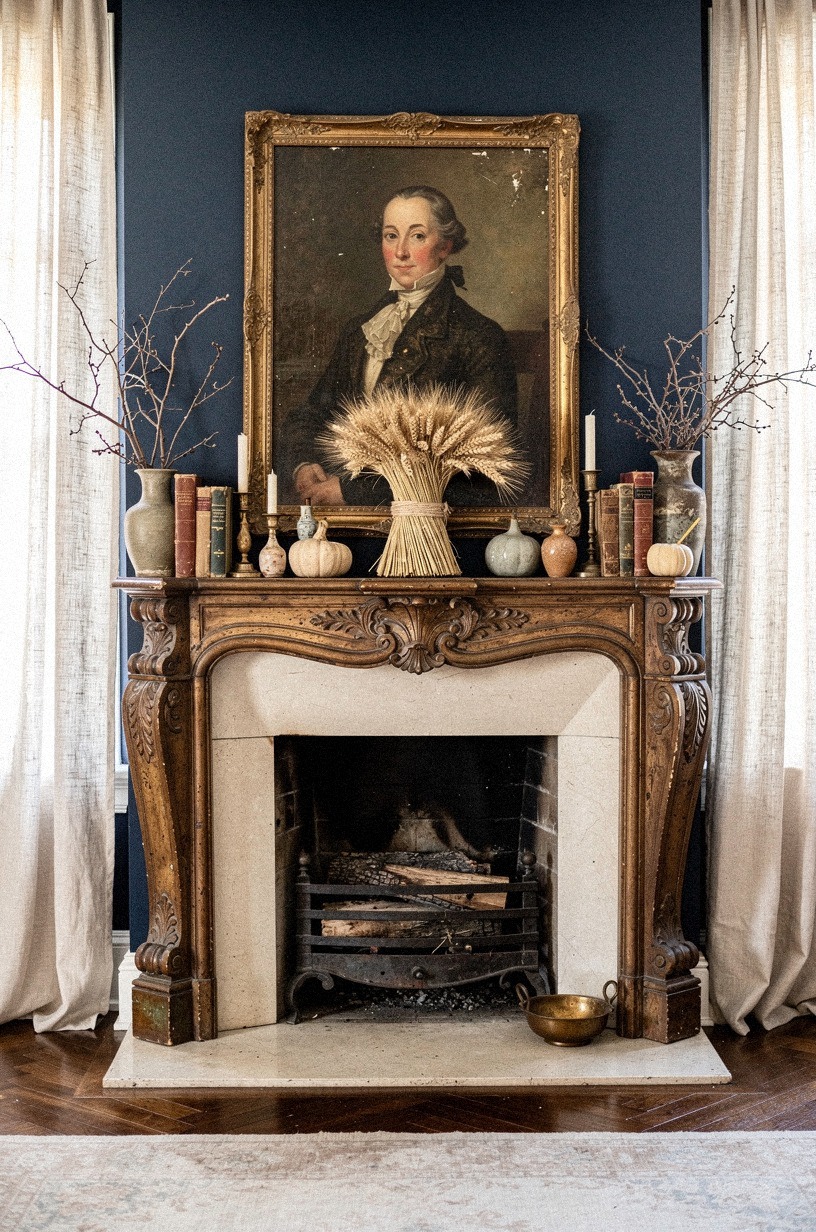
An old oil portrait gives the mantel immediate gravity. Lean it high, then bundle wheat below so the softness sits under the heavier visual weight of the painting. From a low floor-level angle, that top-and-bottom relationship is exactly what keeps the mantel from feeling too sweet.
I'd skip bright landscapes here. Portraits feel stranger, moodier, and more truly collected.
The wheat should stay tied and upright, not exploding outward, because the painting needs a steady base. Two small bundles usually beat one giant one.
And yes, Sherwin-Williams Evergreen Fog SW 9130 helps old frames and wheat feel hushed instead of dusty. If you want the Evergreen Fog effect on more walls, this moody neutral roundup walks through the same family of greens.
10Style crocks with burgundy mums and branches
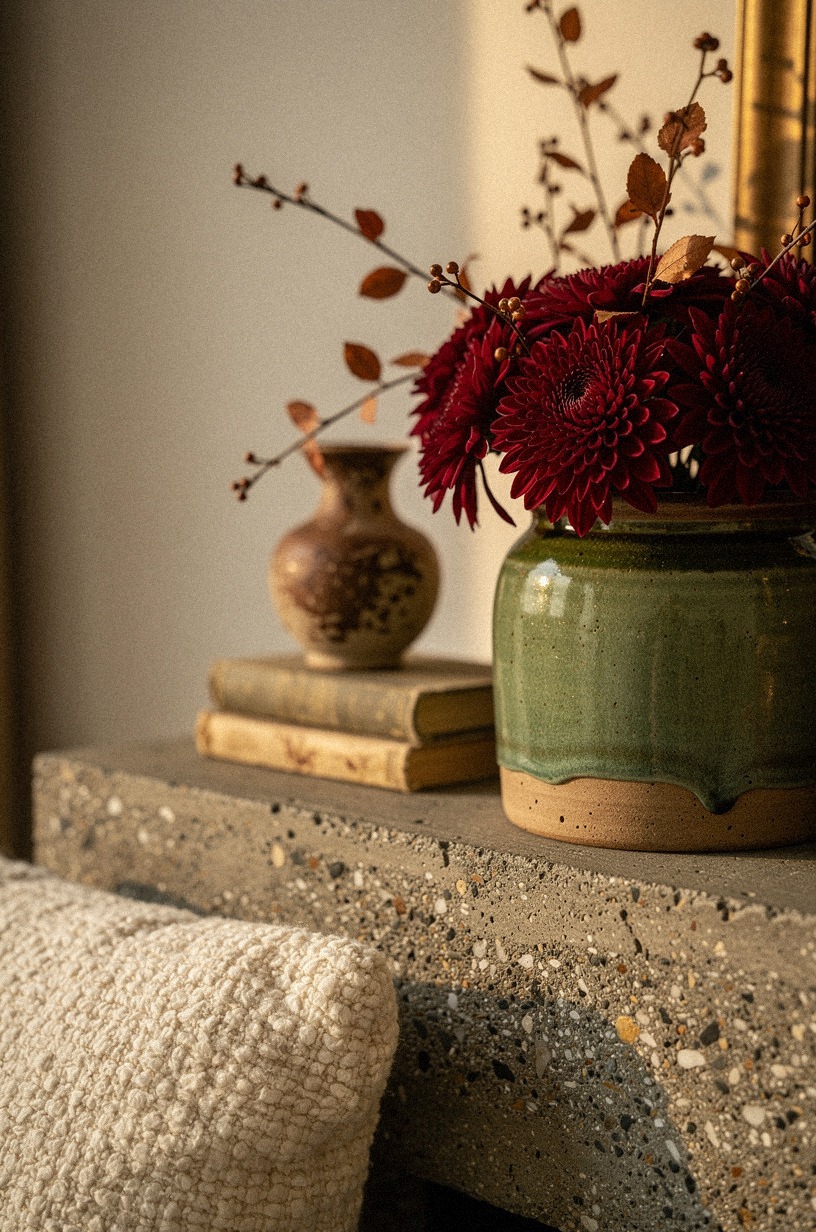
Stoneware crocks bring weight fast, which is why they work so well with burgundy mums and a few autumn branches. The crocks make the flowers feel gathered rather than florist-perfect, and the deep wine color keeps the mantel warm without sliding into bright harvest noise. In close view, the rough crock surface is doing almost as much work as the petals.
Keep the mums low and full, then let the branches run just a little taller behind them. Too much branch height and the crock loses authority.
I also wouldn't mix in yellow mums just because the garden center has them. Burgundy is quieter and far better with antique pieces. One salt-glazed stoneware crock plus one darker brown crock is enough.
For more on the "deep wine + antique pottery" palette, this quiet-wealth roundup is a good mirror.
11Hang a brass sconces pair beside garland
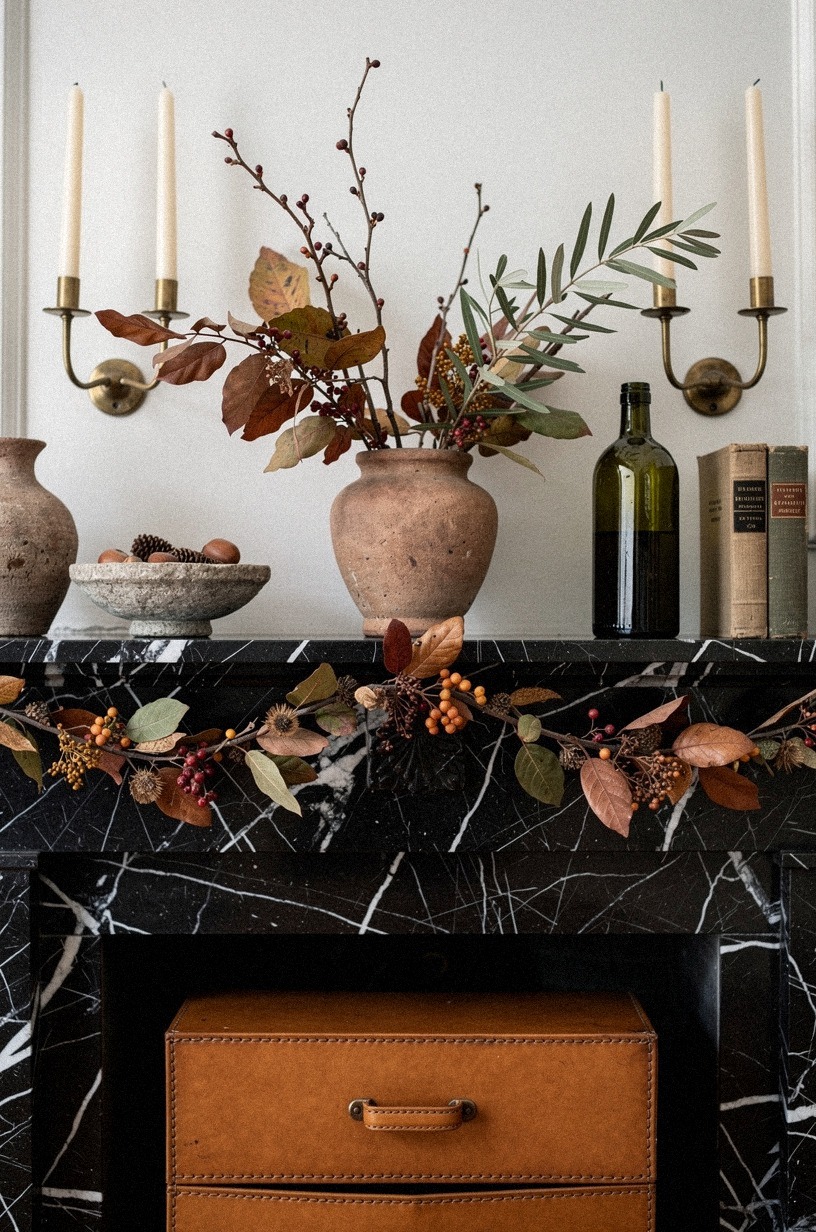
A pair of brass sconces gives the mantel year-round credibility, and once they're wired in, every fall after this one gets easier.
12Fill apothecary jars with acorns and cloves
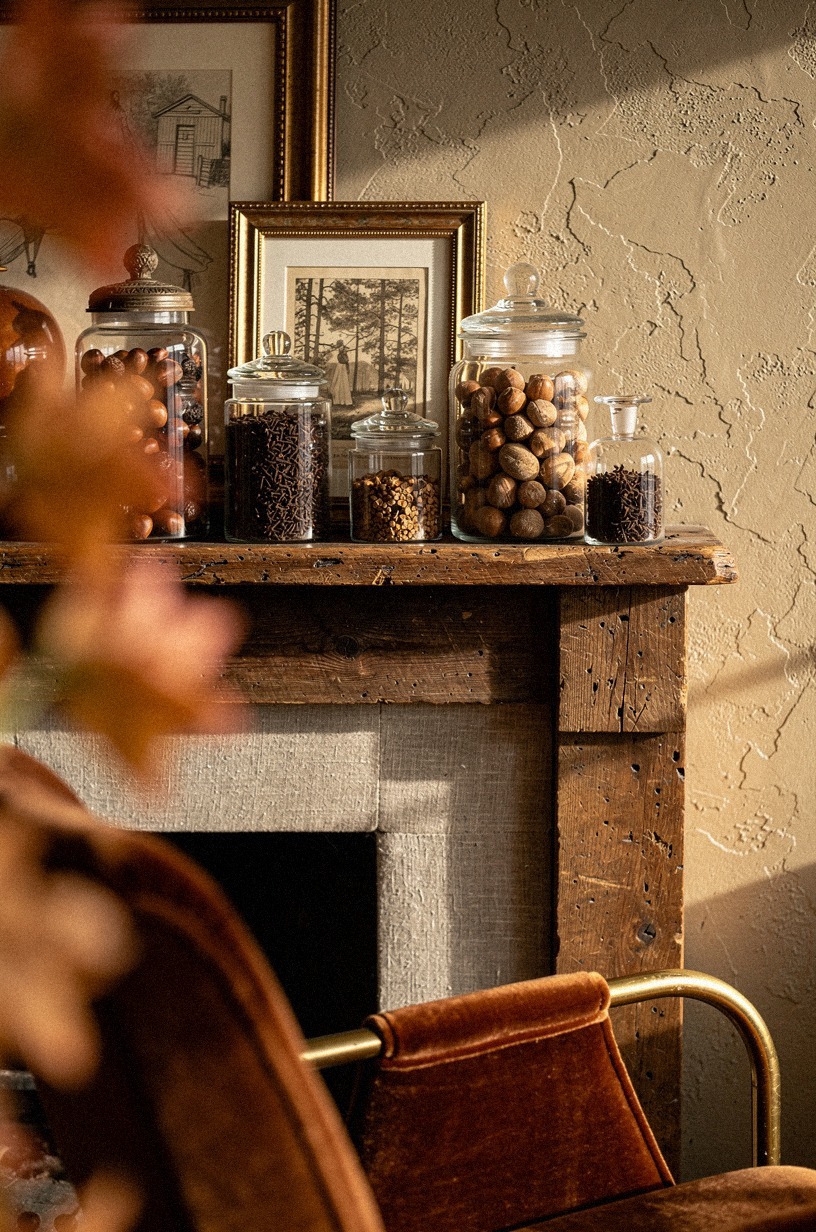
This is the tiny detail people remember later. Fill apothecary jars with acorns and whole cloves so the glass gives you shine while the contents bring texture, scent, and a little darkness. Through a softer foreground view, the jars feel like old pantry pieces someone kept because they were useful and beautiful.
Vary the jar heights, but not wildly. One tall, one medium, one squat is enough.
I also like imperfect acorns because too-uniform filler looks fake in the wrong way. The cloves should stay a darker layer, not take over the whole jar. And keep the lids on.
That's what makes the grouping feel antique rather than buffet-style.
13Anchor each end with aged wooden corbels
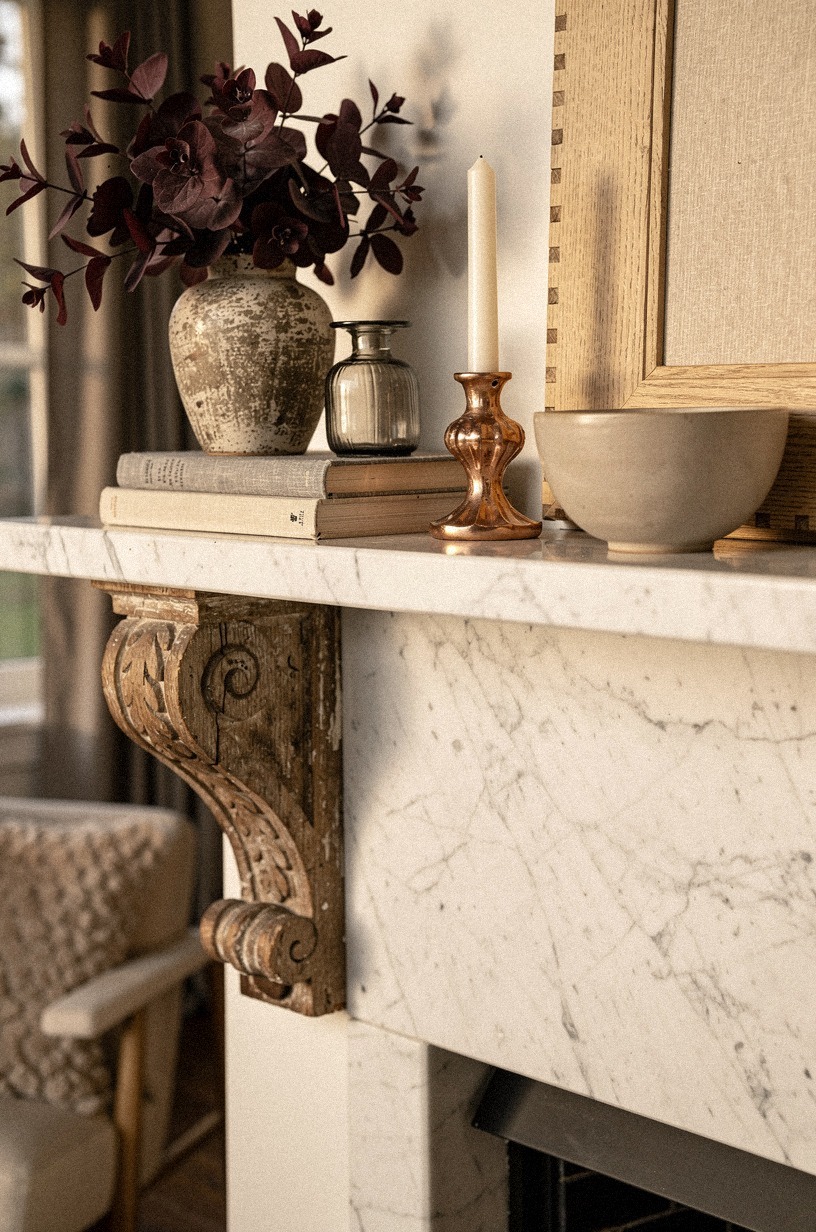
If the mantel itself feels visually light, aged wooden corbels give it instant authority. Place one at each end so the shelf gains a little old-house seriousness, especially on a Carrara marble mantel with soft gray veining. The wood is what keeps the marble from drifting cold.
Tiny decorative brackets won't help you. You need corbels with enough scale to feel architectural, not apologetic.
I also wouldn't stain new ones too dark and call it done. Softer wear and a waxed finish look more believable.
If your room already has pale oak somewhere else, repeat that tone here so the fireplace feels related to the rest of your room. This warm minimalist guide shows how the same oak repeat reads in a bedroom.
14Weave plaid ribbon through dried oak leaves
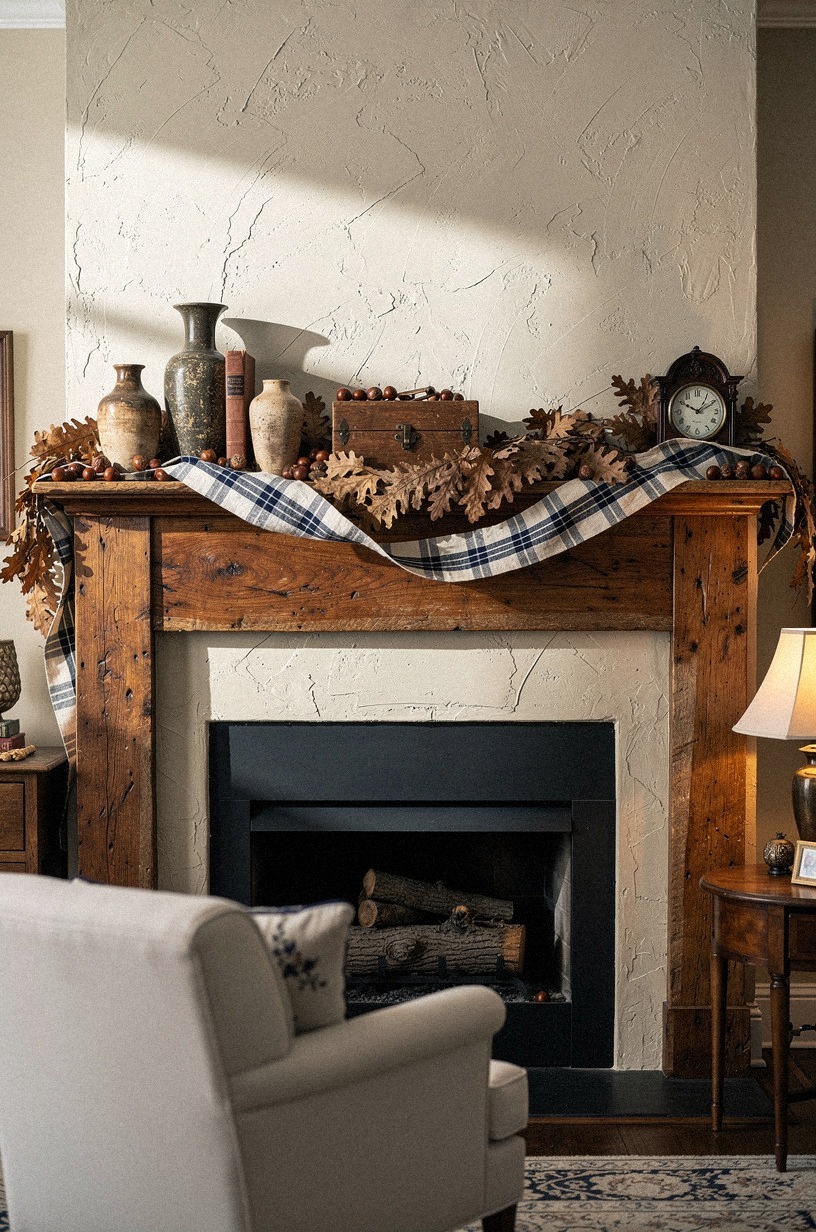
Plaid gets risky fast, so keep it quiet.
15Display antique clocks between cream taper candles
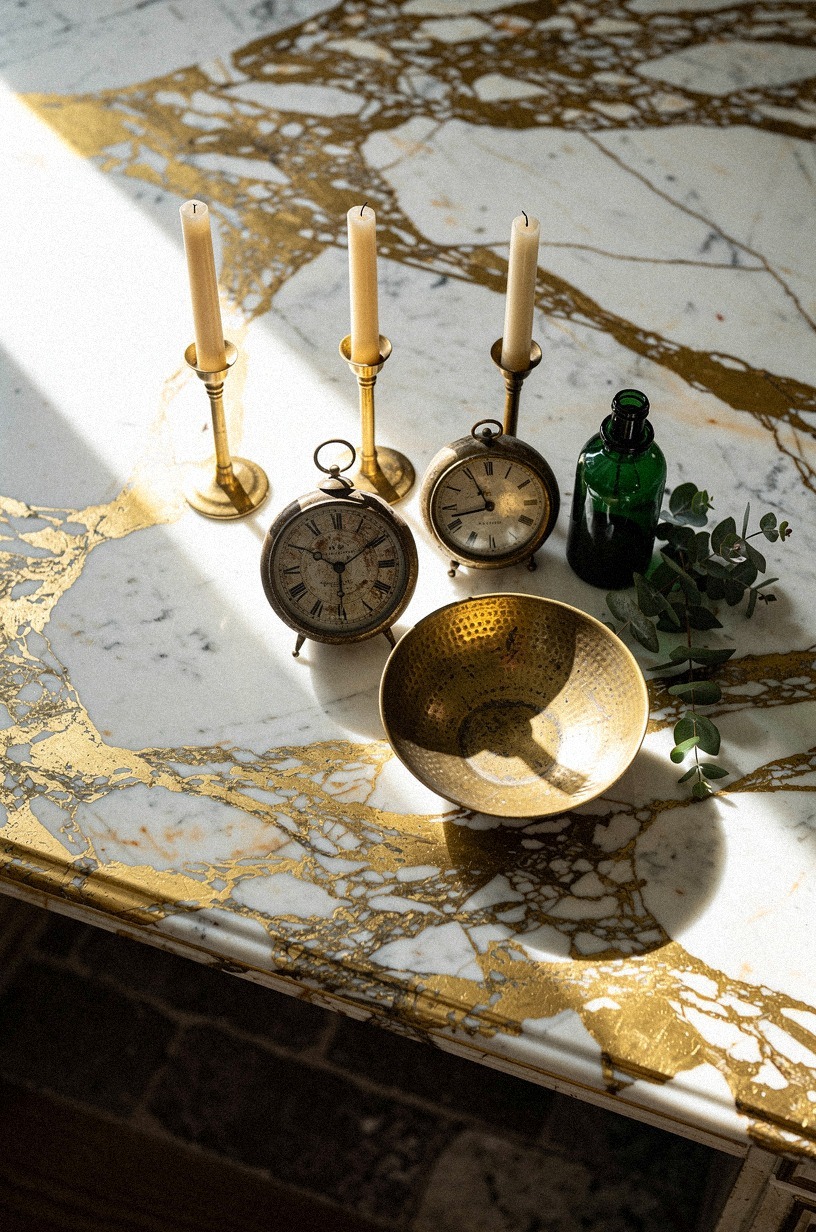
An antique clock gives the shelf a focal pause. Set one or two between cream taper candles on a Calacatta marble mantel with gold veining, and the warmth in the stone will keep the clocks from feeling stern. From overhead, those round or arched faces break up the long shelf in exactly the right way.
I like clocks that are worn but still legible, because a little use makes them feel real. You don't need every candle lit either.
One or two glowing tapers beside a quiet clock face is enough to change the whole mood. And keep the holder heights a bit uneven so the clocks aren't boxed in. Lovely, every time!
For the same "one moving focal point" logic in a different room, this Japandi feature is a good companion read.
16Crown the mantel with a faded harvest wreath
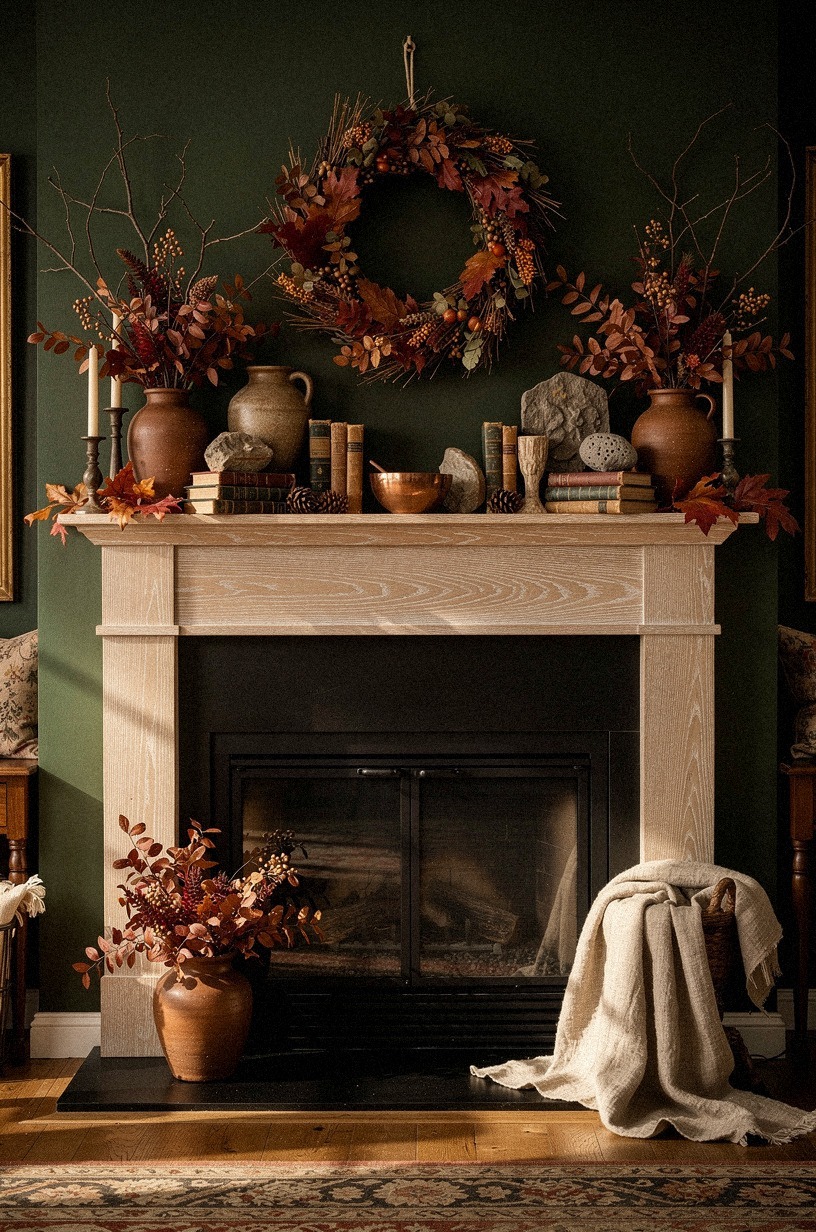
A faded harvest wreath is the finish, not the starting point.
How do I keep the look believable through November?
A mantel earns the season when at least one anchor, one textile, and one color repeat somewhere else in the room. I've watched people dress a beautiful shelf and then sit it in a cold, bright-white room.
The shelf does the work, the room undoes it, and nobody knows why. The fix is rarely more decor.
It's pulling one note from the mantel into a side table, a console, or a chair cushion. The same logic shows up all over this polished-warm guide if you want a second look at how the eye reads repeat color.
The other half is restraint. A mantel that has eight ideas is a mantel that has none. If you can take one thing off, take it.
The shelf will look richer, the objects will read larger, and you'll still have the heirloom feel you wanted.
What's the real difference between antique fall mantel decor and a styled one?
You can spot a styled shelf from across the room. It looks brand new, every object matches, and nothing has a chip or a fade.
An inherited shelf, even a brand-new one built to look inherited, has at least one imperfect piece doing the heavy lifting. That's the difference. Patina, crazing, soft wear, a faded label, a hand-me-down book with a cracked spine.
The object doesn't have to be old, but it has to look like someone loved it.
Most people over-buy to fix this. Don't.
You want one real piece and a few quiet supports. The math is the same as a good room: one statement, two textures, one piece of warmth.
Anything past that gets loud.
Can I pull this off on a small fireplace?
Yes, and a small mantel actually has an advantage. A tight shelf forces you to edit, and editing is the whole game.
I'd skip the large portraits and oversized trays and go with the mirror, the lace runner, one crock, and a small cluster of taper candles. Four pieces, max.
Your mantel will read intentional from across the room and quiet from up close.
The only thing you can't cheat on a small mantel is height. A single taller piece, whether it's the mirror, the portrait, or a tall vase, gives you the upward line that keeps the shelf from feeling cramped. That's why an old gilt frame with a sepia print inside is worth more than a row of small objects on a tight mantel.
Why does The Heirloom Filter make collected fall styling feel richer?
Because the best vintage fall mantel ideas with antique, collected character don't read seasonal first. They read believable first. I've messed this up by buying filler pieces that looked fine in a cart and cheap on my shelf.
The shift came when I started asking a better question: could this object stay here after October and still make sense to you? If the answer was no, out it went.
That's The Heirloom Filter. First choose your anchor with age or weight: mirror, portrait, crock, clock, corbel, wreath. Then choose one softening layer like lace, velvet, old paper, or magnolia.
Then choose one color temperature and stay loyal to it. Warm brass with amber.
Weathered wood with cream. Oxidized silver with muted gourds. You don't need ten accents if the materials are doing the storytelling, and you don't need to explain every choice. That's when you'll know it's working for you.
The room budget matters too, because a mantel can't fix broken proportions. If your rug should really be 8x10 or 9x12, your coffee table wants to land around 16 to 18 inches tall, or your seating still feels adrift, handle that first. Then let the mantel be the jewelry.
That's the order you'll thank yourself for later. These typical US ranges keep your room plan honest:
The Old-House Balance Rule over seasonal clutter
If you want this look to land, repeat your old note somewhere beyond the mantel itself. A worn frame on a side table.
A tray of amber glass on the console. One old book stack near your sofa.
That's The Old-House Balance Rule, and it keeps your fireplace from feeling like a decorated island.
And keep your palette tighter than you think you should. Two woods, one metal, one deep autumn color, done. But more variety usually reads undecided, not collected.
This calm-room story makes the case, and this neutral roundup shows the same discipline in cream-and-walnut rooms.
What People Always Want to Know
What is the best vintage fall mantel arrangement for a small living room?
The best small-room version is usually the mirror with amber bottles or the low books with one ironstone pitcher. Both give height without crowding depth. If your living room is tight, you'll do better with one strong anchor and fewer side pieces.
Where can I buy vintage fall mantel pieces on a budget?
Start with Target Threshold, IKEA, and Wayfair for basics, then look at thrift stores, estate sales, and Facebook Marketplace for the pieces that add age. Secondhand wear is the shortcut. You'll usually find better mirrors, trays, clocks, and old frames that way.
How much does a vintage fall mantel makeover cost?
About $100 to $300 is typical if you're refreshing only the mantel and reusing a few things you already own. Editing is the free upgrade.
You'll save more if you remove bright filler first, then spend on one anchor, a few candles, and one honest textile or branch layer. That's where I'd start.
Can I create this look in a rental?
Yes, and you should start with what you already have. Cheap works when the materials feel believable. Lean old frames, reuse bowls or crocks, clip branches from your yard, and stack books before you buy a single filler piece. So much better!
Is a vintage fall mantel worth styling in a small space?
Yes, it's worth it because your small fireplace becomes a focal point fast. The mantel does more visual work in a compact room. Keep the center breathable, use one taller anchor, and let the side accents stay narrow. The same "one anchor, narrow neighbors" rule shows up in this bedroom layout guide if you want a parallel read.
Is this style rental-friendly for mounting wreaths and sconces?
Yes, because the best moves are removable. Rental-safe styling is easy here. You can lean mirrors and portraits, use battery sconces, hang wreaths with removable command strips, and build the whole look from objects that can move with you.
How do I make a brand-new mantel look collected?
Add at least one imperfect piece. A chipped pitcher, a faded book, a tarnished tray, or a frame with a little wear. The imperfection does the storytelling for you. Without it, even a beautifully styled shelf reads brand new, and brand new is the opposite of collected.
Start With the Mirror and the Amber Bottles
If I had to pick one, I'd start with the antique mirror and amber bottles. That pairing gives you height, glow, and age in one move, and the reflection makes the whole mantel feel fuller without adding clutter. Pin that first step for later and let everything else build around it.
You'll thank yourself by the second weekend.