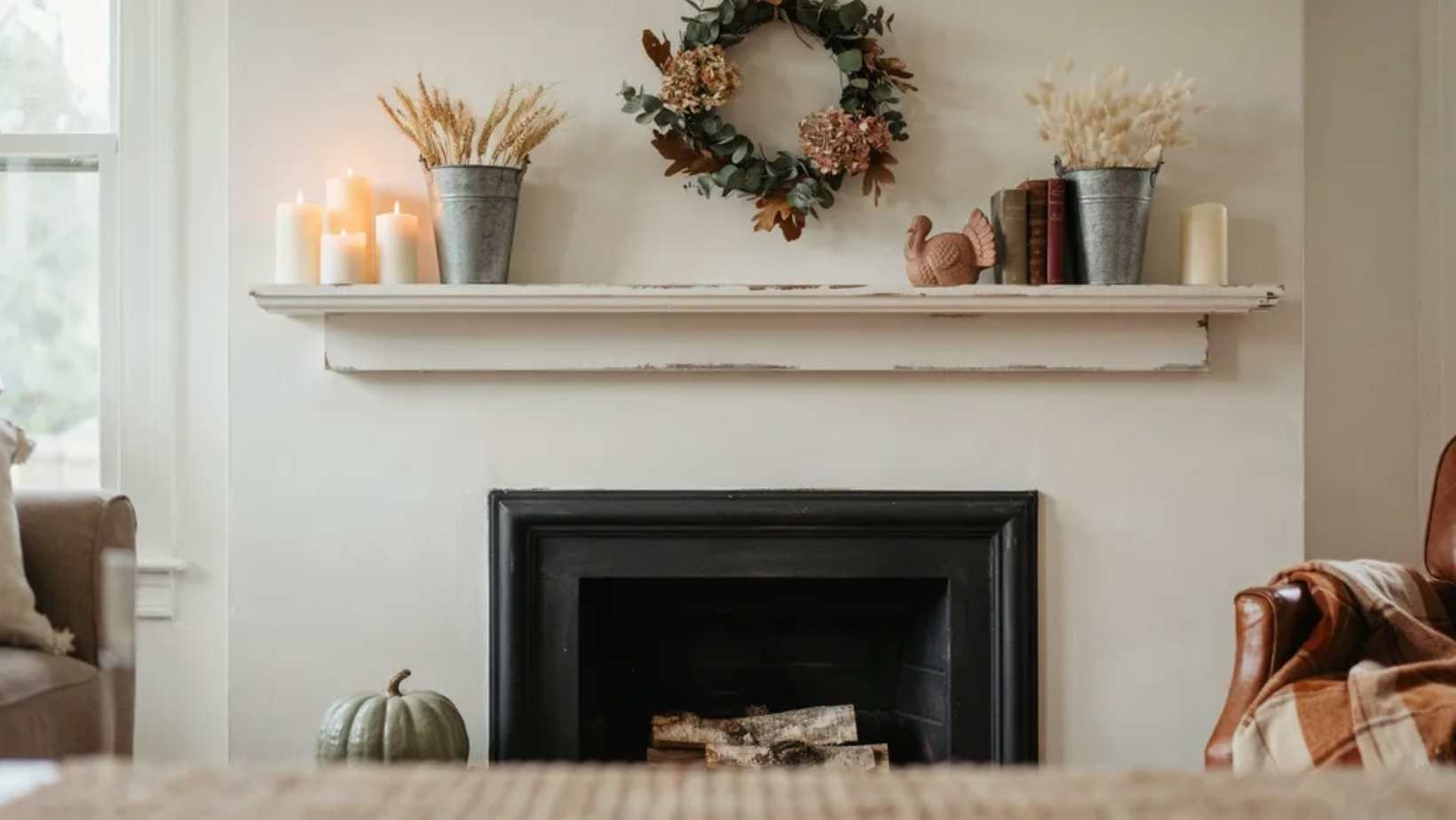
17 Farmhouse Fall Mantel Ideas That Make Guests Linger
22 june 2026Farmhouse fall mantel ideas work best when you keep the palette tight, the heights staggered, and the spend in the styling lane, not the renovation lane. I learned that after one bad September when I crowded my fireplace with tiny orange filler and made the whole room feel fussier, not warmer. Your mantel doesn't need more stuff. It needs a better pecking order.
- Bracket the mirror with corn husk wreaths
- Want instant layering? Raise the pumpkins on risers
- Trail bittersweet garland over iron hooks
- Prop plaid shutters behind the candle line
- Cluster crockery jugs with maple branches
- Need doorway impact? Tuck wheat sheaves in galvanized buckets
- Frame the hearth with apple crates
- Ticking stripe + gourds = the cheapest move you'll make all fall
- Hang a tobacco basket above the mantel
- Amber demijohns beside stacked books (yes, on concrete)
- Black mantel? Try dried orange slices woven through cedar
- Set black lanterns at uneven heights
- Mix copper mugs with mini pumpkins
- Lean a chalkboard sign behind foliage
- Bundle cinnamon sticks in linen ribbon (the scent move)
- Scatter acorns along a barnwood tray
- Cream knit stockings soften the whole wall
1Bracket the mirror with corn husk wreaths
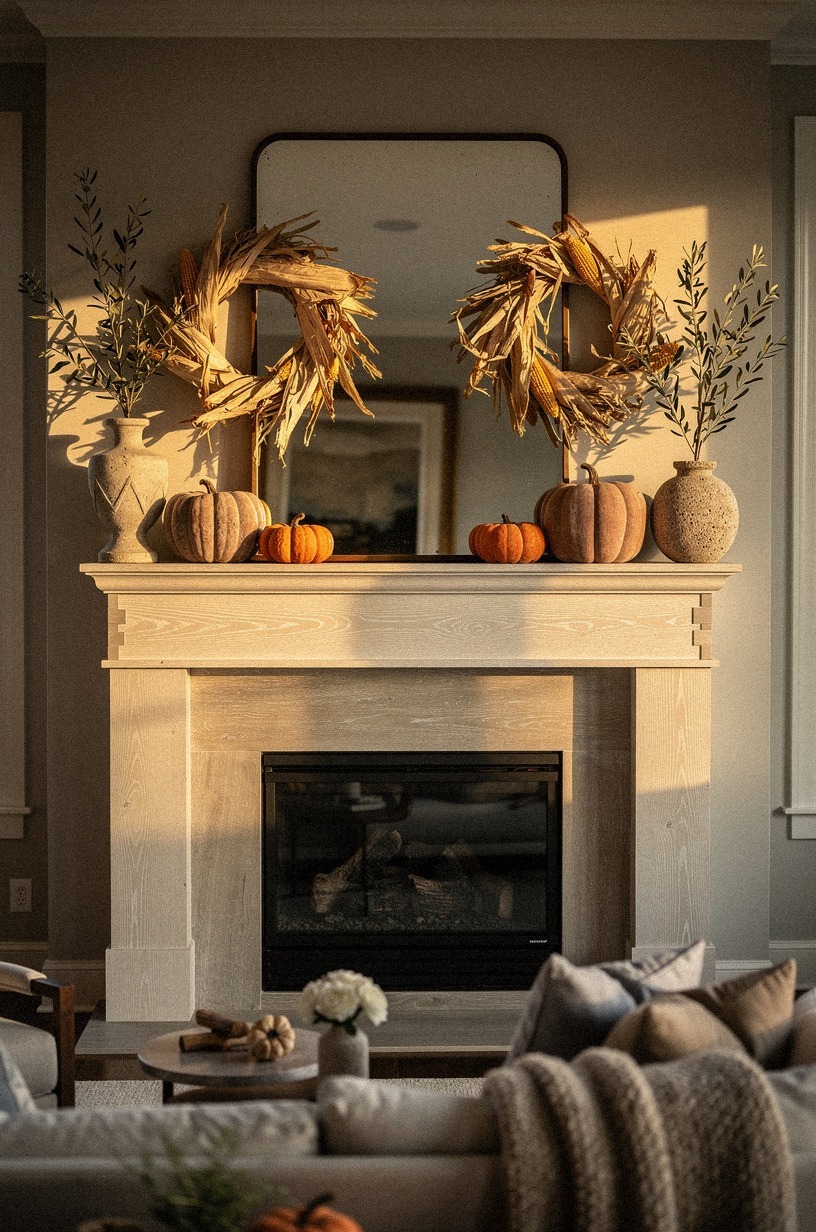
Start with the mirror, then give it company instead of competition. When you bracket a central mirror with corn husk wreaths, your eye reads the whole mantel as wider, calmer, and more deliberate.
That matters if your beam is cerused white oak and the dovetail joinery is worth seeing, because the wreaths frame the architecture instead of covering it. I like the wreaths slightly higher than the midpoint of the glass so the reflection still feels open and bright.
Keep the pumpkins low and the wreaths dry, papery, and a little imperfect. Two balanced terracotta pumpkins and a pair of stone vessels underneath are enough if you want gathered charm without that themed-store feeling.
I'd skip glossy orange here every time. The natural husk color is better because it lets the pale oak, olive branches, and mirror do the talking, and your guests will notice the whole wall before they notice the objects.
If you're already rethinking the whole front-door wreath story, my fall-friendly wreath roundup shows the same hand-tied texture logic at scale.
2Want instant layering? Raise the pumpkins on risers
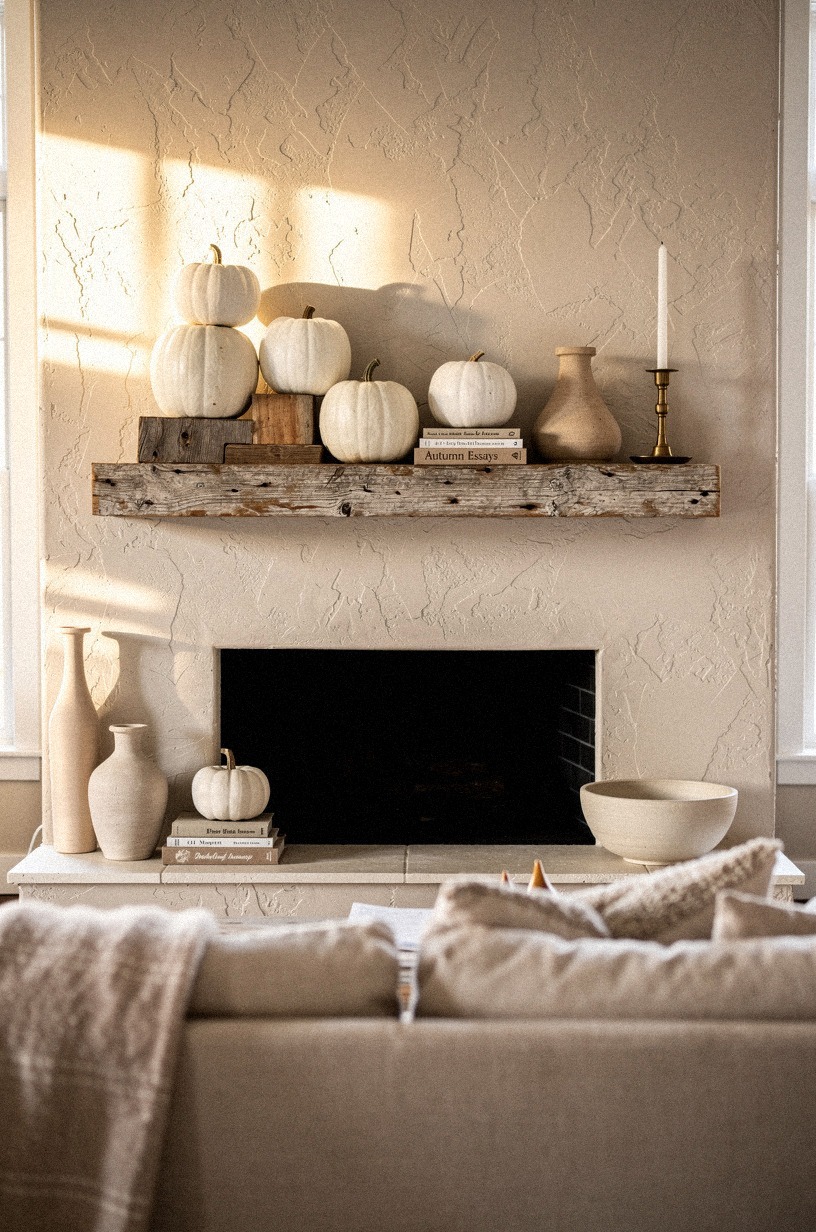
If you want your mantel to feel layered the second you step into the living room, raise the pumpkins instead of buying more of them.
3Trail bittersweet garland over iron hooks
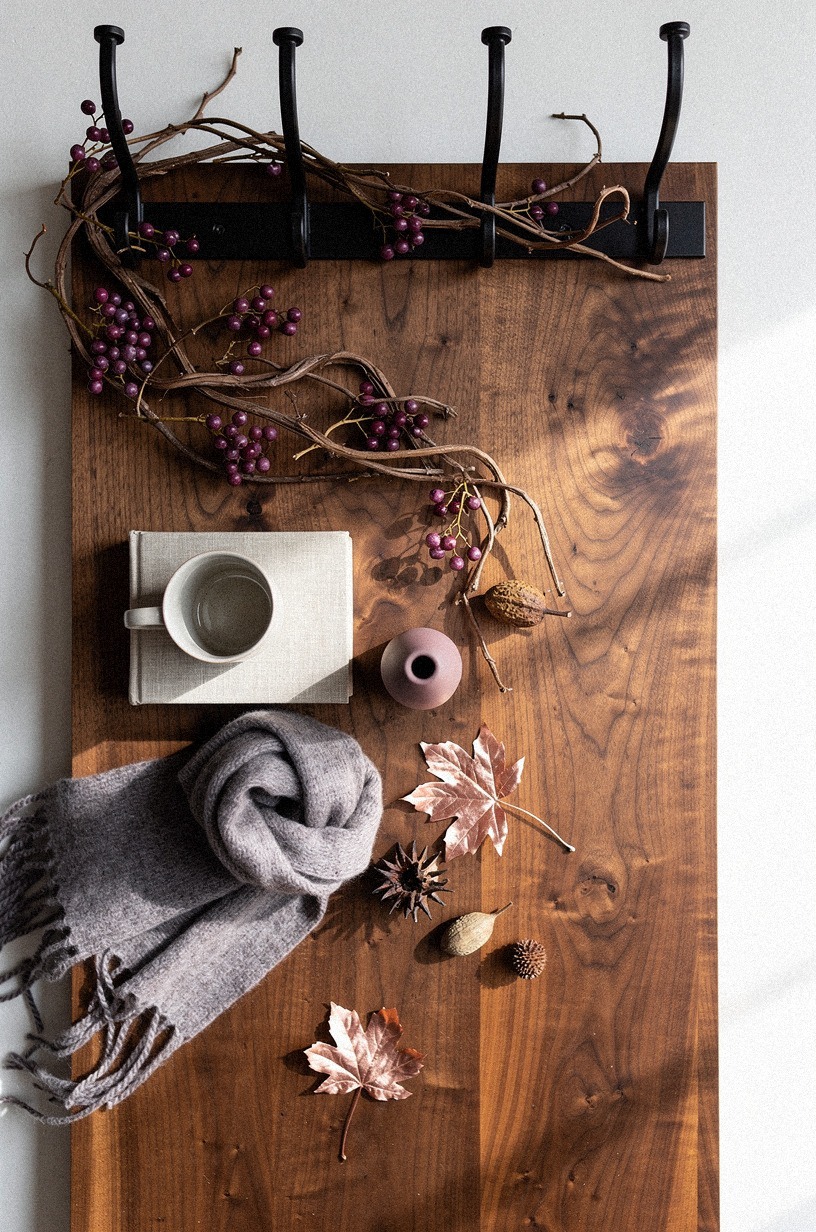
This is the move for a mantel that already has strong wood and doesn't need bulk. Trail bittersweet garland over black iron hooks, let it skim across a book-matched walnut surface, and keep the line loose enough that you can still see the mantel edge.
Your eye wants motion here, not a thick rope of leaves pasted across the front. The little drop between hooks is what gives the arrangement rhythm.
I like the berries off center, with a hand-hammered copper bowl catching the warmer notes below. Why does that matter?
Because walnut can go visually heavy if every object on top of it is heavy too. A thinner garland, darker hooks, and one reflective bowl keep the whole thing from turning muddy.
And if you're working through other glow-heavy spots in the house, my favorite reference for that balance is this cozy backyard lighting guide, because the same low-amber logic works indoors.
4Prop plaid shutters behind the candle line
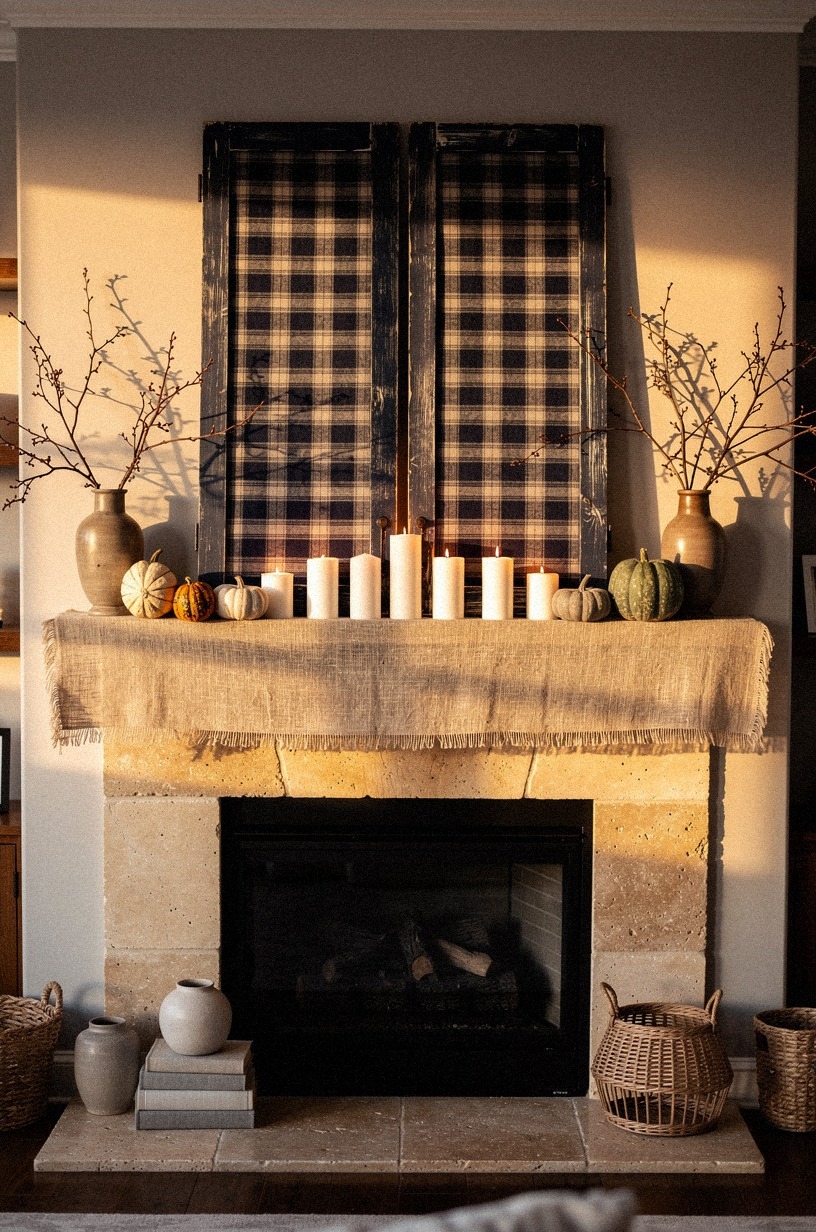
A flat candle row can look decent from straight on and dead from every other angle. Prop plaid shutters behind it and the whole scene gets depth without asking you to buy larger objects. The shutters add pattern, the warm travertine surround keeps the base soft, and a raw linen runner catches light in a way bare stone never will.
If your room already has navy, white, and walnut in it, this is one of the easiest ways to make those tones feel intentional.
Keep the candles even, but let the backdrop do the irregular work. I prefer warm ivory tapers in mixed holders over identical glass hurricanes, because the little finish changes keep the farmhouse fall mantel from feeling rented for a photo shoot. And please don't prop the shutters perfectly upright.
A slight lean reads more natural. You want them to feel discovered in the room, not measured with a level.
If you're building the same soft-glow mood into the bedroom corner, this candlelight + romance piece shows how tapers carry an entire wall.
5Cluster crockery jugs with maple branches
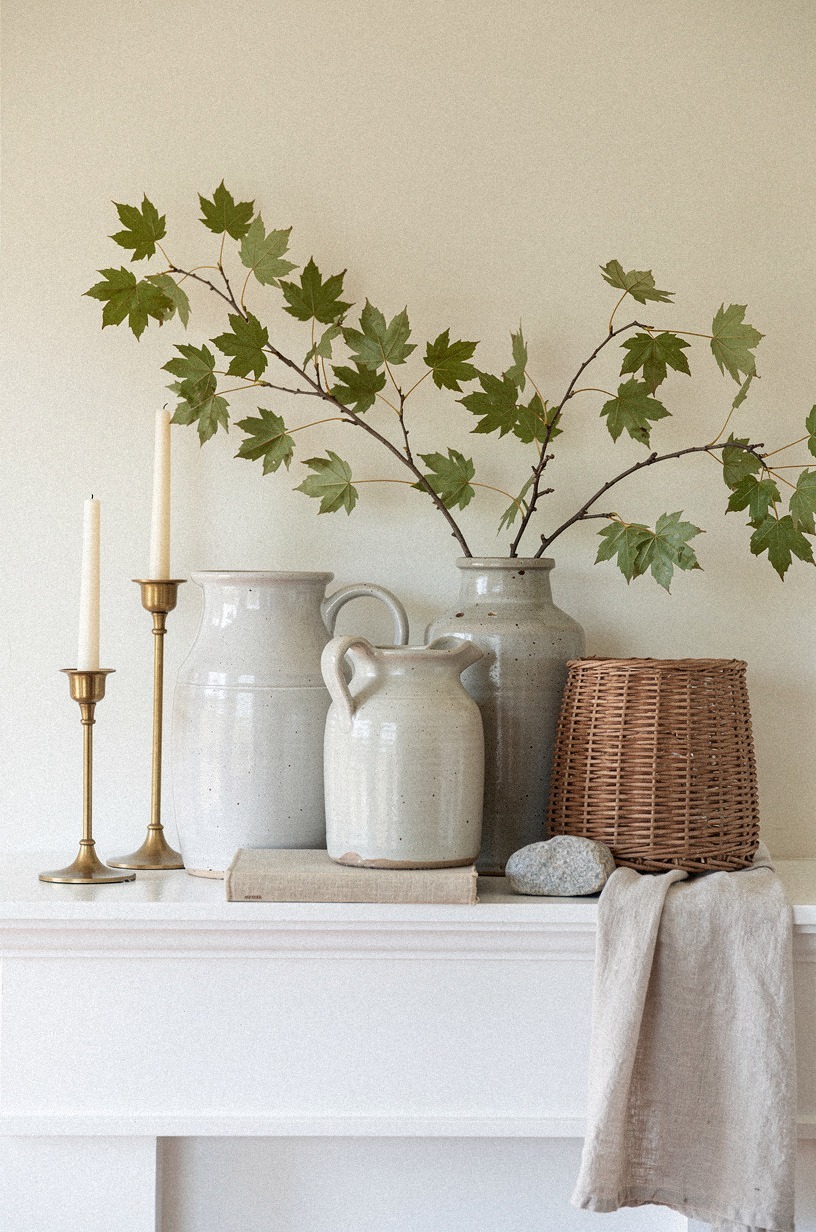
This idea works because the wall stays calm. When you cluster crockery jugs on a cream backdrop and fill them with muted maple branches, the arrangement can stay small in frame and still feel rich.
Your eye catches the rounded pottery shapes first, then the leaf movement, then the unlacquered brass candlesticks. That's the right order.
If the leaves scream louder than the pottery, the mantel starts feeling temporary.
I like three jugs at most, with one holding the tallest stems and the other two doing the visual grounding. But I'd skip bright red maple here.
Muted emerald, olive, and tired rust are better because they sit more comfortably beside a cream wall and keep the brass looking aged instead of shiny. If your living room leans soft neutral, a wall like Benjamin Moore Revere Pewter HC-172 makes those greens feel even more settled.
The same principle carries beautifully onto the dining table, by the way. This outdoor tablescape guide covers the wider jug-and-branch logic for an autumn dinner.
6Need doorway impact? Tuck wheat sheaves in galvanized buckets
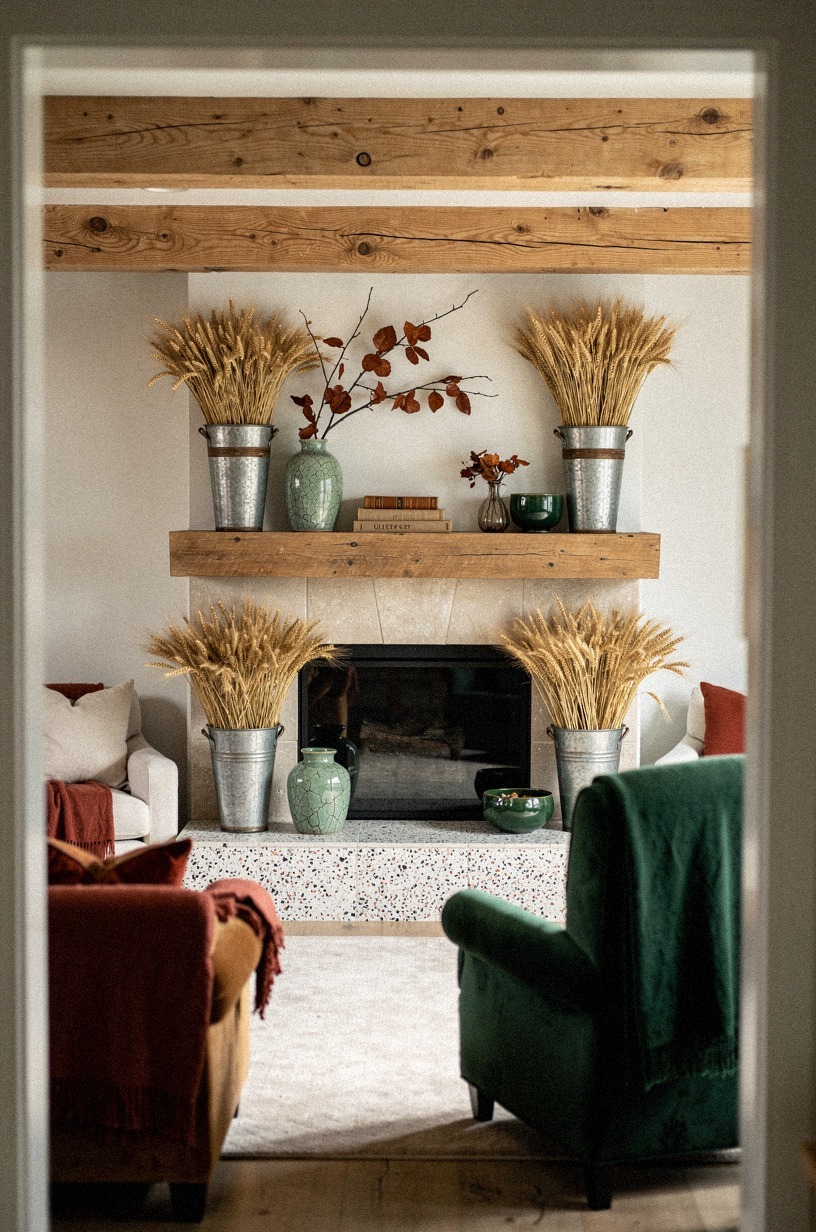
When the mantel is viewed through a doorway, scale matters more than cute detail.
7Frame the hearth with apple crates
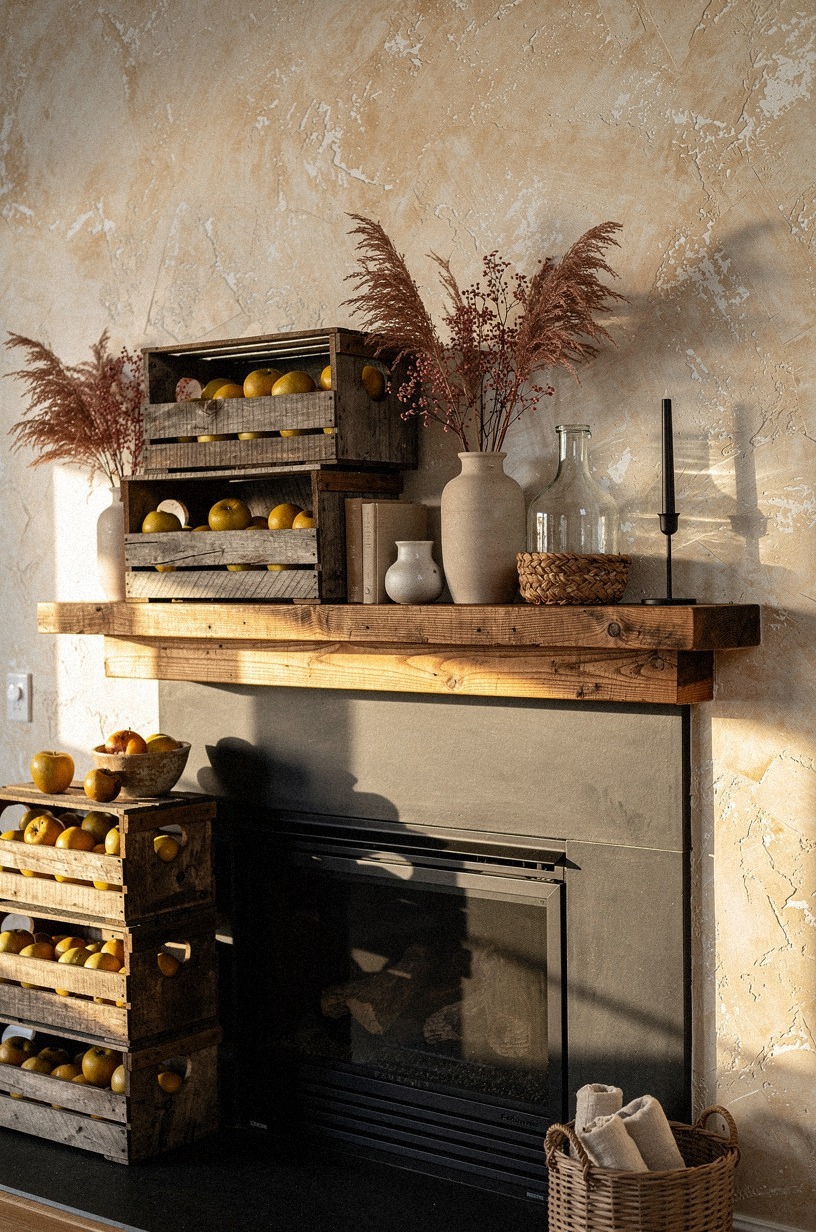
If the fireplace surround is dark, give the floor-level styling some structure. Apple crates stacked on either side of the hearth frame the opening beautifully, and the golden apples inside them throw a warm note against a charcoal fireplace surround without asking the mantel top to do all the work. The dusty rose dried florals help too, especially when the wall texture reads like hand-applied Venetian plaster and needs something soft nearby.
I like one crate per side in a smaller room and two only if the firebox is wide enough to hold the extra visual weight. Too many crates make the hearth feel like storage.
One or two make it feel composed. Here's the spending reality if you're deciding whether to stop at styling or go bigger:
That table is exactly why I tell people to try crates, branches, and lighting first. Most rooms don't need the high tier. They need better staging around the firebox.
Huge difference! And if you're weighing whether to splurge on the fireplace itself or its styling, my honest fire pit vs fireplace breakdown is a useful reality check before you commit.
8Ticking stripe + gourds = the cheapest move you'll make all fall
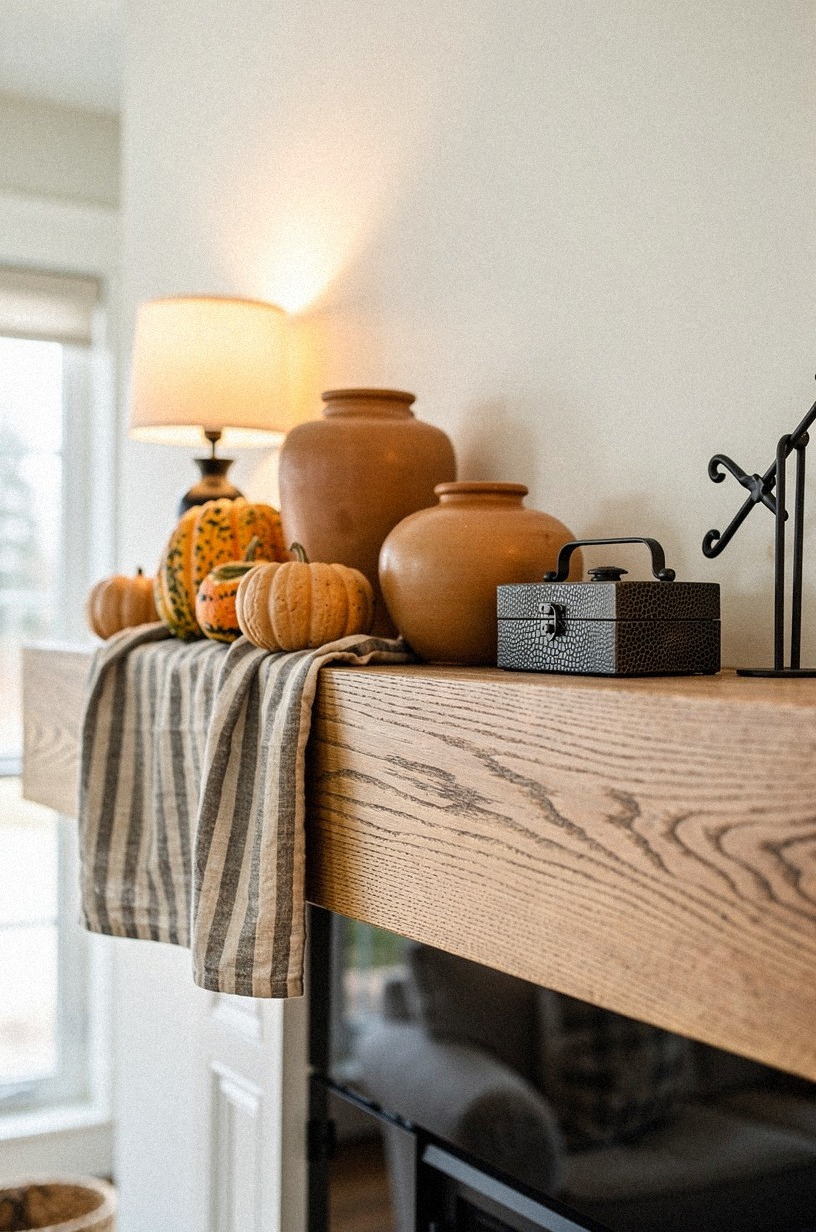
This is one of those small changes that does much more than it should.
9Hang a tobacco basket above the mantel
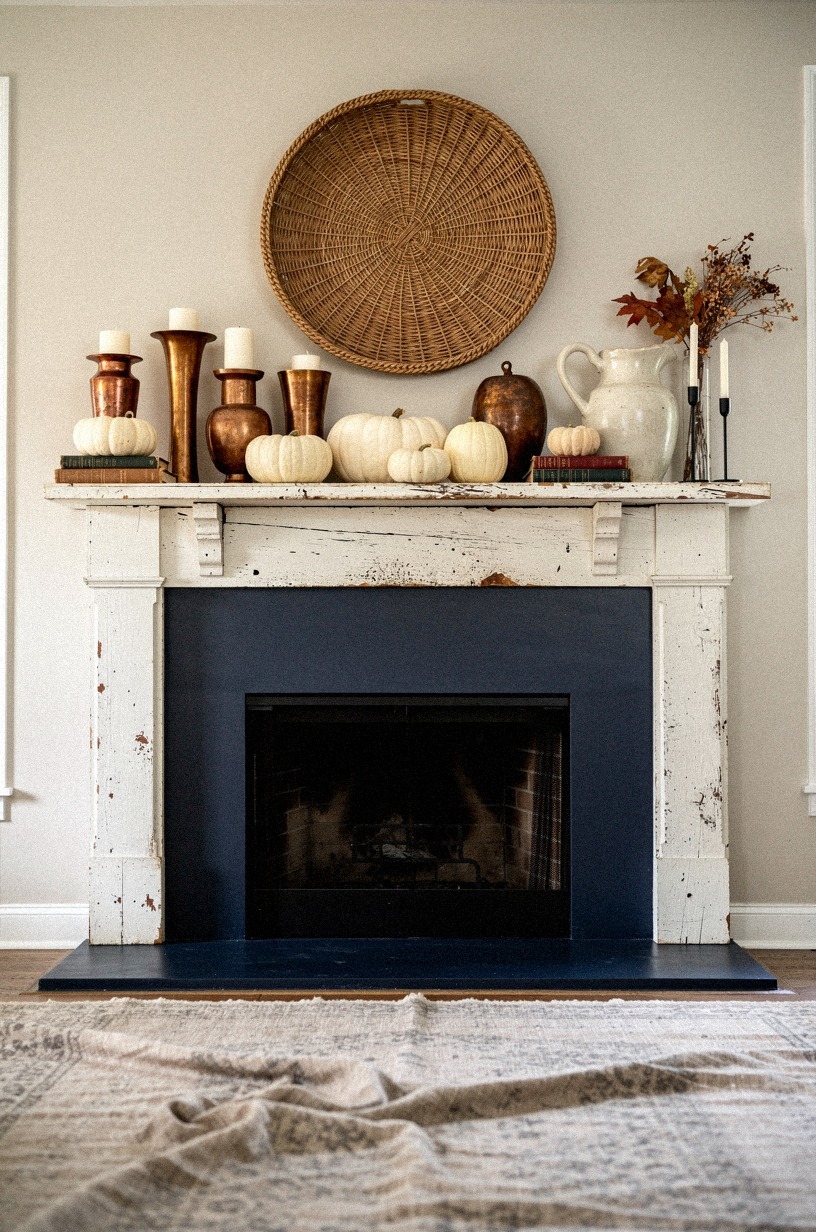
Sometimes the best answer is to go bigger above the beam so you can stay quieter on the beam itself. A large tobacco basket over the mantel gives the wall the scale it wants, especially when the surround below is painted a deep midnight blue and already has enough mood. Your ivory pumpkins and copper vessels can stay spare because the basket is doing the top-half work for you.
I wouldn't center a tiny framed quote here. I'd rather use one oversize basket and let the negative space inside it keep the wall breathable. The woven texture also helps a lot if the room has Belgian flax linen upholstery or a lived-in slipcovered sofa nearby.
Hard metal, soft fabric, open weave. That's a better mix than art plus more art, and it keeps fall fireplace decor mantles farmhouse styling from feeling overexplained.
For the same "one big thing above" move in a smaller space, this dramatic entryway piece is worth a look.
10Amber demijohns beside stacked books (yes, on concrete)

This is a detail shot move, which means your surfaces matter. Place amber demijohns beside stacked books on a poured concrete mantel slab with visible aggregate and you get that good contrast between rough and glowing. The cedar sprigs give the glass a reason to be there, and the warm cream knit nearby keeps the composition from feeling cold.
If your mantel material is hard and modern, you need those softer notes or the whole scene turns too sharp for fall.
But stack the books flat, not upright, and keep the demijohns in odd numbers. I like two bottles and one shorter vessel, with the tallest glass set closest to the center so the books can taper outward.
Don't use shiny new hardcovers if you can help it. Frayed jackets and faded cloth spines are the better call because they make the concrete feel collected instead of brand new.
If you enjoy that stacked-and-styled moment on a serving tray, this bar tray styling guide covers the same demijohn-and-books logic in a smaller frame.
11Black mantel? Try dried orange slices woven through cedar
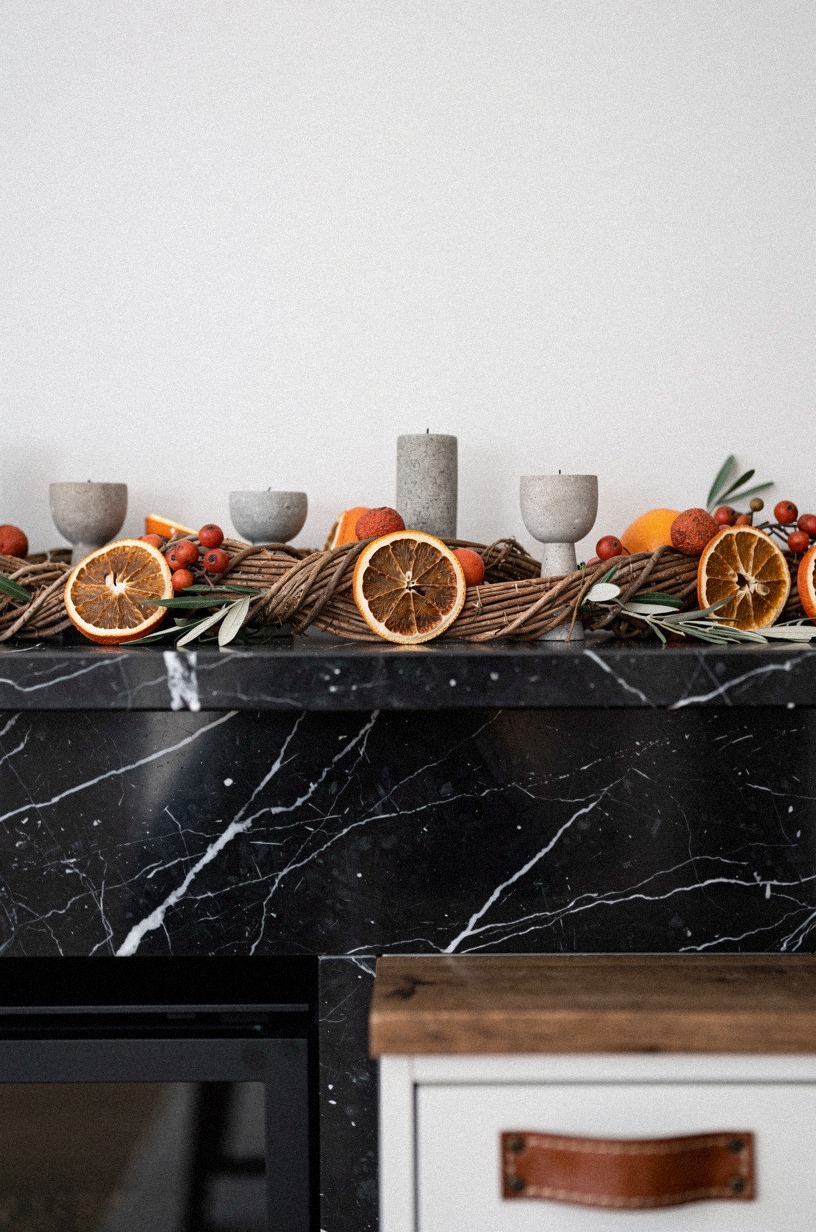
A black mantel can take more contrast than most people think.
12Set black lanterns at uneven heights
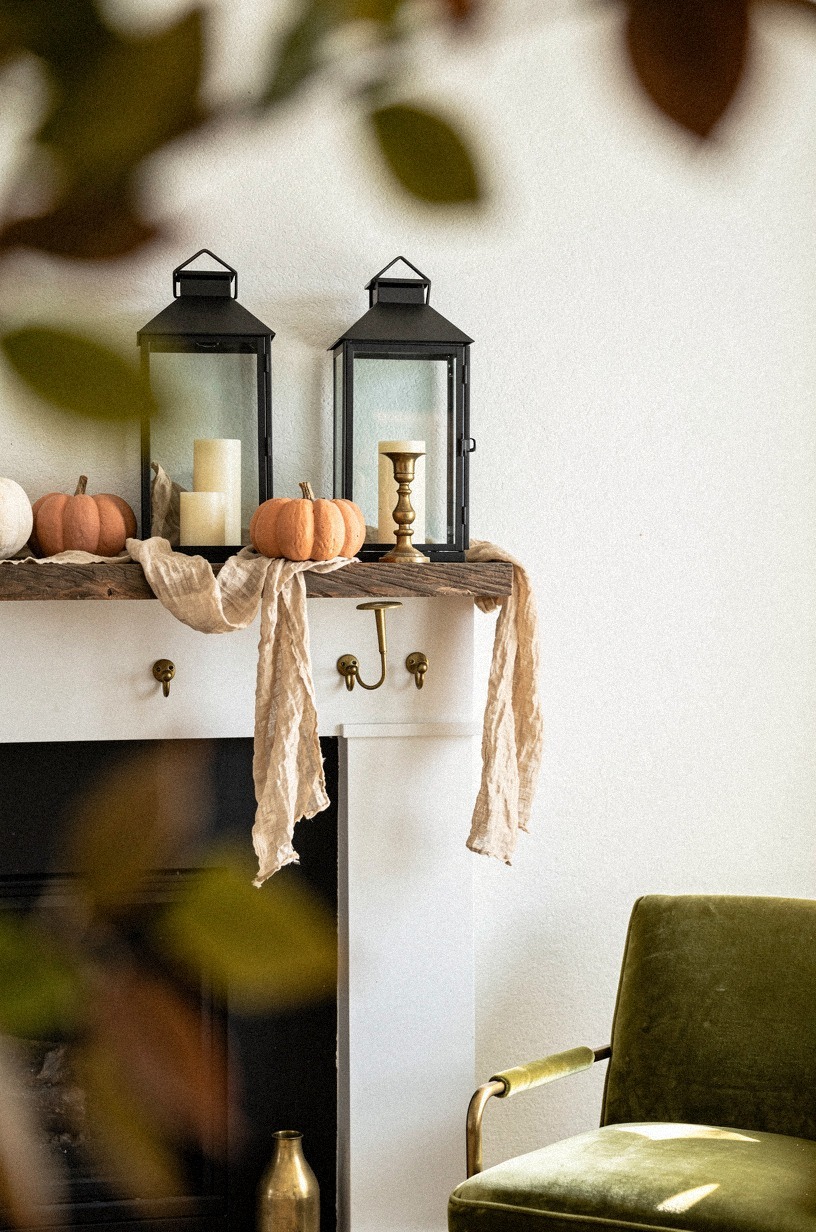
Lanterns are one of the fastest ways to make a mantel feel evening-ready, but only if the heights are off on purpose. Set black lanterns at uneven heights beside clay pumpkins and linen ribbons, and the whole fireplace gets that staggered skyline look your eye loves from across the room. Through soft foreground branches, the bright living room still feels airy, but the mantel itself feels grounded.
That's the sweet spot.
I use what I call the Three-Height Light Stack here: one tall lantern, one medium, one low supporting object so the line never flattens out. But keep the ribbons soft and sparse.
Too much fabric turns the lanterns into centerpieces. Against a bright room, the black metal is already doing enough.
If your guests linger longer after sunset, this is usually why. The mantel starts telling the room it's time to settle in. It works every time!
And if you want the same candle-lit-after-dark logic on the back porch, my year-round fire pit hangouts guide covers the bigger fire version.
13Mix copper mugs with mini pumpkins
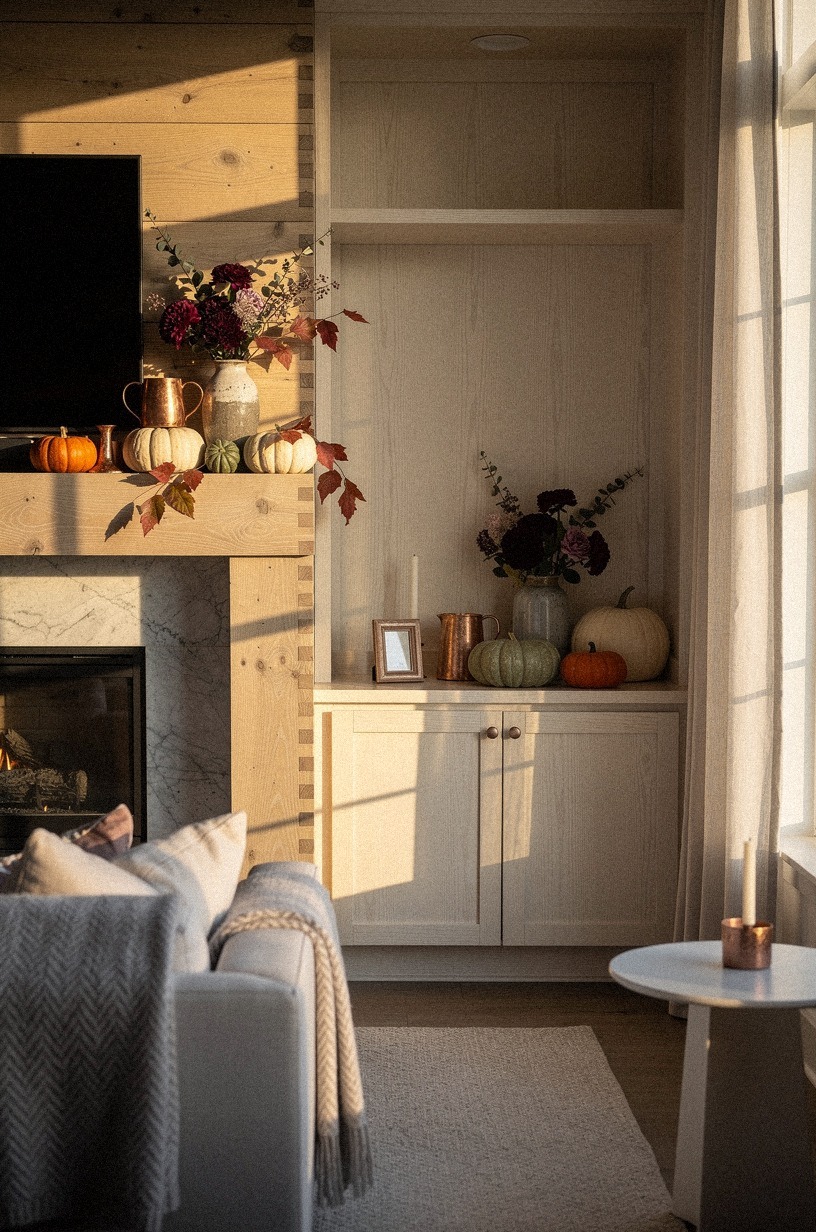
Copper is great on a mantel because it gives you warmth without asking for more color. Mix copper mugs among mini pumpkins on a Carrara marble surround and the rose-gold glints do a lot of the heavy lifting for you.
Plum florals help bridge the cool gray in the marble to the warmer white oak built-ins nearby, and that bridge matters. Without it, marble can feel a little too clean for farmhouse fall mantel ideas.
I like the mugs scattered, not grouped like barware, with one slightly tucked behind a pumpkin so the shine peeks out instead of shouting. But I'd keep the pumpkins ivory and stone-toned here, not bright orange.
Carrara already has movement. You don't need more noise.
If you enjoy that warm-metal gathering mood beyond the living room, this backyard dinner party ideas piece uses the same copper-plus-candle logic in a different setting.
14Lean a chalkboard sign behind foliage
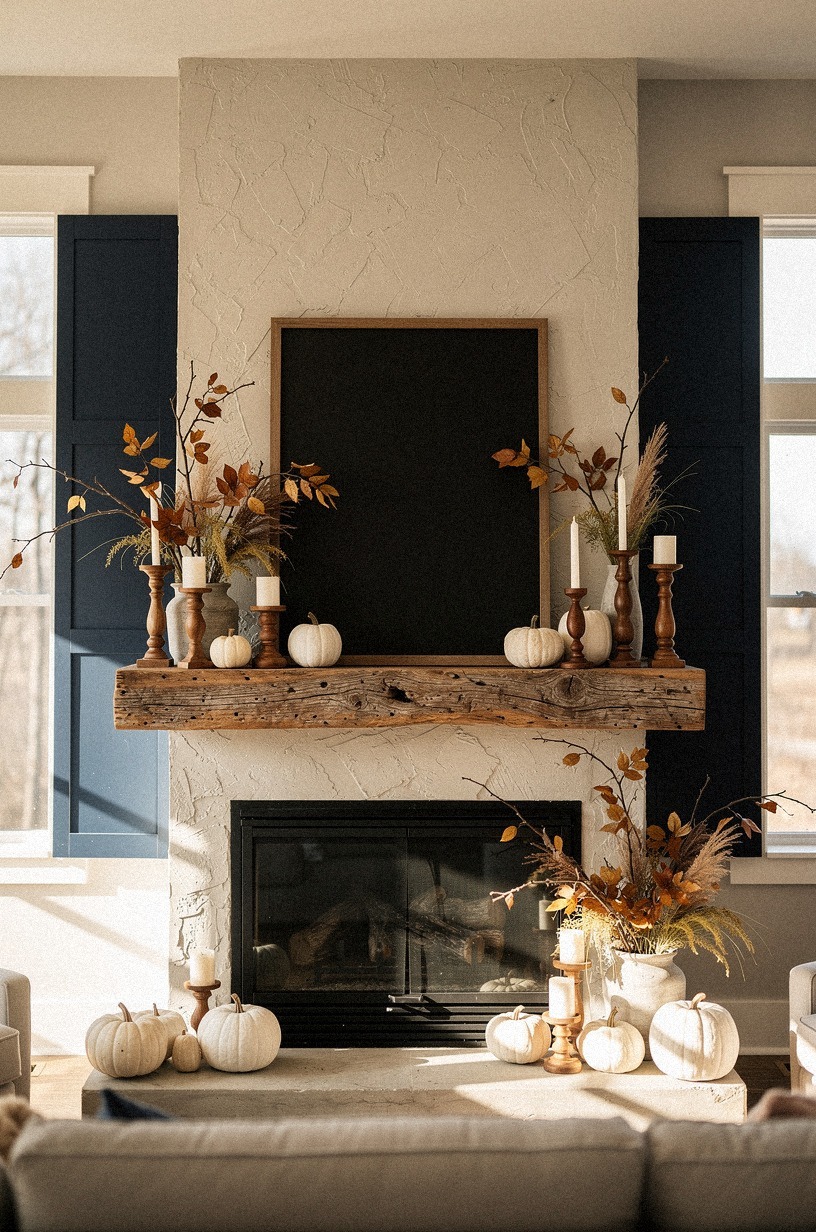
A blank chalkboard sign can be useful precisely because it says nothing. Lean it behind autumn foliage, add navy shutters, white pumpkins, and walnut candleholders on weathered teak, and you get a dark backdrop that helps every lighter object stand out.
Your eye reads the chalkboard as depth first, message board second. That's why I prefer it blank.
Words would only flatten the scene.
Keep the foliage loose enough that the chalkboard edge still shows. I want to see a hint of that dark rectangle behind the leaves, because it gives the white pumpkins something to bounce off.
And from the doorway, the contrast between chalkboard black, navy shutters, and warm teak is what makes the arrangement feel layered instead of busy. But don't letter a seasonal phrase on it.
Honestly, that's the one move that can cheapen the whole mantel in five seconds. If you're after that same dark-backdrop effect for a front door instead, my front-door wreath lineup covers the closest cousins of this idea.
15Bundle cinnamon sticks in linen ribbon (the scent move)
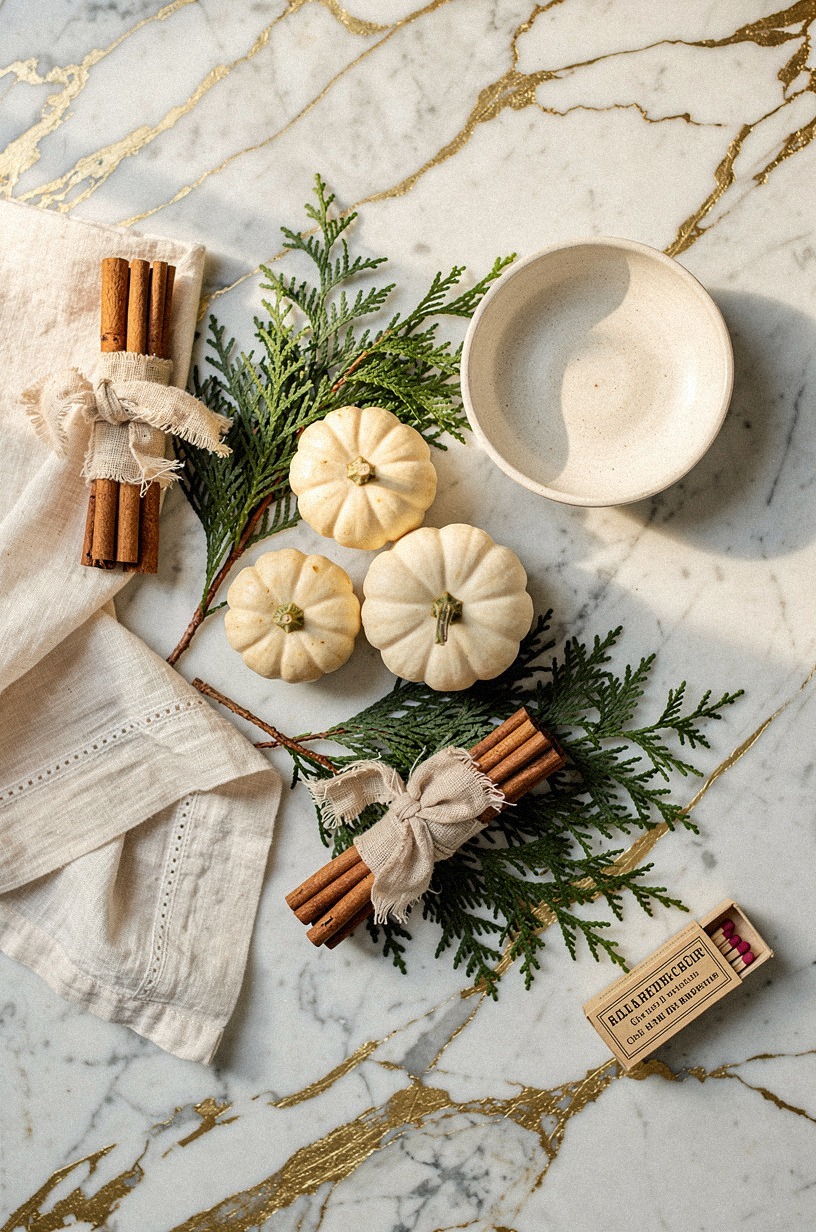
This is a close-up detail, so it has to earn its place with texture.
16Scatter acorns along a barnwood tray
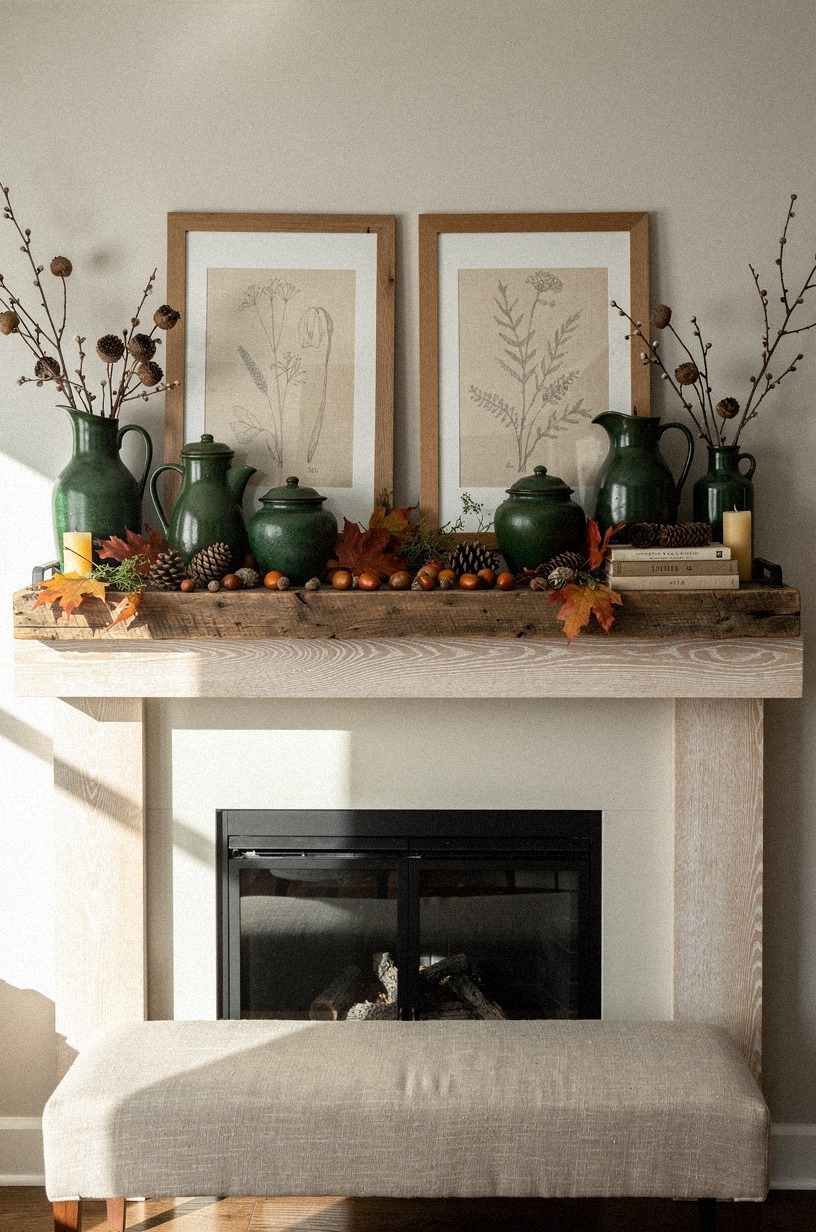
Acorns are best when they behave like punctuation, not the whole sentence. Scatter them along a barnwood tray centered on a cerused white oak mantel, then let forest green crockery and rust leaves build the wider color story around them.
Your natural oak frames nearby help too, because they repeat the wood note without making the mantel itself feel overmatched. This idea works because the tray contains the mess.
I prefer a shallow tray with rough edges and only a loose line of acorns, not a packed bowl full of them. But the acorns should still look intentional, which means a little spacing and a few caps turned upward so the shapes vary.
If you dump them, the room reads undecided. If you place them with a light hand, the mantel feels gathered and easy, not precious. If you want to see this tray-and-acorn moment scaled up to a whole coffee table, my rustic outdoor kitchen guide uses the same rough-tray logic in a different setting.
17Cream knit stockings soften the whole wall
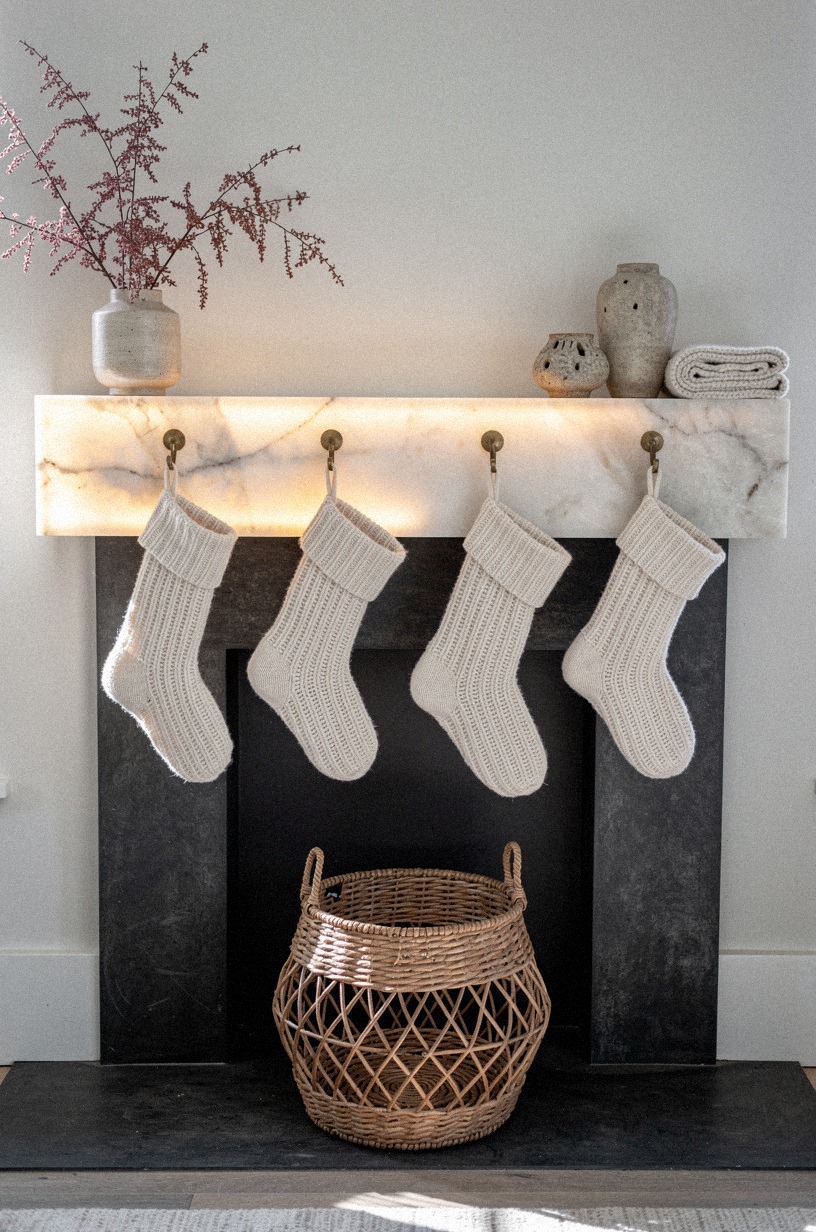
This is the gentlest version of fall-to-winter crossover, and I love it for that. Cream knit stockings hanging from aged brass hooks soften a backlit translucent onyx mantel instantly, especially when dusty rose branches and a charcoal fireplace are already giving you contrast. The knit texture takes the edge off the stone, and the warm glow through the onyx makes the whole setup feel lived with instead of staged for one month.
Keep the stockings relaxed and lightly weighted so they hang straight without looking full. I wouldn't overstyle them with tags, bells, or giant bows.
The beauty is in the texture and the light coming through the onyx. And if you want one seasonal shift that keeps paying off after fall, this is it.
You can move from leaves to winter greens later and the stockings still make sense. For the same quiet-knit-on-stone logic in a bedroom corner, my warm cocoon bedroom roundup is a useful sister read.
The Two-Wood Rule
Here's the rule I keep coming back to with farmhouse mantels: if your beam, tray, shutters, crates, or risers all read like the same wood tone, the room flattens out. You need two woods talking to each other.
Cerused white oak with weathered teak. Reclaimed barnwood with walnut.
Pale oak with darker apple crates. That tiny contrast is what keeps gathered charm from turning bland.
I've ignored this before and paid for it with a mantel that looked careful but dead. When every wood surface matches, your eye stops moving.
But when one wood is chalkier and one is deeper, the pumpkins, metal, and foliage suddenly look more intentional. It's subtle. It works every time.
If you want to push the two-wood logic into a bigger room, the same trick shows up in this antique farmhouse bedroom piece, where oak and walnut carry the whole room.
Why the Gathered-Weight Rule Works
The farmhouse mantels people remember are almost never the ones with the most product on them. They're the ones with the best weight distribution. That's what I mean by the Gathered-Weight Rule.
One larger thing above, one taller thing to the side, one lower element near the hearth, then a few smaller pieces that echo the same color family without matching like a catalog set. Once I started looking at mantels that way, I stopped buying filler and started reading the fireplace like architecture.
I also think this is why so many fall mantels miss. People chase the season before they read the room. They buy orange first, signage second, and texture last, when the order should be almost the opposite.
Start with what the fireplace already gives you. Is the surround warm travertine, Carrara marble, charcoal paint, or translucent onyx?
Is the beam rough or refined? Does the room already have navy, plum, camel, forest green, or soft cream in it?
Your answers decide whether corn husk, cedar, copper, and knit will feel grounded or random.
And honestly, the gathered look is less about rusticity than editing. Farmhouse doesn't mean everything has to be distressed, and fall doesn't mean every warm color belongs at once.
I'd rather see one perfect Farrow & Ball Hague Blue No.30 backdrop with wheat and black iron than a mantel loaded with ten cute objects that don't respect the wall behind them. I'd also rather see one quality mirror, one tobacco basket, or one stack of old books than a row of identical mini signs.
Guests linger when a room feels settled. They leave earlier when it feels busy (even if they can't tell you why). That's the whole game!
The useful part is that this doesn't have to cost much. A styling-first pass can stay in the low hundreds, especially if you already own a mirror, crock, lantern, or knit throw. For bigger living room decisions, these typical numbers help keep expectations honest:
That's why I keep saying your mantel can do a lot of emotional work before you touch the expensive furniture. It sits at eye level, it catches evening light, and it tells the rest of the room how warm to feel. If you're carrying the same weight logic through to a small dining nook, this outdoor patio pillow primer is a small but honest place to start.
A Few Things Worth Answering
What is the best Farmhouse Fall Mantel Ideas for Warm, Gathered Charm for a small living room?
The best option is a mirror plus one lifted pumpkin cluster, because reclaimed wood risers add height without widening the mantel visually. One anchor. One lower group.
One open patch of wall. If your room is tight, restraint makes it feel bigger, not barer.
Where can I buy Farmhouse Fall Mantel Ideas for Warm, Gathered Charm pieces on a budget?
Target, IKEA, and Wayfair are the easiest places to start, and thrift stores still win for baskets, books, and crocks. Look for IKEA candleholders, plain lanterns, and neutral textiles first.
Facebook Marketplace. Church rummage sales.
Old frames with decent bones.
How much does a Farmhouse Fall Mantel Ideas for Warm, Gathered Charm makeover cost?
A styling-only refresh usually lands around $100 to $300, depending on what you already own. Free branches.
Rearranged books. One thrifted mirror.
A small lantern pair. The money usually goes to candles, pumpkins, and one or two better texture pieces.
Can I create a Farmhouse Fall Mantel Ideas for Warm, Gathered Charm on a budget?
Yes, and you can keep it lean if you start with shape before shopping. Use cedar clippings, move a tray from another room, stack books under pumpkins, and clip branches from the yard. Those four moves can carry a mantel before you spend much at all.
Is a Farmhouse Fall Mantel Ideas for Warm, Gathered Charm worth it in a small space?
Yes, it's worth it because a small room feels fireplace changes fast, and that's a good thing. One black lantern at the right height or a single tobacco basket above the mantel can shift the whole wall. Keep the decor shallow.
Let the hearth breathe.
Is Farmhouse Fall Mantel Ideas for Warm, Gathered Charm a good idea for a rental?
Yes, because most of the strongest moves are removable. Lean a chalkboard sign instead of hanging art, use hooks that come off cleanly, and style with crates, trays, branches, and knit layers. For more removable warmth logic, this winter backyard setup guide surprisingly translates well.
The Glow-First Rule
If I had to pick one, I'd start with the black lanterns. They change the room after dark faster than pumpkins ever will, and the uneven heights keep the mantel from going flat.
Pin that idea for later and build your fall layers around the evening light. You'll thank yourself!
Angelica Root
See their portraitI love flowers, fashion… and of course perfumes ! I’m a true perfume lover. My friends always ask me when they want an advice on a new fragrance. What do I do when I’m not visiting perfumeries and department stores ? Well, I read books on botany. Did I tell you that I love flowers,...

