15 Reasons Smart Motorised Curtains Are Worth It for Winter, Finally Explained
24 october 2026Smart motorised curtains are worth it for winter when they help control drafts, daylight, privacy, and evening heat loss. The useful part isn’t the app. It’s the routine. Curtains can close before the room feels cold, open with morning light, and make a drafty window easier to live with.
I learned that after leaving thin panels open through one cold season. The room felt sharp and unfinished. These ideas make automatic curtains warmer, softer, and easier to use every day!
- Layer the Thermal Halo Rule around the window
- Frame the window with electric curtains that reach the floor
- Choose warm lining over extra bulk
- Build the Three-Height Light Stack
- Where Should the Seating Sit?
- Swap Cold White Bulbs for a Softer Evening Scene
- Hang the Soft-Edge Frame for Smaller Rooms
- Use the Cost Ladder Before You Buy
- Paint Around the Automatic Curtain Track
- Anchor Motorized Curtains with a Rug That Overlaps Furniture
- Keep the Two-Layer Privacy Rule Simple
- Let the Curtain Color Carry One Strong Accent
- Are Smart Curtains Solving Your Real Problem?
- Install Electric Curtains Without Making the Room Look Technical
- Style Winter Curtains with Less Furniture
1Layer the Thermal Halo Rule around the window
Start with a close-fitting thermal curtain lining behind your decorative fabric. You’ll notice the difference near the glass first, where winter air can make a room feel uncomfortable. A lining creates a softer buffer between the room and the coldest surface.
I prefer warm lining with organic bouclé on the room side because it filters daylight without making the window feel heavy. A moderate-weight fabric usually looks more relaxed than several thick layers stacked together.
Your motorised curtains should close before the room gets cold, not after. Set them to close around sunset, or slightly earlier if the window faces north. You won’t need to remember the routine during a busy evening, and the room will feel more settled when you sit down.
I’d skip a very thin voile alone beside cold glass. It looks airy, but it offers little insulation. A sheer can work as the daytime layer, though it needs a lined curtain behind it when warmth matters.
2Frame the window with electric curtains that reach the floor
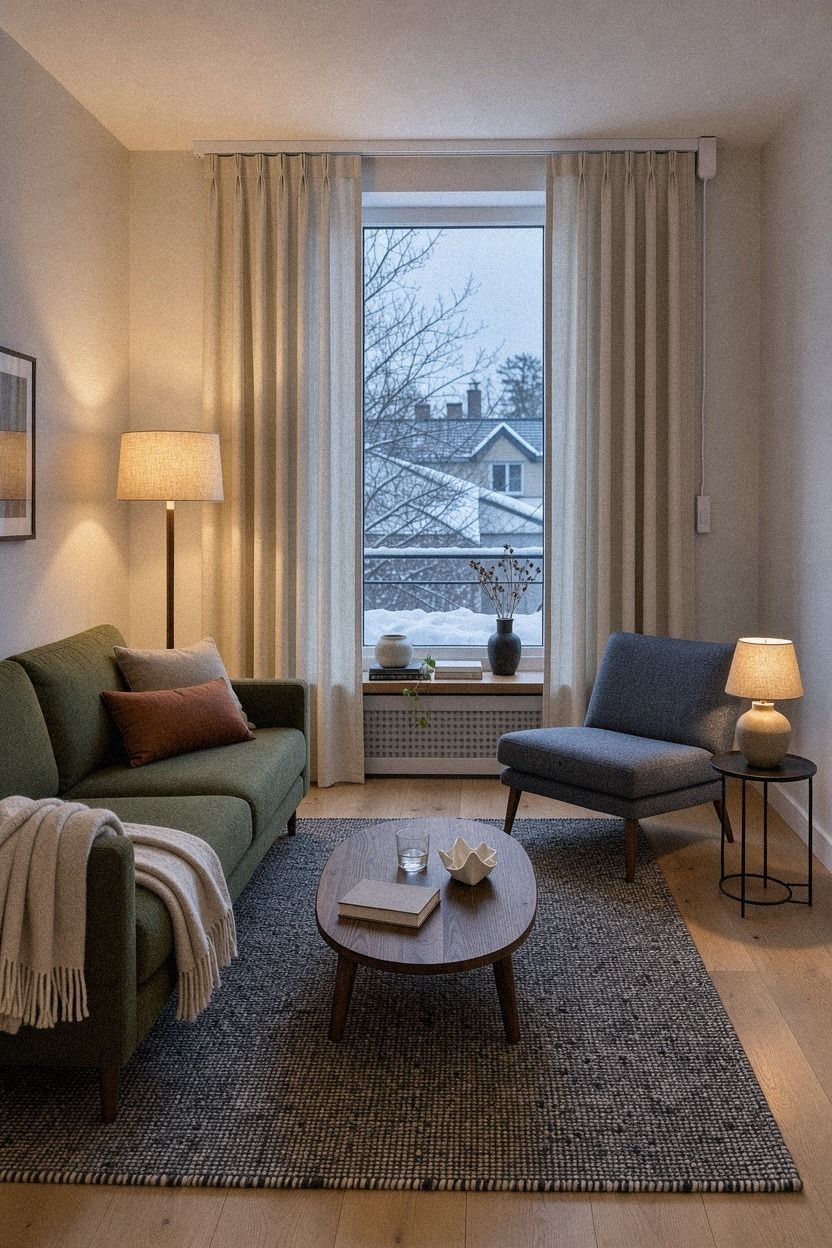
Hang the rod or track 4 to 6 inches above the frame, then let the curtain fall all the way to the floor.
3Choose warm lining over extra bulk
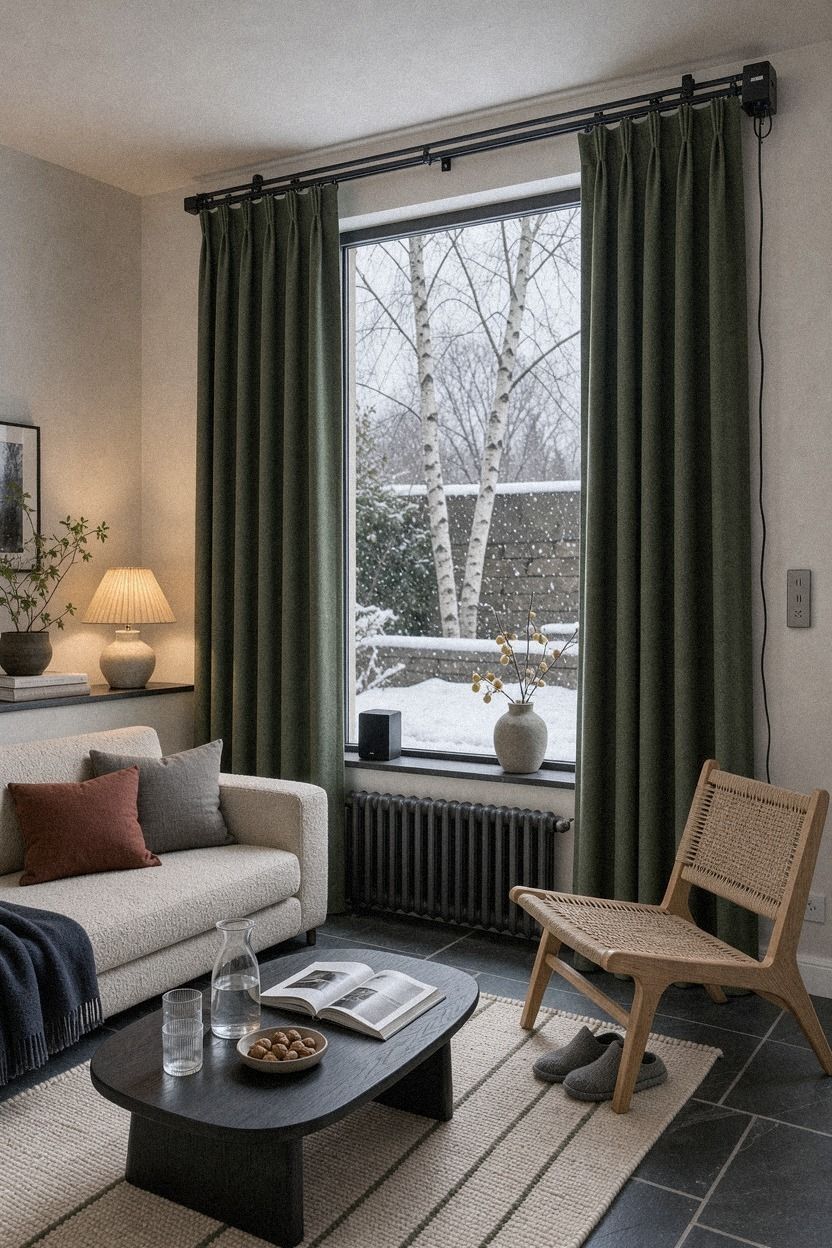
A thick curtain isn’t automatically a warm curtain. Your better move is a moderate-weight face fabric paired with proper lining. That combination improves insulation without turning the window into a dark wall.
Farrow & Ball Studio Green beside deep-pile mohair velvet and natural oak creates a rich, earthy palette that still works when the sky turns gray. You could also use warm rust, muted clay, olive, or a soft mushroom shade if the room already has strong wood tones.
Test the setup by standing beside the window after sunset. If you feel a cold stripe along your arm, the issue may be a gap at the side rather than the fabric itself. Side returns, overlapping panels, and a track that extends beyond the frame can make a surprising difference.
I’d skip piling three heavy layers onto a narrow window. The stack becomes bulky, the room loses light, and the automatic track has to work harder. One well-fitted lined panel will usually look cleaner.
The lining should also match the room’s practical needs. A blackout lining suits a bedroom, while a thermal interlining may be enough for a living room that still needs afternoon light.
4Build the Three-Height Light Stack
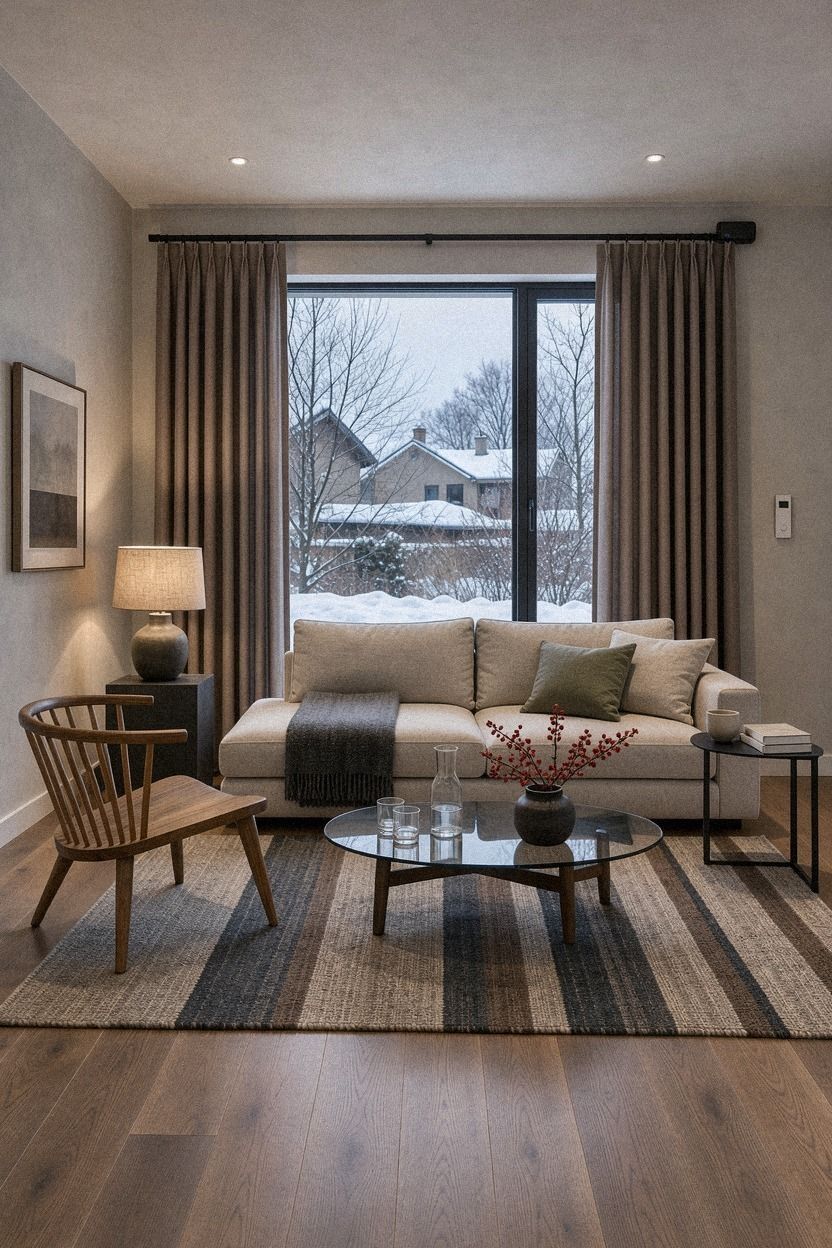
Your curtains shouldn’t carry the whole winter mood alone. Build three light levels: overhead light, task light, and ambient light. This gives the room a layered feeling whether the curtains are open at noon or closed at 5 p.m.
A Carrara marble console with subtle grey veining and a small lamp makes the lowest light feel warm and grounded. Near a reading chair, use a directional lamp with a fabric shade. The light should land where you need it instead of flooding the entire room.
Keep the overhead fixture dim when the curtains close. Put your reading lamp near the chair, then add a low glow on a shelf or sideboard. I don’t like relying on one bright ceiling fixture because it flattens the room and makes every fabric look colder.
You’ll notice the room feels more comfortable before you change any furniture. That’s the real benefit of layered lighting. It lets the curtain become part of a complete evening setting rather than a solitary attempt to make the room feel warm.
If your motorised system closes automatically, connect the timing to the lighting routine when possible. A curtain that closes while every light remains off can make the room feel gloomy. A low lamp that switches on shortly afterward creates a much gentler transition.
5Where Should the Seating Sit?
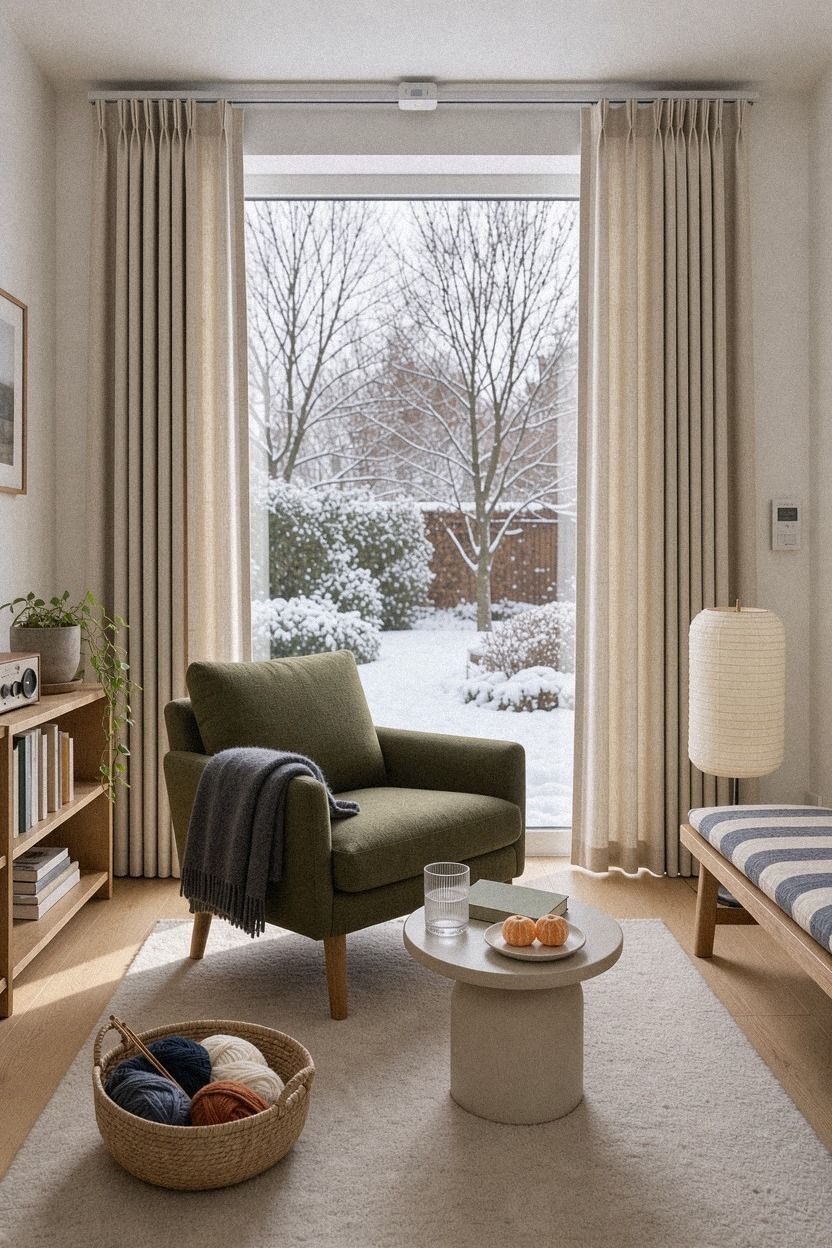
Move your main chair a little away from the coldest glass, then angle it toward the room rather than straight at the window. You’ll still enjoy the daylight, but you won’t sit directly inside the draft zone.
A warm camel-upholstered chair beside a reclaimed weathered teak side table adds physical warmth near the window. Place a small side table beside it for a mug, book, or lamp. The arrangement should feel useful before it feels decorative.
Leave enough space for the curtain to close without brushing against the chair. If the panels catch on furniture every evening, you’ll eventually stop using the schedule. A clear path keeps the automation pleasant.
I’d rather have one comfortable chair positioned well than several pieces squeezed into the coldest part of the room. Your seating plan affects how warm the space feels because it determines where you spend time.
A natural-fiber rug can also soften the floor beneath the seating area. Choose one that extends beyond the chair legs so the zone feels anchored instead of temporary.

6Swap Cold White Bulbs for a Softer Evening Scene
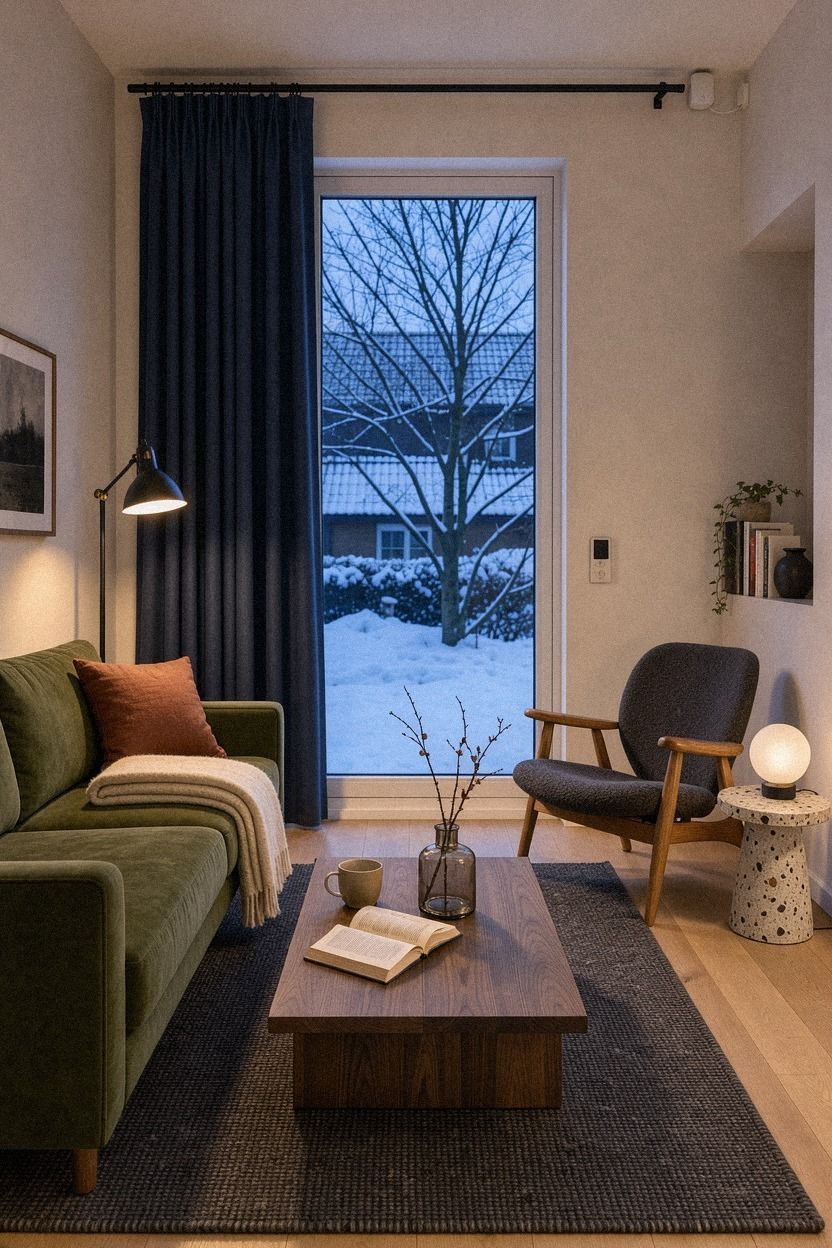
Automatic curtains can close at the right moment, but the room still needs a good response afterward. Use warm bulbs in your lamps so the fabric reads soft instead of blue-gray.
A Calacatta marble lamp base with gold veining is especially effective with ivory linen because the stone picks up a quiet amber glow after dark. A linen drum shade can diffuse the light without creating harsh shadows across the curtain folds.
You’ll want the curtain fabric and bulb color to support each other. A bright cool bulb can make rich velvet look dull, while a softer bulb brings out texture. I’ve made this mistake in a rental, and the curtains looked beautiful in daylight but flat at night.
Don’t judge your fabric only at noon. Check it during the hour when you’ll use the room most. Winter evenings expose every mismatch between the wall color, fabric, flooring, and light source.
For most living spaces, a warm white around 2700K creates a comfortable scene. Bedrooms can handle something softer, while a kitchen or work area may need a slightly clearer task light. The goal is variation, not one identical bulb in every fixture.
7Hang the Soft-Edge Frame for Smaller Rooms
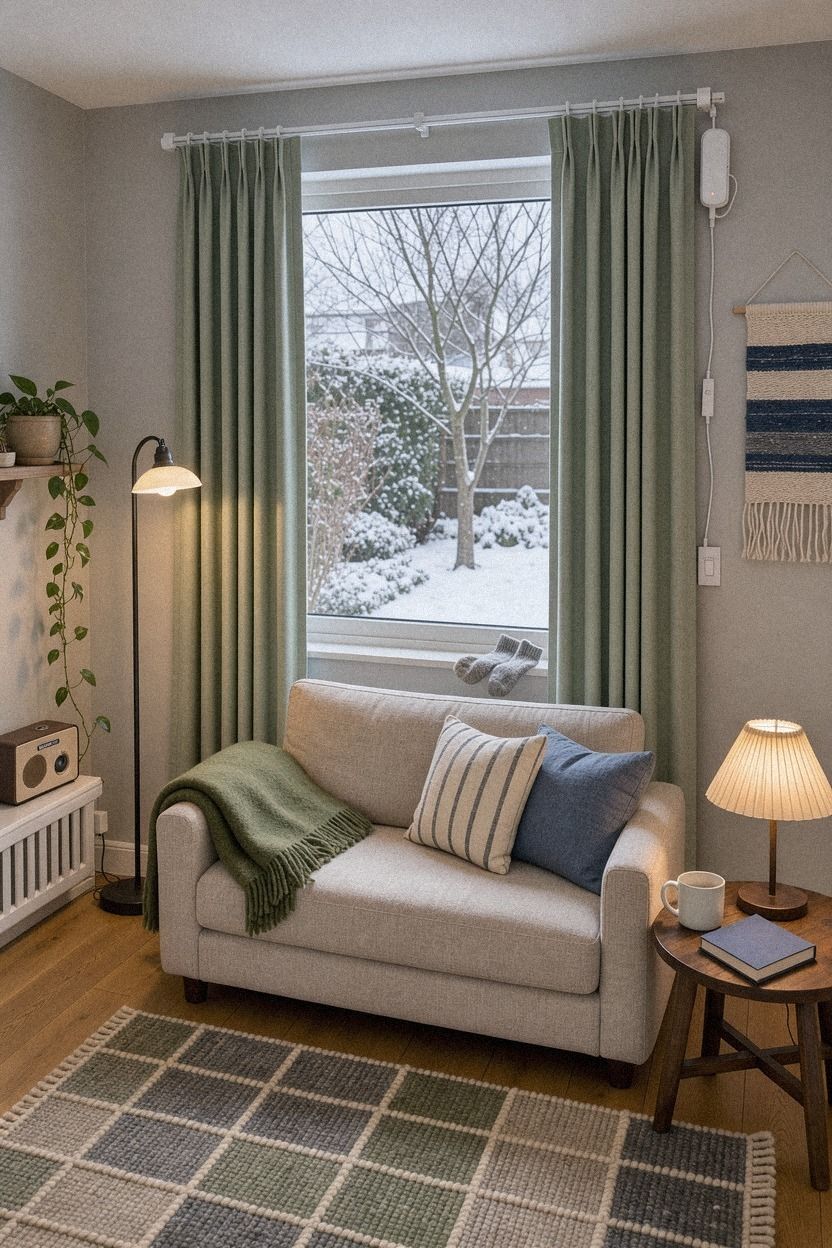
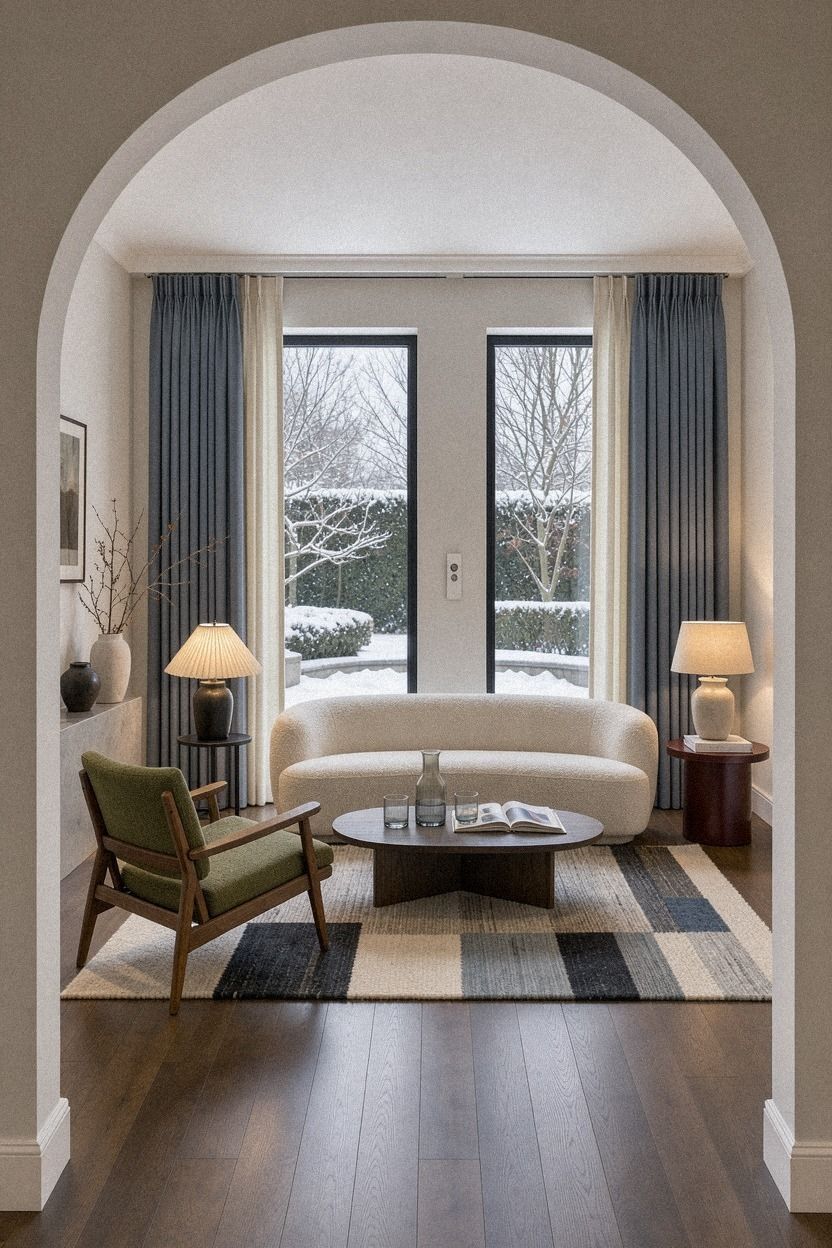
Use your curtain panels to draw a soft rectangle around the window rather than stopping them exactly at the frame.
8Use the Cost Ladder Before You Buy
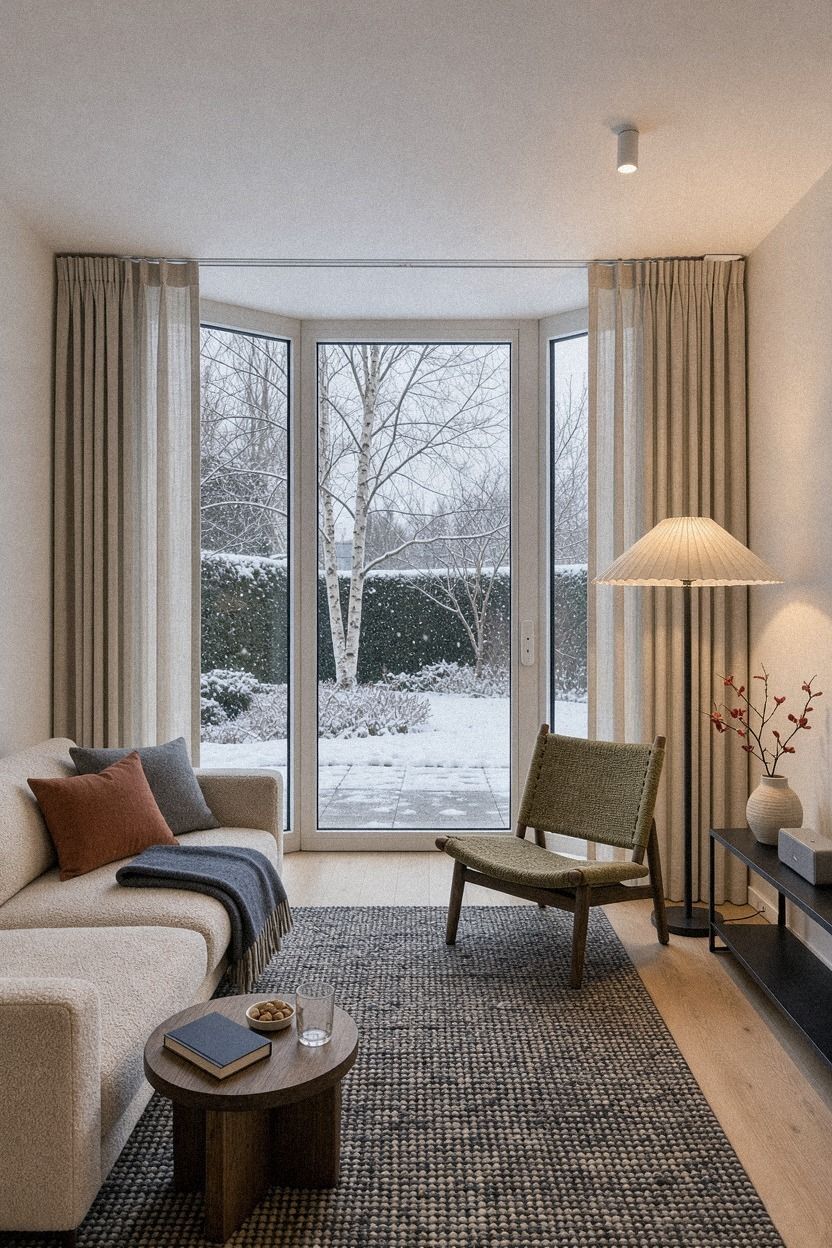
Smart curtains make more sense when you look at the whole room rather than one exciting device. You might need a rug, better lighting, or paint before you need custom fabric. The right order depends on what makes the room uncomfortable now.
Your curtain project can sit inside a broader budget without taking over the room. Wool rug pricing alone commonly falls around $400-$1,500, while linen drapes for a pair are often less expensive than custom upholstery.
A basic motorised track may suit an existing pair of curtains. A full custom system can include measuring, fabrication, wiring, installation, and smart-home integration. Those costs add up quickly, so decide whether you need automation, better insulation, or a complete visual change.
I’d spend first on the window treatment if the glass dominates the room. I wouldn’t choose a motor simply to avoid fixing a poor layout. You’ll feel more warmth when the whole zone works together.
Set aside money for installation if the window is unusually wide, tall, recessed, or close to a radiator. A smooth track depends on accurate alignment and enough clearance.
9Paint Around the Automatic Curtain Track
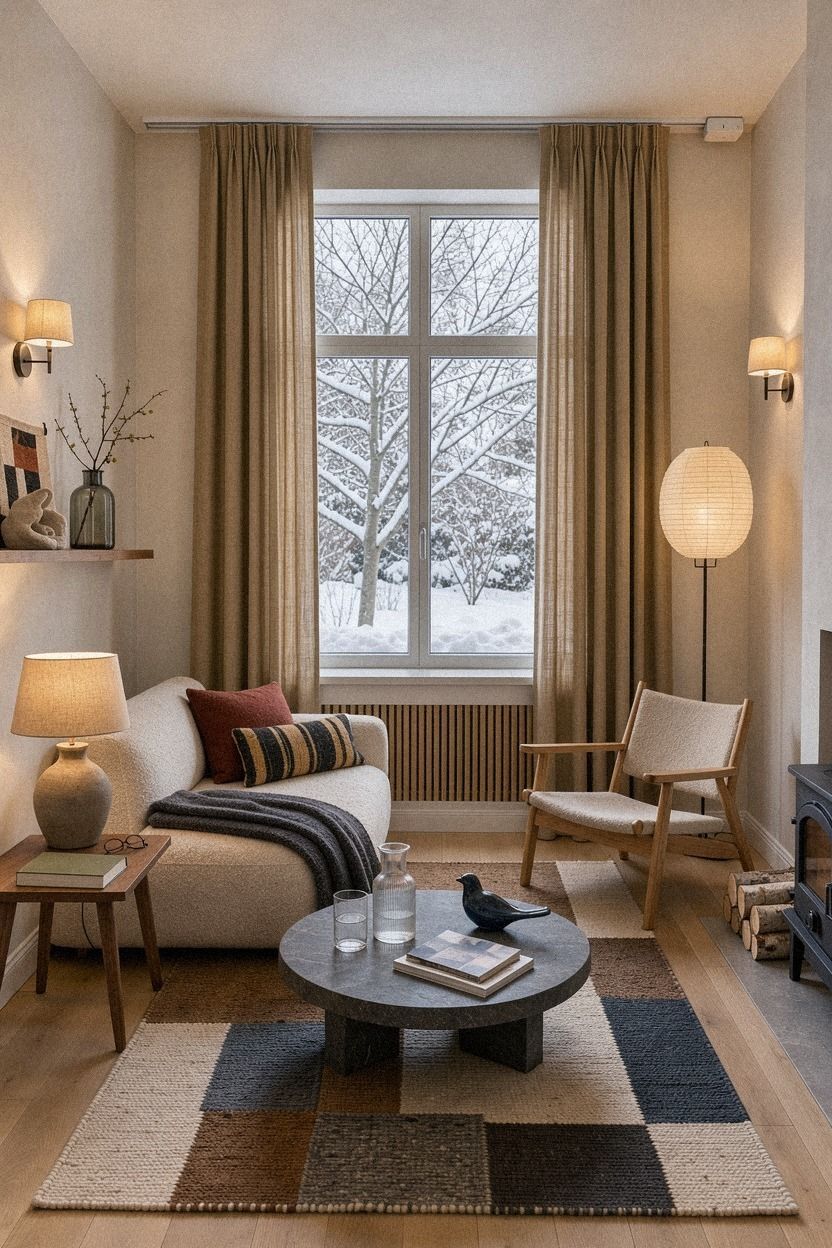
Choose wall color after you’ve considered the curtain fabric, especially if the track is visible. The wall and hardware should support the window instead of competing with it.
Farrow & Ball Setting Plaster can bring a soft clay warmth to the room without making the walls heavy. Benjamin Moore Muslin OC-12 offers a quieter linen-like alternative, while a muted clay shade can make a large window feel more grounded.
If you’re painting the track surround, match it to the wall for a quieter effect. A book-matched walnut surround can make the technology feel intentional, while aged brass hardware adds warmth without becoming distracting.
You’ll want to sample paint beside the actual curtain fabric. Winter daylight changes quickly, and a color that feels creamy in the morning can appear gray by late afternoon.
I’d avoid choosing the paint in isolation. Look at the wall, floor, fabric, and evening bulbs together. The room will feel more coherent when their undertones point in the same direction.
10Anchor Motorized Curtains with a Rug That Overlaps Furniture
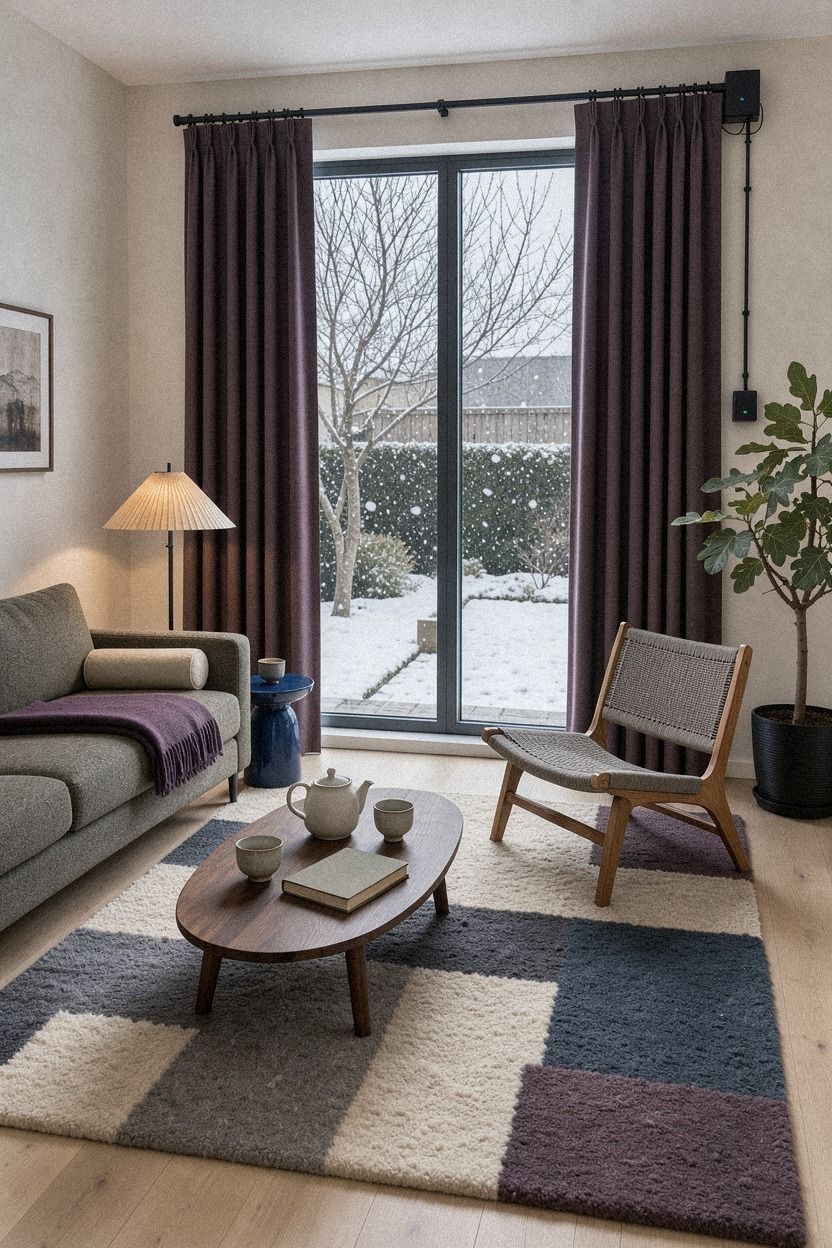
A window treatment can look disconnected when the floor zone has no anchor. Choose a rug large enough for your furniture to overlap it, then let the curtain fabric echo one color from the pattern.
A warm travertine side table can add visual weight near the seating area, while a wool rug usually gives the room more softness. A flatweave rug can suit a high-traffic area, while a deeper pile may feel better in a quiet bedroom.
Your curtains should reach the floor while the rug defines where you sit, read, or talk. That separation makes the room feel intentional without adding clutter.
I don’t like a tiny rug floating in front of a large window because it makes every element look undersized. Choose scale first, then pattern. You’ll find that the curtains feel more substantial when the floor has enough texture beneath them.
If the room already has patterned upholstery, choose a quieter rug and let the curtain provide the accent. If the furniture is plain, a subtle geometric pattern can add movement without fighting the window.
11Keep the Two-Layer Privacy Rule Simple
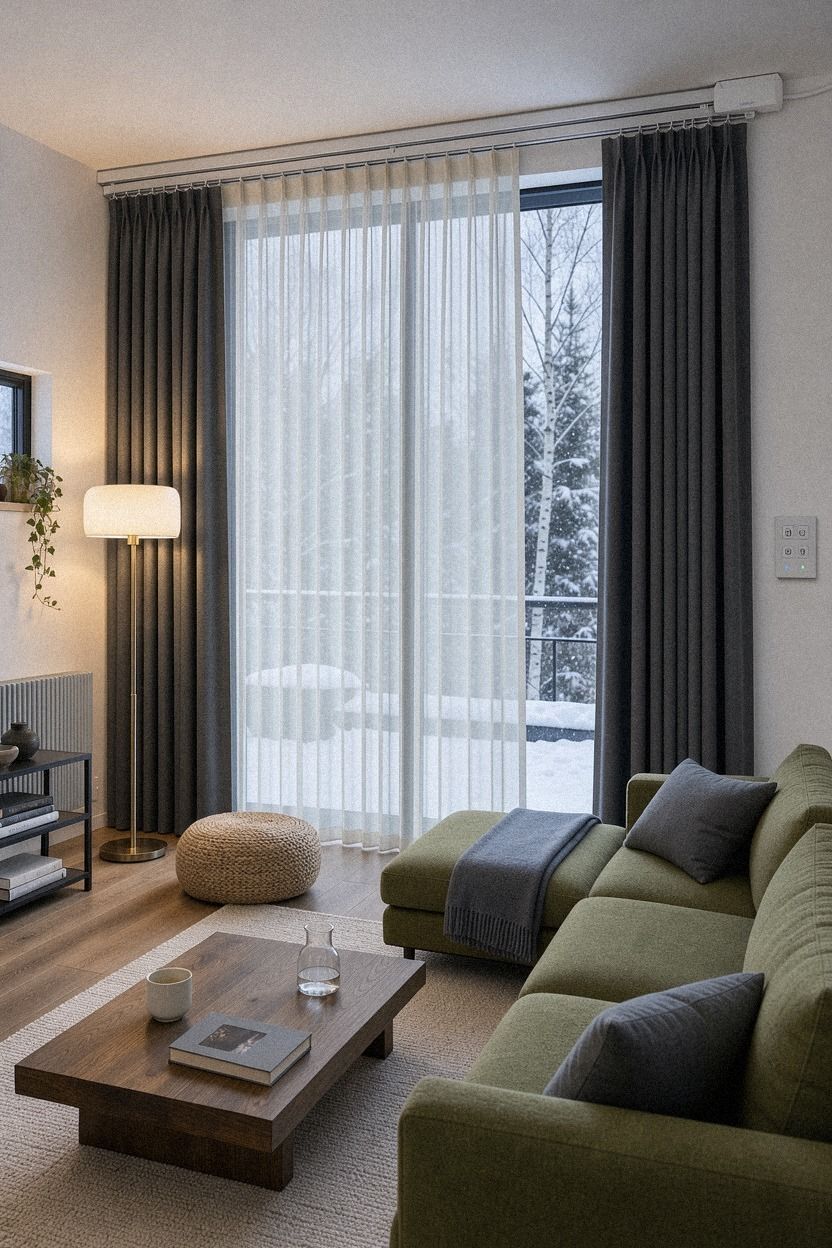
Use one sheer layer for daytime privacy and one lined layer for evening warmth. This arrangement gives you control without forcing one fabric to perform every job.
A white cotton voile or light linen sheer can filter direct sunlight while keeping the room from feeling exposed. Pair it with a navy-lined curtain and warm walnut furniture for a deeper winter palette.
You’ll also gain more flexibility during changing winter weather. On a bright afternoon, the sheer can reduce glare.
On a cold evening, both layers can close together. If the sun warms the room in the morning, the automation can open the lined panels while leaving the sheer partly drawn.
I’d avoid adding a third decorative layer unless the window is exceptionally wide. Too many panels can crowd the stack, reduce usable glass, and make the track look less graceful.
Choose a privacy layer that still looks attractive when the main curtain is open. The sheer remains visible for much of the day, so it deserves the same attention as the heavier fabric.
12Let the Curtain Color Carry One Strong Accent
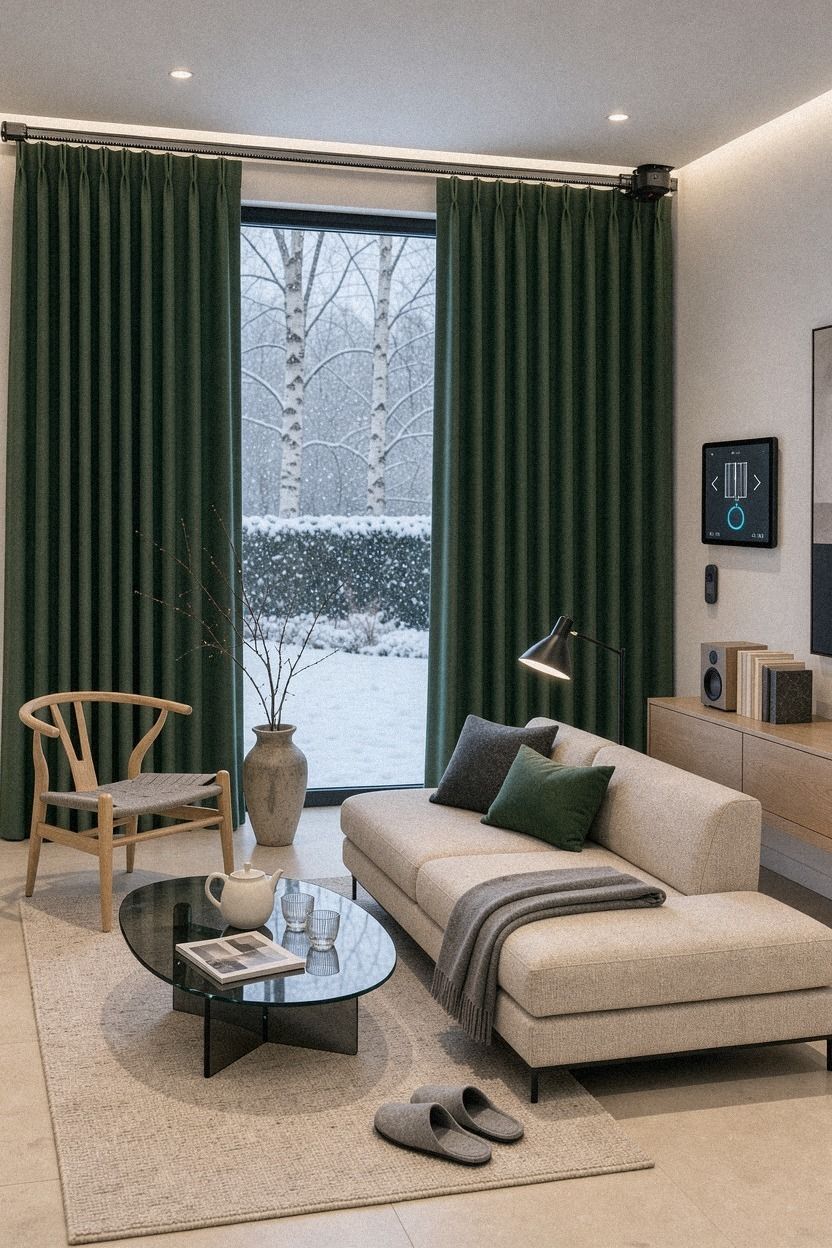
Choose one curtain color that gives your winter palette a clear point of view. Farrow & Ball Studio Green can make a bright room feel grounded, while warm ivory keeps a smaller space light.
Your other textiles don’t need to match exactly. They only need to share a temperature or undertone. An emerald curtain could sit beside cream upholstery, aged brass, or an oversized-chip terrazzo table.
I’d rather see one confident panel with quiet furniture than five competing accent colors. Pair the curtain with a cream chair or a simple terrazzo table, then let the fabric lead.
You’ll notice the room feels more refined when the eye knows where to land. Don’t choose a dramatic shade only because it photographs well. Check it in cloudy daylight, when winter shows you the truth.
For a more flexible result, use color in the curtain and repeat it once in a cushion, vase, or artwork. The repetition should feel incidental rather than perfectly coordinated.
13Are Smart Curtains Solving Your Real Problem?
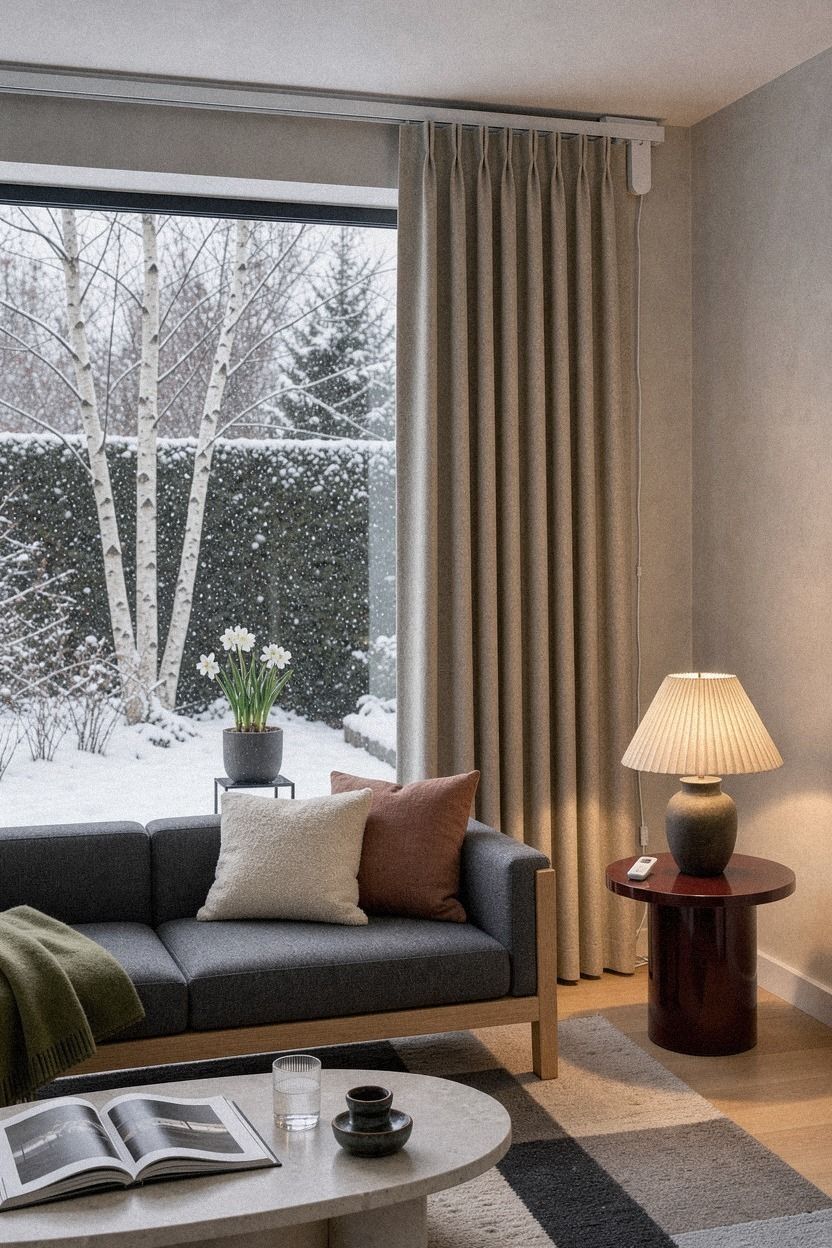
Smart curtains are most useful when your windows are difficult to reach, unusually tall, very wide, or exposed to strong temperature changes. They also help when your daily schedule makes it easy to forget the evening close.
If the room already feels warm and the curtains are easy to operate, automation may be a convenience rather than a necessity. That can still be worthwhile, but your budget may have a greater effect elsewhere.
Ask yourself what keeps bothering you. Is it cold glass, harsh morning sun, lost privacy, difficult access, or a room that feels unfinished? Each problem points toward a different solution.
A thermal lining behind forest-green fabric addresses cold glass. A blackout lining helps with sleep.
A sheer layer manages daytime privacy. A wall finished in hand-applied Venetian plaster can add warmth and texture, while natural oak brings an easier, more grounded note.
A motorised track adds timing and access. You don’t need every feature if only one issue affects your routine.
I’d test the fabric and placement before committing to the motor. If the room feels better with a manual curtain closed at the right time, automation may be a useful final layer.
14Install Electric Curtains Without Making the Room Look Technical
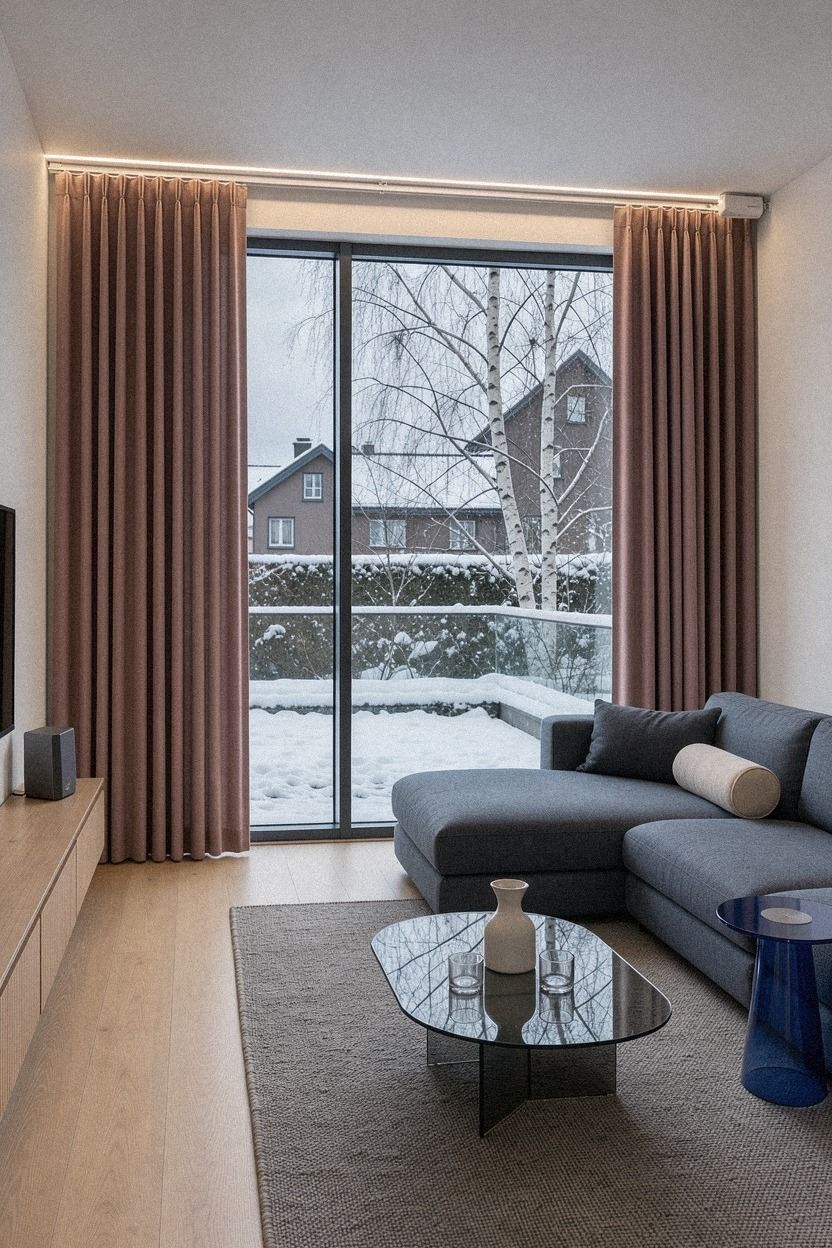
Hide the track inside a simple valance, shallow pelmet, or painted recess if the hardware feels too visible. A dusty-rose or charcoal surround with shagreen accents can soften a modern track, while aged brass hardware keeps the mechanism warm.
Your goal isn’t to pretend the technology isn’t there. It’s to keep it from becoming the first thing your eye sees. Clean lines usually look more considered than decorative hardware added around a motor.
You’ll want enough clearance for the panels to glide without rubbing against the sill or radiator. Check the full path before installation, especially if the window has deep trim or a nearby heating unit.
I’d skip bulky finials and brackets that interrupt the movement. A clean track feels more sophisticated, and you’ll appreciate it every morning when the curtains open smoothly.
Check the power location early. Wired systems may need an electrician, while battery-powered options require access for charging or replacement. Make sure you can reach the control unit without moving furniture.
The installation should also account for fabric weight. Velvet curtains and lined wool blends may require a stronger track than lightweight cotton. A quiet motor is valuable, but only when the system is correctly sized.
15Style Winter Curtains with Less Furniture
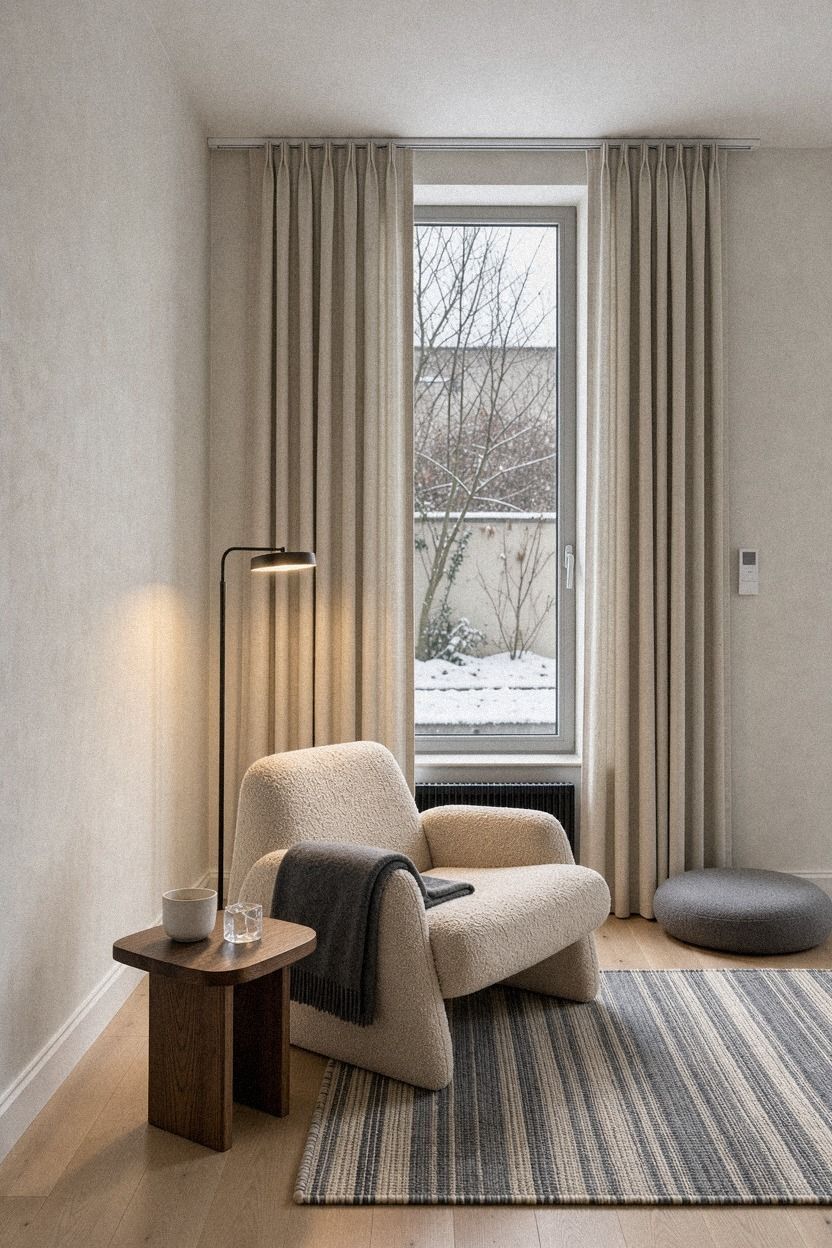
Let the fabric and light do more work by giving the window some breathing room. A narrow console, one substantial lamp, and a small bowl can be enough.
Washed Belgian linen curtains and a camel leather chair with black accents add warmth without competing with the folds. A low piece of furniture keeps the sightline open and lets the full curtain height remain visible.
Your room doesn’t need another shelf just because the window looks empty. Leave some wall visible and place one piece of art nearby, with its center around 57 to 60 inches from the floor.
I’d skip filling every corner because clutter makes the curtains feel less special. If your panels already have a strong texture, keep nearby accessories simple. A black ceramic bowl, aged brass lamp, or single cream object can finish the area without crowding it.
The best winter rooms usually have a little restraint. You’ll notice the warmth in the fabric, the lower light, and the clear space around the window. That balance feels lived-in without becoming busy!
The Winter Curtain Choice I’d Make
I’ve gone back and forth on smart-home features because some solve problems nobody has. Curtains are different when your windows are large, drafty, hard to reach, or exposed to intense afternoon sun.
In winter, the useful part isn’t the novelty of pressing a button. It’s the repeated timing. Your curtains can close before the room loses its evening warmth, open with the morning light, and stay consistent when your week gets messy.
I’d choose a system only after fixing the fabric, length, and track placement. A badly sized curtain will still look wrong when it moves automatically. Benjamin Moore White Dove or another warm neutral can make the room brighter, but color won’t rescue panels that stop above the floor.
I made that mistake once, and the short hem made the whole window look cheaper than the fabric was. Length changes the architecture of a room more than most people expect.
The most valuable change is usually the one you’ll notice every day. If you’re working near the window, choose easy control.
If you’re styling a small rental, choose a simple removable solution. If you want a richer room, choose lining and texture before adding more objects.
You don’t need every feature. You need a curtain that closes cleanly, blocks the sharpest chill, and looks good when it’s open.
Winter design should feel practical first, then inviting. That’s why I prefer quiet fabrics, warm light, and a schedule you’ll stick with.
The room doesn’t need to look futuristic. It needs to feel good at 7 a.m. and again after dinner, when the glass is dark and the curtain becomes part of the room’s comfort!
The Questions Worth Answering First
What are the best smart motorised curtains for a small room?
Choose full-length panels with a slim track and a light face fabric. Linen drapes in warm ivory keep the room bright, while a quiet motor avoids bulky hardware. You’ll get the most space from panels that stack outside the frame instead of covering the glass.
Where can I buy smart curtains on a budget?
Look at IKEA, Wayfair, and Target, then check Facebook Marketplace or local thrift shops for usable curtain panels. I don’t use affiliate links here, and there’s no commission disclosure to make. Measure first, because the right width matters more than a trendy color.
How much does a smart motorised curtain makeover cost?
A small room refresh can run about $100 to $300 when you reuse the rod, paint, and furniture you own. The curtain system, fabric, and installation affect the total. You can keep costs down with second-hand panels and a simple layout.
Can I create this look on a budget?
Yes, and you can start with three low-cost changes: move the rod 4 to 6 inches above the frame, let the panels reach the floor, and add warm bulbs. Paint in Benjamin Moore White Dove OC-17 can also make winter daylight feel brighter.
Are smart motorised curtains worth it in a small space?
Yes, when the window is difficult to reach or dominates the room. Automation keeps the space consistent without adding furniture. Use a slim track, pale fabric, and panels that stack beside the frame so your small room keeps as much daylight as possible.
Are smart motorised curtains a good idea for a rental?
Yes, if you choose a no-damage setup. Tension rods, removable brackets, and lightweight panels can give you a layered look without permanent wiring. You’ll want to confirm the rod can hold the fabric, and you shouldn’t drill into a rental wall without permission.
Where I’d Start First
If I had to pick one, I’d start with full-length lined curtains. They soften cold glass, make the ceiling look taller, and still work when the motor is switched off.
Choose the fabric before choosing the technology. Once the length, lining, color, and track placement feel right, automation becomes the part that makes the room easier to enjoy.


